Displaying reports 7041-7060 of 86324.Go to page Start 349 350 351 352 353 354 355 356 357 End
Reports until 10:22, Friday 06 December 2024
H1 CDS (OpsInfo)
david.barker@LIGO.ORG - posted 10:22, Friday 06 December 2024 - last comment - 13:20, Friday 06 December 2024(81650)
CDS alarm status during CP1 fill

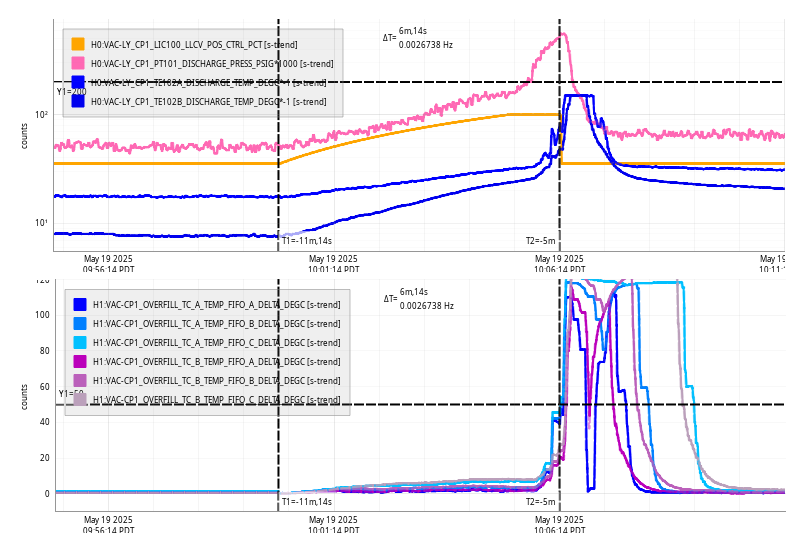
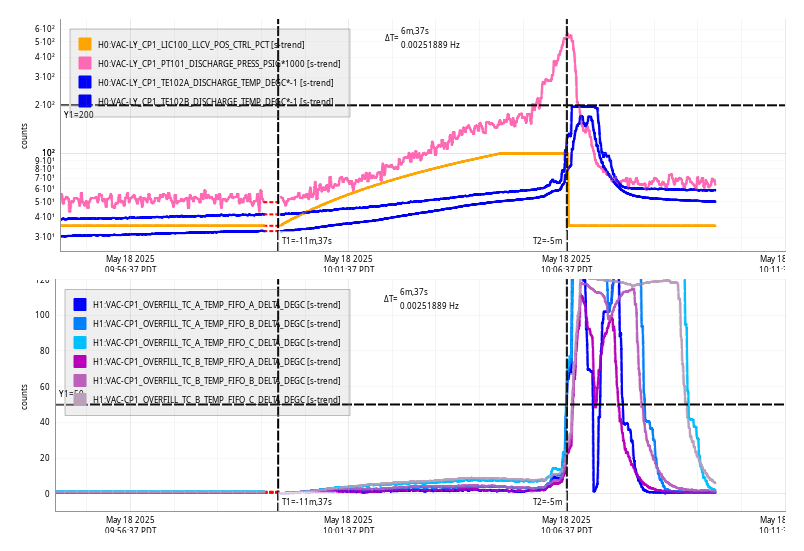
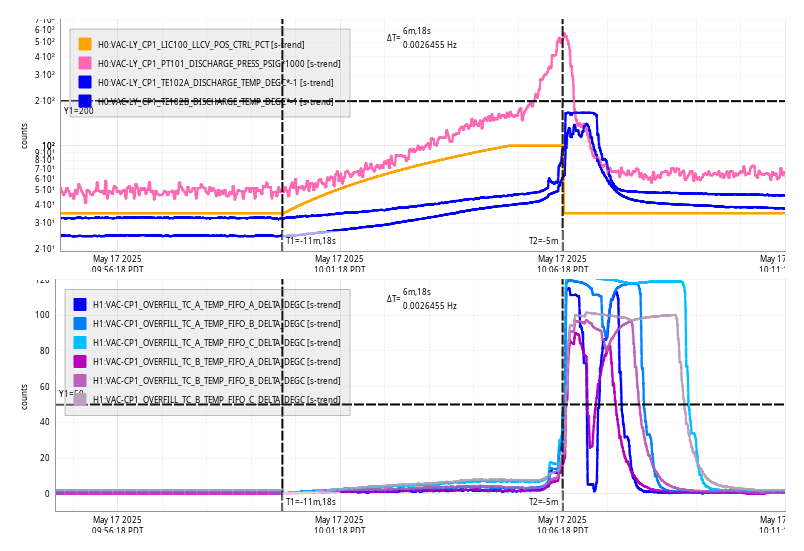
Note to Operators: During the CP1 fill (which starts daily at 10am) the CDS ALARM system shows RED because the LN2 Liquid Level Control Valve (LLCV) is ramped up to 100% open. The alarm system puts this channel into alarm when its value exceeds 50%. This alarm should clear within 1 minute of the end of the fill.

Images attached to this report
Comments related to this report
david.barker@LIGO.ORG - 13:20, Friday 06 December 2024 (81654)

Following user feedback, the IFO range "7 segment LED" display on the CDS overview is now GREEN when H1 is in OBSERVE, and orange otherwise.

Images attached to this comment
LHO VE
david.barker@LIGO.ORG - posted 10:10, Friday 06 December 2024 (81648)
Fri CP1 Fill

Fri Dec 06 10:07:29 2024 INFO: Fill completed in 7min 25secs

Gerardo confirmed a good fill curbside.

Images attached to this report
LHO General
ibrahim.abouelfettouh@LIGO.ORG - posted 07:38, Friday 06 December 2024 - last comment - 08:31, Friday 06 December 2024(81644)
OPS Day Shift Start

TITLE: 12/06 Day Shift: 1530-0030 UTC (0730-1630 PST), all times posted in UTC
STATE of H1: Observing at 158Mpc
OUTGOING OPERATOR: Tony
CURRENT ENVIRONMENT:
    SEI_ENV state: CALM
    Wind: 2mph Gusts, 1mph 3min avg
    Primary useism: 0.02 μm/s
    Secondary useism: 0.19 μm/s
QUICK SUMMARY:

IFO is in NLN and OBSERVING as of 14:14 UTC.

Looks like we got to NLN at 13:30 UTC but IFO couldn't go to OBSERVING, which caused guardian to call OWLOperator (Tony) - alog 81643

Comments related to this report
david.barker@LIGO.ORG - 08:31, Friday 06 December 2024 (81645)

FYI: the PRM camera (h1cam13) is offline for Robert's HAM2 viewport work. Its image is blue-screen on the FOM.

H1 General (SUS)
anthony.sanchez@LIGO.ORG - posted 06:26, Friday 06 December 2024 - last comment - 12:23, Friday 06 December 2024(81643)
OWL Shift Call

TITLE: 12/06 Owl Shift: 0600-1530 UTC (2200-0730 PST), all times posted in UTC
STATE of H1: Lock Acquisition
INCOMING OPERATOR: Ibrahim
SHIFT SUMMARY:
LOG:
H1 called me to help with SDF issues.
SUS ETMX and ITMX SDFs

These seemed like they were changed randomly in the night but also seemed like that may have unlocked the IFO if reverted so I accepted them.
But now that i'm looking back at Francisco's Alog I think some may have been intentional.
 

More than 1 IFO H1 call tonight:
H1 Called me earlier in the night and I slept though the calls because I did not realise my phone was not properly set up for this owl shift before I went to sleep.


Images attached to this report
Comments related to this report
camilla.compton@LIGO.ORG - 09:29, Friday 06 December 2024 (81646)

Sheila, Camilla

Looking into last night's issues, there were two sets of sdfs that stopped us going into observing:

  • L2L gain: this was changed in lscparams but ISC_LOCK was not loaded so the sdf was accepted as the new value but the guardians set us back to the old value when we relocked.
    • Francisco has added notes to the 81630 code to remember to edit lscparams, reload ISC_LOCK and accept in sdf.
  • TRAMPS: The new SCAN_ALIGNEMENT code 81597 had hard coded TRMAPs of 3 when nominal is 2. Only X arm ran scan alignment so the sdf diffs were only in TSMX and ETMX. 
    • Sheila checked the code doesn't depend on them and edited ALS_ARM.py to set these SCAN_ALIGNEMENT TRAMPS to 2s.

If we loose lock today we need to: load ISC_LOCK and ALS_XARM and ISC_LOCK  and accept 198.6 as the H1:SUS-ETMX_L3_DRIVEALIGN_L2L_GAIN and the TRAMPs as 2s. If we don't loose lock by the end of the day we should drop out of observing, change the L2L and TRAMPS, reload   guardians and accept sdf.

ibrahim.abouelfettouh@LIGO.ORG - 12:23, Friday 06 December 2024 (81652)

https://services1.ligo-la.caltech.edu/FRS/show_bug.cgi?id=32847

FRS Ticket Logging the 3hrs 30 mins out of OBSERVING

LHO General
ryan.short@LIGO.ORG - posted 22:01, Thursday 05 December 2024 (81642)
Ops Eve Shift Summary

TITLE: 12/06 Eve Shift: 0030-0600 UTC (1630-2200 PST), all times posted in UTC
STATE of H1: Observing at 159Mpc
INCOMING OPERATOR: Tony
SHIFT SUMMARY: Quiet shift with H1 observing throughout; current lock stretch is at 7 hours.

LHO General
thomas.shaffer@LIGO.ORG - posted 16:16, Thursday 05 December 2024 (81628)
Ops Day Shift End

TITLE: 12/06 Day Shift: 1530-0030 UTC (0730-1630 PST), all times posted in UTC
STATE of H1: Observing at 155Mpc
INCOMING OPERATOR: Ryan S
SHIFT SUMMARY: The day started with Calibration and commissioning, with a commissioning lock loss. Recovery was striaght forward, then a large 7.0 earthquake off the coast of CA took us down for 4 hours. Recovery here was also straight forward. Observing for 1.5 hours.
LOG:

Start Time System Name Location Lazer_Haz Task Time End
16:34 PEM Robert LVEA n Turning on measurement devices 16:51
18:44 VAC Travis, Janos CER n Getting supplies 18:51
18:54 EE Fil LVEA YES Checking picomotors 19:24
19:11 FAC Tyler CS n Forklifting around CS 20:33
19:35 PEM Robert LVEA YES Setting up viewport measurements 22:27
19:41 SUS Sheila, Oli CR n Quad moves 20:11
20:43 VAC Jordan LVEA Yes Looking for parts 20:49
22:09 PSL Jason LVEA Yes Grabbing a part 22:19
LHO General
ryan.short@LIGO.ORG - posted 16:09, Thursday 05 December 2024 (81640)
Ops Eve Shift Start

TITLE: 12/05 Eve Shift: 0030-0600 UTC (1630-2200 PST), all times posted in UTC
STATE of H1: Observing at 156Mpc
OUTGOING OPERATOR: TJ
CURRENT ENVIRONMENT:
    SEI_ENV state: CALM
    Wind: 1mph Gusts, 0mph 3min avg
    Primary useism: 0.03 μm/s
    Secondary useism: 0.19 μm/s
QUICK SUMMARY: H1 recovered easily after the earlier EQ and has been observing for just over an hour.

H1 General
thomas.shaffer@LIGO.ORG - posted 15:13, Thursday 05 December 2024 (81639)
Back to Observing 2308UTC

Recovered after the 7.0 earthquake off of the coast of CA. Recovery was basically automatic, the only thing I did was untrip ISIs and SUS watch dogs when I could, and tell guardian when to start initial alignment.
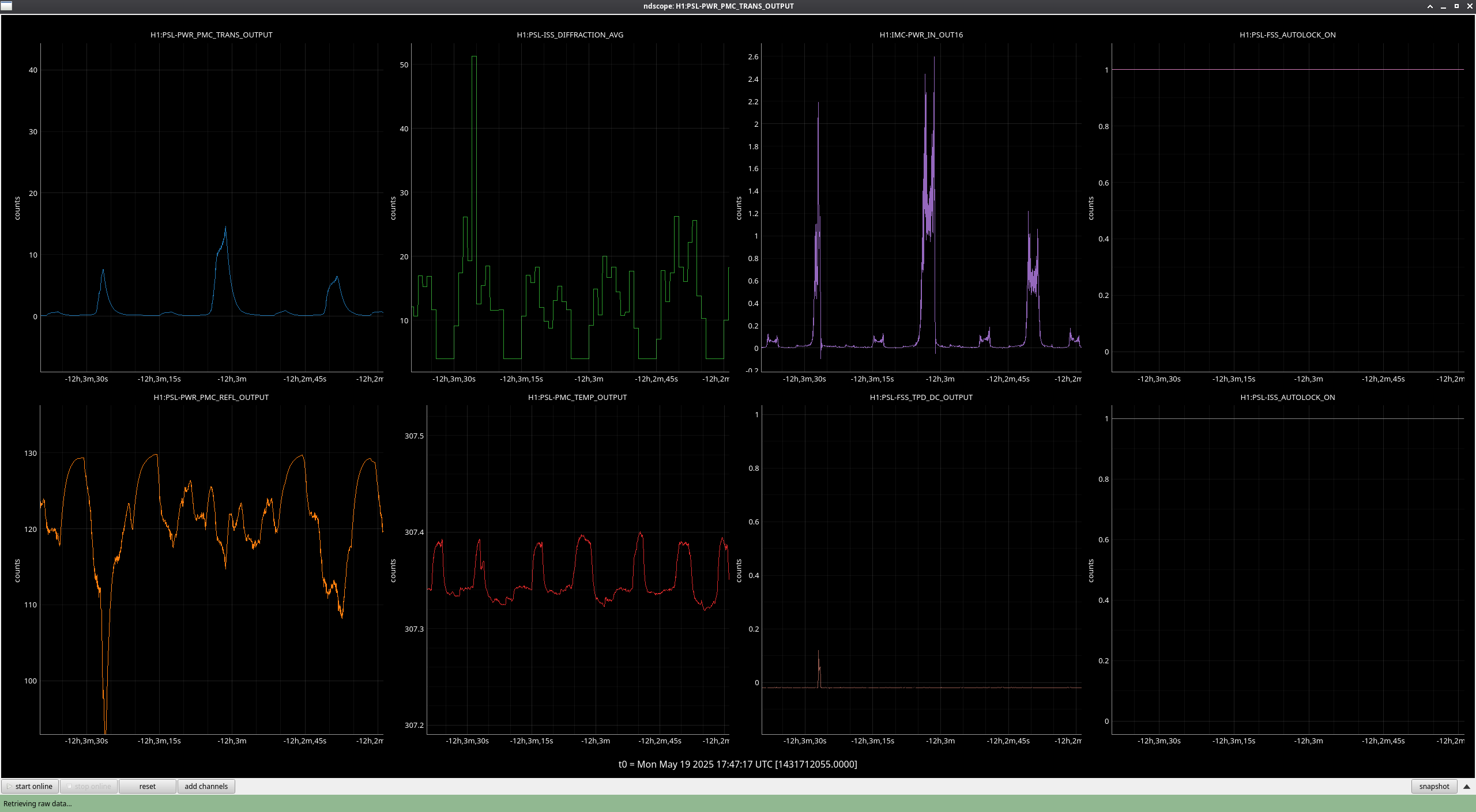
Initially we went into Observing but Francisco realized that his his from earlier today (alog81630) didn't make it in. We updated lscparams.py with the new value and the Observe.snap. The safe.snap was saved at a value of 1.0, so we must be relying on ISC_LOCK to make the change.

One other SDF was found from the pico H delay. This was unmonitored.

Images attached to this report
H1 ISC
sheila.dwyer@LIGO.ORG - posted 13:52, Thursday 05 December 2024 (81638)
DARM boost removed because of glitch when ramping it off

Camilla, Sheila, help from CDS team

We've been having some locklosses during the ESD transitions, some of them seem to be related to a large glitch that happens at the end of the 10 second output ramp time when DARM1 FM1 (a boost) is turned off in preparation to switch back to ETMX control where the boosts are in the pum rather than the DARM bank. 

Erik and Jonathan told us that since the filter ramp is linear, it's not suprising that there is a discontinuity when the ramp time ends.  They have opened a ticket after a discussion about ways to avoid this: 667

We could make this better by increasing the ramp time, but we want to keep this state short because of a slow instability we can get if we wait here: 81430

For now we've removed the boost which was being turned on in the state DARM offset before the ASC gets engaged, during the power up. The attachments compare the ESD drives with and without this filter being ramped off, the glitch is gone.

Images attached to this report
H1 ISC
jim.warner@LIGO.ORG - posted 13:20, Thursday 05 December 2024 (81637)
IMC Gain redistribution added back to ISC_LOCK

At Sheila's suggestion, I've turned the IMC gain redistribution back on in LASER_NOISE_SUPPRESSION, ISC_LOCK state number 575. Just a reminder, this is the code (lines 5793-5806 now):

       if self.counter ==5 and self.timer['wait']:
            if self.gain_increase_counter <7:  #icrease the imc fast gain by this many dB
                #redistribute gain in IMC servo so that we don't saturate splitmon in earth quakes, JW DS SED
                #setting this to not change the gain sliders October 9, because Camilla saw that the IMC locklosses that we think are due to laser glitches started happening on the day we did this gain redistribution. alog 80561
                ezca['IMC-REFL_SERVO_IN1GAIN'] -= 1
                ezca['IMC-REFL_SERVO_IN2GAIN'] -= 1
                ezca['IMC-REFL_SERVO_FASTGAIN'] += 1
                time.sleep(0.1)
                self.gain_increase_counter +=1
            else:
                self.counter +=1
        
        if self.counter >= 6 and self.timer['wait']:
            return True

This can be turned off by setting changing gain_increase_counter <0, on line 5794. If we are losing lock during this state we should turn it off again, or reduce the gain_increase_counter to <5 or something.

H1 CDS
david.barker@LIGO.ORG - posted 13:09, Thursday 05 December 2024 (81636)
CDS Cell Phone Alarms visible in control room

FRS9371

The CDS alarms system status is now shown on the CDS Overview MEDM. The attached snapshots show the system when there are no alarms, and when two test alarms were raised.

Clicking on the "CDS ALARM" button on the overview opens the alarm MEDM.

Details:

The locklossalert EPICS IOC was modified to provide, as EPICS PVs, the ALARMS GPS time, the number of active alarms, and the channels which are in alarm.

locklossalert and alarms both run on cdslogin, and so a temporary file is used for the interprocess communication. Alarms updates the file on the minute and LLA reads the file at the 30 second mark.  If the temporary file stops being updated, the oveview button will turn magenta to indicate a stopped service.

Images attached to this report
H1 SYS
filiberto.clara@LIGO.ORG - posted 12:17, Thursday 05 December 2024 (81635)
Verification of Picomotor E

With the IFO down due to an earthquake, went out to the LVEA to verify installation and location of the Picomotor Driver E. This controller was slotted for Optical Lever but never implemented.

Control and readback cables are connected to the Corner 2 Slow Controls Chassis (D1100680) in the CER. Cables labeled H1:IO_305 and H1:IO_306 are connected in slot 5 on the rear of the chassis. Cables are routed to the HAM6 ISC racks. No driver is installed in the LVEA. Cables are disconnected and coiled up in the cable tray.

H1 General
thomas.shaffer@LIGO.ORG - posted 11:26, Thursday 05 December 2024 (81633)
Lock loss 1846 UTC Large earthquake

7.0 off the coast of N. California. Tripped all ISIs and many suspensions.

LHO VE
david.barker@LIGO.ORG - posted 10:10, Thursday 05 December 2024 (81632)
Thu CP1 Fill

Thu Dec 05 10:07:59 2024 INFO: Fill completed in 7min 56secs

Jordan confirmed a good fill curbside.

Images attached to this report
H1 CAL (CAL)
francisco.llamas@LIGO.ORG - posted 09:32, Thursday 05 December 2024 - last comment - 10:44, Friday 06 December 2024(81630)
Changed drivealign L2L gain from kappa_tst

FranciscoL, SheilaD

Changed H1:SUS-ETMX_L3_DRIVEALIGN_L2L_GAIN by 3.63 % using KappaToDrivealign.py at gps 1417450784.

Script output:

Average H1:CAL-CS_TDEP_KAPPA_TST_OUTPUT is -3.6267% from 1.
Accept changes of    
H1:SUS-ETMX_L3_DRIVEALIGN_L2L_GAIN from 191.711517 to 198.664299
Proceed? [yes/no]
yes
Changing
H1:SUS-ETMX_L3_DRIVEALIGN_L2L_GAIN
H1:SUS-ETMX_L3_DRIVEALIGN_L2L_GAIN => 198.6643

First figure (kappa2drivealign_ndscope) is an ndscope of the relevant channels. The the second plot (top to bottom) is CAL-CS_TDEP_KAPPA_TST_OUT with a verticar marker aligned at a time where the uncertainty from CAL-CS_TDEP_PCAL_LINE3_UNCERTAINTY (third plot)  increased. This increase in uncertainty is expected from turning off lines before calibration measurement.

KAPPA_TST_OUT is around 1 from minute 5 to the marker, which is the objective of changing the drive gain.

Images attached to this report
Comments related to this report
francisco.llamas@LIGO.ORG - 10:44, Friday 06 December 2024 (81651)

Attaching trend of CAL-CS_TDEP_KAPPA_TST from long lock stretch after changes.

Images attached to this comment
H1 CAL
thomas.shaffer@LIGO.ORG - posted 09:01, Thursday 05 December 2024 (81629)
Calibration Sweep 1630 UTC

Following our usual instructions.

Simulines start:

PST: 2024-12-05 08:35:51.659267 PST
UTC: 2024-12-05 16:35:51.659267 UTC
GPS: 1417451769.659267
 

Simulines end:
PST: 2024-12-05 08:59:32.899615 PST
UTC: 2024-12-05 16:59:32.899615 UTC
GPS: 1417453190.899615
 

2024-12-05 16:59:32,822 | INFO | File written out to: /ligo/groups/cal/H1/measurements/DARMOLG_SS/DARMOLG_SS_20241
205T163552Z.hdf5
2024-12-05 16:59:32,830 | INFO | File written out to: /ligo/groups/cal/H1/measurements/PCALY2DARM_SS/PCALY2DARM_SS
_20241205T163552Z.hdf5
2024-12-05 16:59:32,834 | INFO | File written out to: /ligo/groups/cal/H1/measurements/SUSETMX_L1_SS/SUSETMX_L1_SS
_20241205T163552Z.hdf5
2024-12-05 16:59:32,838 | INFO | File written out to: /ligo/groups/cal/H1/measurements/SUSETMX_L2_SS/SUSETMX_L2_SS
_20241205T163552Z.hdf5
2024-12-05 16:59:32,843 | INFO | File written out to: /ligo/groups/cal/H1/measurements/SUSETMX_L3_SS/SUSETMX_L3_SS
_20241205T163552Z.hdf5
ICE default IO error handler doing an exit(), pid = 911686, errno = 32

Images attached to this report
H1 General
thomas.shaffer@LIGO.ORG - posted 08:26, Thursday 05 December 2024 - last comment - 09:03, Thursday 05 December 2024(81627)
Out of Observing 1619UTC for planned calibration and commissioning

We should return to Observing at 20 UTC.

Comments related to this report
thomas.shaffer@LIGO.ORG - 09:03, Thursday 05 December 2024 (81631)

Lock loss at 1701UTC, commissioning caused. Ended a 37hr:21min lock, the 3rd longest in O4b.

H1 PEM (DetChar, PEM, TCS)
robert.schofield@LIGO.ORG - posted 18:06, Thursday 14 November 2024 - last comment - 10:19, Thursday 19 December 2024(81246)
TCS-Y chiller is likely hurting Crab sensitivity

Ansel reported that a peak in DARM that interfered with the sensitivity of the Crab pulsar followed a similar time frequency path as a peak in the beam splitter microphone signal. I found that this was also the case on a shorter time scale and took advantage of the long down times last weekend to use  a movable microphone to find the source of the peak. Microphone signals don’t usually show coherence with DARM even when they are causing noise, probably because the coherence length of the sound is smaller than the spacing between the coupling sites and the microphones, hence the importance of precise time-frequency paths.

Figure 1 shows DARM and the problematic peak in microphone signals. The second page of Figure 1 shows the portable microphone signal at a location by the staging building and a location near the TCS chillers. I used accelerometers to confirm the microphone identification of the TCS chillers, and to distinguish between the two chillers (Figure 2).

I was surprised that the acoustic signal was so strong that I could see it at the staging building - when I found the signal outside, I assumed it was coming from some external HVAC component and spent quite a bit of time searching outside. I think that this may be because the suspended mezzanine (see photos on second page of Figure 2) acts as a sort of soundboard, helping couple the chiller vibrations to the air. 

Any direct vibrational coupling can be solved by vibrationally isolating the chillers. This may even help with acoustic coupling if the soundboard theory is correct. We might try this first. However, the safest solution is to either try to change the load to move the peaks to a different frequency, or put the chillers on vibration isolation in the hallway of the cinder-block HVAC housing so that the stiff room blocks the low-frequency sound. 

Reducing the coupling is another mitigation route. Vibrational coupling has apparently increased, so I think we should check jitter coupling at the DCPDs in case recent damage has made them more sensitive to beam spot position.

For next generation detectors, it might be a good idea to make the mechanical room of cinder blocks or equivalent to reduce acoustic coupling of the low frequency sources.

Non-image files attached to this report
Comments related to this report
camilla.compton@LIGO.ORG - 14:12, Monday 25 November 2024 (81472)DetChar, TCS

This afternoon TJ and I placed pieces of damping and elastic foam under the wheels of both CO2X and CO2Y TCS chillers. We placed thicker foam under CO2Y but this did make the chiller wobbly so we placed thinner foam under CO2X.

Images attached to this comment
keith.riles@LIGO.ORG - 08:10, Thursday 28 November 2024 (81525)DetChar
Unfortunately, I'm not seeing any improvement of the Crab contamination in the strain spectra this week, following the foam insertion.

Attached are ASD zoom-ins (daily and cumulative) from Nov 24, 25, 26 and 27.
Images attached to this comment
camilla.compton@LIGO.ORG - 15:02, Tuesday 03 December 2024 (81598)DetChar, TCS

This morning at 17:00UTC we turned the CO2X and CO2Y TCS chiller off and then on again, hoping this might change the frequency they are injecting into DARM. We do not expect it to effect it much we had the chillers off for a ling period 25th October 80882 when we flushed the chiller line and the issue was seen before this date.

Opened FRS 32812.

There were no expilcit changes to the TCS chillers bettween O4a and O4b although we swapped a chiller for a spare chiller in October 2023 73704

camilla.compton@LIGO.ORG - 11:27, Thursday 05 December 2024 (81634)TCS

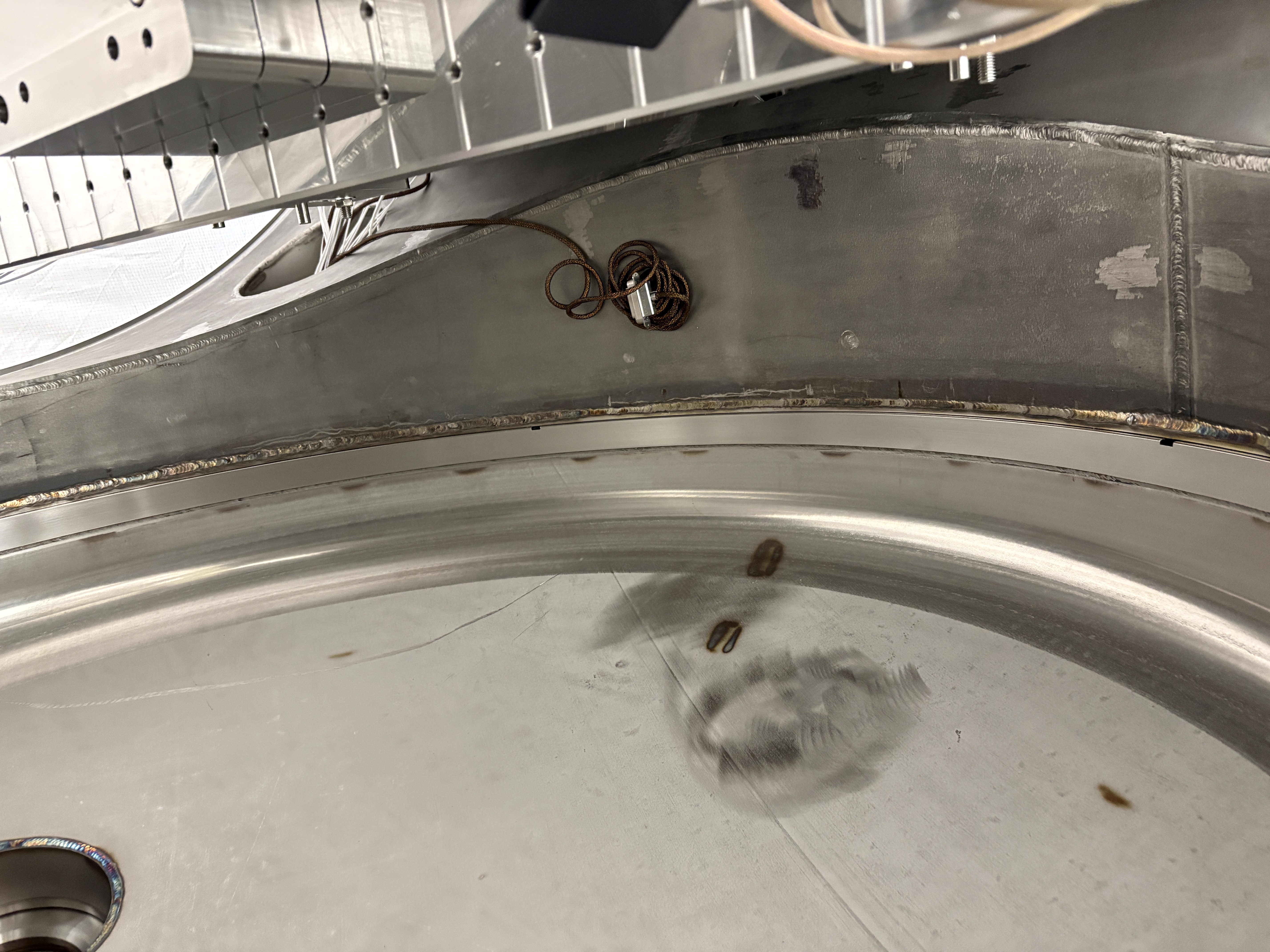
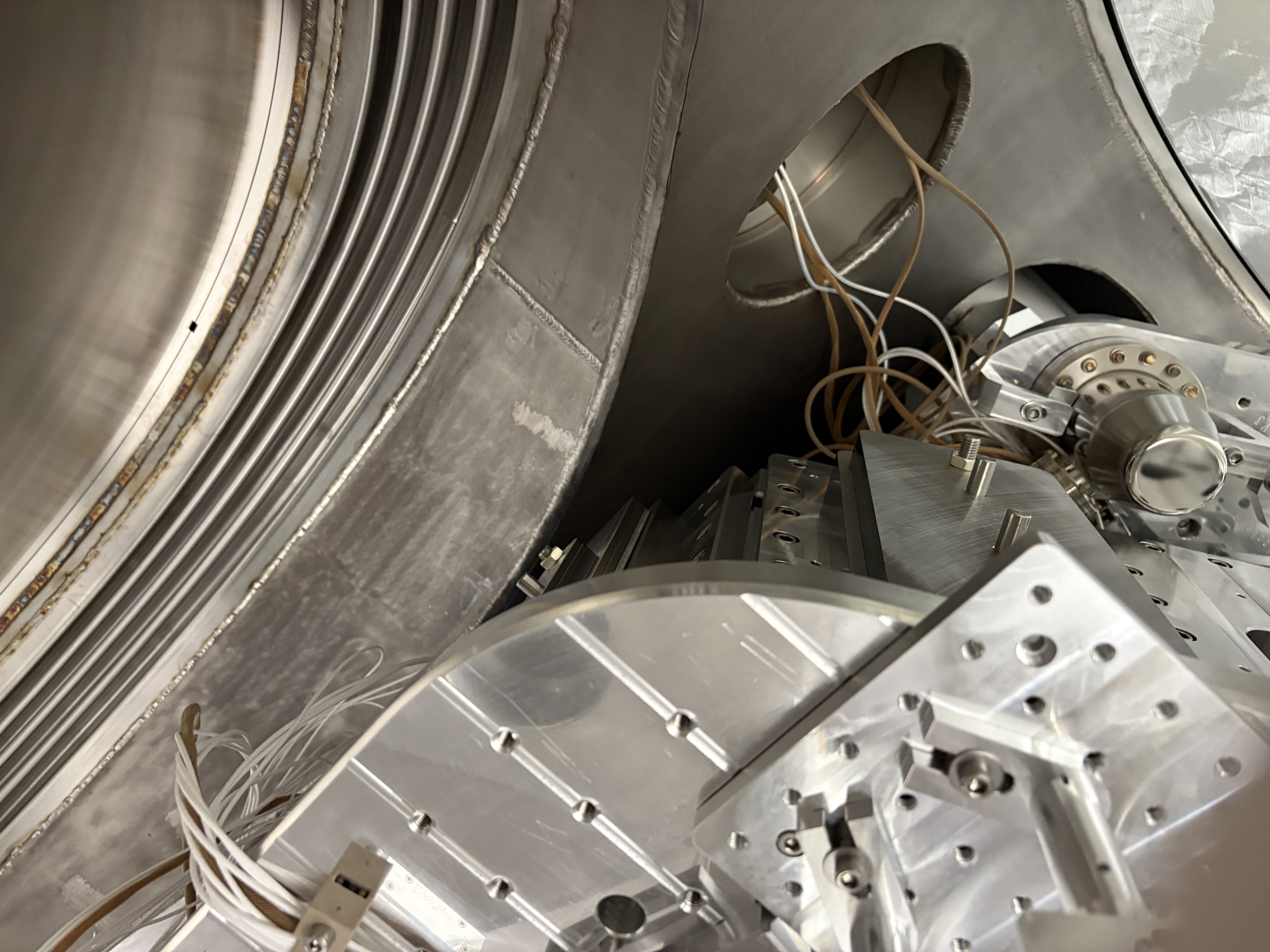
Between 19:11 and 19:21 UTC, Robert and I swapped the foam from under CO2Y chiller (it was flattened and not providing any damping now) to new, thicker foam and 4 layers of rubber. Photo's attached. 

Images attached to this comment
keith.riles@LIGO.ORG - 06:04, Saturday 07 December 2024 (81663)
Thanks for the interventions, but I'm still not seeing improvement in the Crab region. Attached are daily snapshots from UTC Monday to Friday (Dec 2-6).
Images attached to this comment
thomas.shaffer@LIGO.ORG - 15:53, Tuesday 10 December 2024 (81745)TCS

I changed the flow of the TCSY chiller from 4.0gpm to 3.7gpm.

These Thermoflex1400 chillers have their flow rate adjusted by opening or closing a 3 way valve at the back of the chiller. for both X and Y chillers, these have been in the full open position, with the lever pointed straight up. The Y chiller has been running with 4.0gpm, so our only change was a lower flow rate. The X chiller has been at 3.7gpm already, and the manual states that these chillers shouldn't be ran below 3.8gpm. Though this was a small note in the manual and could be easily missed. Since the flow couldn't be increased via the 3 way valve on back, I didn't want to lower it further and left it as is.

Two questions came from this:

  1. Why are we running so close to the 3.8gpm minimum?
  2. Why is the flow rate for the X chiller so low?

The flow rate has been consistent for the last year+, so I don't suspect that the pumps are getting worn out. As far back as I can trend they have been around 4.0 and 3.7, with some brief periods above or below.

Images attached to this comment
keith.riles@LIGO.ORG - 07:52, Friday 13 December 2024 (81806)
Thanks for the latest intervention. It does appear to have shifted the frequency up just enough to clear the Crab band. Can it be nudged any farther, to reduce spectral leakage into the Crab? 

Attached are sample spectra from before the intervention (Dec 7 and 10) and afterward (Dec 11 and 12). Spectra from Dec 8-9 are too noisy to be helpful here.


Images attached to this comment
camilla.compton@LIGO.ORG - 11:34, Tuesday 17 December 2024 (81866)TCS

TJ touched the CO2 flow on Dec 12th around 19:45UTC 81791 so the flowrate further reduced to 3.55 GPM. Plot attached.

Images attached to this comment
thomas.shaffer@LIGO.ORG - 14:16, Tuesday 17 December 2024 (81875)

The flow of the TCSY chiller was further reduced to 3.3gpm. This should push the chiller peak lower in frequency and further away from the crab nebula.

keith.riles@LIGO.ORG - 10:19, Thursday 19 December 2024 (81902)
The further reduced flow rate seems to have given the Crab band more isolation from nearby peaks, although I'm not sure I understand the improvement in detail. Attached is a spectrum from yesterday's data in the usual form. Since the zoomed-in plots suggest (unexpectedly) that lowering flow rate moves an offending peak up in frequency, I tried broadening the band and looking at data from December 7 (before 1st flow reduction), December 16 (before most recent flow reduction) and December 18 (after most recent flow reduction). If I look at one of the accelerometer channels Robert highlighted, I do see a large peak indeed move to lower frequencies, as expected.

Attachments:
1) Usual daily h(t) spectral zoom near Crab band - December 18
2) Zoom-out for December 7, 16 and 18 overlain
3) Zoom-out for December 7, 16 and 18 overlain but with vertical offsets
4) Accelerometer spectrum for December 7 (sample starting at 18:00 UTC)
5) Accelerometer spectrum for December 16
6) Accelerometer spectrum for December 18 
Images attached to this comment
Displaying reports 7041-7060 of 86324.Go to page Start 349 350 351 352 353 354 355 356 357 End