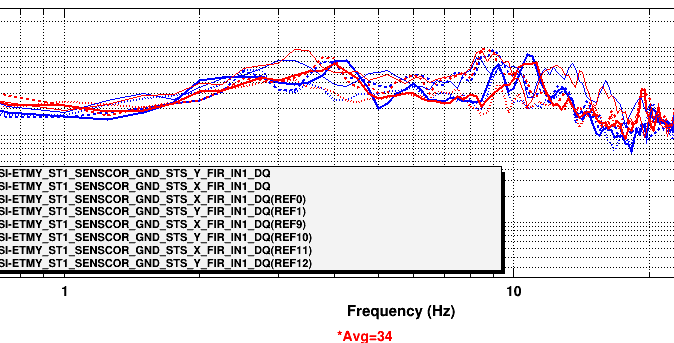
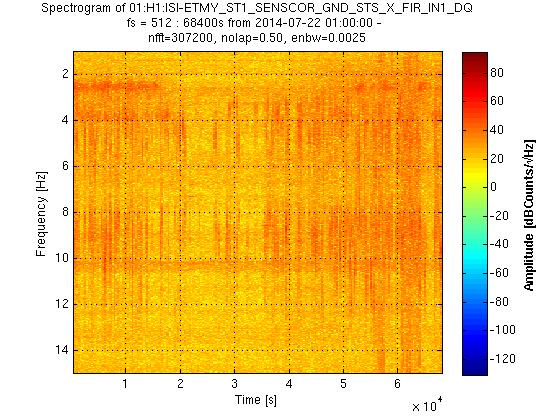
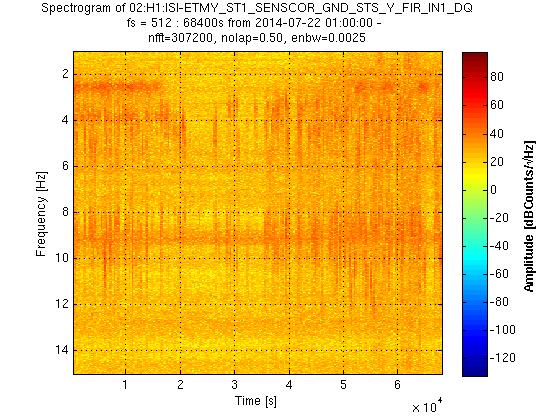
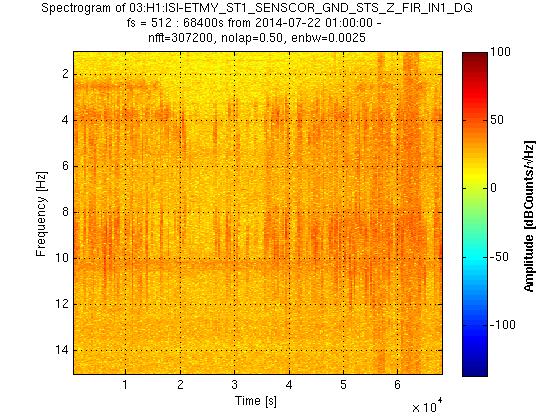
will run for ~ 16 hours (undamped / damped for main and reaction chain)
Almost all of the bolts for the mirror holder bases etc. were not tight enough, so we retightened them. In one case a bolt that attaches the post to the base plate was not tight, and I actually ended up rotating the entire post while tightening the bolt for the mirror holder. That was a steering mirror upstream of the green EOM. I was able to recover the alignment easily.
We tried to see the red beat note but couldn't. The fiber power is decent (50-60uW), but we're throwing away a lot for polarization analyzer PD, then we throw away 50% on the BS, and we're only getting 5-8uW at BBPD. But we're sending almost 19mW from Prometheus.
Blocking the beam changes the noise floor of BBPD, we changed the NPRO temperature up and down and saw nothing. BBPD itself seems to be working OK, we connected AM laser to the network analyzer and BBPD was responding.
The mode matching looks suspicious though it could be just a trick on the eye as one beam has much more power than the other. Tomorrow we'll go back and try to improve mode matching.
Ideally the fiber polarization should be adjusted so you're not pitching ~75% of the beam onto the polarization monitor PD. I'd noticed the polarization drift last week and just didn't get around to adjusting the controller.
We started welding in fused silica fibres this morning and now have 3/4 fibres installed. We plan to weld the final fibre tomorrow morning, followed by de-stress and hanging. Travis, Gary, Giles
Aidan, Alastair, Dave H, Dave R, Albert L, Eric G, Thomas V.
Tidied up the plumbing on TCSX. Installed plumbing on TCSY. All three picomotor mirrors installed and confirmed to be working on TCSX.
Hooking up proximity sensors for flipper mirrors. Installed shutter on TCSX laser.
Morning shift covered by Corey
130 - TCS crew energizing laser on optical table at BSC3. Beginning to populate table at BSC1. Did I see Dave Reitze working on this?
various ISI/SUS trips throughout the afternoon as a result of commissioning.
New screens showing oplev path on the QUADS after updating what Stuart did at LLO. I made a small correction and commited SUS_CUST_QUAD_OVERVIEW to the svn. cf attached screenshot
Betsy and I stowed ITMx (see attached picture). Plan for this guy is to get the sealed door on the box later today or tomorrow, then leave it in the cleanroom until its ready to move over to the beer garden. Margot
[Rich M. Arnaud]
ETMY GS13 V2 input signal was sitting at around 6000cts whereas the others at ~100 cts. Turning off/on the digital Gain + DWH switches brought it back to ~1000cts. Better. Though, it seems like there is still an offset that adds up to the signal.
Arnaud, Eric G, Apollo, Thomas We've installed the optical lever with two levels of 1:10 whitening in hardware and complimentary de-whitening in software. They are calibrated to micro-radians and I've attached a plot showing the linear response. The difference in their gains is most likely due to their difference in beam width. Pit_Gaussian_width = 2.02 mm Yaw_Gaussian_width = 1.41 mm H1:SUS-ETMY_L3_OPLEV_PIT_GAIN = 95.50 H1:SUS-ETMY_L3_OPLEV_YAW_GAIN = 69.33 H1:SUS-ETMY_L3_OPLEV_SUM_OUT = 20,000 counts.
(Daniel, Alexa)
We measured the dark noise and shot noise of the LSC RF PD in the refl path of the IMC.
From this measurement we calculated the AC transimpedance of the PD to be 2.1kOhm (with a 100 Ohm DC transimpedance).
Started off morning with many RED systems. Jeff B walked me through getting everyone (SUS, HEPI, ISI) in BSC2 back & then went from there.
Days Activities:
-Had to leave shift at 1:30 and was spelled by Justin B.
Log-Log plot attached with T0 set to start of rough pumping (~700 torr).
Demonstrated MTP safety valve closes and turbo spins down with the removal of AC to the scroll pump -> This mimics the functionality of a loss of "Motor Run" signal from the nominal backing pump -> Shut down QDP80 and purge air supply
model restarts logged for Tue 01/Apr/2014
2014_04_01 12:39 h1susetmy
2014_04_01 12:39 h1susitmy
2014_04_01 12:42 h1broadcast0
2014_04_01 12:42 h1dc0
2014_04_01 12:42 h1fw0
2014_04_01 12:42 h1fw1
2014_04_01 12:42 h1nds0
2014_04_01 12:42 h1nds1
2014_04_01 12:51 h1susitmx
2014_04_01 12:52 h1susetmx
All restarts expected and part of Tuesday maintenance.
The attached log/log plot gives the estimate that it will take a little over three weeks for the pressure to get to 3 x 10^-7 torr which will reduce to 1 x 10^-8 torr when the chamber is open to the cryo pump.
There was a magnitude 8 earthquake in Chile, all BSC ISIs tripped.
How did the new BSC SEI guardians do in recovering everything? Where there any problems or hiccups? Did it go smoothly?
Thanks for posting the data, Sheila. We (by which I mean Hugo) will look at this a bit more. A quick look makes it seems that all three vertical drives on 3 of 4 platforms were pushed to the max within 1 second of each other. Many people (W. Hua, Rana, Dan Clark, me, Peter F, et. al.) have suggested that using that using the sensor correction to only isolate against differential motion, rather than trying to get rid of the absolute motion as the whole site heaves up-and-down would be a smart thing to do. I think this will be a good example to look at. -Brian
TIme series were collected on both BS (ground STS, high gain) and ETMX (ground T240, low gain) at LHO.
They can be found on the svn at:
ligo/svncommon/SeiSVN/seismic/Common/Data/2014_04_01__Chile_Earthquake_Data/
For reference, LHO ground sensor time series were also colected for previous earthquake data, recorded on March 3rd of 2014. ligo/svncommon/SeiSVN/seismic/Common/Data/2014_03_10__Earthquake_Data/
Chris, Sheila
Our measurements of the COMM noise with the WFS locked have an rms of 20Hz, measured down to 0.1 Hz. To make sure this was reasonable, we turned off the refl bias path so that the laser was locked only to the green beat note. The transmitted power fluctuations are noticably less than the HWHM of 40Hz, so this seems believable. (StripTool is the second screenshot attached).
We wanted to try locking the arm half way down the fringe so we could make a measurement of the noise using the transmitted power. Since the IR trans PD is normalized to 1 when the cavity transmission is maximized, the calibration of this signal is just a high frequency gain of 84 (FWHM of the arm cavity), and to correct for the refl bias loop gain we have a pole at zero and a zero at 3Hz. The correct calibration has a more complicated frequency dependence, so we would have to do the real calibration to make a comparison above about 42 Hz. Neither of these traces have the cavity pole at 42 Hz corrected for. You can see that the side of fringe measurement agrees with the normalized refl PD signal well up to 100 Hz . (1st screen shot attached)
We repeated the measurement in the normal configuration, where we lock on resonance using the refl bias path, and the noise is the same (30Hz rms down to 0.02Hz). The RMS is dominated by the pitch mode, so we will work on increasing the WFS bandwidth tomorrow. Tonight we tried OpLev damping (this added noise around 1 Hz) and turning up the pitch OSEM damping gains (inconclusive so far).
We redid the measurement with the WFS outputs held, and saw that the noise was high again (100Hz rms down to 0.1Hz), with the WFS on again we were back to the low noise state. So we can safely say the WFS are helping.
We also checked that the noise is the same from 3-100Hz with and without the refl bias path engaged.
For future reference I took a spectrum of the 5 HSTS (MC1 MC2 MC3 PR2 PRM) from monday morning before the corner station was vented.
The isolation and damping on HAM2 and HAM3 ISIs were ON, and feedforward was OFF. The suspensions damping loops were closed. The chambers were under vacuum.
The attached pdf shows a comparison between the 5 HSTS, for every "mass" levels (M1 M2 and M3) and every degree of freedom.
Few things to notice on the plot :
- The performances are really consistent from one chamber to an other
- Signal is really close to sensor noise, especially at the bottom mass
- There is an interesting feature between ~0.1Hz and ~1Hz seen for longitudinal transverse and vertical dofs. This is something I would need to double check, but I'm pretty sure it is transmitted ground motion.
For future reference and ACCEPTANCE REVIEW I attached the undamped/damped version of the spectra, adding the local osem basis to the plots for the 5 HSTS in HAM2-HAM3 chamber.
FIRST PDF = UNDAMPED
SECOND PDF = DAMPED
NOTE : 60Hz spike for some of the osems spectra, especially top mass osems of PRM.
FInished when checked 4/7 (Arnaud is away).
M0 undamped: 2014-04-02-1080519986_H1SUSETMY_M0_0p01to50Hz_tf.mat
M0 damped: 2014-04-02-1080537980_H1SUSETMY_M0_0p01to50Hz_tf.mat
R0 undamped: 2014-04-03-1080555846_H1SUSETMY_R0_0p01to50Hz_tf.mat
R0 damped: 2014-04-03-1080573824_H1SUSETMY_R0_0p01to50Hz_tf.mat
Everything looks good except that as usual the R0 cabling has pushed the pitch modes up in frequency.
Comparison plots pending.