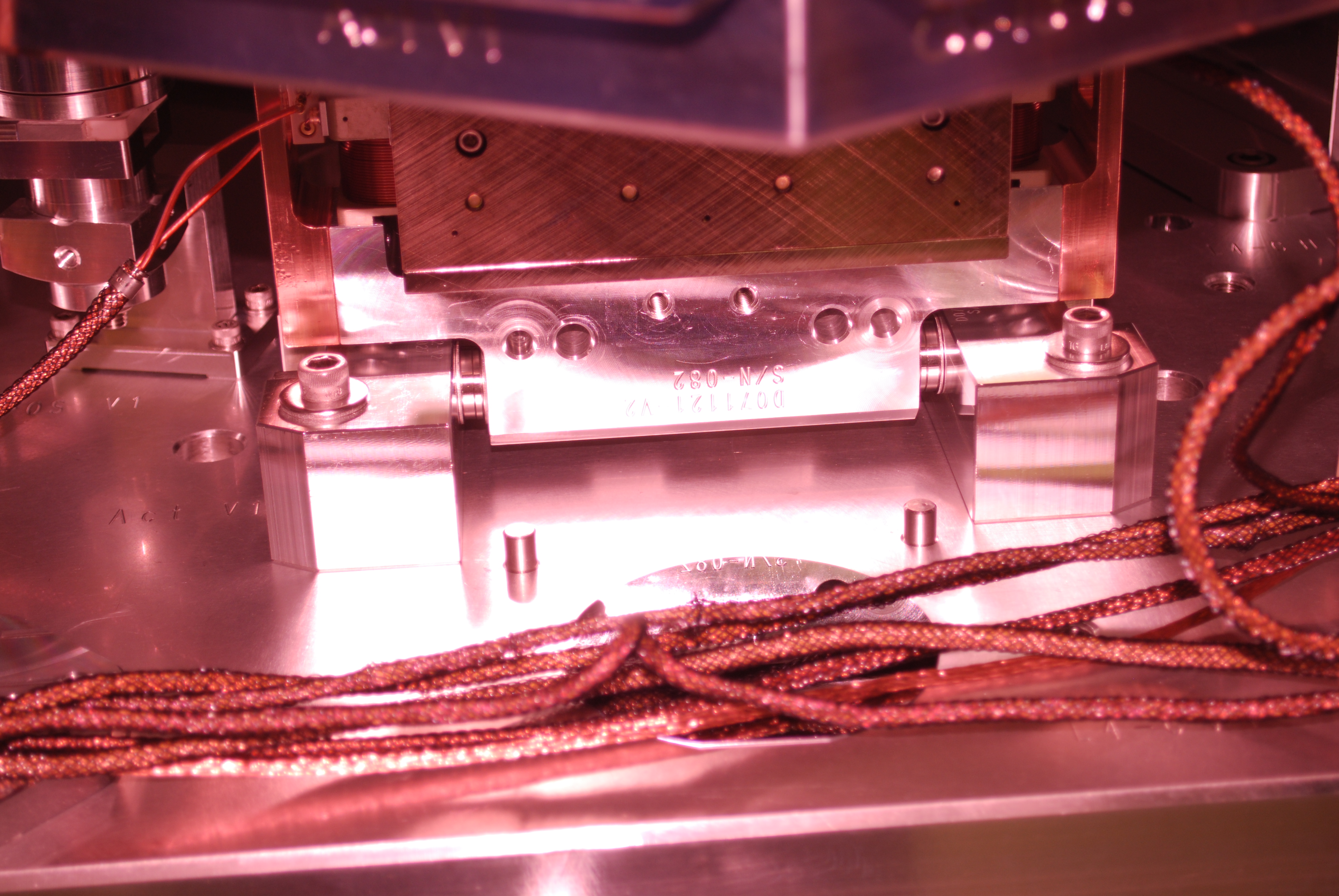
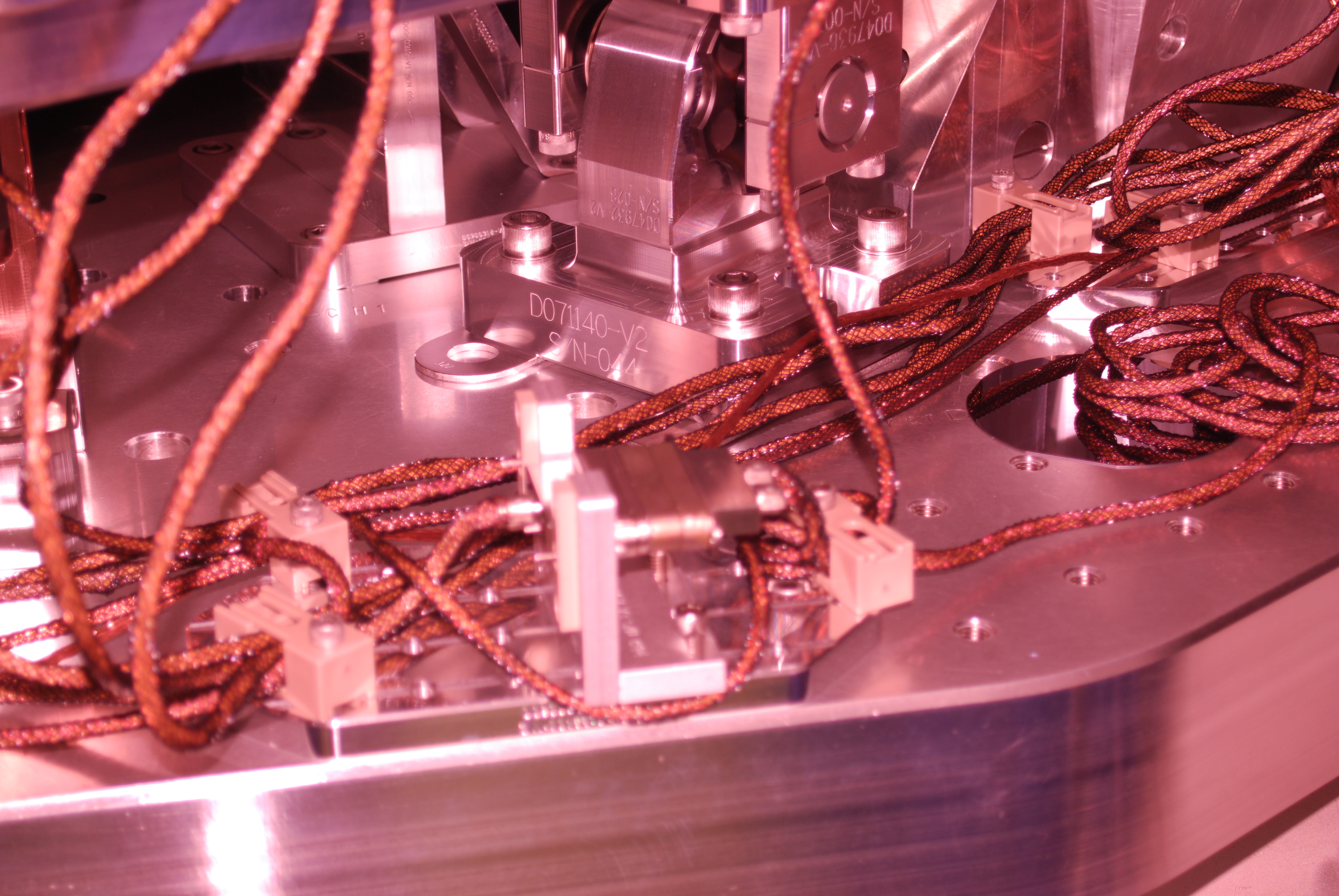
I set the damped TFs running last night to check effectiveness of new damping settings. Measurements done when checked at 7:45 am. Plots pending.
^/trunk/QUAD/X1/ETMX/SAGM0/Data/2013-05-30-1053969993_X1SUSETMX_M0_0p01to50Hz_tf.mat
^/trunk/QUAD/X1/ETMX/SAGR0/Data/2013-05-30-1053987452_X1SUSETMX_R0_0p01to50Hz_tf.mat
This is a late alog from yesterday morning. Before the gate valve was open I went out to end y to adjust the transmontane position to see if the 10 uW beam on the refl pd was a gobst beam. With a better alignment of the Trans mon there were: 8.87 mW green power before the EOM, 1.35mW onto the refl PD and -0.220 volts on the dc output.
[Alexa, Kiwamu]
We are ready for closing the WFS loops.
We excited MC3_M1_P at around 3 Hz with an amplitude of 10 counts by AWG. Monitoring the peak in DTT we minimized a signal leaked in the Q-phase. The WFS-A looked perfect and we didn't re-adjust it at all. As for WFS-B we adjusted segment 2 (whose cable was replaced) and segment 3. Plus, later on we flipped the sign of all the segments by further rotating the demod phases by 180 degs in order to have the same signal sign as that of WFS-A.
Attached are plots of dust counts requested from 5 PM May 27 to 5 PM May 28.
The dust monitor at location 14 in the LVEA (H2 PSL enclosure) is indicating a calibration failure.
Attached are plots of dust counts requested from 5 PM May 28 to 5 PM May 29.
The dust monitor at location 14 in the LVEA (H2 PSL enclosure) is indicating a calibration failure.
Attached are plots of dust counts requested from 5 PM May 29 to 5 PM May 30.
The dust monitor at location 14 in the LVEA (H2 PSL enclosure) is indicating a calibration failure.
Modified detailed CDS overview screen to include h1asc model. Added h1asc .par and .ini files to the data concentrator master file, restarted the data concentrator. Restored the symbolic link of the SITEMAP.adl file to the proper place in userapps directory.
MC1 MC2 and MC3 Phase 3b M1 to M1 transfer functions have been measured over the past weekend. They all show good agreement with model and previous measurements.
The attached files are showing comparison between model, phase 3a and 3b (except for MC2 3b vs 3b)
MC1 (allhstss_2013-05-29_Phase3b_H1MC1_ALL_TFs.pdf)
MC2 (allhsts_2013-05-29_Phase3b_H1MC2_ALL_TFs.pdf)
MC3 (allhsts_2013-05-29_Phase3b_H1MC3_ALL_TFs.pdf)
files and data have been commited on the svn under the following directories :
/ligo/svncommon/SusSVN/sus/trunk/HSTS/Common/{MatlabTools/Data}
/ligo/svncommon/SusSVN/sus/trunk/HSTS/H1/${MC1/MC2/MC3}/SAGM1/${Data/Results}
All of those top stage transfer functions look good.
The only thing to note is that MC2 has its pitch (1Hz) and roll modes (1.5Hz) coupled into the vertical mode as seen on the 3rd page of the 2nd pdf. It is significantly reduced by the damping
This coupling increased after pump down (orange/pink vs cyan/green).
Summary of important events:
- Sheila found the Y-ITM cameras unplugged, she plug them and turn them on.
- LVEA crane maintenance. Talk to Ski or John for more details.
- Apollo working in X End, which (I guess) trigger the dust monitors several times over there.
- Y arm: GV 1,5,6,9,10,11,12,17,18 open
- The main gate seems broken, Ski said will take care of it - (Now, 16:00, is working well)
- PSL died ~2PM, not clear reason why. For more details talk to Michael R.
NOTE: no alarm when this happen, I think we should have an alarm for events like this.
- PSL recovered ~3PM ( Go hIFO! )
pablo
I restarted the PSL alarm handler and we should be getting alarms now.
We moved the ergo arm and the genie lift (commonly reffered to as a "duct jack") from the LVEA to EX. We will relocate more items on THE LIST depending on crane availability. Drilling of the test stand is ongoing, 25% complete. CPB CR frame work is reassembled and ready for filters and lights pending some slight modifications for the valve motor box interference. Curtain install is 40% complete and ongoing. All CPB CR filters were tested individually in the first bay in a small clean room with a particle counter and results were 000. We will install all filters in the clean room and retest, with results expected to be as good as previous testing. Annulus piping on GV 2 is 40% complete and ongoing.
The PSL shut off today when the oscillator internal shutter was accidentally closed. This caused the power watchdog on the oscillator to trip as it couldn't lock to the frontend and the power dropped.
I found the laptop in the laser room (which remotely connects to the Beckhoff computer in the diode room) glitching, as the pointer was randomly moving and rapidly left-clicking even though I wasn't touching it. It looks like it wandered over to the internal shutter button where it clicked and closed the shutter. Thankfully to open the shutter a new window pops up with a warning of a possible Q-switch, and the button to confirm this is in a different position. The pointer was not able to move over to this area and open the shutter. I restarted the laptop which fixed the problem, and was able to bring back the laser. I closed the remote desktop client to ensure this couldn't happen again.
I wrote a little function that shows the coherence between the different channels. It creates a video to ease the viewing of the results (each frame is a frequency step).
I looked at the cross coupling on ISI-BSC6 using the following configuration:
- HEPI not controlled (It might be interresting to redo the measurement with the HEPI controlled)
- ISI controlled level 3, Blend 250mHz on both stages, T240s in stage 1 super sensor
- Sensor correction on both stages in X, Y and Z directions (no HEPI-L4C & STS-2 blend)
The video of the results can be downloaded at: https://svn.ligo.caltech.edu/svn/seismic/BSC-ISI/H1/ETMY/Scripts/Misc/ H1_ISI_ETMY_Cross_Coupling_20130515.avi
The list of channels is presented in: https://svn.ligo.caltech.edu/svn/seismic/BSC-ISI/H1/ETMY/Scripts/Misc/ Channels_List.txt
At 80mHz (where the motion amplification created by the control is maximal), the coherence matrix is presented in attachment (H1_ISI_ETMY_Coherence_Matrix_80mHz_20130515.jpg). Each patch is the coherence value.
Lots of information are displayed in the plot. For instance some of the important cross couplings are:
- Sensors Z to Rz on both stages
- Sensors X to Ry (on stage 2)
- Sensors Y to Rx (on stage 2)
- Actuators drive X->Ry,Rz (on both stages)
- Actuators drive Y->Rx,Rz (on both stages)
- Actuators drive Z->Rz (on both stages)
Previous experiences showed that large amplifications at low frequency are created by the control (reasons not totally defined). These amplifications are difficult to evaluate with the seismometers since the measured motions are in (or close from) the noise floor of the inertial instruments. Even if it is tricky to look at the position sensors, they can give us a good idea of the inertial motion amplification (HEPI is not controlled or controlled in position at 80mHz).Below the blend frequency, the error signal should ideally be dominated by the position sensors signals. Consequently, the relative motion between stage 0 - stage 1 and stage 1-stage 2 should be zeroed out.
The attached plot (H1_ISI_ETMY_ASD_CPS_Different_Sensor_Correction_20130515.jpg) shows the relative motion of the two stages (at the center of the horizontal actuators plan) when the ISI is controlled with the configuration described above.
Stage 1 - Comparison No control (black) vs Control (blue):
- In the X,Y directions, the motion of stage 1 relative to stage 0 is amplified by 1000 in the 50mHz-80mHz frequency band.
- In the Z, Rz directions, the motion of stage 1 relative to stage 0 is amplified by 50-100 in the 50mHz-80mHz frequency band
- In the Rx, Ry directions, the amplification of the stage 1 motion is limited in the 50mHz-80mHz frequency band
Stage 2 - Comparison No control (magenta) vs Control (red):
The relative motion between stage 1 and stage 2 is only amplified in the Z and RZ directions (amplification factor 50-100).
Regarding these results, it seems that most of the low frequency amplification comes from stage 1.
(Jax, Sheila)
The green beam is officially on ITMY again!
Unfortunately we no longer have the baffle photodiodes at our disposal, so we can't reproduce the OAT calibration. The rough alignment was achieved by viewing the beam on the pitch and yaw axes of the ITMY and averaging the counts on either side of the optic.
measurements - (pitch, yaw) in counts:
| (-19300, 9170) | ||
| (-14400, 11870) | optic | (-14400, 6470) |
| (-4900, 9170) |
The nominal TMS alignment is (-14400, 9170).
The HEPI is controlled in position with a 100mHz UGF. The location of the HEPI structure is:
| May 30, 2013 - 12h00 PT | IPS | Raw count |
| H1 | -5730 | |
| H2 | -5670 | |
| H3 | -7646 | |
| H4 | -8630 | |
| V1 | -6783 | |
| V2 | -387 | |
| V3 | 2123 | |
| V4 | -2334 |
No YAW offset was added.
I worked more on getting the beam back to the ETM. I got the beam visible on the cage but need to turn the illuminators on to align onto the ETM. The beam is visible on the ETM cage at (P,Y) = (220, -230).
Sheila D, Michael R
We realigned the reference cavity to get the autolocker to lock on a 00 mode. The transmitted PD is reading 2.15 V, which is about what it was before the chiller broke.
I set the common gain to 22.4 dB to get a UGF at 310 kHz.
Very good isolation results were presented in aLOG Sensor Correction Results. During the test, the ISI was the only controlled system. The ISI is locked at DC to stage 0 but the HEPI structure (stage 0) can still wander around since HEPI is not controlled.
HEPI position control:
Since isolation performances of the HEPI are limited (amplification of the motion around the blend frequency and the HEPI sensor correction is not as good as the ISI one), it seems attractive to implement a simple position control to lock HEPI to the ground and steer the whole HEPI-ISI as desired.
In this case, the HEPI-L4C inputs of the super sensors are turned off (via zero gain filters for convenience) and no filters applied to the IPSs.
Then, some rudimentary isolation loops (couple of poles and zeros) were designed such that the UGF is 100mHz. This low UGF allows not changing the HEPI dynamics in the ISI control bandwidth (Low gain peaking between 100mHz and 30Hz).
At low frequency, when no control is engaged, the ground, the HEPI and the ISI are moving together. With the sensor correction, the CPS signals are added to STS-2 signal to evaluate the inertial motion of stage 1. But when the stage 1 of the ISI is driven, HEPI-stage 0 also moves (cf aLOG Feedforward and figure transfer functions from ISI to HEPI in attachment – H1_ISI_ETMY_Interraction_HEPI_ISI_20130530.jpg). Consequently, the stage 1 inertial motion is misevaluated since HEPI motion is not considered.
By increasing the UGF of the position control on HEPI, the HEPI piers and stage 0 are locked together and the stage 1 inertial motion evaluation should be better.
In attachment H1_ISI_ETMY_ASD_Stage_1_Z_Different_Configuration_20130522.jpg , spectra of stage 1 motion in the Z direction are presented in different configurations:
- ISI controlled + No HEPI control
- ISI controlled (with sensor correction on stage 2) + HEPI control (UGF 10Hz - super sensor IPS +L4C + Sensor correction)
- ISI controlled (with sensor correction on stage 1&2) + HEPI control (Position control – UGF 100mHz)
- ISI controlled (with sensor correction on stage 1&2) + HEPI control (Position control – UGF 5Hz)
It seems that controlling the HEPI using a “pure position control” doesn’t improve or deteriorate the isolation performance of the ISI (vs no HEPI control) but it’s simpler to implement than the regular L4C-IPS blend.
Isolation is better when the sensor correction is implemented via the stage 1 of the ISI. Increasing the UGF of the position control from 100mHz to 5Hz doesn’t seem to improve the isolation of the ISI.
After reviewing the results, I found a calibration issue in the HEPI L4C in the X and Y directions. The couplings are actually lower than initialy presented. It explains why controlling the HEPI in position with a 5Hz UGF vs 100mHz doesn't seem to affect the sensor correction (Ground to stage 1 of the BSC-ISI).
Redoing the damped TFs on X1 with new damping filters and gains per LHO alog 6548.
Measurements had completed when checked at 8:40 am. However Betsy mentioned that the HEPA fan had been turned back on, so there may be some excess noise - plots pending.
^/trunk/QUAD/X1/ETMX/SAGM0/Data/2013-05-29-1053906843_X1SUSETMX_M0_0p01to50Hz_tf.mat
^/trunk/QUAD/X1/ETMX/SAGR0/Data/2013-05-29-1053924316_X1SUSETMX_R0_0p01to50Hz_tf.mat
The damped TF data had much more sensible peakiness but it was pretty noisy and there were major dropouts in R0 L and T, so I got Betsy to turn the fan back off and I'll rerun them.
Oops - commented on wrong alog.