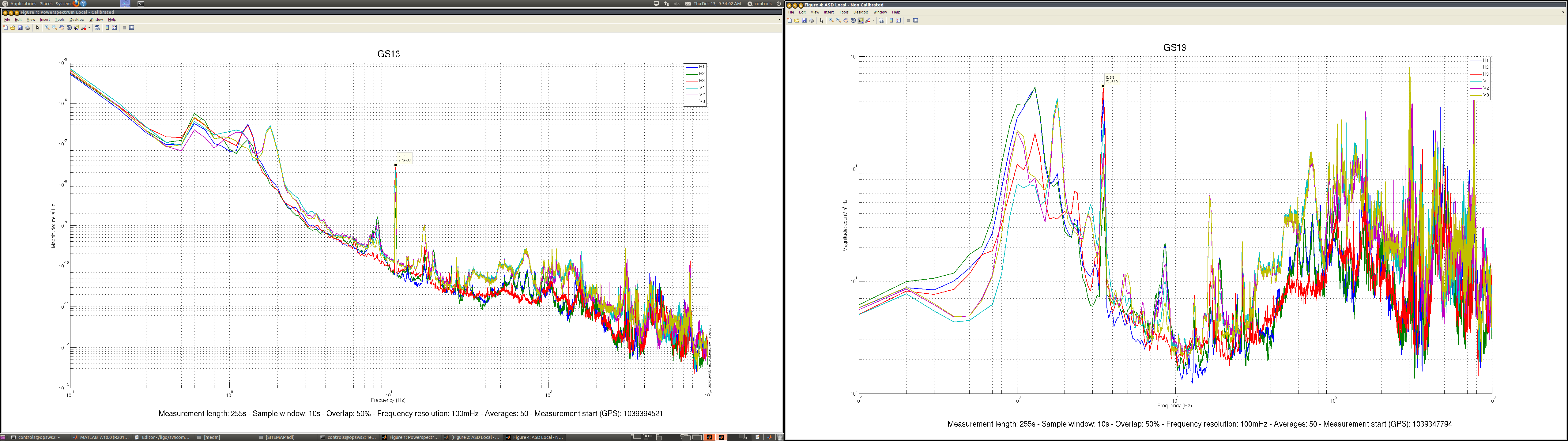
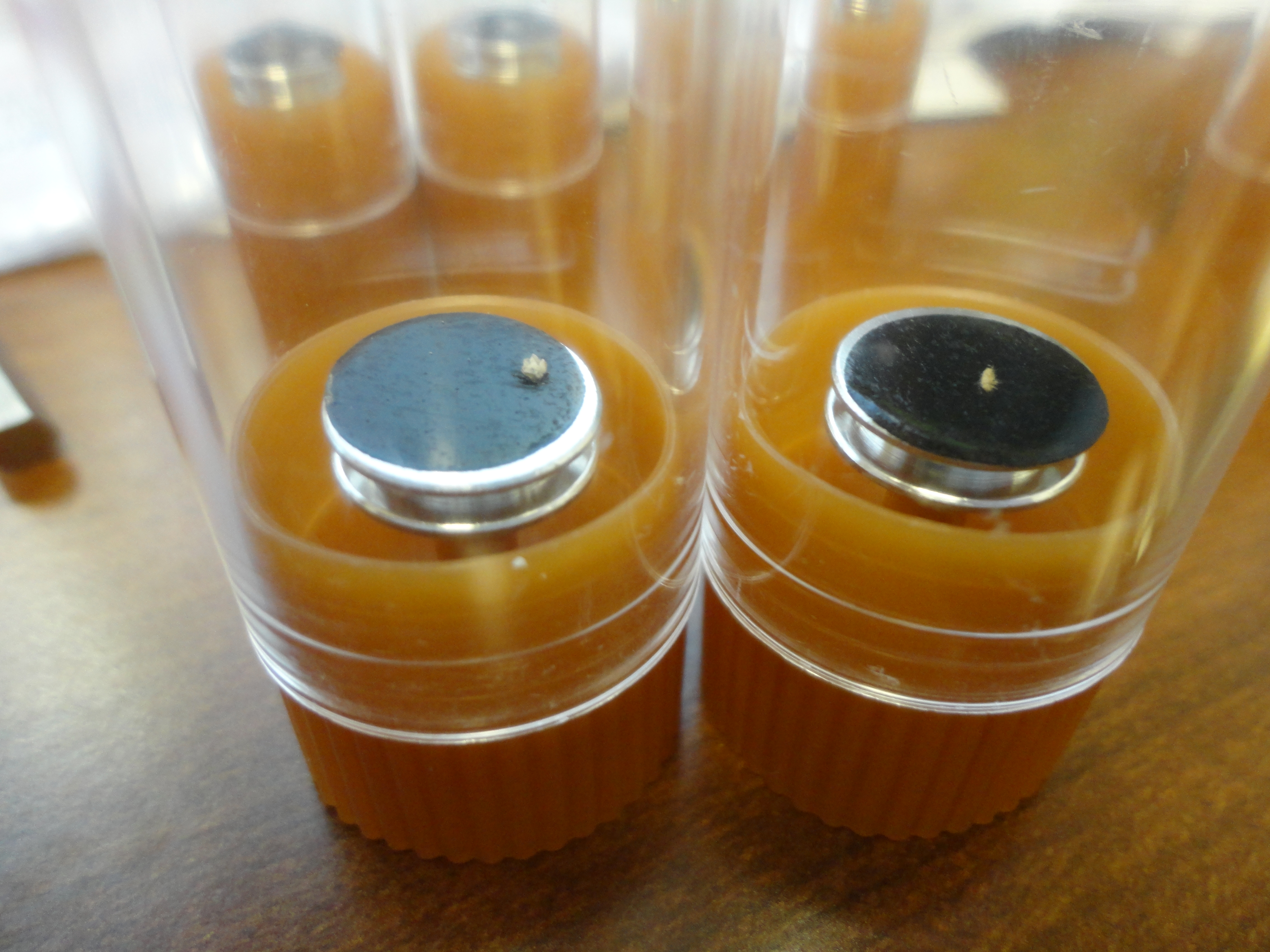
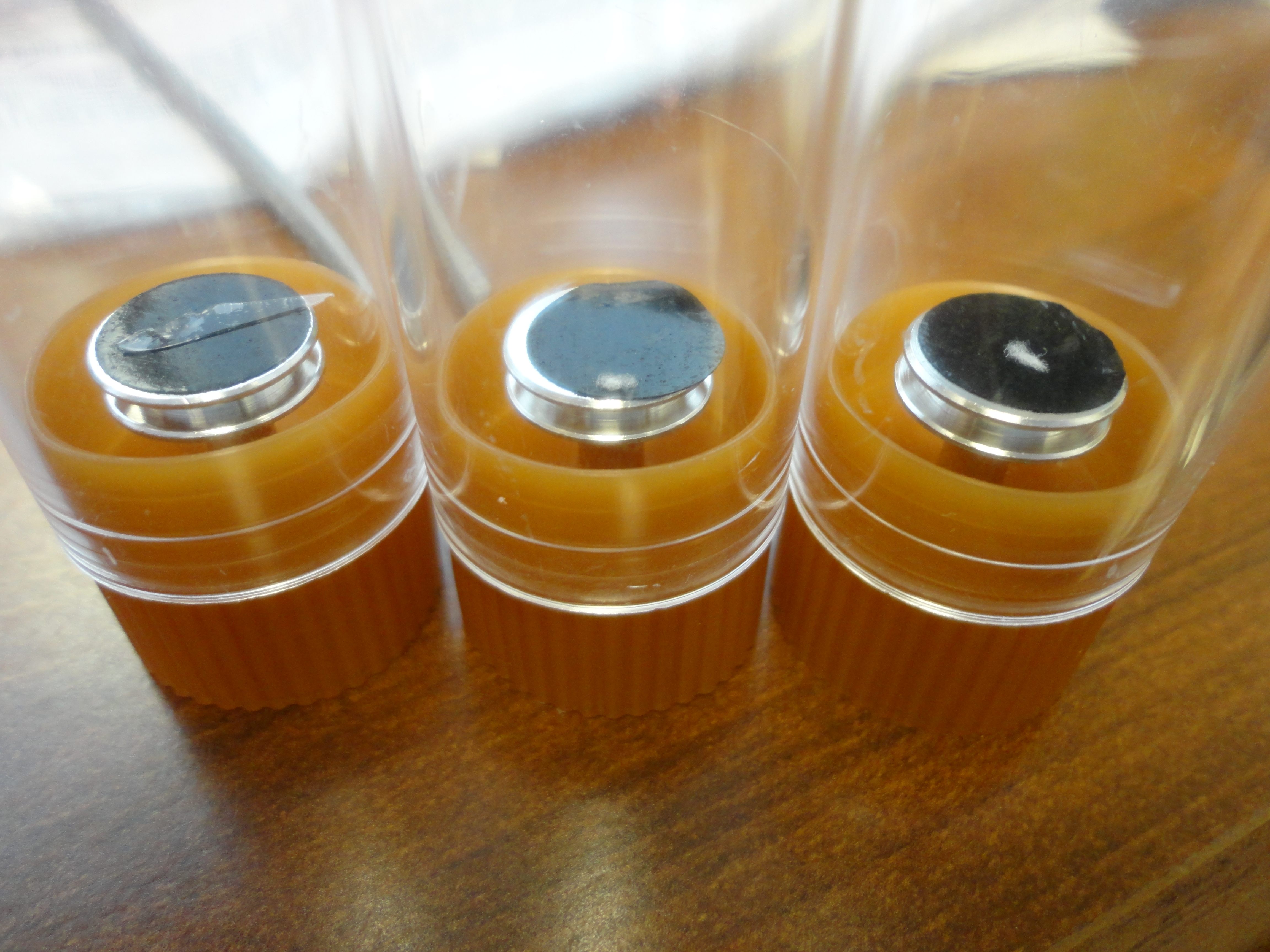
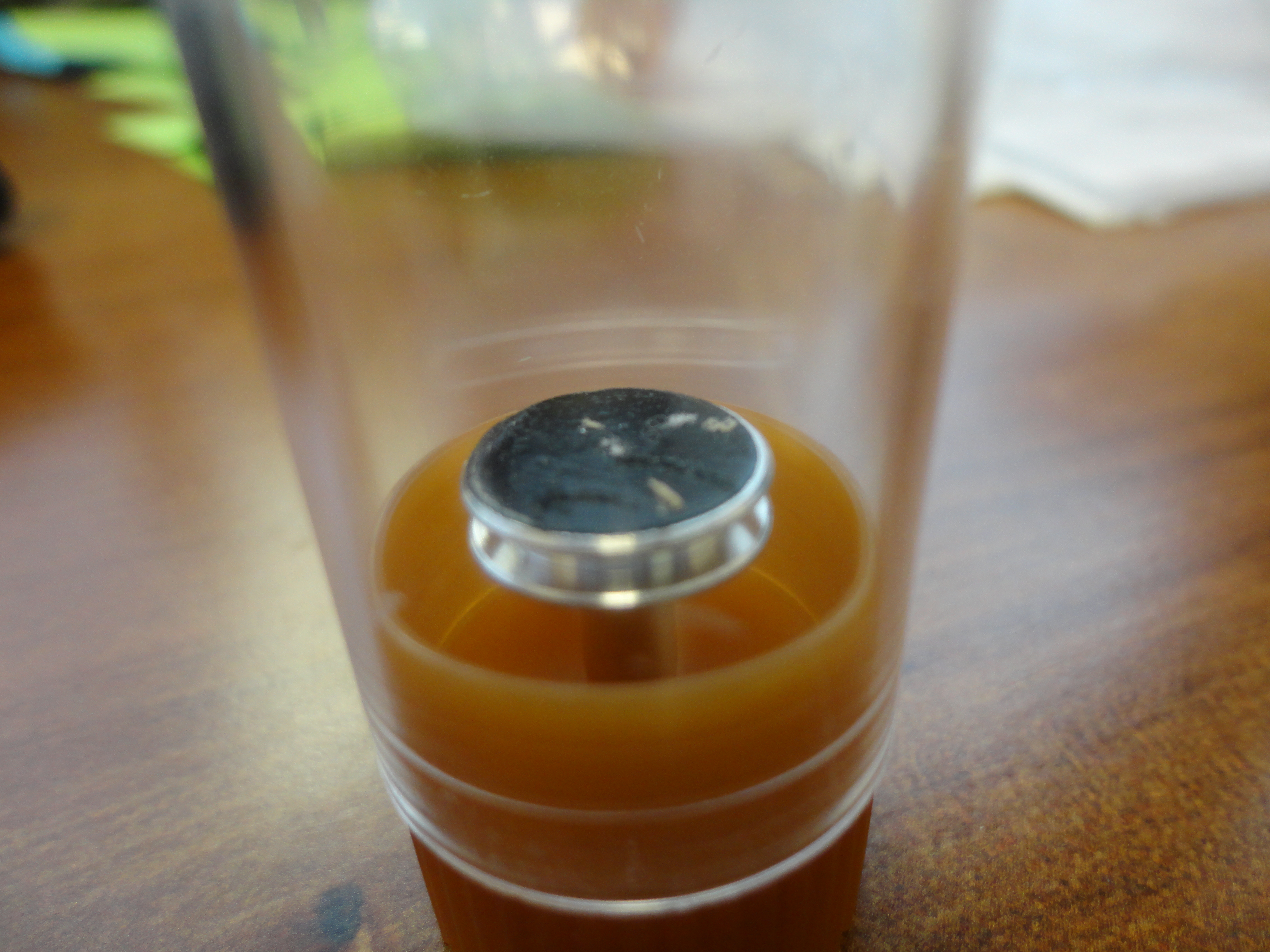
Added an SSD drive to the tape backup machine, this has sped up the backup process by a factor of 4. Jonathan installed an evaluation one time password login machine called cdsssh onto the 10.20 network. The nat router is routing a non ssh port through to it for testing.
Attached are plots of dust counts > .5 microns.
Measurements began at 102 168 1447 (~ 17:23 PST)
The fourth dust barrier was repaired and installed between HAM4 and the new Mode Cleaner Tube. Start of work checks on compressors,hoses, etc were completed and brushing started in BSC2. Upper, collar and mid sections were all brushed today and only ONE (1!) drill was used.
The attached are diagonalization measurements run on H2 SUS ETMY M0 & R0 for Vertical and Yaw DoFs this afternoon. Every measurement indicates ideal isolation of at least 20dB on both DoFs for both top masses.
The attached are the latest TF measurements on H2 SUS ETMY M0 & R0 top masses. There may be indication of rubbing in the M0 Transverse DoF seen in the 0.6Hz to 2Hz band. All the other DoFs look fairly clean for all bands.
Summary of install of the new DAQ Test Stand (DTS X1) May 14th - 18thth Rolf, Dave, Richard, Jim. -------------------- We have installed the following X1 systems in the H2 EE building: Timing, including timing fanout and IRIG-B distribution. We are running the new Timing Master Fanout in the MSR with a GPS antenna connected directly to its F-type connector. DC power (12V) for the IRIG-B and timing fanout. Networking, including three switches: the general X1 network switch; the FE-DAQ network switch with 10GE link to data concentrator; the 10GE DAQ switch The x1boot machine, which is also the code build machine. RCG branch2.5 was installed and the x1ioppsl0 model was built. All file systems for user apps, rtscore, rebuild etc. were constructed. The NAT router connecting X1 with GC. We ran a GC line from the GC switch in the H2 racks. We installed a new Vyatta based NAT router, using the original GC address for the DTS (badger.ligo-wa.caltech.edu) We installed one IO Chassis with an AC PS, we booted one front end, the x1psl0 system. ------------------------ Next item is to get the DAQ fully operational.
Measurements on H2 SUS ETMY M0 & R0 began at 1021432185 (May 18 2012 20:09:30 PST). Estimated completion time is May 19 at ~04:00 PST.
Turbo pump was started yesterday at 16:22 local time, pressure this morning had reached 3.4x10^-03 torr, no update on current pressure since CC has not turned on yet, but pump continues to pump.
Started turbo at 16:25 local time, about 30 min. later I started the CC, we see a pressure of 1.30x10^-05 torr.
Attached are plots of dust counts > .5 microns. I have also included plots of the mode for the dust monitors at end Y to show when they were moved.
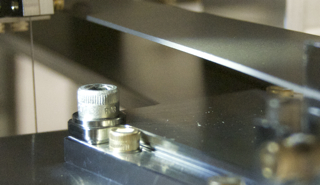
Dan tested beam diverter and everything worked including the motor and the two reed switches.
That's strange as one of the two reed switches was stuck before, but somehow it's unstuck. Anyway it's good.
I'm curious to get my hands on this Beam Diverter, after my experience with building five of them. For me, the Sensor Magnet's polarity seem to affect the functionality for the Reed Switches (Chirs Guido mentioned the position of this magnet was more the issue for him).
Dave restarted all the models of h2seib6. Gerardo moved dust monitor 2 in the end Y LVEA into the clean room over BSC 6. The IOP watchdogs for SUS BSC6 were tripped (in chamber work)
Today, we finished fixing the PUM (L2) LR magnet/flag. We then verified that the suspension was free of any mechanical rubbing (many head to toe inspections) and adjusted all OSEMs to nominal settings, accounting for buoyancy. So, we are ready for TFs on this guy.
Summary:
The power supply and fan issues with the i/o chasses could be solved with a new power supply producing smaller magnetic fields (being planned by CDS), routing cables away from power supplies, and a separate supply for the fans. The strongest magnetic field coupling sites to the OSEM read back channels were the cable connectors to the chasses that the signal passes through and not boards such as the a to d board. However, since the cables pass close to the power supply, the dominant coupling for the power supply fields was to the cables instead of the connectors at their ends. The separate issue of the fan frequencies showing up in channels can be solved by using an external power supply: the remaining coupling (from magnetic fields) when using a separate supply was measured here to be down by at least ten.
Power supplies in the I/O chasses:
In a previous log I reported that magnetic fields from the I/O switching power supply were strong enough to couple into channels at an unacceptable level (here). Since then, I have investigated the magnetic field coupling sites to see if there were any coupling sites that could be mitigated.
I looked for magnetic field coupling sites to one of the UIM OSEM readback channels for ITMY. I used a centimeter scale coil and slowly scanned circuit boards etc., while monitoring the coupling on a screen. The strongest coupling that I found was to the cable connectors to the UIM coil driver, the anti-aliasing module and the I/O chasis. The coupling to the connectors was stronger than the coupling to the a to d board, or any other location inside the coil driver or I/O chassis or along the cables. Note that this is only a test of coupling to the read back channel: I have not fully tested coupling of rack magnetic fields to the coil actuators.
Notwithstanding that the strongest coupling site was to the cable connectors, the dominant coupling site for the fields from the I/O chassis power supply was to the cables themselves because they pass so close to the power supply. Figure 1 demonstrates cable coupling, showing that when the cable into the UIM coil driver was about 10 cm from a field generator set on the I/O chassis power supply, the injected comb showed up strongly on the channel, but much less so when the cables were moved about 40 cm away from the field source, with no other changes.
Fans in the I/O chasses:
I noted in a recent ilog (here) that i/o chasis fan frequencies showed up in the channels passing through the chasis. When the fans were run on a separate power supply, the coherence was lower, but because of time constraints and dtt crashes, I was not able to run long coherence measurements to make sure that the coupling was much lower. Figure 2 shows the results of a recent 79,000-average coherence measurement, and the fan peaks appear to be showing with a low level of coherence. The plot suggests that the coupling of the fans to the i/o chassis channels is down by a factor of about 10 when the fans are run on a separate power supply.
For this reason, I think that running the fans on a separate power supply will be sufficient. So, to solve the issues I have raised recently, the i/o chasis power supplies should be replaced and the fans should run on independent supplies. There is a chance that power supply ripple from the fans would not be a problem with the new power supplies. I have not tested this.
Relocated the Y-End station dust monitor #2, it is set inside the BSC06 clean room, it is next to the SE pier. However it needs to move closer to where the action is, but we need a longer cable to accomplish that, yes we are looking for a longer cable. Dust monitor #1 remains located West of the iLIGO racks inside one of the cleanrooms.
We found a cable, thanks Richard, so we re-relocated the dust monitor (#2), now the location is by the NW pier of BSC06.
The dust monitor labeled 'L' is at location 1. The dust monitor labeled 'M' is at location 2.
Attached are plots of dust counts > .5 microns.
Pumping was stopped overnight, system is not designed to run unattended, will restart early tomorrow. Pressure at 1.74 torr.