Displaying reports 17541-17560 of 86768.Go to page Start 874 875 876 877 878 879 880 881 882 End
Reports until 14:11, Friday 14 July 2023
H1 ISC (CAL, ISC)
craig.cahillane@LIGO.ORG - posted 14:11, Friday 14 July 2023 (71333)
Correlated DARM noisebudget - June 28 2023
On June 28 2023, Sheila and Naoki took one hour of no-squeeze data with the hot OM2 alog 70930.
Directly afterwards, I took a DARM OLG and PCAL injection using noise_recorder, with good coherence > 0.9 everywhere between 6 and 700 Hz.

With these three inputs, we can construct the correlated DARM noisebudget directly from measurements in a model-independent way.
This eliminates most of the dependence on the calibration model when reconstructing correlated DARM.


Results
The interactive correlated DARM noisebudget .svg is hosted here:
https://lhocds.ligo-wa.caltech.edu/exports/craig.cahillane/gitcommon/correlated_noise/figures/20230628_195416_utc/correlated_darm_calibrated_zoomed_binwidth_0p1.svg
The same .pdf is posted as the first attachment.

Most of the noisebudget terms are from the latest LHO noisebudget squeezed time, taken from 
/ligo/gitcommon/NoiseBudget/aligoNB/out/H1/lho_darm_noisebudget/lho_darm_noisebudget.hdf5.

Notes
0) The noisebudget terms come from a time with squeezing injected, so for my correlated noise both shot noise and radiation pressure noise should be elevated compared to what is plotted.  I have included the Unsqueezed shot noise estimate here.

1) The correlated noise seems to be dominated by thermal noise in the bucket, around 200 Hz.  See Evan's alog 68482 with a different method for a comparison.

2) At low frequencies, the noisebudget expected is higher than what is measured.  This is true for the normal squeezed DARM measurement in the NB as well.  Not sure if this NB is out of date, or if I'm including old terms that shouldn't be included anymore (like this RadiationPressure term or PUMDAC term).

3) At high frequencies, we are hitting some unknown correlated noise floor, just as we have in the past.  I am sure we have resolved the actual correlated noise floor because I've used logbinning (which gives you many more effective averages at HF), and I ran at a few different binwidths (0.1 Hz, 0.25 Hz, 1.0 Hz) and this correlated noise floor became better resolved and did not go lower.

4) At very high frequencies (> 4 kHz), correlated noise is limited by frequency noise.  The precise mechanism of HF frequency noise coupling to DARM is not well-understood, but it can be made to go extremely low given a good mode-matching thermal state, e.g. red Freq/DARM TF here.

4) There were significant glitches during this hour of data, as there usually are.
The second pdf shows the difference between the glitchy vs "PSD-rejected" spectral densities, where I threw out abnormally high PSDs.
 
5) Sheila has made these plots already in alog 70978, but was struggling because the correlated noise and DARM noise were having some 7% error in the totally-correlated regime (~20 Hz), casting doubt on the rest of the results (only at the few-percent level).  I don't understand the source of those issues, but I don't think I am having the same issue.  I zoomed way in at 20 Hz and there was no difference (PDF 3).  

6) I did not do any DCPD balance matrix corrections because the current matrix has very small values ( SUM = 0.9996 * A + 1.0004 * B ).


Code
I've revamped the code in 
/ligo/gitcommon/correlated_noise/code/plot_cross_correlation.py
to be easily usable with labutils env.
plot_cross_correlation.py needs access to the noise_recorder DARM measurement data and the aligoNB lho_darm_noisebudget.hdf5 file, so this code will only run on CDS machines.

To run, 
1) open plot_cross_correlation.py  
2) go to the USER PARAMETERS section (~line 453 as of this writing), and make sure the parameters look correct.  You can even change the binwidth, (I found 0.1 Hz, 0.25 Hz, and 1.0 Hz all actually worked, but 0.3 Hz did not just because of annoying array length problems).
3) In terminal, run 
conda activate labutils
cd /ligo/gitcommon/correlated_noise/code/
python plot_cross_correlation.py


Details
I calibrated the PCAL using a gain of 1 and two poles at 1 Hz.  This is our ultimate meters reference.
I used the DARM OLG data directly to remove the DARM loop sensing noise correlating effect.  I extrapolated in the low and high frequency regimes using a 1/f and 1/f^2 function, respectively.
The DARM sensing function is just a simple gain and pole fit using scipy.curve_fit().  At this time, there was very little detuning and so no need for a more complex sensing model.
"PSD-rejection" is just the process of finding the median PSD value at some frequency, assume an exponential distribution, and throw out any PSD that comes in above a certain threshold.  It's sort of like median-averaging meets glitch-gating without the headaches.


alogs
Sheila's June 21th (cold OM2) and June 28th (hot OM2) correlated noise plots: alog 70891
Naoki's No-SQZ times for June 28th: alog 70930
Sheila resets the OMC DCPD matrix, and does some DCPD math: alog 70453
Evan turns down and bandstops the DARM loop at 100 Hz to avoid DARM loop correlations: alog 68482
May 2021 correlated noisebudget: alog 59073
O3 correlated noisebudget: alog 57284
Non-image files attached to this report
H1 PEM (DetChar, PEM, SEI)
siddharth.soni@LIGO.ORG - posted 13:23, Friday 14 July 2023 - last comment - 13:23, Friday 14 July 2023(71312)
Peak close to 2.6 Hz in HEPI Y could be related to the DARM noise in 20-40 Hz

This is regarding the excess noise at LHO mostly in 20-40 Hz band that I discussed earlier in the alog 71214. In the Q scans, this noise appears as “scratches” mostly between 20-40 Hz band. As mentioned in this alog, these scratches are separated by ~ 0.2 seconds, which would correspond to 1/(2*0.2) or 2.5 Hz motion upconverted to 20-40 Hz band. This noise started getting worse around June 22 when LHO moved to lower power. This change resulted in improved sensitivity at lower frequencies, and this can partly explain the increased visibility of this 20-40 noise in DARM. 

I also noticed that there is a peak at 2.55 Hz in HEPI Y and Ground Y that shows up on June 17 (barely visible) gets stronger between June 17 and June 22 and has been present everyday since then. This peak is visible in most HAMS, here’s HAM6. There is another peak at 1 Hz that appeared on June 21 and has been present every since. 

The appearance of this 2.55 Hz peak could be the second factor responsible for the increase in noise June 22 onwards. However, this doesn’t explain why this noise is present in the data prior to June 22 (albeit with a smaller rate).

Images attached to this report
Comments related to this report
siddharth.soni@LIGO.ORG - 09:14, Friday 14 July 2023 (71323)

This peak is also present before May 6. So for some reason, the peak disappeared between May 7 and June 17. 

H1 General
camilla.compton@LIGO.ORG - posted 13:04, Friday 14 July 2023 - last comment - 16:02, Friday 14 July 2023(71331)
H1 into Commissioning for next 3 hours

Have scheduled commissioning work this afternoon from 20:00UTC to 23:00UTC. Mainly PEM and alignment work.

Comments related to this report
camilla.compton@LIGO.ORG - 16:02, Friday 14 July 2023 (71339)

Commissioning was cut short due to a 22:29UTC lockloss from a seismic event  71336

H1 TCS
camilla.compton@LIGO.ORG - posted 12:14, Friday 14 July 2023 (71328)
ITM HWS SLEDs need to be replaced.

Cao noticed that the ITMY HWS signal was not good and the SLED needs replacing. See attached. Both SLEDs have degraded over the past 7 month (quicker than the 1 year expected lifetime) and should be replaced. We'll plan to do this in a future Tuesday maintenance day.

SLED inventory recorded in 66832, SLEDs last swapped in Dec 2022 66179.

Images attached to this report
LHO VE
david.barker@LIGO.ORG - posted 10:23, Friday 14 July 2023 (71326)
Fri CP1 Fill

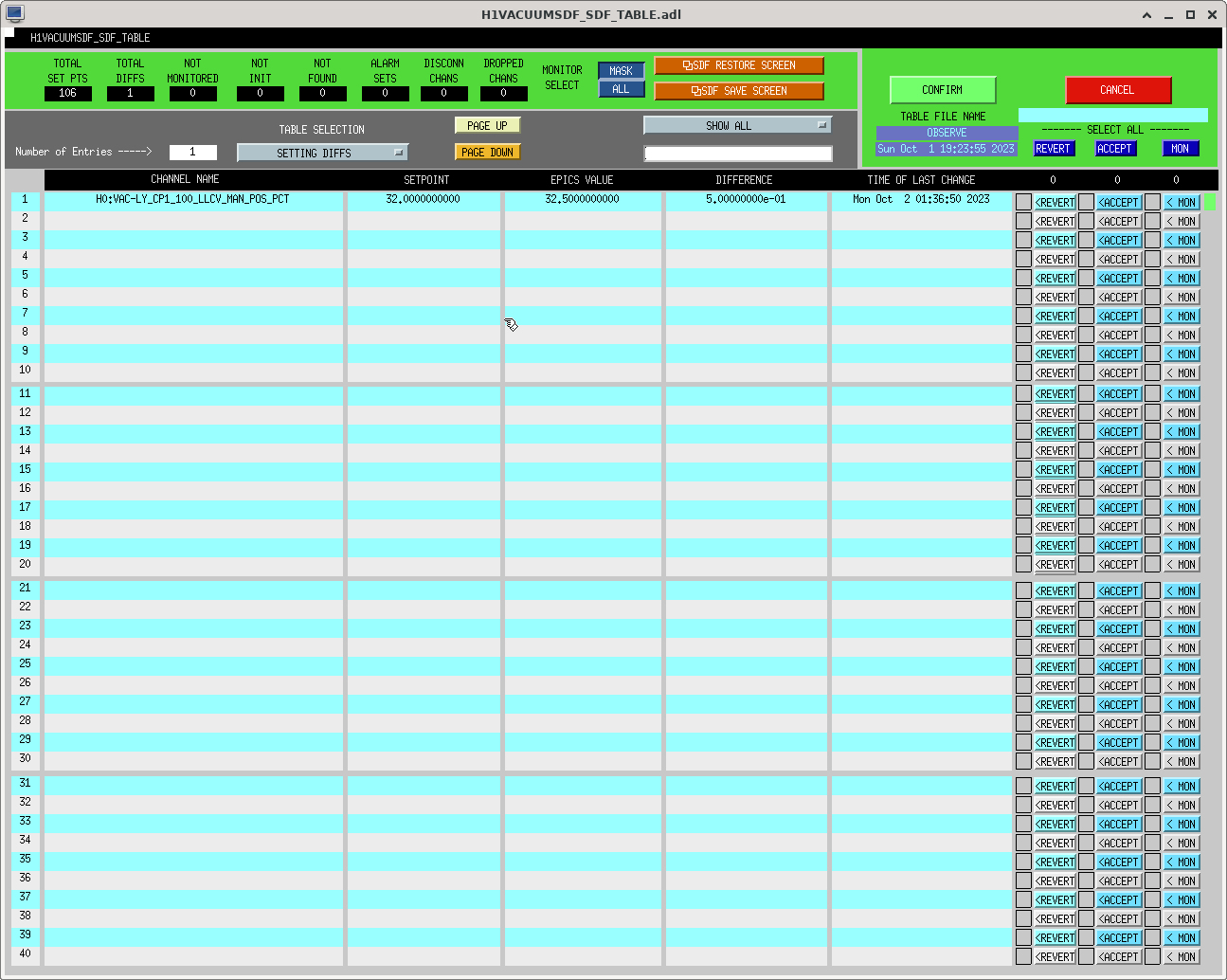
Fri Jul 14 10:06:06 2023 INFO: Fill completed in 6min 6secs

Travis confirmed a good fill curbside

Images attached to this report
H1 SUS (SUS)
oli.patane@LIGO.ORG - posted 09:58, Friday 14 July 2023 (71325)
Analysis of In Lock Charge Measurements (FAMIS #25074)

Closes FAMIS 25074

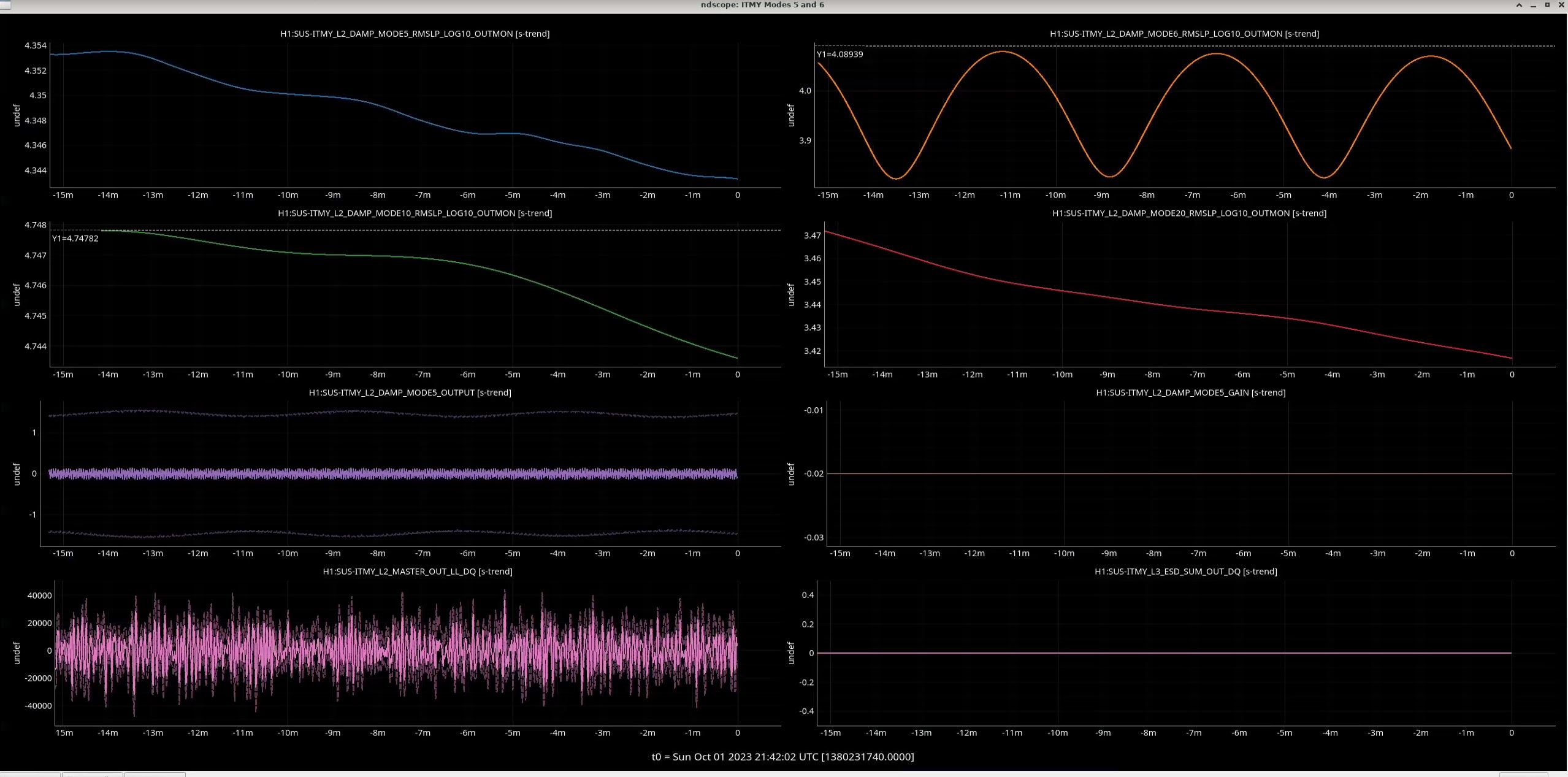
Ran analysis on Tuesday's In-Lock Charge Measurements for the ETMs/ITMs. Figures attached.

Images attached to this report
H1 General (Lockloss)
camilla.compton@LIGO.ORG - posted 09:24, Friday 14 July 2023 - last comment - 11:32, Friday 14 July 2023(71324)
Lockloss at 16:18UTC

1373386724 Caused by Camilla accidently adding an factor of 10 into the AS 36Q yaw +35000 offset when turning it back on, 71302 71320. Sorry.

Comments related to this report
camilla.compton@LIGO.ORG - 11:32, Friday 14 July 2023 (71327)

Back to NLN and Observing 18:27UTC, fully automated relock. Spent 1h8 in OMC_WHITENING damping violins. Accepted the ASC sdf's from 71302 for AS 36Q yaw offset +35000.

Images attached to this comment
H1 PSL (PSL)
oli.patane@LIGO.ORG - posted 08:53, Friday 14 July 2023 (71322)
PSL Status Report (FAMIS #25487)

Closes FAMIS 25487


Laser Status:
    NPRO output power is 1.825W (nominal ~2W)
    AMP1 output power is 67.22W (nominal ~70W)
    AMP2 output power is 135.2W (nominal 135-140W)
    NPRO watchdog is GREEN
    AMP1 watchdog is GREEN
    AMP2 watchdog is GREEN

PMC:
    It has been locked 1 days, 17 hr 38 minutes
    Reflected power = 17.03W
    Transmitted power = 109.3W
    PowerSum = 126.3W

FSS:
    It has been locked for 0 days 5 hr and 53 min
    TPD[V] = 0.7685V

ISS:
    The diffracted power is around 1.8%
    Last saturation event was 0 days 5 hours and 53 minutes ago


Possible Issues:
    ISS diffracted power is low

       - Known by Jason. Plan to bump up diff power when detector is next out of lock.


LHO General
corey.gray@LIGO.ORG - posted 08:06, Friday 14 July 2023 (71316)
Fri OWL Ops Summary

TITLE: 07/14 Owl Shift: 07:00-15:00 UTC (00:00-08:00 PST), all times posted in UTC
STATE of H1: Observing at 133Mpc
SHIFT SUMMARY:

Other than a rumbling & fast earthquake, it was a nice shift.  

LOCK#1:

LOG:

H1 General
oli.patane@LIGO.ORG - posted 08:06, Friday 14 July 2023 (71321)
Ops DAY Shift Start

TITLE: 07/14 Day Shift: 15:00-23:00 UTC (08:00-16:00 PST), all times posted in UTC
STATE of H1: Observing at 129Mpc
CURRENT ENVIRONMENT:
    SEI_ENV state: CALM
    Wind: 4mph Gusts, 3mph 5min avg
    Primary useism: 0.01 μm/s
    Secondary useism: 0.05 μm/s
QUICK SUMMARY:

Detector Locked and Observing for 1:50.

Commissioning scheduled from 1-4pm Pacific.

H1 ISC (ISC)
corey.gray@LIGO.ORG - posted 06:42, Friday 14 July 2023 (71320)
ASC SDFs ACCEPTED

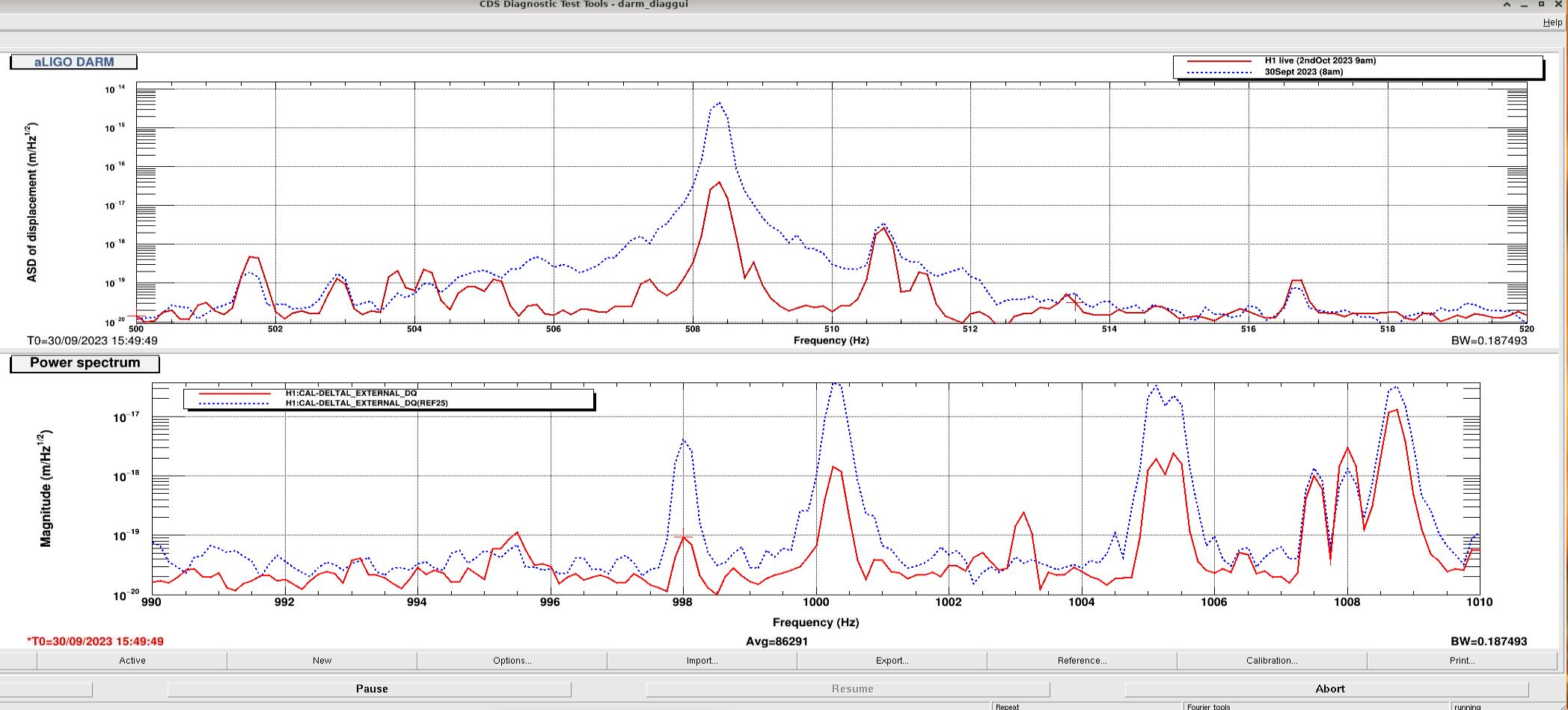
Accepted SDF diffs for ASC (see screenshot...a couple of time-ramps and offset changes).  This looks related to Sheila's alog:
https://alog.ligo-wa.caltech.edu/aLOG/index.php?callRep=71302

Images attached to this report
H1 General
corey.gray@LIGO.ORG - posted 02:49, Friday 14 July 2023 - last comment - 05:34, Friday 14 July 2023(71318)
(FAST) 6.3 EQ Ends H1's Lock at 23.5hrs

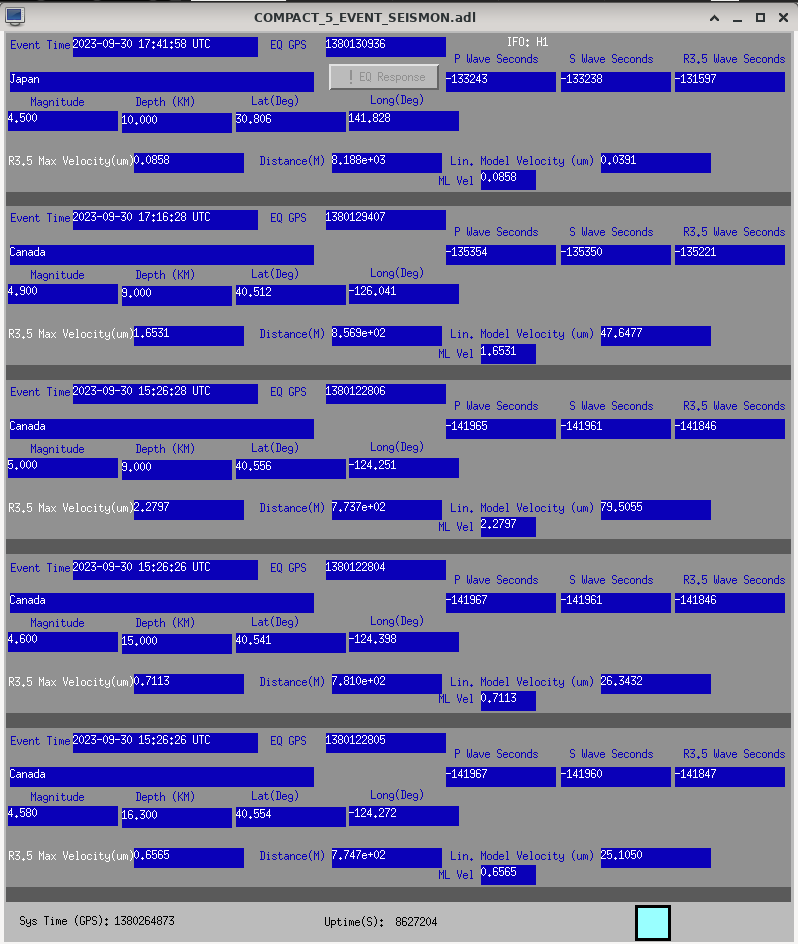
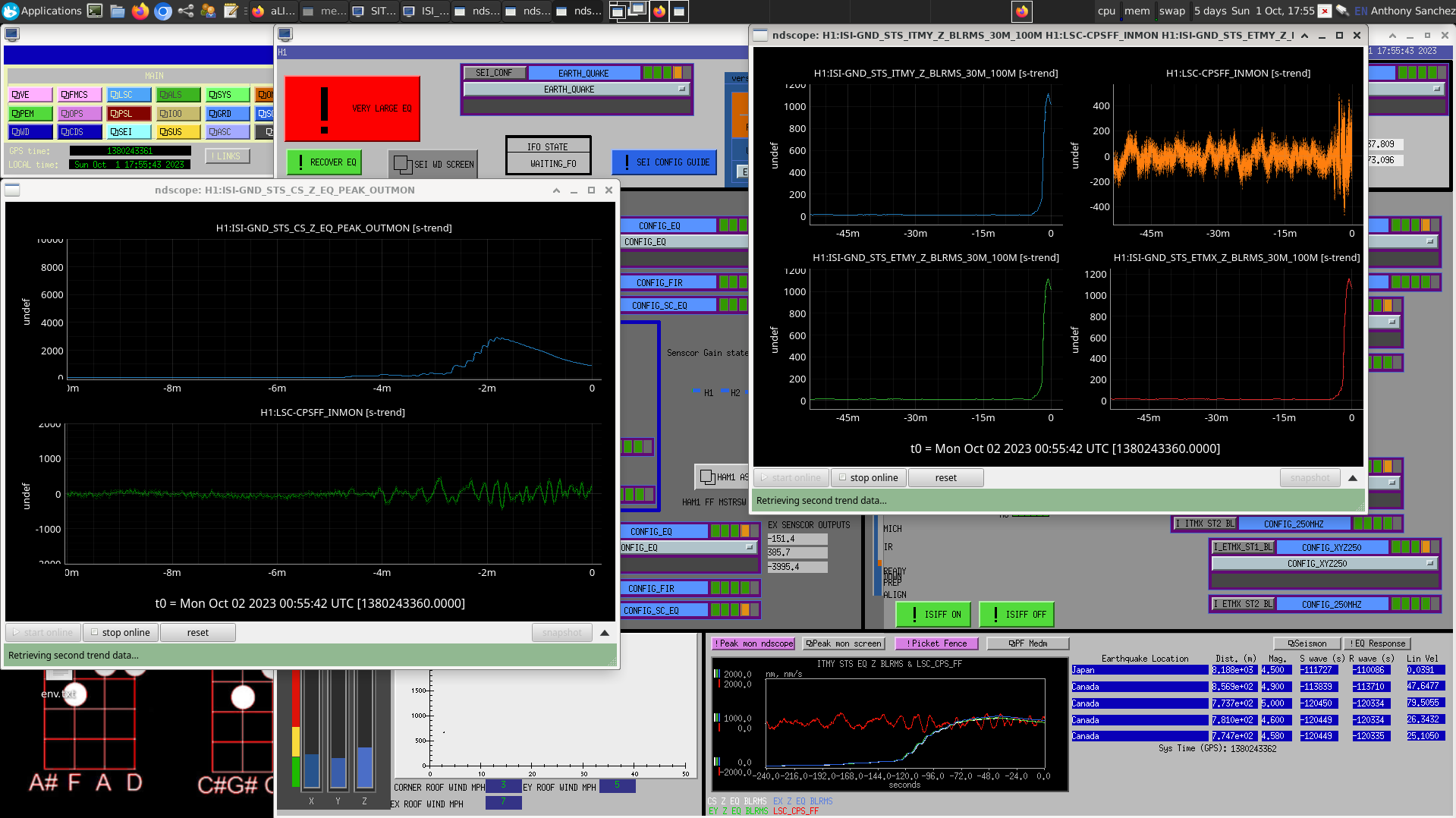
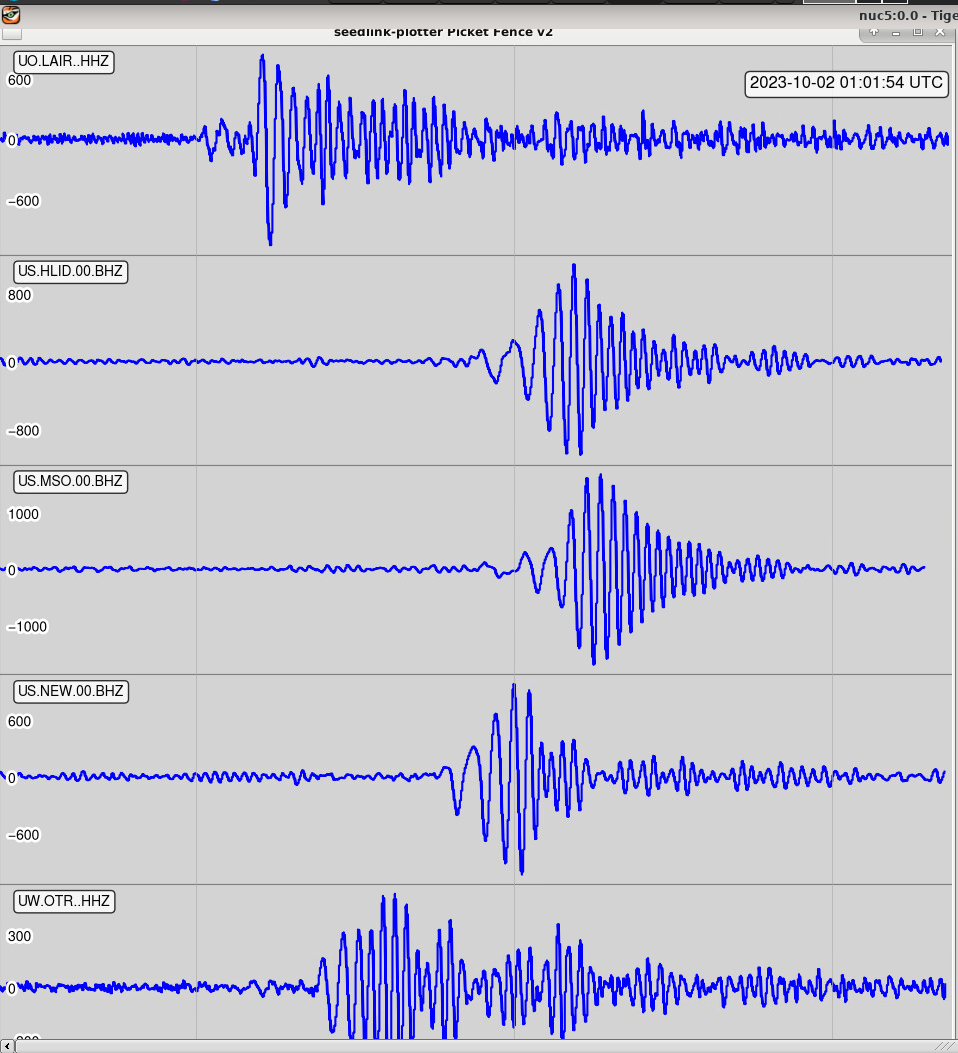
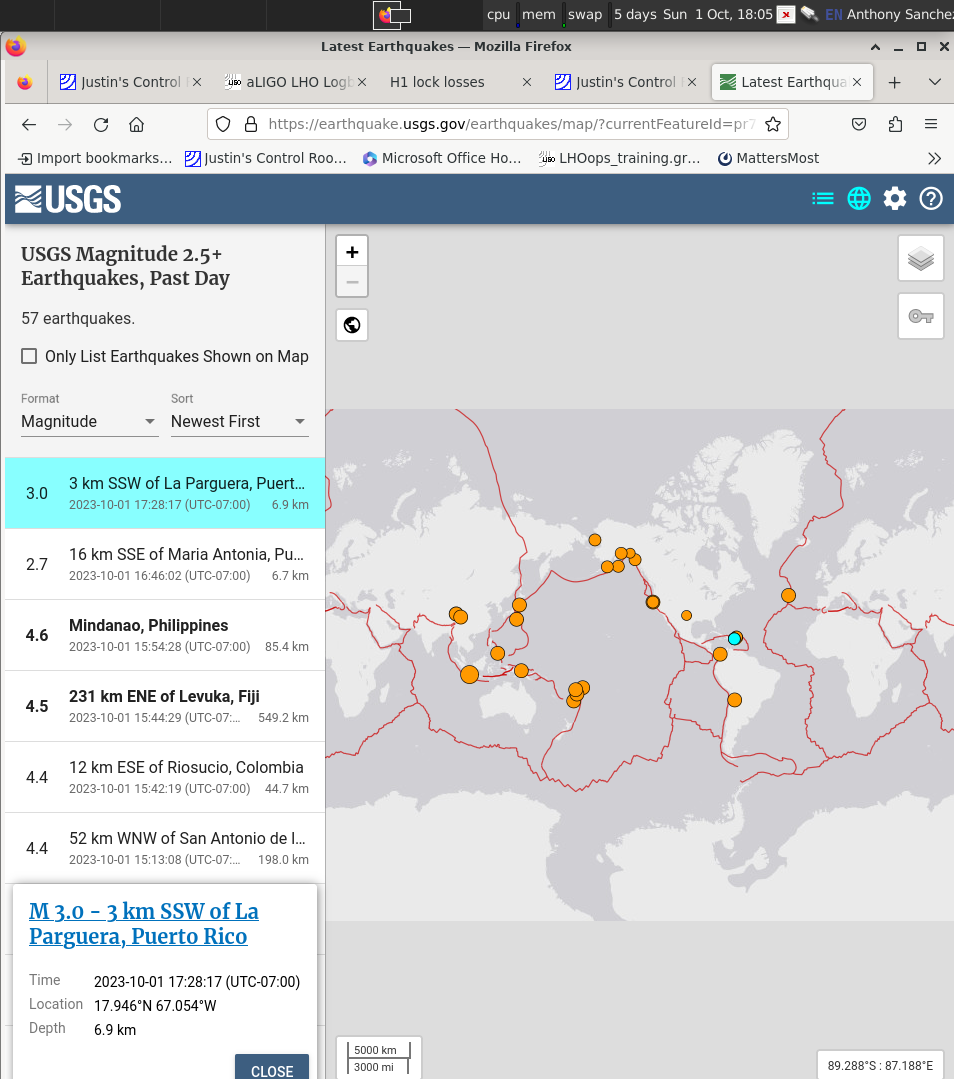
This was a fast earthquake with SEI_ENV going to EARTHQUAKE mode being the first heads-up about it, with Tidal signals(nuc28) and Picket Fences showing seismic motion a few seconds after.....with H1 losing lock at 936utc (L1 dropped out 932utc).

IMC could not lock for the first 7min-post lockloss due to seismic motion.  Once it locked, will hold at LOCKING ARMS GREEN for 30min & then asses seismic situation for locking.

It's been 12min and the USGS site still has not posted this Earthquake (I found it via other fast websites), but as I typed Verbal noted "incoming earthquake from Guatamala).

Comments related to this report
corey.gray@LIGO.ORG - 05:34, Friday 14 July 2023 (71319)

Almost back....doing the usual violin waiting dance at OMC Whitening....I think it's time for lunch though....I'll come back to check on things, since it'll take a while here.

LHO General
corey.gray@LIGO.ORG - posted 00:46, Friday 14 July 2023 (71315)
Fri OWL Ops Transition

TITLE: 07/14 Owl Shift: 07:00-15:00 UTC (00:00-08:00 PST), all times posted in UTC
STATE of H1: Observing at 129Mpc
CURRENT ENVIRONMENT:
    SEI_ENV state: CALM
    Wind: 14mph Gusts, 10mph 5min avg
    Primary useism: 0.02 μm/s
    Secondary useism: 0.04 μm/s
QUICK SUMMARY:

All looks well on the H1 front--currently been locked 21.75hrs.  Got to visit with Ryan (whom I've not seen in forever!) & catch up. 

LHO General
ryan.short@LIGO.ORG - posted 00:02, Friday 14 July 2023 (71314)
Ops Eve Shift Summary

TITLE: 07/14 Eve Shift: 23:00-07:00 UTC (16:00-00:00 PST), all times posted in UTC
STATE of H1: Observing at 133Mpc
SHIFT SUMMARY: H1 has been locked for 21 hours and observing for 8 hours. Very quiet evening with one earthquake passing through.

Handing off to Corey for the night.


LOG:

No log for this shift.

H1 ISC (ISC, TCS)
elenna.capote@LIGO.ORG - posted 22:00, Thursday 13 July 2023 - last comment - 14:47, Friday 14 July 2023(71284)
Current 60W thermal/mode matching state different from April 60W

Dan Brown, Cao, Kevin K., Elenna

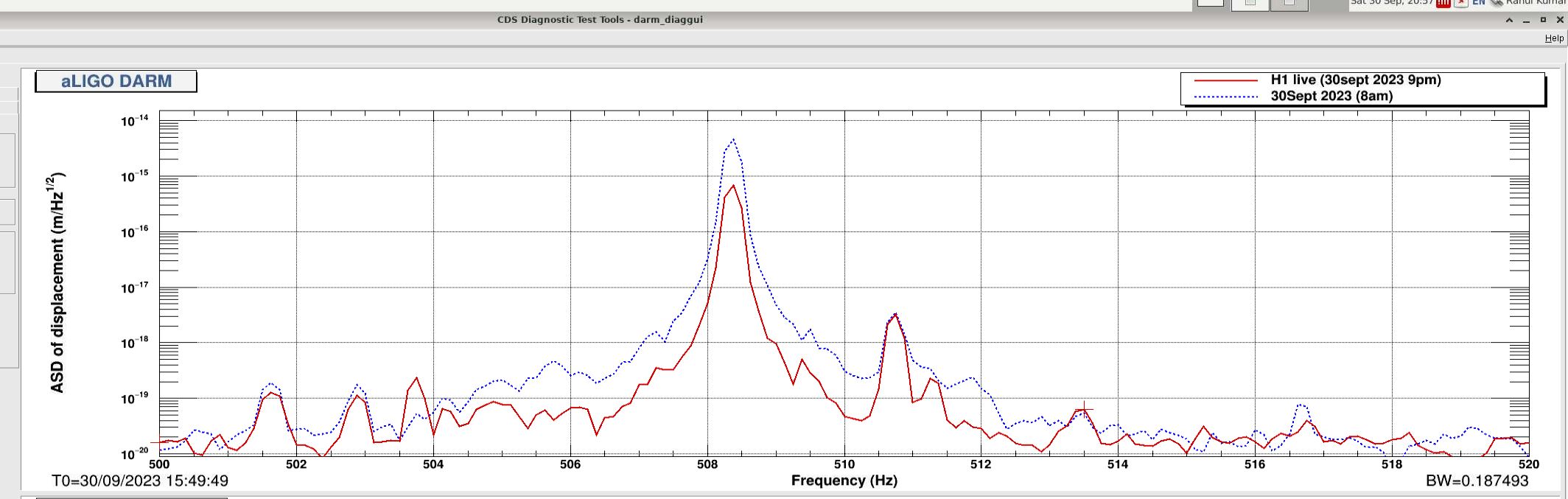
I made a plot comparing the high frequency DARM spectrum around 10 kHz comparing our current 60W configuration to the configuration we had the last time we were at 60W, specifically April 6. These plots were both made well into each lock, so the thermal transients had settled. I believe they are an apples-to-apples comparison of the high frequency region for these two locks and IFO configurations. Three features stand out as different between the two spectra: the 2nd order HOM peaks are not in the same location, they are not the same height, and the overall DARM spectrum is lower in the blue trace (April), than the red trace (now). This indicates that the arm modes are not as well matched now as they were in April, and the frequency noise noise now is higher by a factor of 1.7 than it was in April.

If nothing else had changed in the IFO, we should have been able to successfully revert to the blue trace by powering down and reverting all other settings.

I think the reason we haven't been able to revert to the previous 60W state is related to the mysterious changes that occurred on and after May 19 when the HVAC caused many issues. Whatever changed in May caused us to ring up a PI, increased the jitter noise, and changed our mode matching. My hypothesis is that the alignment shifted in some way. Unfortunately none of the suspension, oplev or ISC signals indicate an alignment shift.

I asked Cao to take a look at the ITMX hartmann wavefront sensor. Cao made the following two plots: one showing the center of the beam position in x (yaw) and y (pitch), and the other showing a heat map of ITMX. The two times they compare are the two locks I compare in my DARM plot: the blue "old" trace from April 6, 60W, and the orange "new" trace showing now at 60W. The beam position has changed, and the heat map shows that we are heating the ITMX point absorber more than we did previously.

If the spot has moved closer to a point absorber, this would explain our increase in jitter. If the spots on the test masses are shifting, this could also affect PIs like the 80 kHz that may be spot dependent. A spot position change could also aggravate the point absorber to where the radius of curvature and substrate lensing would change enough that our mode matching solution via the ring heaters would no longer be sufficient. We only have evidence that the spot has changed on ITMX, but there is a chance that it could have changed on the ETMs as well, where we know the 80 kHz acoustic mode is located. Unfortunately, we don't seem to have any good signals that could track this on the ETMs, so we are flying blind.

Overall, one of our goals (especially in powering down) is to get the IFO mode matched well enough that we can reduce frequency noise and be able to achieve a good level of squeezing. I think we should consider moving the spots on the test masses, especially ITMX. Those who remember, you might be thinking "we already tried this and saw no effect!" However, we have a different IFO now, and I think it is worthwhile to try moving further away from our point absorbers.

Images attached to this report
Comments related to this report
victoriaa.xu@LIGO.ORG - 12:21, Friday 14 July 2023 (71329)SQZ

From 70263, see screenshot comparing DCPD spectra at the 4.5dB sqz times from 3/29 -- H1 was more shot-noise-limited in that configuration, aka technical noise was lower, so squeezing quantum noise was more effective at reducing total noise. At e.g. 10 kHz around 2xHOM spacing, ignoring the 3dB difference b/c we are at 40mA vs. 20mA then, and comparing noise levels at 10.1 kHz near 2xHOM,
   ~ 2e-8, on 3/29 for 4.5dB sqz (20mA on dcpd's);
   ~ 6e-8, from elenna's plot on 4/6, assuming the channel is also H1:OMC-PI_DCPD_64KHZ_AHF_DQ, and still 20mA on dcpd's;
   ~ 8.5e-8, today 7/14 from CR screenshots (I think still 40mA vs. 20mA on dcpds; so over 4x as high as the best squeezing time at 60W, but only ~2x higher is kinda expected)

Since the HVAC changes, at least the disaggrated temperature trends at EX VEA do see an overall change, see individual sensor temp trends at EX from 70518; I looked into it then to see if anything has changed for the 80.3kHz ETMX PI that started ringing up. While the "average VEA" trends show almost no total change over the last few months, the individual sensors have seen considerable changes between March/April and now.

camilla.compton@LIGO.ORG - 14:47, Friday 14 July 2023 (71334)

Nice plots Elenna. I was concerned that we did a lot of CO2 changes 6th April but get the same result remaking Elenna's plot using April 5th data. The HWS beam can move if SR3 moves (HWS beams reflected off SR3) but SR3 has the same position between the 2 times to < 2urad. All TCS settings and ITMX A2L the same in both times. See attached plots comparing 04/05 and 07/13.

Images attached to this comment
H1 DetChar (DetChar)
marissa.walker@LIGO.ORG - posted 16:25, Thursday 13 July 2023 - last comment - 01:44, Friday 14 July 2023(71301)
Daily range drop at 17:00 UTC

Brina, Marissa

We noticed that there seems to be a daily drop in the BNS range by a few megaparsecs for about 10 minutes at around 17:00 UTC. I have found it most clearly since June 22, but there are a couple of times before that. 

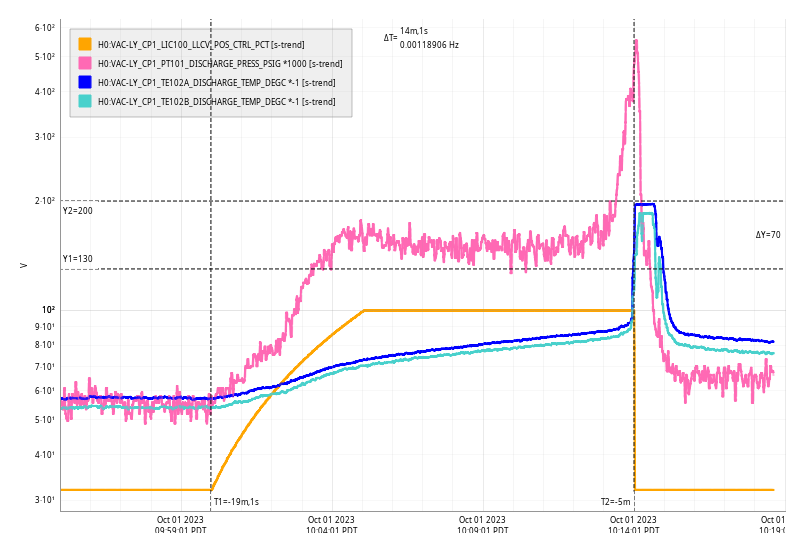
I scrolled through the daily Lasso pages and found that two of the days (June 24 and 25) picked up the channel H1:SUS-ITMY_L3_OPLEV_BLRMS_P_3_10 as correlated with this dip (see this figure). On June 30 lasso picked up the channels H0:VAC-LY_TERM_M17_CHAN2_IN_{MA, COUNTS} and  H0:VAC-LY_CP1_PT101_DISCHARGE_PRESS_{MA/PSIG}.mean (figure). 

I plotted H1:SUS-ITMY_L3_OPLEV_BLRMS_P_3_10 and H0:VAC-LY_TERM_M17_CHAN2_IN_MA for June 22 - 25, 28, 30, July 6-8, and saw that both channels spike each day at the same time as the drop in range. 

I’ve attached examples from June 23 and July 7 showing the lineup of these channels at 17 UTC. I have not yet checked to see if these channels spike at other times causing dips in the range, but I haven’t noticed any other regular times with dips like these.

Just from looking at the summary pages, we weren't able to see anything noticeable in the strain spectrogram at these times. We made spectra comparing a few minutes before the range drop (16:55) and during the range drop (17:02) - see attached spectrum. We did this for a couple of times and don't see a huge obvious difference, but during the dip the spectrum does show slightly higher noise from around 20-200Hz.

Images attached to this report
Non-image files attached to this report
Comments related to this report
ryan.short@LIGO.ORG - 16:40, Thursday 13 July 2023 (71306)

This is likely correlated to the daily fill of CP1 based on the timing. Interesting about the noticeable range drop during observing, though.

Log from June 23 fill; log from July 7 fill

travis.sadecki@LIGO.ORG - 17:55, Thursday 13 July 2023 (71311)VE

Tagging VE

Note that the CP1 autofills were moved from 20:00 UTC to 17:00 UTC on May 4 (aLog 69315).  

shivaraj.kandhasamy@LIGO.ORG - 01:44, Friday 14 July 2023 (71317)

On all the six occasional of the CP1 fill last week, we see this drop in the range (plot attached).

Images attached to this comment
Displaying reports 17541-17560 of 86768.Go to page Start 874 875 876 877 878 879 880 881 882 End