Displaying reports 37781-37800 of 89089.Go to page Start 1886 1887 1888 1889 1890 1891 1892 1893 1894 End
Reports until 10:08, Friday 01 November 2019
H1 AOS
betsy.weaver@LIGO.ORG - posted 10:08, Friday 01 November 2019 (52876)
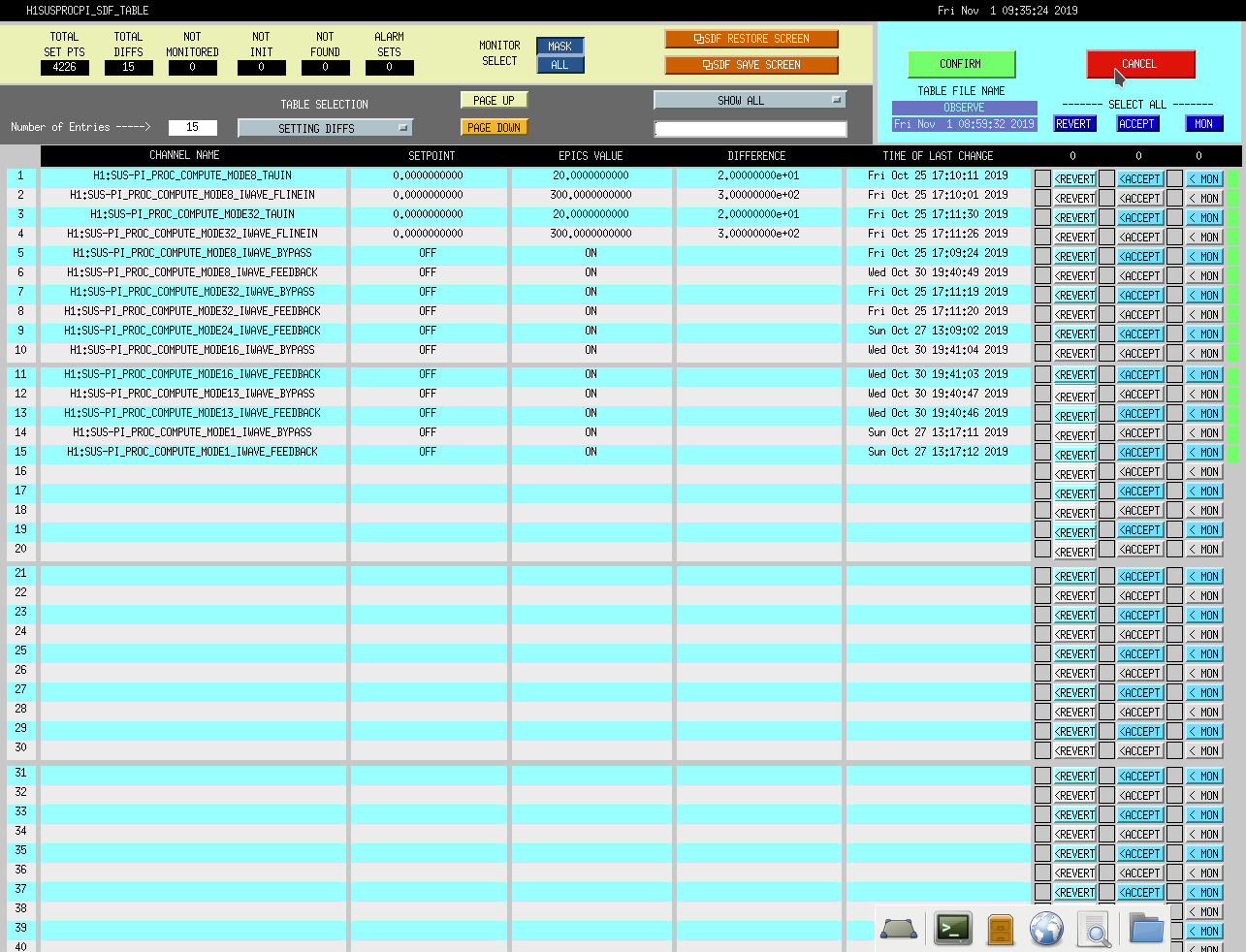
SDF Cleanup - beginning of O3b

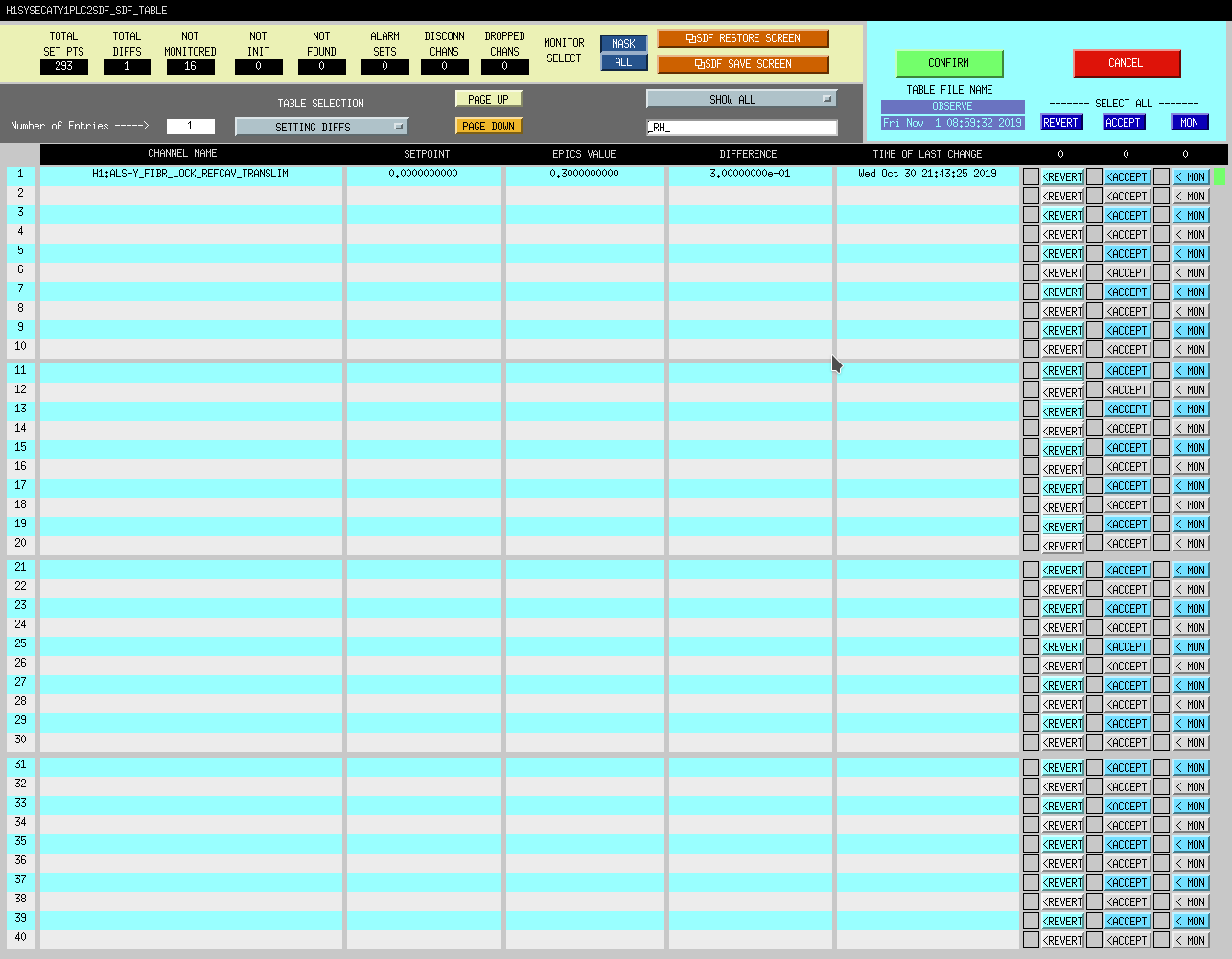
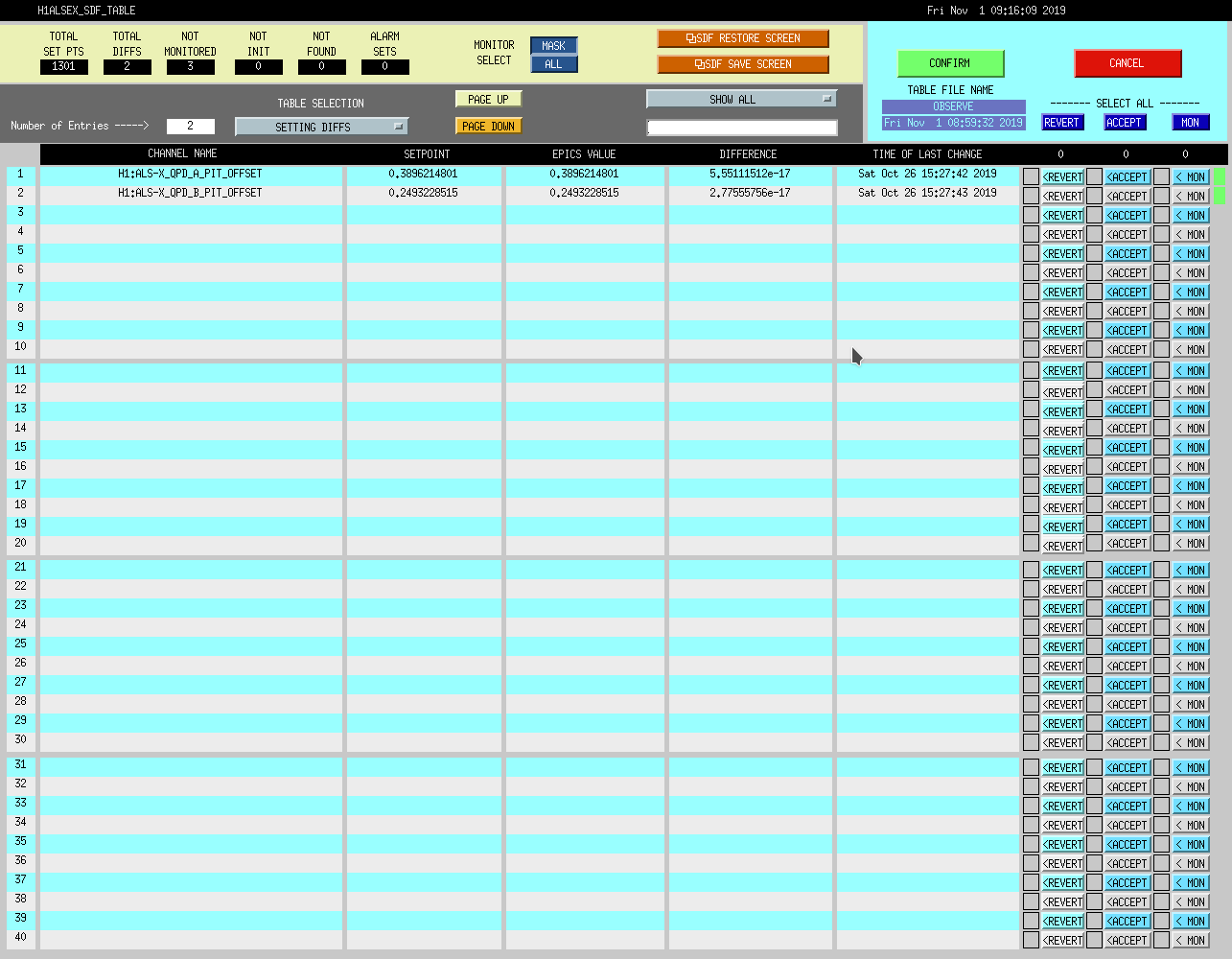
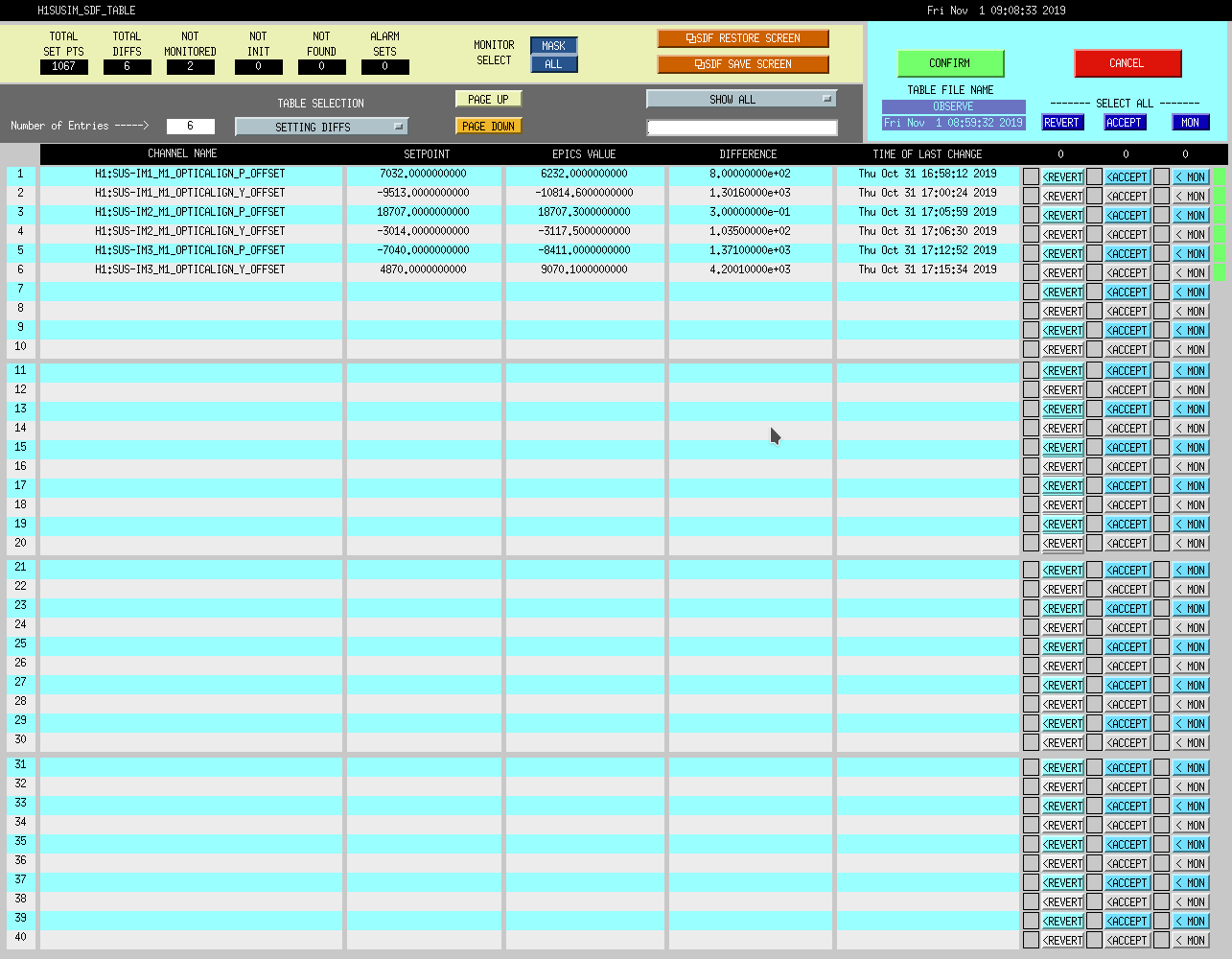
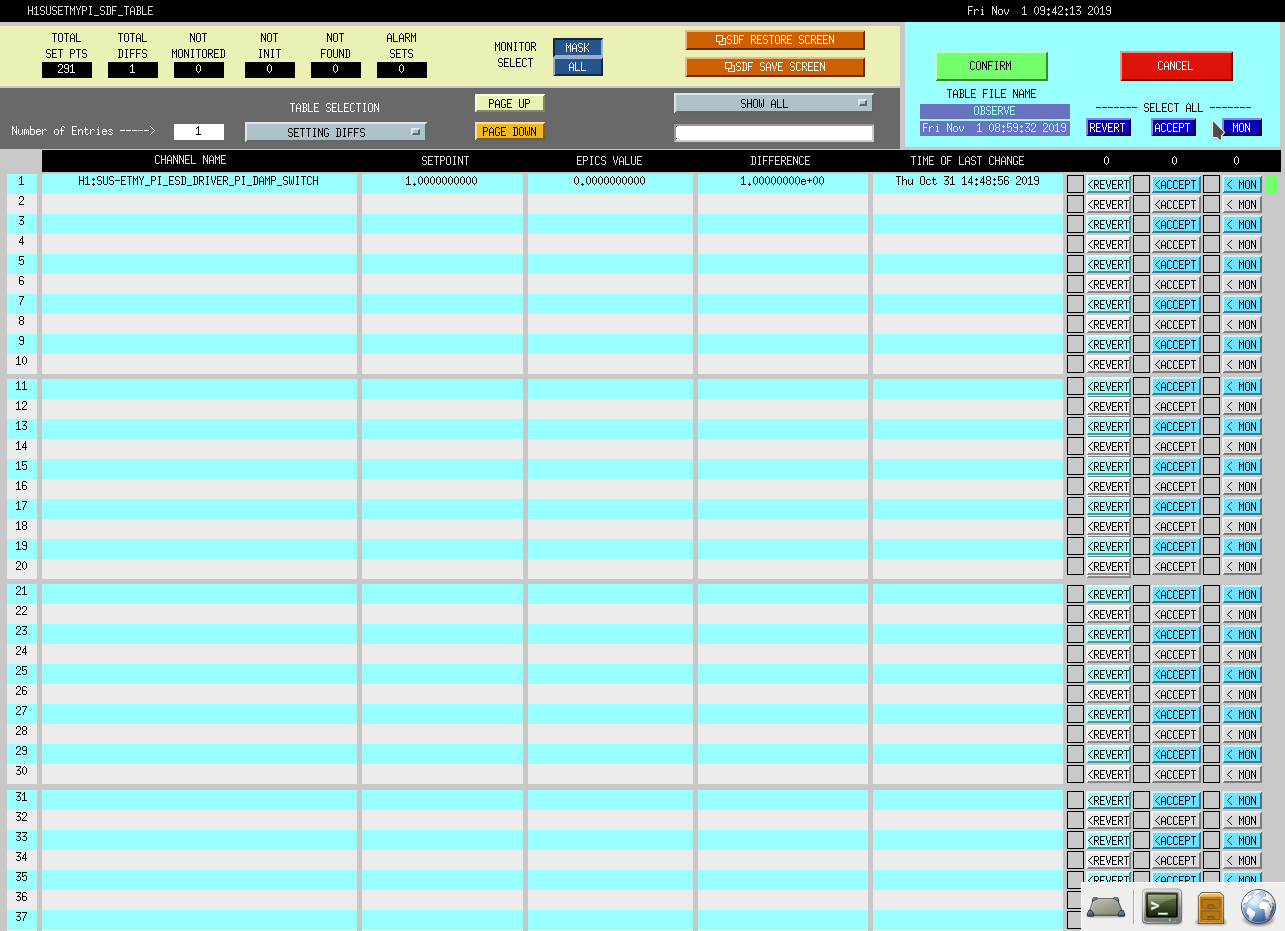
SDF Cleanup:

- ALSY Fiber Lock Refcav Limiter - accepted diff presumably from Daniel's effort on Wed

- ALSX QPD Offsets - 10^-17 diff in values from Sat change

- IM1, 2, and 3 ALignment Offsets

- PI Mode Feedback and Bypass buttons, iWAVE Lines and other settings REVERTED - word on the street is that these are not actively used so we reverted, likely from Jenne/Gavin work earlier in the week and last week.

- ETMY ESD PI MASTER OUTPUT DRIVE ACCEPTED as OFF (0.00) - in direction from Sheila

- IFO was previously set to INJECT_KILL, Cheryl brought back to INJECT_SUCCESS


- Craig's SEI CPS DIFF ON/OFF script halted with it in the OFF state


OUT of NOMINAL SETTINGS/CONFIGURATIONS not to believed to effect range and to be worked next Tuesday:

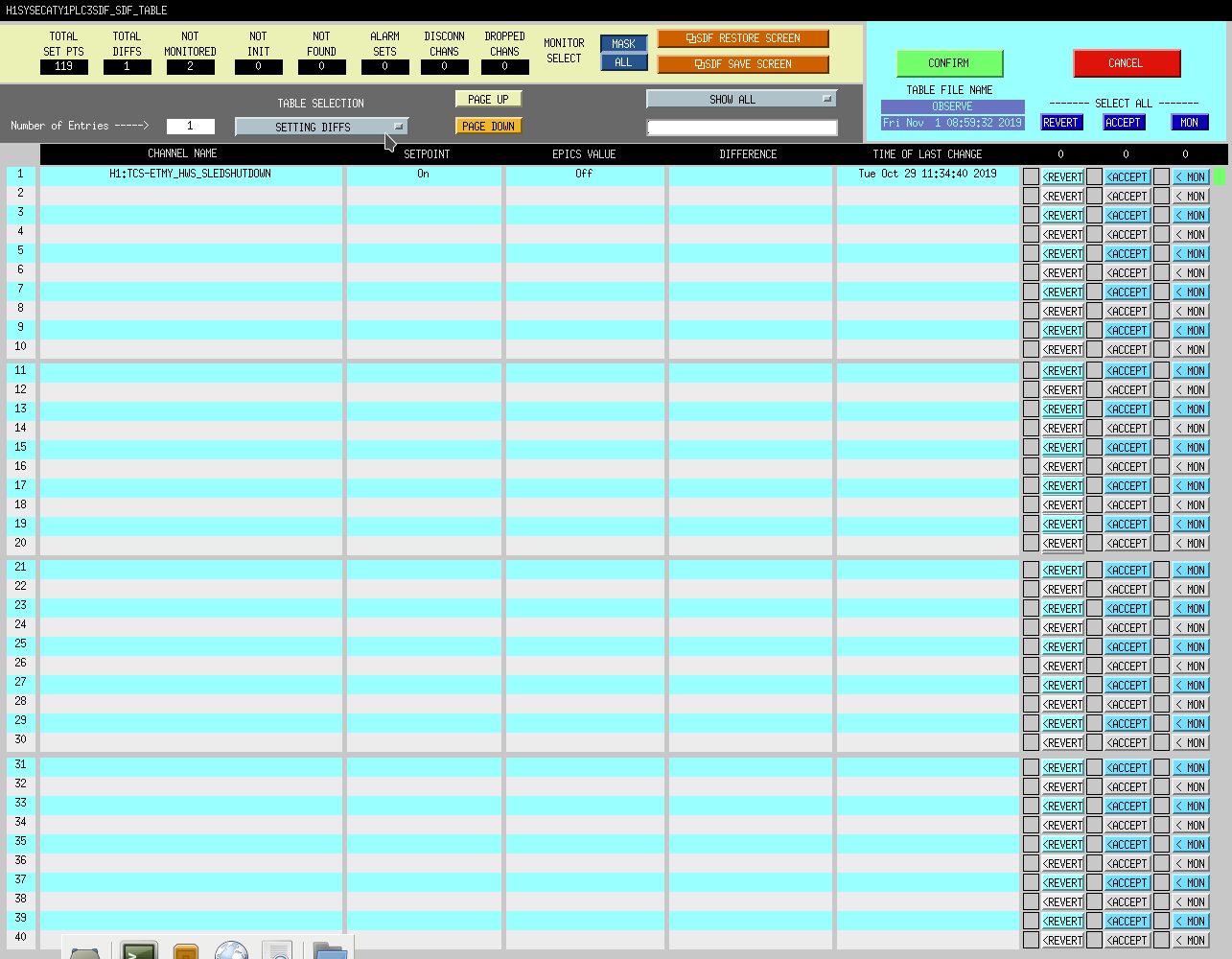
- ETMY HWS SLED is ON - will turn off early next week (SDF SET accepted as "OFF" due to incorrect sign of on/off switch)

- Safety Scaffolding still erected all over HAM5 and 6

- Phase Camera still installed on ISCT1

- Ladder for camera work still propped against HAM2


Images attached to this report
H1 CAL (OpsInfo)
jeffrey.kissel@LIGO.ORG - posted 10:03, Friday 01 November 2019 (52878)
Restarted PCALX High Frequency Roaming Line
J. Kissel

After the h1calex (which includes PCALX, but was restarted for the purposes of NCALX) restarts on Oct 29th -- see LHO aLOG 52768 -- the safe.snap restored the PCALX high frequency roaming line frequency to 1234.0 Hz -- an old start-up value. 

Normally, during the run, the HIGH_FREQ_LINES guardian manages this frequency comparing observation ready segments against the amount of time it's been at any given frequency. Because we haven't had any observation ready segments since the model reboot, then the frequency was not restored. 

I've run "INIT" on the HIGH_FREQ_LINES guardian, such that we resume observation with a standard start frequency of 4001.3 Hz.

I've also updated the OBSERVE and SAFE.snap files to have 4001.3 Hz as the start frequency instead of 1234.0 Hz, such that upon reboot of the model in the future, it'll come back with the standard excitation start frequency.
H1 AOS
sheila.dwyer@LIGO.ORG - posted 09:59, Friday 01 November 2019 (52872)
SRCL ringing up and tripping BS ST2

After a lockloss with no known cause this morning we had two locklosses in the final CARM offset reduction step (called resonance), because the SRCL loop rang up at around 80 Hz and tripped BS ST2 ISI. (screenshot attached).

1256656146

1256655253

The SRCL gain was increased in the guardian in the step called "CARM offset reduction", there were comments that the gain increase didn't seem necessary.  We measured again today and it seemed OK to skip the gain increase, so I commented this out.  The guardian was later lowering the gain again for low noise, so the final state of the SRCL loop isn't impacted by this change. The next lock I didn't see any signs of a ring up like this.

Images attached to this report
H1 AOS
robert.schofield@LIGO.ORG - posted 09:59, Friday 01 November 2019 (52877)
Turned off equipment under ISCT1 to reduce fan noise

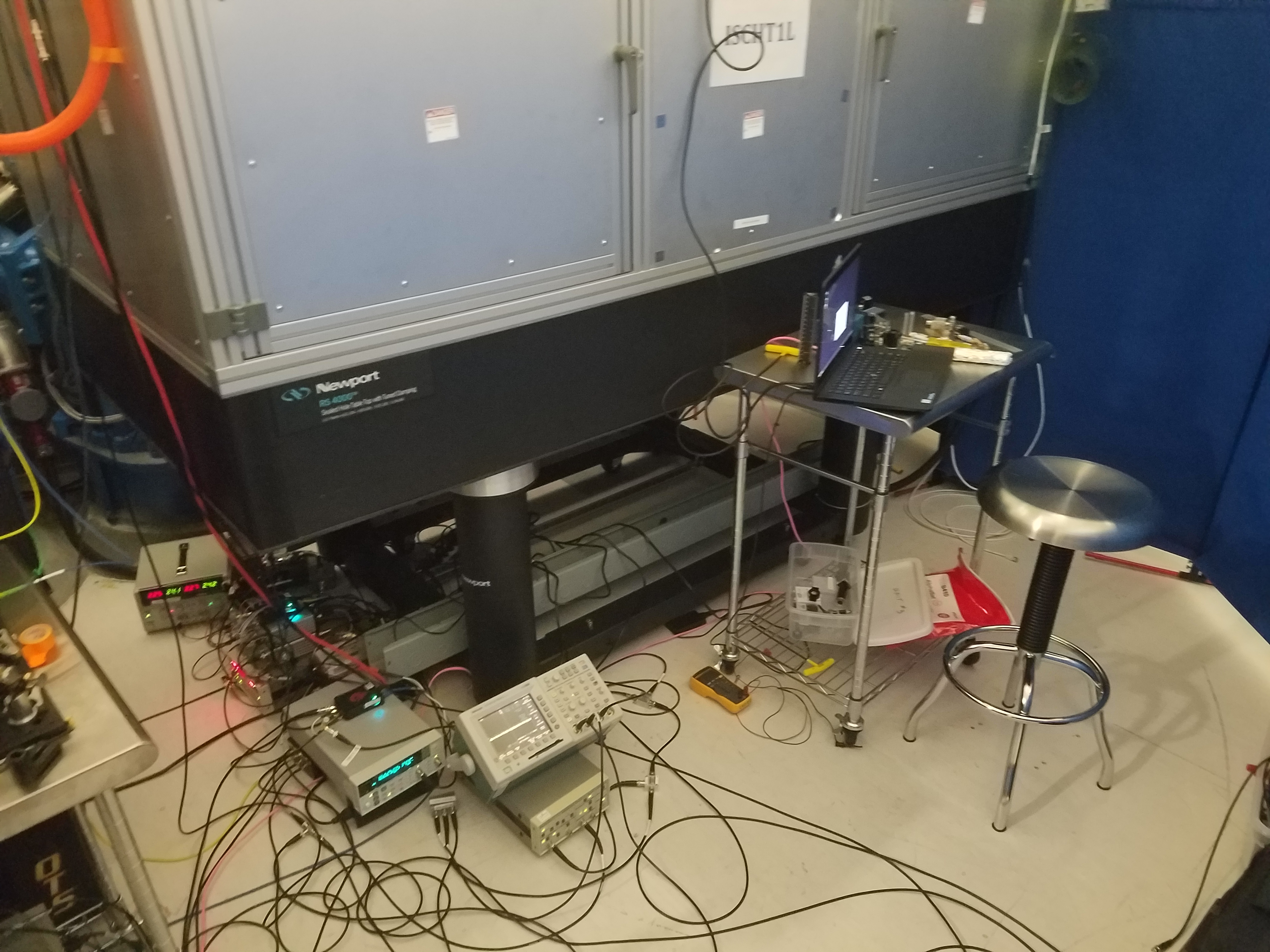
Sheila and I turned off equipment under ISCT1 (phase camera) because the fans, especially in the power supplies, were the loudest sources in accoustically sensitive regions of the LVEA.

H1 General (OpsInfo)
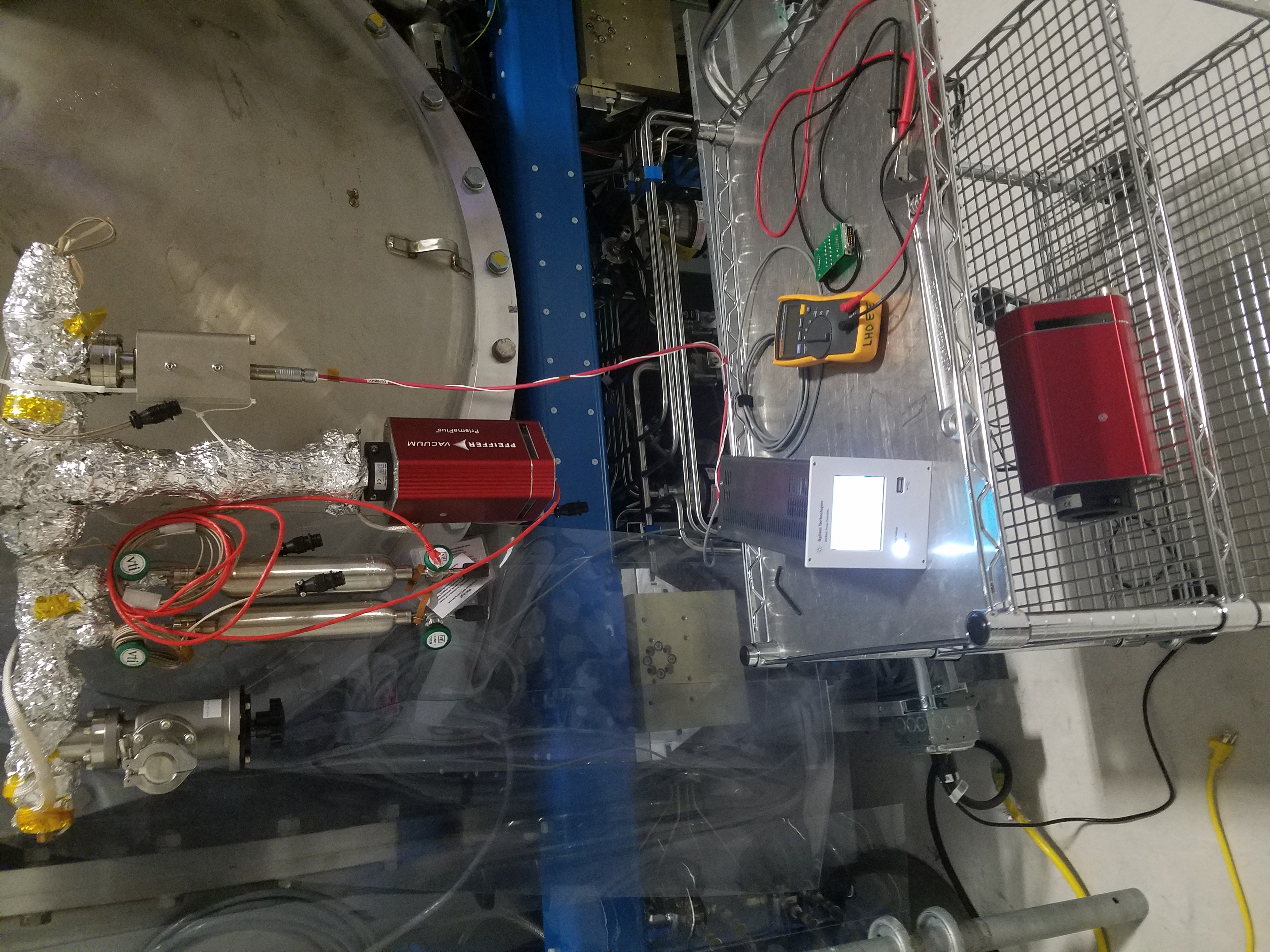
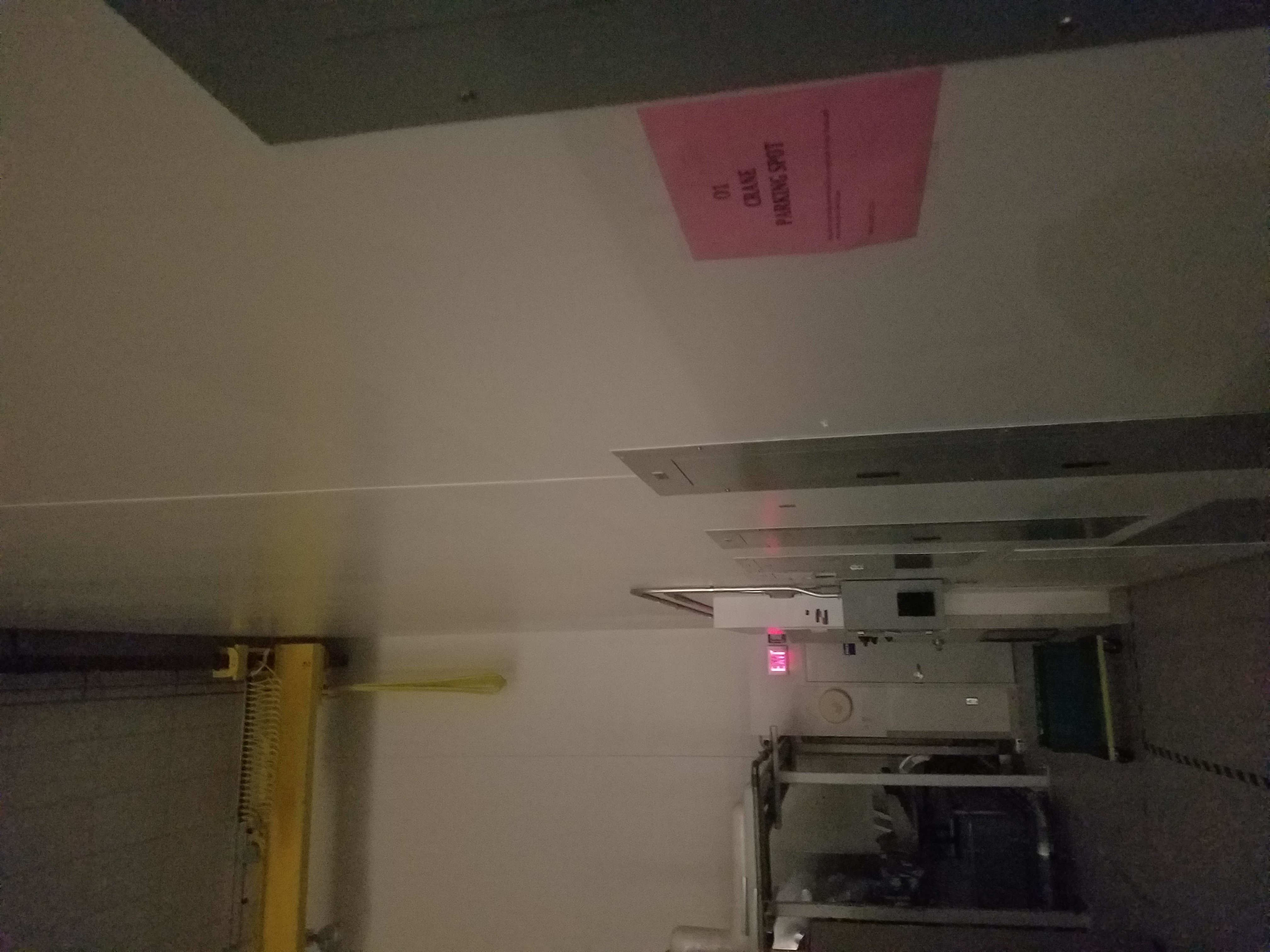
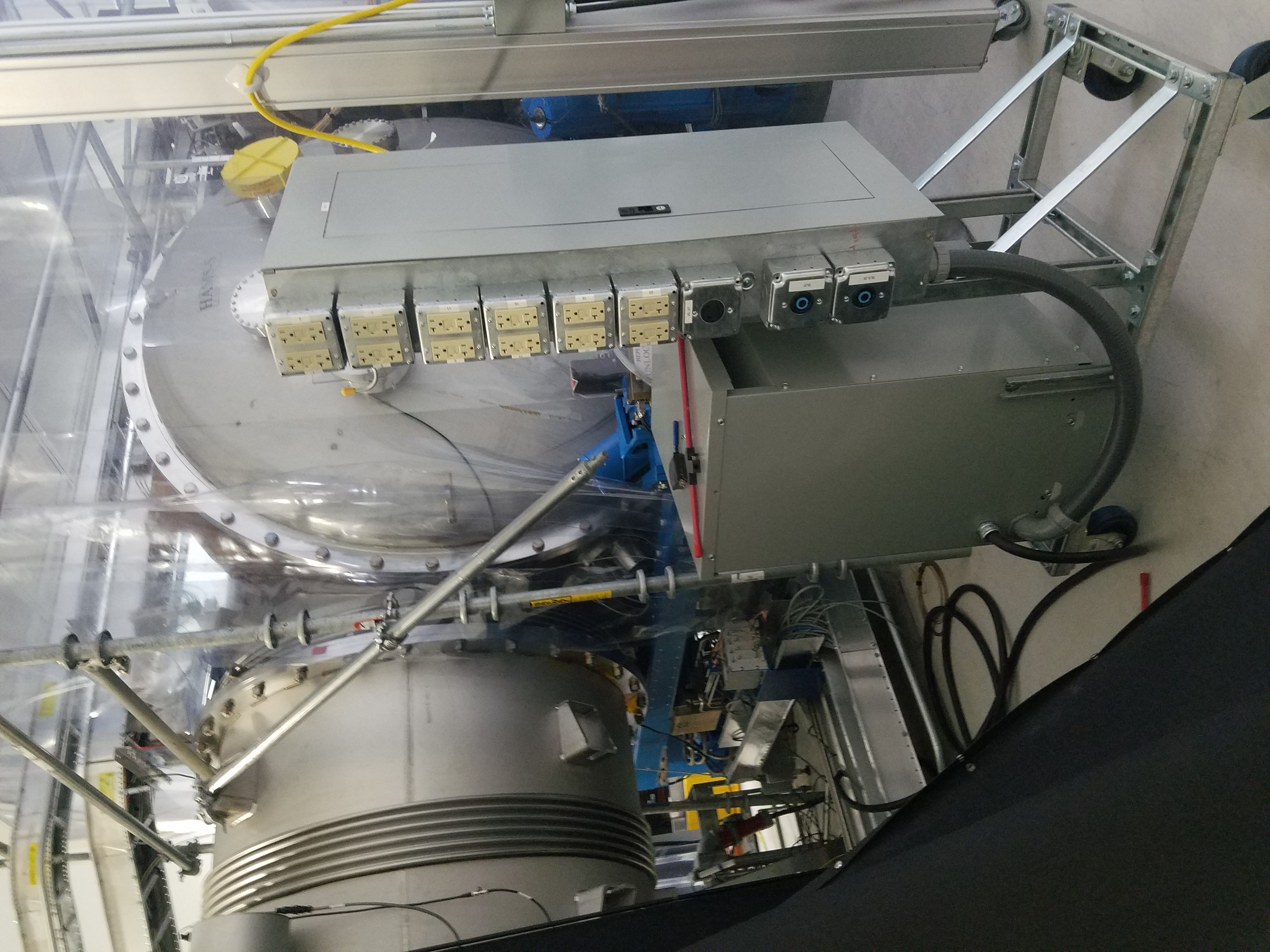
thomas.shaffer@LIGO.ORG - posted 09:26, Friday 01 November 2019 - last comment - 11:24, Friday 01 November 2019(52875)
LVEA and End VEAs Swept

Most notable LVEA items:

More common LVEA items:

Richard swept the end station VEAs. Most notable features were:

Images attached to this report
Comments related to this report
kyle.ryan@LIGO.ORG - 11:24, Friday 01 November 2019 (52881)

I recall that the North crane had been in its nominal, marked, "parking"  location during O3a, i.e., it isn't, now, where it had been prior to the October break.

H1 CAL
jeffrey.kissel@LIGO.ORG - posted 09:19, Friday 01 November 2019 (52874)
Updates to PCAL Coefficients Saved in OBSERVE.snap SDF system
J. Kissel, for D. Bhattacharjee, V. Bossilkov, S. Karki, E. Payne, R. Savage

The PCAL Team have updated the calibration (via EPICs record settings) on all of the real data streams of the displacement estimates for PCAL -- see LHO aLOGs 52828, 52853 and 52837 to account for recently identified systematic error.

I've accepted these changes (including the decision to update the force coefficient with the O2 / O3 mass problems with the force to displacement transfer function that was made later) in to the SDF system; both the safe and OBSERVE.snap.
H1 IOO
cheryl.vorvick@LIGO.ORG - posted 08:36, Friday 01 November 2019 (52870)
OPS Day Transition

TITLE: 11/01 Day Shift: 15:00-23:00 UTC (08:00-16:00 PST), all times posted in UTC
STATE of H1: Corrective Maintenance
OUTGOING OPERATOR: Jeff
CURRENT ENVIRONMENT:
    SEI_CONF state: WINDY
    Wind: 3mph Gusts, 2mph 5min avg
    Primary useism: 0.02 μm/s
    Secondary useism: 0.15 μm/s
QUICK SUMMARY:  we had a dedicated crew here overnight, and work on H1 continues this morning

Activities/Status as of 15:36UTC:


H1 AOS
craig.cahillane@LIGO.ORG - posted 05:18, Friday 01 November 2019 - last comment - 09:16, Friday 01 November 2019(52868)
Change_SEI_DIFF_guardian.py script running on zotws5 Workspace 9
Ran Jenne's SEI_DIFF guardian state changer.  Should be killed before the start of the run.
Comments related to this report
hugh.radkins@LIGO.ORG - 09:16, Friday 01 November 2019 (52873)

Cntl C'd this at 0914pdt about 8 minutes before it was scheduled to start again.  SEI SDFs are all green.

H1 AOS (ISC)
craig.cahillane@LIGO.ORG - posted 04:33, Friday 01 November 2019 (52866)
LSC FF should be redone but not urgent
Jenne asked us to check the SRCL feedforward after we moved the SRCL offset from 0 to 50 counts.
We kinda want to keep the SRCL offset at 50 counts for tonight since Nutsinee optimized the squeezing for that IFO configuration.  Georgia put the 50 cts SRCL offset in the guardian.
I checked the SRCL coherence with DARM, it does not seem urgent for now so we'll leave it for during-the-run commissioning time.  PRCL seems most coherent with DARM.
Non-image files attached to this report
H1 ISC (Lockloss)
daniel.brown@LIGO.ORG - posted 04:04, Friday 01 November 2019 - last comment - 04:32, Friday 01 November 2019(52865)
Relocking

Not sure why we lost lock around 01:20 PST, no one was poking the interferometer at the time.

Comments related to this report
georgia.mansell@LIGO.ORG - 04:32, Friday 01 November 2019 (52867)
  • The TR_Y offset also didn't get set correctly when we went through DOWN, I updated it by hand.
  • To minimise the SRC error signals in PREP_ASC_FOR_FULL_IFO for an alignment with good buildups, we changed:
    • SRC1_P offset from -5 to -3.5 (this gets switched off as we power up anyway)
    • AS_C pitch offset from 0 to -0.16
    • AS_C yaw offset from 0 to -0.06
    • This worked well for this one lock and hopefully don't mess up initial alignment or DRMI
  • We've updated the final SRCL offset added in LOWNOISE_LENGTH_CONTROL to 50 cnts
H1 CAL (CAL)
timesh.mistry@LIGO.ORG - posted 03:44, Friday 01 November 2019 (52860)
NCAL Update -- Installed at EX!

[Gavin Timesh]

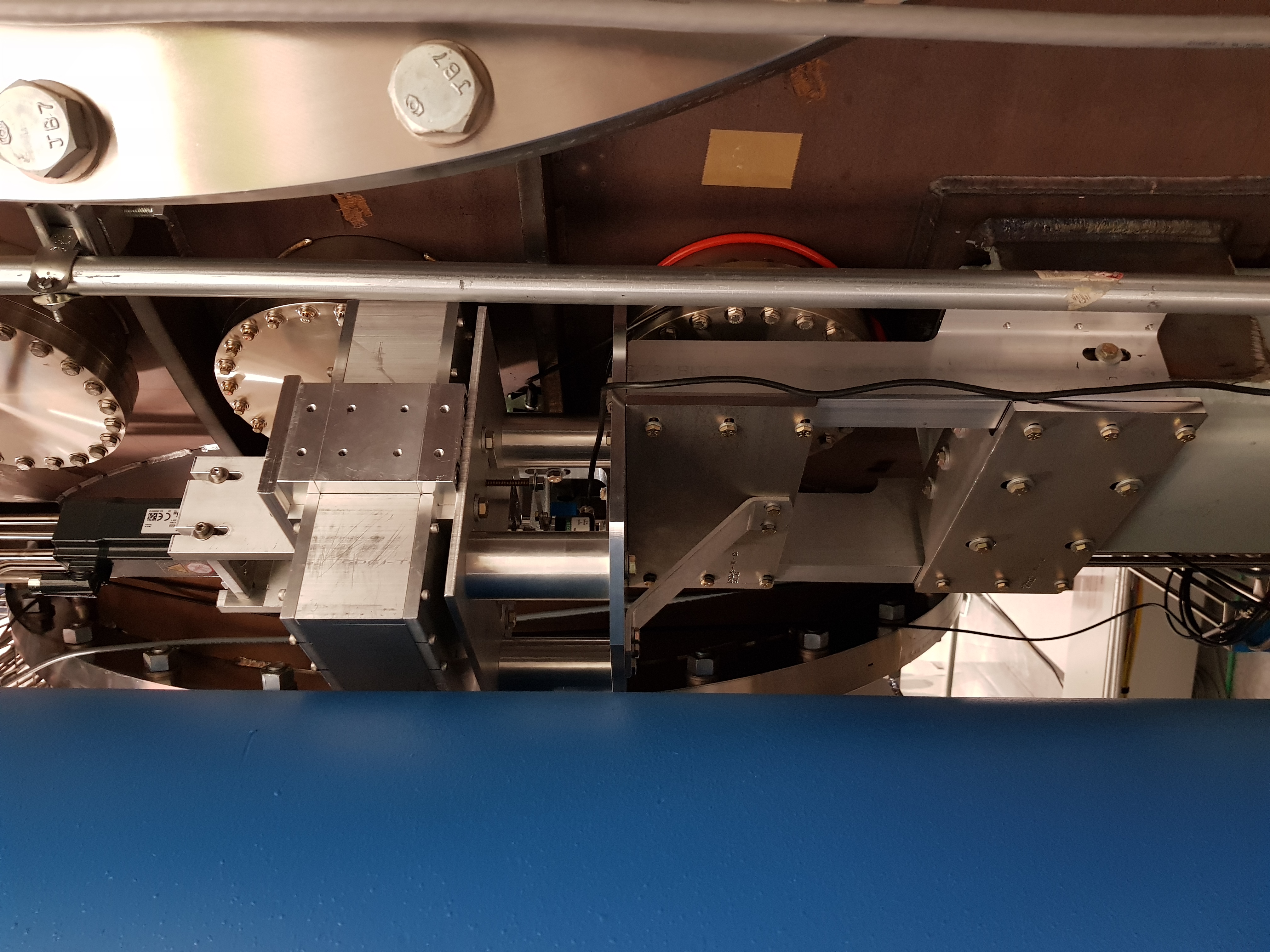
With permission from the comissioning team, we went to the X-End and the NCAL Prototype has now been installed.Pictures to follow later.

There were a lot of factors that lead up to the final install at the end station and there are still plenty of things to do but the goal of having the NCAL at the end station by the end of the O3 commissioning break has been achieved.  

Drilling the BSC Pier

[Kyle, Bubba, Rick, Ethan, Gavin,Timesh]

To ensure accurate location of the drilled and tapped holes, we doubled checked the alignment of the drill fixture and the NCAL mount. We found that the holes still matched well between the drill fixture and the NCAL mount. During the drilling process, the fixture stayed relatively affixed, with very little movement and only required a small adjustment half way through the drilling process. Tapping the holes was relatively easy. The change to use fine threads instead of coarse threads makes the tapping process easier as well as increasing the strength of the fixing (in shear and tension) and less susceptible to loosen under vibrations. We decided to drill and tap for 5/16"-24 x 1" holes on the BSC pier. This is for 2 reasons: 1) To increase the strength of the fixings 2) To overcome the large slot size, that would have resulted in using stacks of washers had we use 1/4-20 x 1" as originally called out however, now we can use 1 lock washer and a bolt as normal. 

To start with, the drill fixture (jig) had drill bushings installed that would allow the drilling of a hole suitable for a 1/4-20 bolt. During the drilling process, after each hole was drilled successfully, we used a metal dowel pin placed though the drill bushing in the fixture and through the newly drilled hole to pin the fixture in place. This would prevent the fixture moving while the other holes are being drilled. Once all the holes were drilled, the dowel pin were removed one by one. For each pin that was removed, a new drill bushing is inserted to drill a 5/16"-24 bolt hole and the hole was drilled. Since a 1/4-20 sized pilot hole now exists, the drilling process of opening up the hole to 5/16-16 is easy to do. After which, a tap bushing replaces the drill bushing and the hole is tapped for 5-16"-24 threads. Once the hole  is tapped, a bolt is screwed in a finger tightened to the tap bushing to hold the drill fixture in place. The steps of removing the smaller bushing, inserting the bigger bushing, tapping and bolting are repeated until all 9 holes are completed.

After the drilling and tapping was completed, all the bolts were undone and the drill fixture was removed. The bolts were all inserted into the pier and wound in fully to clean the newly made threads and IPA was used in conjunction to lubricate the threads and help remove dirt/debris. Once we were satisfied the threads were clean, we removed the bolts and mounted the NCAL mount onto the pier. The drilled and tapped holes align to the holes on the NCAL mount and, using lock washers, the NCAL mount was bolted to the BSC pier. The mount was fully assembled up to the stage where the NCAL would be abled to be lifted onto it. The bolts have yet to be torqued however they are tight.

First Installation Attempt on 24th October 2019

[Ethan, Timesh]

We went to the X End to attempt to install the NCAL onto the mount that has already been bolted onto the BSC pier. When placing the NCAL upon the mount, we found that we cannot bolt the NCAL to the NCAL plate. We are ~2mm short of being able to bolt  the NCAL down. This is because, the NCAL cover is touching the flange bolts and there is not more room to move the NCAL. The solution is  to slot the bolt hole on the NCAL plate. This would allow the NCAL to translate towards and away from the chamber giving greater flexibility in the NCAL positioning on the NCAL mount. The draw back of this is that there is reduced repeatability to have the NCAL in the same place each time it is removed and installed. The distance of the NCAL to the test mass must have an uncertainty of less than 1cm otherwise the uncertainty in the force coefficient rises steeply.

Testing the Optical Encoder

[Timesh]

The optical encoder allows the rotor shaft to be piped into the front end DAQ at a higher rate then the typical slow rate that the Beckhoff systems are recorded at (since the Beckhoff signals are encoded into EPICS which is fixed at 16Hz sampling rate). This is not an upgrade but a part of the intended design as specified in the NCAL FDR and we can go as far as 65535Hz if we wanted to. The reason for having a faster rate than 16Hz is to have good phase resolution. With 1 kHz sampling with the NCAL at 30Hz, you will have about ~ 360/(1024/30) = 10 degrees of phase resolution. This signal can then be used to take transfer functions with other sub-systems in LIGO as well as provide a way of calculating the force coefficient from the NCAL to the test mass in the front end. 

I had issues setting up the optical encoder however after a lot of help from Krishna, the commissioners and the EE lab people, I was able to get it working. The demon tweak was removing the power supply ground to the satellite box for the encoder. When I plugged the satellite box power, I had also connected the power supply ground to the satellite box which was injecting noise as well as not the correct way to supply +/- 15V to the satellite box. Once the issue was solved, the optical encoder was connected to the lower end of the NCAL shaft. Spinning the NCAL at 3148 counts (30Hz), the Beckhoff software reports 3147 +/- 1 counts, the frequency as measured on the oscilloscope by the optical encoder is 30 +/-0.6 Hz from a +/-10V sawtooth signal. As the NCAL spins up and down, I can see the phase of the sawtooth wave signal change accordingly and accurately measures the spin frequency.

Second Installation Attempt on 31st October 2019

[Gavin, Timesh]

While the IFO was struggling to lock, we were given permission to go to the X end to install the NCAL. We took the NCAL plate that had the required bolts holes slotted by Tyler as well as the rest of the NCAL system. This included the NCAL PC, the motor controller, the required cables and the motor. 

We attached the NCAL plate to the NCAL mount first before lifting and mounting the NCAL onto the NCAL plate. The NCAL has been fully assembled such that is has the optical encoder attached as well as the Tungsten Masses installed in the rotor. The slots now allowed us to move the NCAL away from the flange bolts and bolt the NCAL to the NCAL plate, securing the NCAL  in place. We tighten up the bolts with alan keys and spanner, with the aim to torque these down at a later time.We also installed cover plates over the exposed NCAL shaft and motor coupler. This is made of sheet metal but we will look to replace this with imact resistant acrylic. We also have the rigid coupler installed that couples the NCAL shaft to the direct drive motor. We will explore using a flexible coupler as this may reduce the stresses on the motor due to misalignment of the NCAL shaft to the motor, this increasing the lifetime of the unit. 

In addition, we installed and ran the cable from the Beckhoff motor controller to the NCAL but the cable has not been connected as of yet. Moreover, we installed the PC in the EE bay and connected it to the network. We connected the NCAL computer to port 9 in the EE rack. There will be no data coming though the front end as the Beckhoff Channels are ready but not been added to the front end yet since this would require a  front end restart. Moreover, we connected the grey satellite box to the optical encoder  but we were unable to locate the BNC cable that runs the signal to the H1CALEX chassis. This will have to be done at an opportune time ot during a Tuesday Maintenance. 

We removed all of our tools and equipement from the X end station since it is no longer necessary to have all the equipment at the end station now. The surveying equipment is still in place and is ready to survey (IAS) the NCAL to get the final position number of the NCAL to the Test Mass. We ran out of time to test power and comms so this will have to be done later.

Things to Do

IAS NCAL
Complete cabling
Test power and comms
First test spin (either over network or directly thought the Beckhoff)
Test NCAL shut down procedures.
Test spin using the network
Install MuMetal shielding
Magnetic, acoustic and vibrational coupling tests with PEM
Test different motor couplers
Install impact resistant acrylic shield

Images attached to this report
H1 ISC (ISC)
craig.cahillane@LIGO.ORG - posted 03:35, Friday 01 November 2019 - last comment - 22:04, Saturday 02 November 2019(52864)
Intensity noise projection
Just processed an intensity noise injection from earlier tonight.  The coupling is about the same as before and does not limit DARM.

Injection script in /ligo/home/craig.cahillane/Git/IFO/general/scripts/Intensity_noise_injection_caller.py
Plotting script in  /ligo/home/craig.cahillane/Git/IFO/general/scripts/intensity_noise_injection_plotter.py

Command Line: python intensity_noise_injection_plotter.py /ligo/home/controls/craig.cahillane/Git/IFO/IntensityNoise/data/Injections/20191031/1256622575_GPSstart_Intensity_inj_7_7300_Hz.pkl 1256625100 1256625300 --logbin
Non-image files attached to this report
Comments related to this report
craig.cahillane@LIGO.ORG - 22:04, Saturday 02 November 2019 (52929)
Adding .txts for posterity
Non-image files attached to this comment
H1 SQZ (SQZ)
nutsinee.kijbunchoo@LIGO.ORG - posted 02:25, Friday 01 November 2019 - last comment - 08:03, Friday 01 November 2019(52863)
IFO SQZ phase/NLG optimization

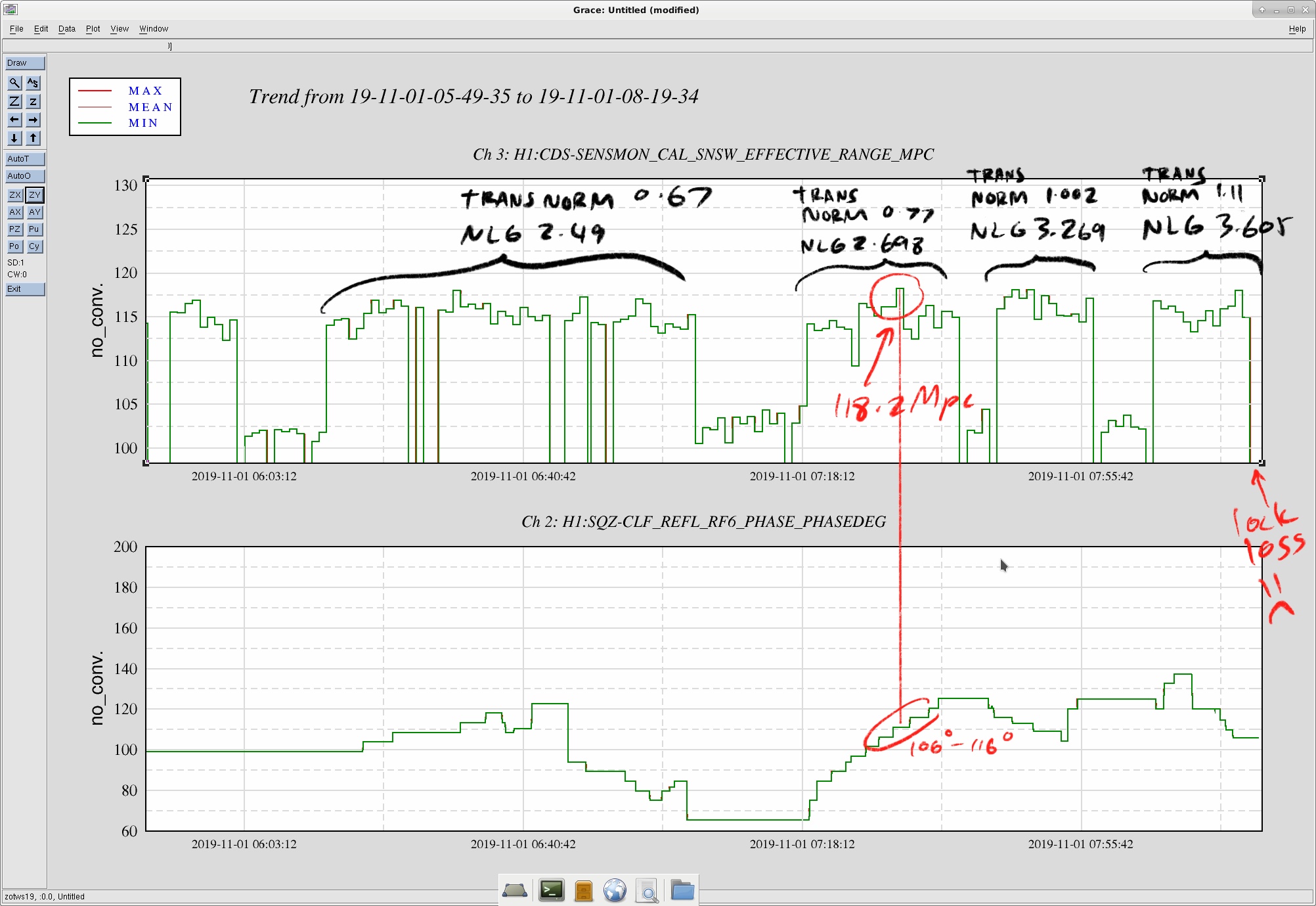
Tonight I rotated the sqz phase around the squeezing angle at various nonlinear gain. So far it is unclear that higher nonlinear gain (up to 3.6) degrades squeezing at a noticeable level. The best range we saw was done at NLG of 2.698 (118.2Mpc on the SENSMON_CAL_EFFECTIVE_RANGE_MPC, barely touching 120 on the control room BNS monitor). 118 Mpc was also achieved at NLG of 3.269 and 3.605. During the measurement I monitor Lee's DB monitor to make sure that NLG didn't degrade significantly. At 3.605 I didn't have a chance to continue to rotate the phase just to see if the range would get better or worse before the lockloss. Dan will be posting about that. During the lockloss I was simply waiting for the BNS range to integrate. Nothing was adjusted. The OPO gain was compensated for the higher pump input.


I set the pump power at 0.77 normalized transmission, this gives nonlinear gain of 2.766, as close as I could get to the best measurement seen on BNS range. The phase is set to 110deg.


The start time of this measurement was 06:02:38UTC (reference time), end time was 08:18:31UTC. The next quick thing to do is to reduce the CLF power just to see if it changes squeezing.

Images attached to this report
Comments related to this report
daniel.sigg@LIGO.ORG - 08:03, Friday 01 November 2019 (52869)

Renormalized the OPO TRANS power to show 1. Normalization changed from 262nA to 200nA (was 122uA in O3a), which corresponds to ~527nW. So, the OPO now runs at 1.64 times the stored green cavity power. CLF REFL still shows 120µW.

Accpected all squeezer SDF changes.

H1 CAL (CAL)
timesh.mistry@LIGO.ORG - posted 00:39, Friday 01 November 2019 - last comment - 08:32, Friday 01 November 2019(52861)
SRCL Offset Set to 50 Counts and Measuring the Calibration Sensing Function

[Craig, Daniel, Georgia, Cao, Gavin, Timesh]

Cal SVN root: /ligo/svncommon/CalSVN/aligocalibration/trunk

We changed the H1:LSC-SRCL1_OFFSET to 50 counts with a 15 second ramp the set the IFO to NLN_CAL_MEAS. The approximate time of the change was 2019-11-01 05:11:36 UTC (1256620314.918 GPS). The injection files used were (files run in the order given below):
PCAL Sweep:   ^/Runs/O3/H1/Measurements/2019-10-31_H1_50ctSRCLOffset_PCALY2DARMTF_LF_SS_5t1100Hz_10min.xml    (r8655)
OLG Sweep:   ^/Runs/O3/H1/Measurements/2019-10-31_H1_50ctSRCLOffset_DARM_OLGTF_LF_SS_5to1100Hz_15min.xml    (r8655)

The raw data, the raw data, the MCMC model with the measurement, the reference model with all the measurements and MCMC corner plot of this measurement is attached to this alog. Furthermore, as Jeff Kissel had done in his comment to LHO alog 52787, the combined results for O3b SRCL offsets is attached.

There is still evidence of a spring (pro-spring) when the IFO has a SRCL offset of 50 counts however, the spring is smaller than the spring observed when using an offset of 100 counts. There still is a residual that is thought to be from the L2A2L crosscoupling (see for example LHO alog 52787, 51782, 51592). Maybe there is some merit in trying an offset of 75 counts? The downside of this would be that the squeezer system would need to be re-tuned for the new offset since Nutsinee is currently tuning the squeezer to the 50 counts offset configuration (See alog by Nutsinee in the future).

Non-image files attached to this report
Comments related to this report
jeffrey.kissel@LIGO.ORG - 08:32, Friday 01 November 2019 (52871)ISC, OpsInfo
After looking at this data, it'll be fine to run with 50 ct offset for now. so we shall do so for the start of O3B and the foreseeable future.

I've confirmed that this has been programmed in the ISC_LOCK guardian code, so this should be automatically set upon lock acquisition.
H1 PEM
daniel.brown@LIGO.ORG - posted 22:04, Thursday 31 October 2019 (52858)
ISCT1 scatter

Cao, Dan

There were still some lines left over that have coherence with H1:PEM-CS_ACC_ISCT1_REFL_Y between 100-1000Hz. We looked at whether these lines were from the phase camera path still or something else in the POP AIR path. We dumped everything  by block just after the uniblitz shutter and could still see the lines. We then closed the POP beam diverter and we could still see the lines. So it doesn't look like POP AIR or the phase camera are causing these lines.

Images attached to this report
H1 ISC (ISC)
craig.cahillane@LIGO.ORG - posted 20:51, Thursday 31 October 2019 - last comment - 22:41, Thursday 31 October 2019(52855)
Increasing FSS Common Gain by +3dB removes most of frequency noise from DARM
We got back to nominal low noise.

The frequency noise in DARM as extremely bad right when we returned.  
I measured the CARM and IMC loops and found the IMC UGF was 45 kHz and look wonky above 20 kHz.

Georgia increased the FSS common gain by +3dB from 20 to 23 dB after noticing the plummeting transmission and reflection on the FSS.  She also found that the IMC REFL DC light was relatively high (up to 14 mW from the normal 9 mW).  
After +1 dB the frequency noise was replaced by intensity noise, likely imprinted by the ISS from the freq noise incident on the IMC.  
Georgia further increased by +2dB.  This cleared up everything further, now the spectrum is more clear of laser noise.  See first PDF.
The IMC REFL DC light is now back to 9 mW.

The new IMC UGF is 80 kHz.  
New CARM gain is 16 kHz.
See PDF 2.

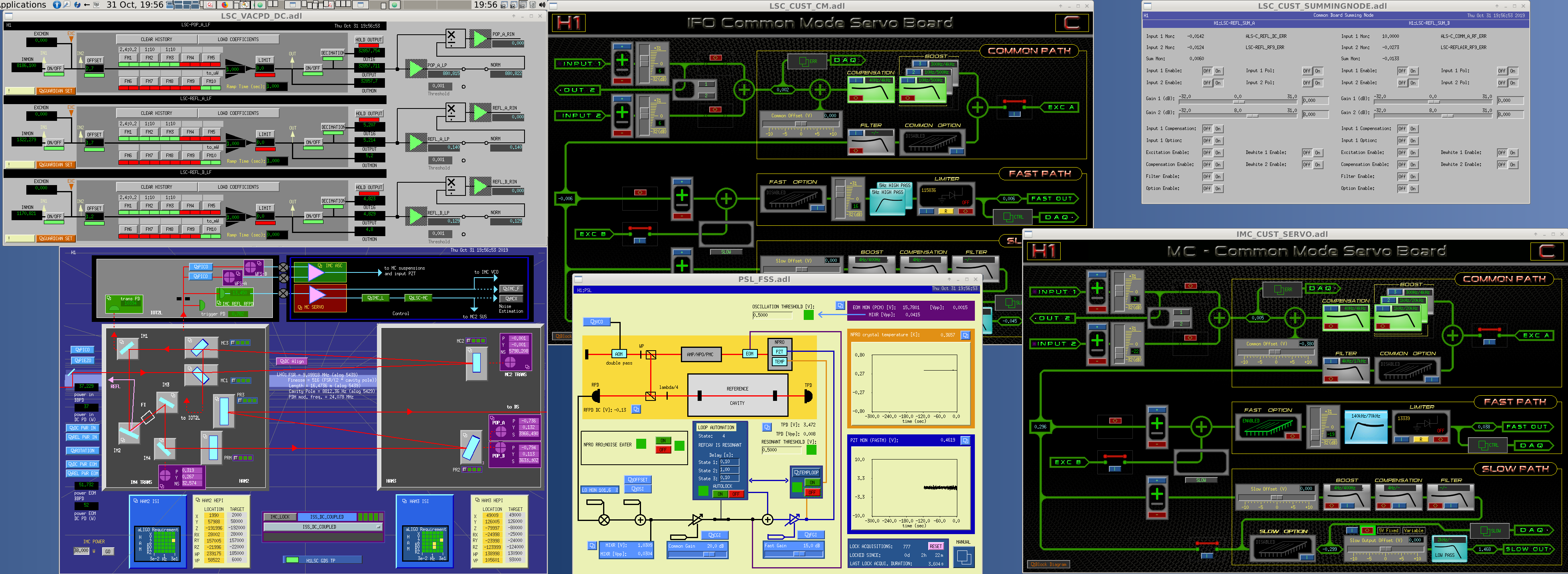
PNG shows the original gain sliders, before we made any changes, and some PD DC powers.
Images attached to this report
Non-image files attached to this report
Comments related to this report
craig.cahillane@LIGO.ORG - 21:30, Thursday 31 October 2019 (52857)
Note, we saw this exact problem before in February, and it was solved in the same way (FSS gain increase): alog 46968

We expect that the power glitches we saw when powering up will go away now that the IMC loop is back to normal.
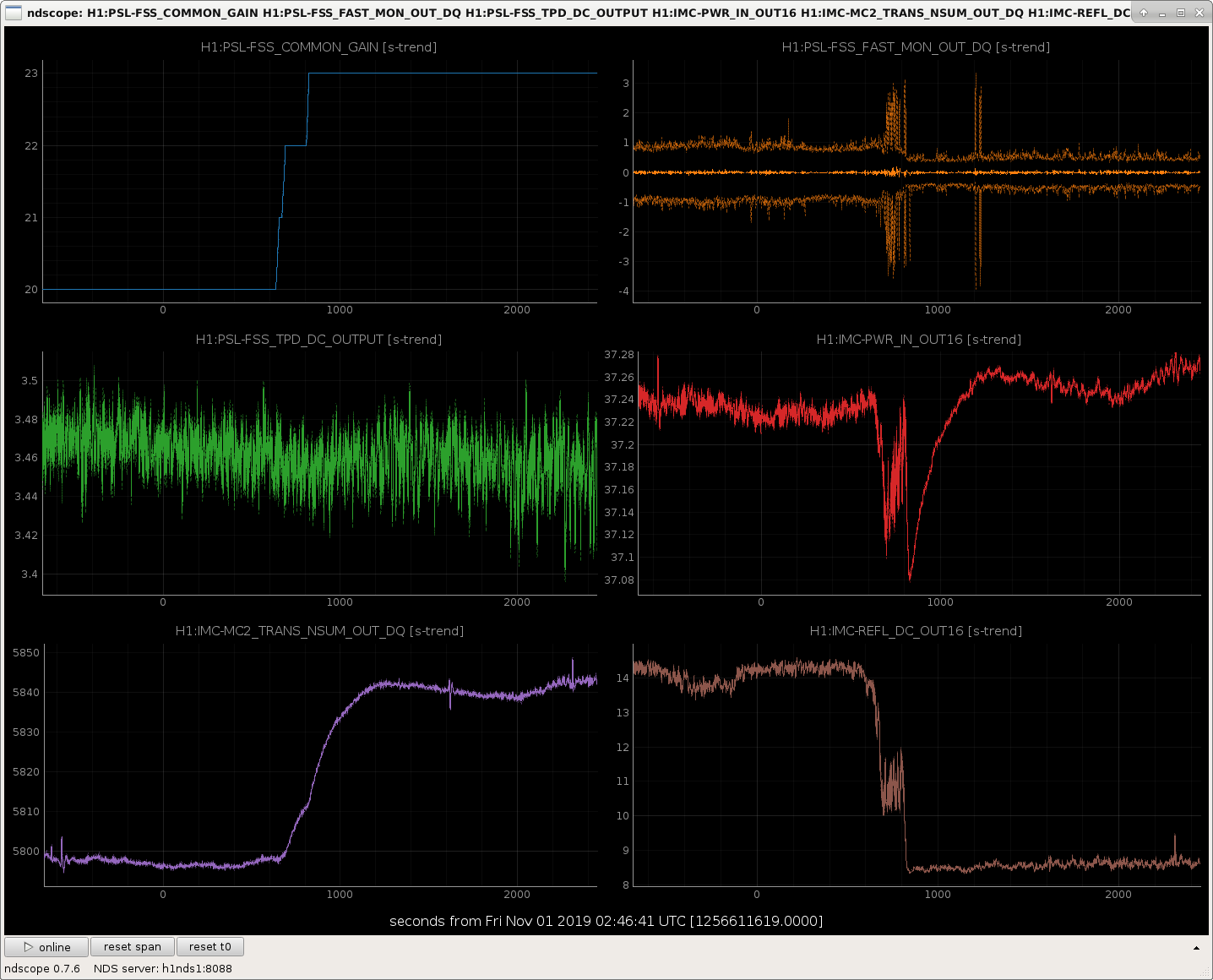
georgia.mansell@LIGO.ORG - 22:41, Thursday 31 October 2019 (52859)

Attaching a screen shot of some time series while I increased the FSS gain:

  • FSS PZT monitor (fast_mon) is less noisy
  • IMC power in is less noisy
  • MC2_trans is higher
  • IMC_refl is lower, back to ~9mW where it was before Tuesday.
Images attached to this comment
Displaying reports 37781-37800 of 89089.Go to page Start 1886 1887 1888 1889 1890 1891 1892 1893 1894 End