Displaying reports 38441-38460 of 89074.Go to page Start 1919 1920 1921 1922 1923 1924 1925 1926 1927 End
Reports until 16:28, Friday 27 September 2019
H1 ISC (ISC, OpsInfo)
evan.hall@LIGO.ORG - posted 16:28, Friday 27 September 2019 (52171)
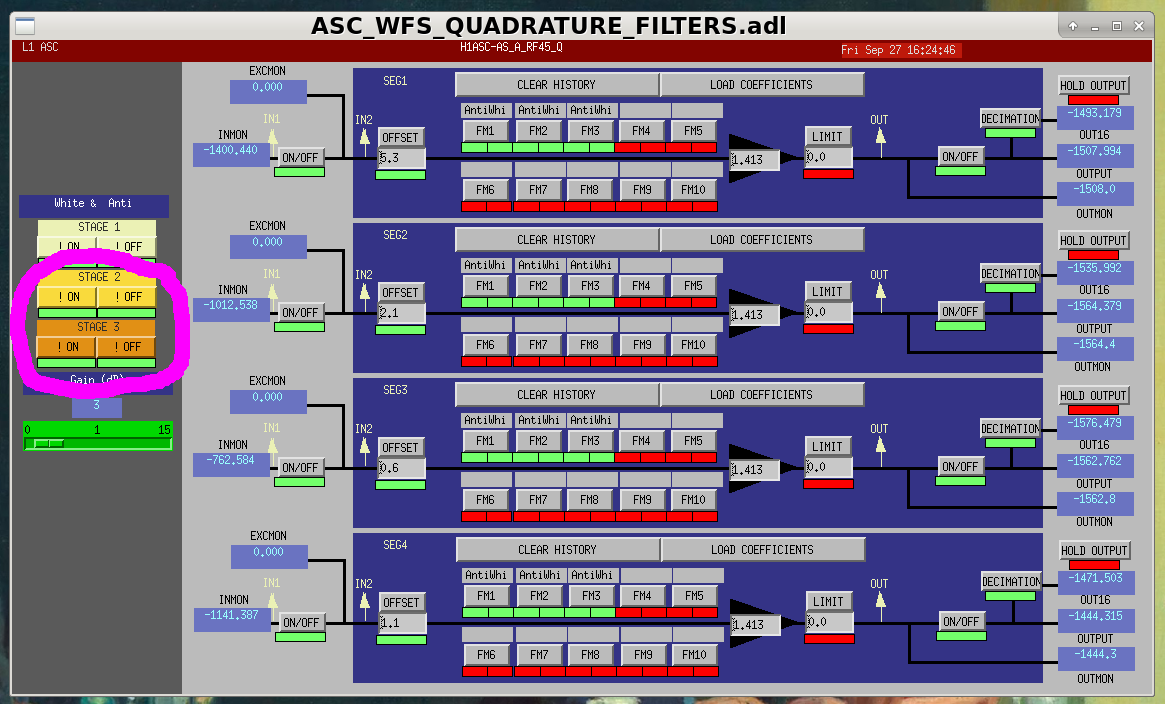
More whitening on AS A RF45, and a note for operators

【Craig, Evan】

Craig already logged here that we added two more stages of whitening on AS A RF45 and then accepted the SDF differences for the resulting antiwhitening filters that have to be engaged.

Note for operators: if you find that this change prevents lock acquisition, you can revert it by going to sitemap > ASC > ASC Overview > AS_A_RF45 (first red button up in the left-hand corner) -> Q filters, and then clicking off Stage 3 whitening and Stage 2 whitening (leave on Stage 1 whitening). You'll then have to accept SDF differences for the eight RF45 filter modules.

However, Craig and I looked at the ADC counts on these channels during previous lock acquisitions and we think there should be no ADC range issues.

Images attached to this report
LHO General
corey.gray@LIGO.ORG - posted 16:19, Friday 27 September 2019 (52168)
Transition to EVE Log

TITLE: 09/27 Eve Shift: 23:00-07:00 UTC (16:00-00:00 PST), all times posted in UTC
STATE of H1: Observing at 118Mpc
OUTGOING OPERATOR: Patrick
CURRENT ENVIRONMENT:
    SEI_CONF state: WINDY
    Wind: 24mph Gusts, 20mph 5min avg
    Primary useism: 0.11 μm/s
    Secondary useism: 0.16 μm/s

Microseism below the 50th percentile and winds are picking up slightly.  Forecast is for some winds up to 20mph and 20% chance of rain tonight...we'll see.
QUICK SUMMARY:

H1 locked 17.5hrs (w/ 2.5hrs of observing).

LHO General
patrick.thomas@LIGO.ORG - posted 16:01, Friday 27 September 2019 (52167)
Ops Day Shift Summary
TITLE: 09/27 Day Shift: 15:00-23:00 UTC (08:00-16:00 PST), all times posted in UTC
STATE of H1: Observing at 118Mpc
INCOMING OPERATOR: Corey
SHIFT SUMMARY: Remained locked entire shift. Some PEM commissioning work and some work done by Evan and Craig.
LOG:

15:12 UTC Beekeeper through gate
15:26 UTC GRB 351754 Fermi 591290703 TRIGGER_DUR:     0.064 [sec] Stand down LLO and Virgo notified
15:28 UTC SEI_CONF to EARTH_QUAKE for eq from Pitcairn Islands
16:17 UTC INJ_KILL to INJ_SUCCESS
16:18 UTC SEI_CONF to WINDY
Jason to optics lab
16:43 UTC Jason out of optics lab
17:41 UTC Ethan and Dripta to optics lab
18:50 UTC Robert and team to end Y
18:59 UTC Dropped to commissioning for PEM
19:02 UTC SEI_CONF to WINDY_NOBRSY
19:46 UTC Adrian driving back to corner station
19:52 UTC Adrian driving to end Y
20:06 UTC Robert done, Evan starting
20:36 UTC Evan and Craig done, back to observing
20:37 UTC SEI_CONF back to WINDY
22:12 UTC Gerardo to mid X
H1 ISC (CDS, ISC)
evan.hall@LIGO.ORG - posted 15:56, Friday 27 September 2019 - last comment - 16:57, Friday 27 September 2019(52166)
DARM FOM reference updated

【Jeff, Evan】

We updated the DARM FOM with a reference from a few hours ago. The old reference (from May 2019) did not reflect several improvements in the noise; e.g., the elimination of certain lines. We do not want to lose track of these improvements during recovery from the vent.

In the attachment, gold is the new reference (116 Mpc) and black is the old reference.

Non-image files attached to this report
Comments related to this report
jeffrey.kissel@LIGO.ORG - 16:07, Friday 27 September 2019 (52169)CAL, DetChar, ISC
A list of improvements major (hardware / configuration / controls) changes I would consider as the major contributors to the improvement:
 - Increase in input laser power from 35 W to 37 W (LHO:49783)
 - Notching of SR3's bounce mode at 27.71 Hz (LHO:49649) #LSCFellows
 - PRCL feedforward creation and improvements (LHO:51553) #LSCFellows
 - Finding and destroying the 48 Hz feature by blocking a beam at a HAM3 viewport (LHO:52136) #LSCFellows
 - Updated calibration (LHO:51819)
evan.hall@LIGO.ORG - 16:57, Friday 27 September 2019 (52172)

The DRMI FOM was also updated to today's noise curves (the old ones were from O1).

Images attached to this comment
H1 CSWG (CSWG)
matthew.ball@LIGO.ORG - posted 15:21, Friday 27 September 2019 (52159)
A2L Decoupling Modeling sample code

M. Ball

I have been modeling angle to length cross-coupling in the quad suspensions. Since I am leaving Hanford, I have prepared a sample Matlab script that covers some of the key modeling I did. It is located in /ligo/svncommon/SusSVN/sus/trunk/QUAD/Common/MatlabTools/QuadModel_Production/asc_angle_to_DARM.m

More details of my modeling work can be found in G1901481-v2.

H1 ISC (ISC, TCS)
aidan.brooks@LIGO.ORG - posted 12:02, Friday 27 September 2019 (52161)
PRG vs input power plot for L1 and H1

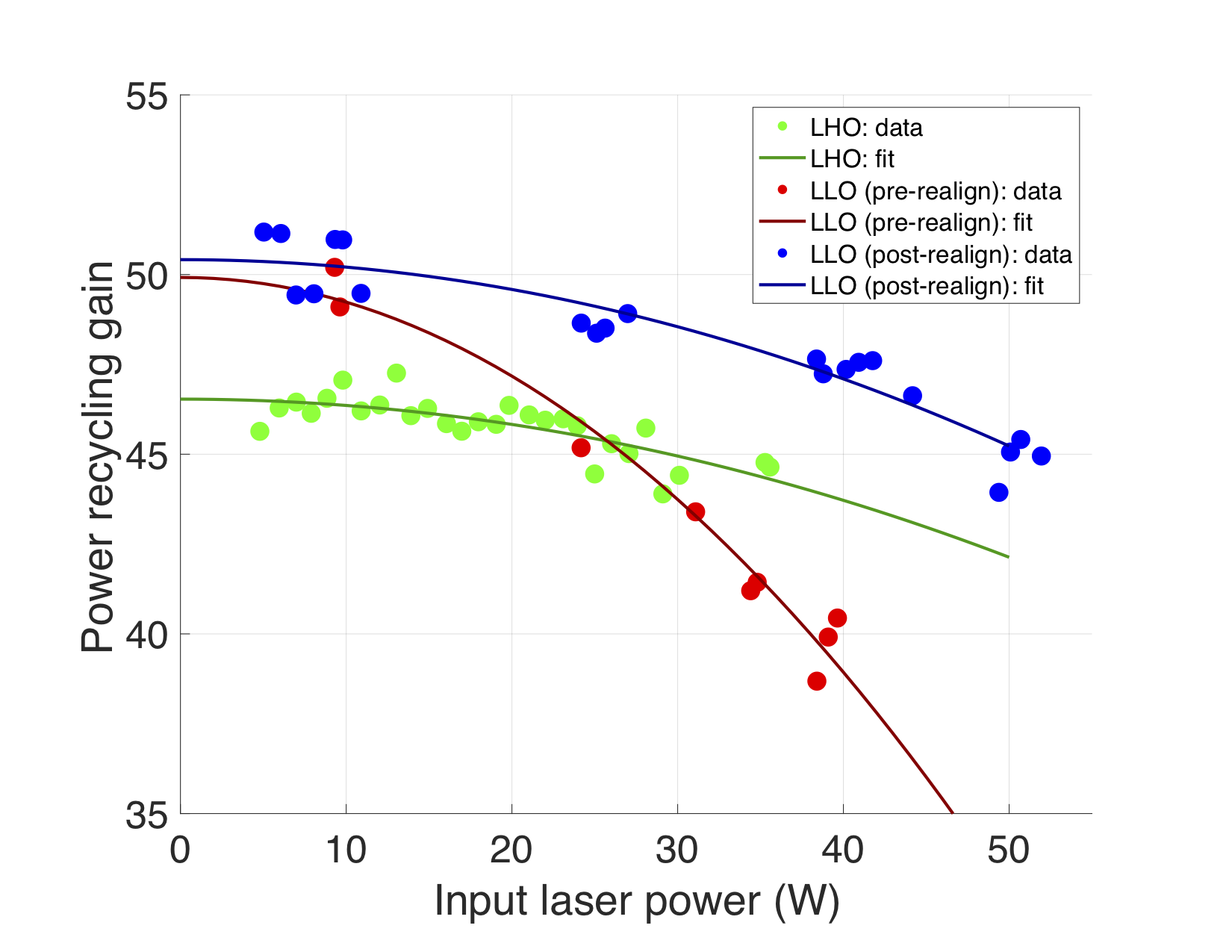
Duplicate of LLO aLOG 48796

Following Valera's initial PRG v input laser power plot, the attached plot shows the PRG vs input laser power for LLO and LHO averaged over the first four months of this year (with LLO divided into pre 3-Feb realignment and post 3-Feb realignment epochs).

The initial dataset was one-minute averages of PRG and LSR PWR. Then the averaging is done by dividing the x-axis (input laser power) into 1W bin widths and working out all times at which the input laser power fell within a particular bin and then averaging the corresponding PRGs. Each bin required a minimum of 30 entries to qualify as a data point in the final average. 

The fitting function is a simple quadratice: F = g0 + a0*P^2


Images attached to this report
Non-image files attached to this report
LHO General
patrick.thomas@LIGO.ORG - posted 08:12, Friday 27 September 2019 (52158)
Ops Day Shift Transition
TITLE: 09/27 Day Shift: 15:00-23:00 UTC (08:00-16:00 PST), all times posted in UTC
STATE of H1: Observing at 118Mpc
OUTGOING OPERATOR: Ed
CURRENT ENVIRONMENT:
    SEI_CONF state: WINDY
    Wind: 12mph Gusts, 9mph 5min avg
    Primary useism: 0.03 μm/s
    Secondary useism: 0.17 μm/s 
QUICK SUMMARY: No issues.
H1 General
edmond.merilh@LIGO.ORG - posted 07:58, Friday 27 September 2019 (52157)
Shift Summary - Owl

TITLE: 09/27 Owl Shift: 07:00-15:00 UTC (00:00-08:00 PST), all times posted in UTC
STATE of H1: Observing at 117Mpc
INCOMING OPERATOR: Patrick
SHIFT SUMMARY:
LOG:

H1 General
edmond.merilh@LIGO.ORG - posted 00:16, Friday 27 September 2019 (52156)
Shift Transition - Owl

TITLE: 09/27 Owl Shift: 07:00-15:00 UTC (00:00-08:00 PST), all times posted in UTC
STATE of H1: Observing at 116Mpc
OUTGOING OPERATOR: Travis
CURRENT ENVIRONMENT:
    SEI_CONF state: WINDY
    Wind: 16mph Gusts, 11mph 5min avg
    Primary useism: 0.05 μm/s
    Secondary useism: 0.21 μm/s
QUICK SUMMARY:

Nothing to report.

H1 General
travis.sadecki@LIGO.ORG - posted 00:00, Friday 27 September 2019 (52155)
Ops Eve Shift Summary

TITLE: 09/27 Eve Shift: 23:00-07:00 UTC (16:00-00:00 PST), all times posted in UTC
STATE of H1: Observing at 115Mpc
INCOMING OPERATOR: Ed
SHIFT SUMMARY:  One lockloss and a fairly quick recovery. 
LOG:

4:27 Lockloss. 

5:47 Observing.  First relock attempt lost it at ENGAGE_ASC_FOR_FULL_IFO.  Second attempt went all the way to NLN.

H1 General
travis.sadecki@LIGO.ORG - posted 16:09, Thursday 26 September 2019 (52154)
Ops Eve Shift Transition

TITLE: 09/26 Eve Shift: 23:00-07:00 UTC (16:00-00:00 PST), all times posted in UTC
STATE of H1: Observing at 117Mpc
OUTGOING OPERATOR: Corey
CURRENT ENVIRONMENT:
    SEI_CONF state: WINDY
    Wind: 14mph Gusts, 10mph 5min avg
    Primary useism: 0.05 μm/s
    Secondary useism: 0.20 μm/s
QUICK SUMMARY:  Microseism is steadily decreasing.

LHO General
corey.gray@LIGO.ORG - posted 16:01, Thursday 26 September 2019 (52125)
DAY Operator Summary

TITLE: 09/25 Day Shift: 15:00-23:00 UTC (08:00-16:00 PST), all times posted in UTC
STATE of H1: Observing at 114Mpc
INCOMING OPERATOR: Travis
SHIFT SUMMARY:

OPERATOR NOTE:  lscparams.py has been adjusted (Jenne) so that we no longer get SDF diffs for ASC HARD RPC gains (see alog). 

About 78min of PEM COMMISSIONING time (which ended due to a lockloss which adds +135min to get back to OBSERVING).  The PEM Commissioning time included (2) separate PEM team activities:  (1) EY TMS scatter & (2) HAM3 stray beam investigations.

OPERATOR OBSERVATION:  My last (3) locking experiences in a row needed an Initial Alignment to make it to NOMINAL LOW NOISE.  Only (3) data points here, but before all these initial alignments, H1 would break locks repeatedly during the ASC (i.e. ENGAGE ASC for FULL IFO) steps.

TeamSpeak has been down for most of the shift.

LOG:

H1 CSWG (CAL, CSWG)
matthew.ball@LIGO.ORG - posted 15:38, Thursday 26 September 2019 (52129)
A2L decoupling filters

M. Ball

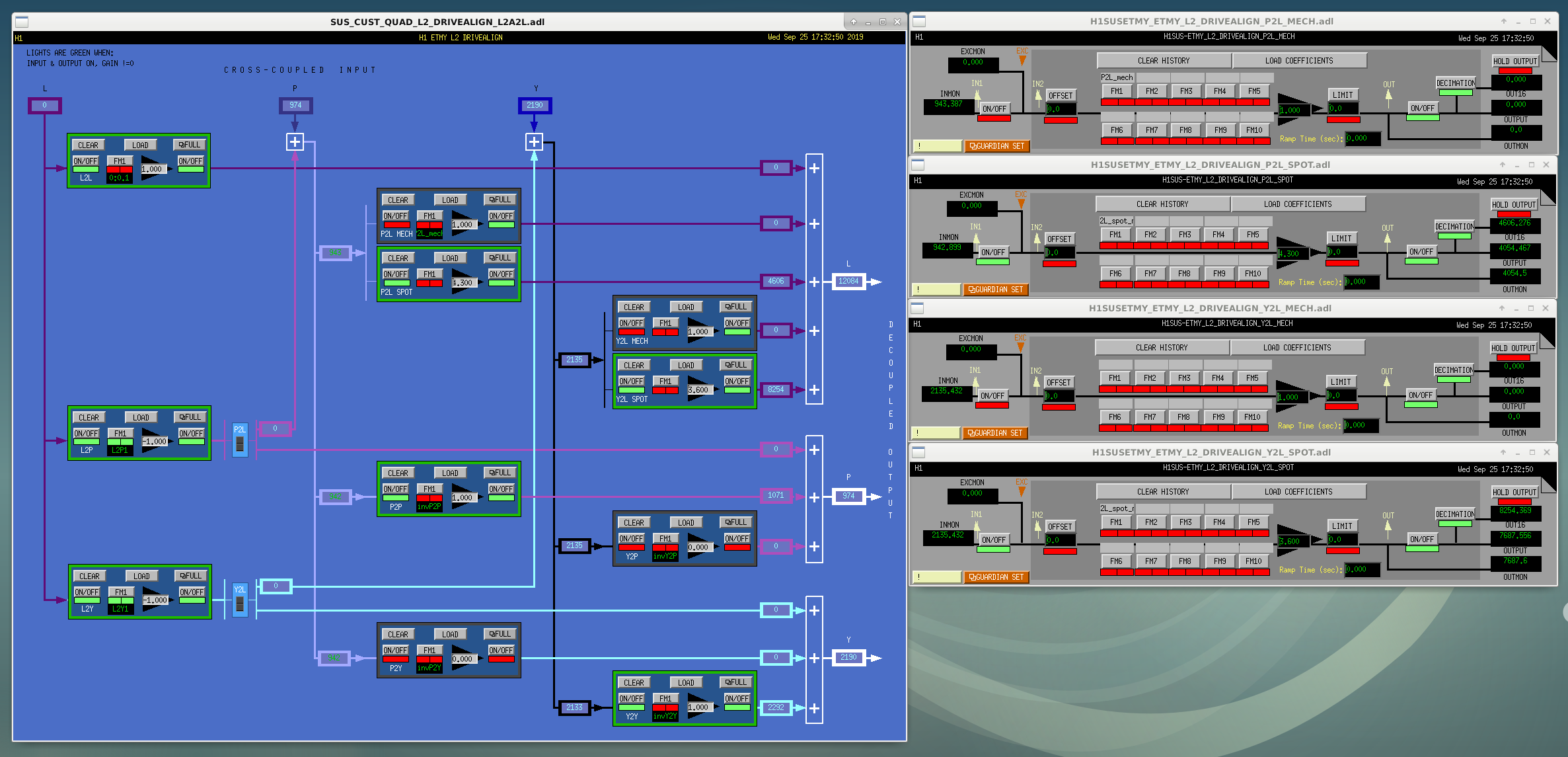
I have been working on angle to length decoupling filters for the quad L2 drivealign matrices. On Friday, September 20, during commissioning time, I installed these filters into the front end (all filters disabled currently). These filters can be activated in the L2 drivealign matrices for each quad suspension. I have attached a sample screenshot of the ETMY drivealign window with the P2L SPOT, P2L MECH, Y2L SPOT, and Y2L MECH filter bank windows, showing where these filters are located (filters are in all quad suspensions but the figure is just of ETMY).

For the pitch to length filters, the filters are located in the "P2L SPOT" and  "P2L MECH" filter banks in the FM1 filter modules for ETMX, ETMY, ITMX, and ITMY. The P2L_SPOT_GAIN channel values will need to be changed as these filters are designed for this gain to be the beam pitch offset (in mm). In the current scheme, the P2L SPOT filter banks are active with just a scalar gain, and the P2L MECH filter banks are disabled. In the new scheme, both the P2L SPOT and P2L MECH filter banks will have filters active in them. The filters added to the P2L MECH filter banks account for suspension dynamics.

For the yaw to length filters, the filters are located in the "Y2L SPOT" filter banks in the FM1 filter modules for ETMX, ETMY, and ITMX.  There is no ITMY Y2L filter as the current spot is centered such that any filter added would be multiplied by zero gain. Any future ITMY yaw offset in the new scheme would benefit from a similar filter. The Y2L_SPOT_GAIN channel values will also need to be changed to the beam yaw offset (in mm). There are no filters added to Y2L MECH since the QUAD model used as a basis for these filters does not accurately represent yaw cross-couplings with other degrees of freedom. Note that the attached drivealign screenshot does not have any filters in the Y2L MECH filter bank for this reason.

The gains in the current scheme and the new scheme are given below.

  Current scheme acqusition gain Current scheme nominal low noise gain New scheme acquisition gain New scheme nominal low noise gain
ETMX P2L SPOT 0.85 4.3 -0.52 -15.97
ETMY P2L SPOT 0.85 4.3 -0.52 -15.97
ITMX P2L SPOT 0.85 -3.965 -0.51 21.76
ITMY P2L SPOT 0.85 -3 -0.52 17.17
ETMX Y2L SPOT 0 3.6 0 -13.11
ETMY Y2L SPOT 0 3.6 0 -13.11
ITMX Y2L SPOT 0 0.055 0 -0.2
ITMY Y2L SPOT 0 0 0 0

Recall that two sets of values are required since lock is first acquired at one spot position then moved to the optimal spot position for nominal low noise.

These values for the new scheme are calculated using QUAD model transfer functions from the penultimate mass to the test mass as follows.

For PITCH: gain=-(P2l+G_P2L*L2l)/(P2p+G_P2L*L2p)     where P2l is the PUM pitch to TST length transfer function from the QUAD model, G_P2L is the P2L_SPOT_GAIN used in the current scheme, L2l is the PUM length to TST length transfer function from the QUAD model, P2p is the PUM pitch to TST pitch transfer function from the QUAD model, and L2p is the PUM length to TST pitch transfer function from the QUAD model. This is evaluated at the dither frequency for that suspension. This gives the beam offset in meters; the filters are scaled such that the new gain should be this offset in mm.

For YAW: gain = -L2l*G_Y2L/(Y2y)     where L2l is the PUM length to TST length transfer function from the QUAD model, G_Y2L is the Y2L_SPOT_GAIN used in the current scheme, and Y2y is the PUM yaw to TST yaw transfer function from the QUAD model. This is evaluated at the dither frequency for that suspension. This gives the beam offset in meters; the filters are scaled such that the new gain should be this offset in mm. Note that this expression does not include Y2l or L2y terms to match the form of the pitch expression. This is because the QUAD model used as a basis for these filters does not accurately represent yaw cross-couplings with length.

I have attached a pdf with properly formated numerical expressions for the new gain for each mass as functions of the gains in the current scheme at the current dither line frequencies.


Moving forward, I recommend that during a future relocking, these filters be activated for testing. To do this, Guardian would need to be changed to include these filters with the new acquisition gain values during "Prep for locking" and with the new nominal low noise gain values during "Engage soft loops".

I recommend measuring spectra of L3 length signals before and after as well as spectra of L2 angular signals with their coherence with DARM before and after these filters are enabled to see if the filters are behaving as they should.

Images attached to this report
Non-image files attached to this report
H1 ISC
evan.hall@LIGO.ORG - posted 14:10, Thursday 26 September 2019 - last comment - 17:49, Thursday 10 October 2019(52114)
Dark and in-lock noise in AS A RF45Q, and a comparison with DCPD sum

【Craig, Evan】

We took a look at the noise is AS A RF45Q in and out of lock. This sensor is used for dHard and we wanted to see if we could gain some insight into the cross-coupling issues between DARM and the angular loops (some previous insight here and previous decoupling work here). We mostly looked at the sum channel (essentially an rf DARM readout) rather than pitch/yaw. There aren't any stunning conclusions here, but if the sub-10 Hz noise is better understood it might provide some clues about how to make improvements.

We found some nonstationarity in the dark noise (wandering lines). With light on the diode in full lock, in the region 10 Hz to 100 Hz it seems like there is some broadband excess that is not a straightforward optical signal (from DARM or dHard).

We wonder if it would make sense to try more whitening on this sensor, as currently there is only one stage engaged (AS B RF45, which is not used for anything, has three stages engaged and hence better dark noise performance).

Dark noise

The first attachment shows the dark noise versus the in-lock noise of this sensor. During the maintenance period we unlocked the IMC and proceeded to measure the dark noise, and we were surprised to find a slowly wandering line in the vicinity of 4–7 Hz along with its harmonics (measurements in green and magenta). We were again surprised when we looked at the individual Q segments and found different responses to these lines (second attachment). For example, Q1 seems entirely insensitive to the fundamental of this line, but is the most sensitive out of the four quadrants to the harmonics. This second attachment also shows the dark noise of the AS B RF45Q quadrants, but since AS B RF45 has more whitening than AS A RF45, the two diodes do not readily lend themselves to comparison.

We also looked at some past times during maintenance days when it seemed the diodes had no light on them (although the IMC was unlocked); one such time is also plotted in the second attachment. Here there are no wandering lines, but the noise at and below 1 Hz is worse (the whitening settings have not changed, according to time machine). Maybe there was some signal since the IMC was still locked.

In-lock noise

The first attachment again shows the noise in AS A RF45Q sum during the full lock. The spectrum at and below 10 Hz is presumably optical signal (DARM plus other effects). The noise above 100 Hz is white, consistent with shot noise. Between 10 Hz and 100 Hz the high-frequency noise appears to aquire some shape that is not white. This region is not coherent with DARM except near various lines (e.g., the dither lines).

The rough calibration was reckoned as follows. Based on previous estimates of the AS port sideband content and the rough number of 250 mW of power leaving the SRM (via the calibration of AS C into milliwatts and the 800 ppm transmission of OM1), it seems that the 45 MHz beatnote signal should be of order 2 mW. Together with the dc value of the AS A RF45 sum channel in counts (about 10000), this can be used to infer that the total measured noise at high-frequency is about 10−7 mW/Hz1/2.

Comparison with DCPD sum

We also made a comparison of AS A RF45Q against the DCPD sum (third attachment). The rf sensor is scaled to match the dc sensor in the region 5–10 Hz, where the two are highly coherent. Above 10 Hz, the rf sensor's noise dominates over the dc sensor. The interpretation of the noises below 5 Hz is less straightforward. One thing that is apparent is that there are regions of high coherence (e.g., around 0.8 Hz) even though the two sensors show spectra with vastly different amplitudes. The sensors could be seeing the same noise, but with different coupling factors. Alternatively, a sensing noise peculiar to the dc readout (e.g., from the OMC) could be being impressed onto the loop and then witnessed by the rf sensor.

Plots for a longer stretch (6 hours, starting at 2019-09-21 09:00:00) of median-averaged data are also attached, with smaller binwidth. Here the large variability in the low-frequency coherence is more apparent.

A next step would be to run bruco on the DCPD sum and the RF45Q sum to see what the major contributors are at these low frequencies. I tried running bruco on Caltech ldas-pcdev12 (for only 1000 seconds), but it just hangs.

Non-image files attached to this report
Comments related to this report
evan.hall@LIGO.ORG - 15:23, Thursday 26 September 2019 (52152)

I am also attaching a comparison between AS A and AS B RF45 sums, along with some ADC count comparisions. AS B RF45Q maintains coherence with DARM up to higher frequency and has an overall lower noise floor than AS A RF45Q. AS B has not received the same careful rephasing as AS A (there is some DARM sensitivity in the I quadrature), but nonetheless is phased so that DARM mostly appears in Q.

It is also interesting to note that the low-frequency regions of high coherence with the DCPDs (0.8 Hz, 1.27 Hz, etc.) show up in both quadratures for both AS A and AS B even though (at least in the case of AS A) the phasing minimizes the appearance of DARM in I above 10 Hz.

The ADC count comparisons seem to indicate that turning on two extra whitening stages on AS A will increase the rms from 200 ct to something like 500 ct.

Non-image files attached to this comment
craig.cahillane@LIGO.ORG - 13:40, Friday 27 September 2019 (52162)
We turned on whitening stages two and three for AS_A_RF45.  

We did this in lock by switching the DHARD sensor from AS_A_RF45 to AS_B_RF45 with a gain of -1.25 in both the PIT and YAW sensing matrix.
Preliminary results suggest no DARM noise improvement, but lowered dark noise in the AS_A sensor above 10 Hz.  Noise was lowered by around a factor of 2.

Accepted this change into the SDF, and are back to observing.
evan.hall@LIGO.ORG - 17:49, Thursday 10 October 2019 (52411)

There was actually a bit of improvement in DARM between 15 and 20 Hz, though it's hard to see without sufficient averaging.

I took an hour of "before" data starting at 2019-09-27 17:30:00 and an hour of "after" data starting at 2019-09-27 20:25:00 and median-averaged it. The plots are attached (I omitted the DARM / dHard yaw coherence to keep the plot from getting overcrowded -- the overall coherence is lower than the pitch DOF). The improvement is subtle, but it's there, particularly at 19 Hz. The changes in coherence and in noise level are roughly consistent with the noise at 19 Hz being dominated by angular fluctuation.

Nothing is particularly surprising here given the previous noise budgeting injections.

Non-image files attached to this comment
H1 CAL
jeffrey.kissel@LIGO.ORG - posted 17:49, Wednesday 25 September 2019 - last comment - 14:36, Friday 27 September 2019(52137)
Calibration Measurements: Full Suite Today, Last before the O3A Break; Some Interesting Results On Thermalization
J. Kissel

Grabbed the full suite of measurements for calibration today. This is the last collection of full sweep calibration measurements during O3A. 

Interestingly, because 13:00 UTC happened to land just after reaching nominal low noise, I was able to capture the sensing function measurements and broadband injections before the IFO had completely thermalized (typically taking about 1 hour), and after. Many more details and plots later, but here're the data files:

Sensing Function:
/ligo/svncommon/CalSVN/aligocalibration/trunk/Runs/O3/H1/Measurements/FullIFOSensingTFs/
Pre-Thermalization:
    2019-09-25_H1_OMCDCPDSUM_to_DARMIN1.xml
    2019-09-25_H1_PCALX2DARMTF_BB_3min.xml
    2019-09-25_H1_PCALY2DARMTF_BB_3min.xml

    2019-09-25_H1_DARM_OLGTF_LF_SS_5to1100Hz_15min.xml
    2019-09-25_H1_PCALY2DARMTF_LF_SS_5t1100Hz_10min.xml
    2019-09-25_H1_PCALX2DARMTF_LF_SS_5t1100Hz_10min.xml

Post-Thermalization:
    2019-09-25_H1_PostThermalize_DARM_OLGTF_LF_SS_5to1100Hz_15min.xml
    2019-09-25_H1_PostThermalize_PCALY2DARMTF_LF_SS_5t1100Hz_10min.xml

    2019-09-25_H1_PostThermalize_PCALY2DARMTF_BB_3min.xml


Actuation Function:
/ligo/svncommon/CalSVN/aligocalibration/trunk/Runs/O3/H1/Measurements/FullIFOActuationTFs/
    2019-09-25_H1SUSETMX_L1_iEXC2DARM_10min.xml
    2019-09-25_H1SUSETMX_L1_PCAL2DARM_8min.xml

    2019-09-25_H1SUSETMX_L2_iEXC2DARM_12min.xml
    2019-09-25_H1SUSETMX_L2_PCAL2DARM_6min.xml

    2019-09-25_H1SUSETMX_L3_iEXC2DARM_12min.xml
    2019-09-25_H1SUSETMX_L3_PCAL2DARM_6min.xml


I'll post the processed results tomorrow.
Comments related to this report
jeffrey.kissel@LIGO.ORG - 13:02, Friday 27 September 2019 (52145)DetChar, ISC
Interesting Sensing Function Results: Confirmation of Evolving Detuned SRC Optical Spring Seen By Time-Dependent Correction Factors, Impacting Response Function Systematic Error

Using the data collected above, I'm able to 
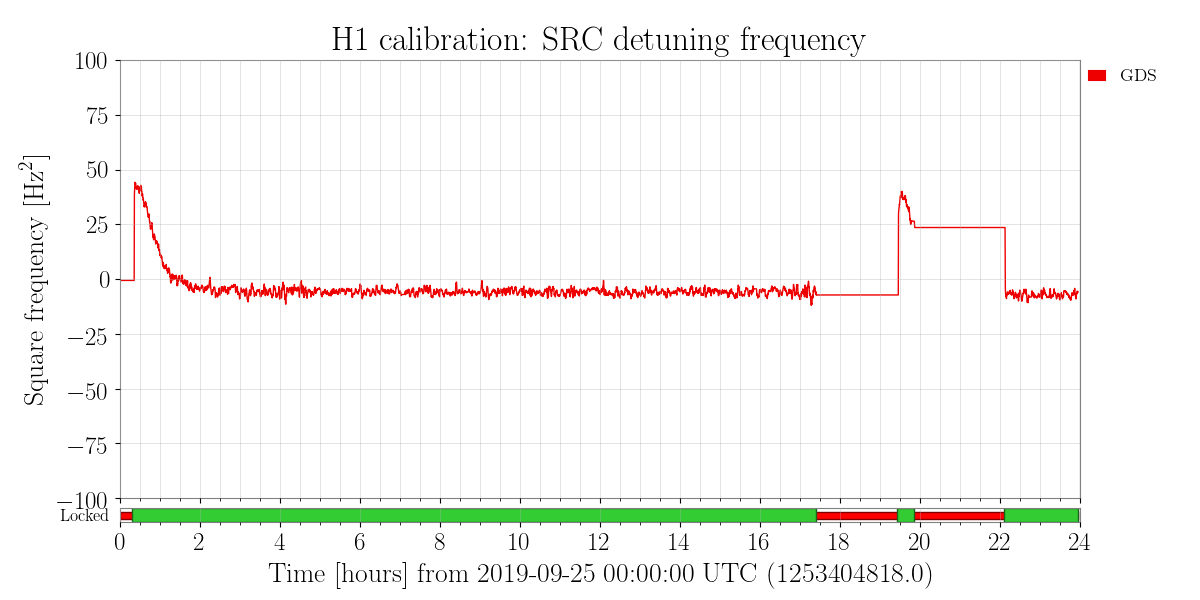
    - Confirm that the ~40 minute time constant for the regular evolution / thermalization of the signal recycling cavity's detuned optic spring frequency seen in the first attachment (an example from the 2019-09-25 summary page) and recently stacked over several re-acquisitions (see LHO aLOG 52139, because it's present at the start of every recent observation stretch) is a real effect during the interferometer's settling after powering up to 37 W. (Note: in the acquisition process, the time between "the input laser power has reached 37 W" and "we're ready for observation" is typically around 5 minutes, much less time than the thermalization takes.)

    - Though the estimate of the spring frequency squared (\xi^2 == f_s^2) from the calibration lines appears to suggest an evolution from "pro-spring" (\xi^2 == f_s^2 > 0, positive, like in August of O3) to just-barely-anti-spring (\xi^2 == f_s^2 < 0, negative, like in O1/O2) -- if any spring at all -- this contradicts the sweep data, which suggests the evolution instead goes from what we know to be an anti-spring response to just-barely-a-pro-spring.

    - At the beginning of the lock stretch, this does indeed result in significant magnitude and phase systematic error in the over all response function, contrary to popular belief that tracking this carefully ''doesn't matter, because the spring frequency is well below the DARM loop UGF.'' 

    - We also can confirm that during this evolution, that systematic error is NOT covered by our recent estimate of the time-independent, 68% confidence interval of the uncertainty budget (from LHO aLOG 52132)
   
    - Finally, once thermalized, however, the measured systematic error is remarkably consistent between lock stretches, and our propagated estimate of that error (via the guassian progress regression) is consistent with measurement.

Attachments to support this:
(1) H1-LOCKED_8DAD23_TIMESERIES-1253404818-86400_TDCFs_f_s_squared_During_Powerup.png: Again, this is an example report from the 2019-09-25 summary page for time-dependent correction factors (a.k.a. TDCFs; see full page here). However, it perfectly demonstrates one unperturbed acquisition (first decay of f_s^2), and the decay in the middle of which I was performing all of the 2019-09-25 measurements.

(2) 2019-09-25_H1_PrevsPostThermalize_sensingFunction_referenceModel_vs_allMeasurements.pdf: This is the standard analyzed plot for sensing functions, comparing against the new 2019-09-09 model -- which has no spring response in the model -- and it shows 
    (a) all of the sensing function measurements that went in to informing the 2019-09-09 model (all taken well in to a long observation stretch), and
    (b) the "Pre" and "Post" thermalized data from 2019-09-25. 
One can clearly see the anti-spring response in the 2019-09-25 Pre-thermalized data -- and note that this was taken at ~20:14 UTC, ~45 minutes after the start of the relevant observation ready segment 19:24 UTC. 

(3) 2019-09-25_H1_PreThermalize_sensingFunction.pdf Looking to gather estimates of what the spring frequency is during this already-45-minutes-thermalized anti-spring "pre-thermalized" measurement, in order to compare it against the calibration-line-reported-estimate of f_s^2, I used our standard MCMC infrastructure, and tested fits with a range from 5 to 5000, and from 20 to 5000 Hz (the latter of which we've used for thermalized data to inform the 2019-09-09 model). The results for the 5 Hz and up fit, which I believe are better are
    f_cc = 416.4 +/- 0.75 Hz
    f_s  = 2.137 +/- 0.03 Hz #anti-spring.
(Note: the optical gain / \kappa_C estimate in both cases agrees with the reference model to within 0.5%, and the Q_s estimate has always been poor / meaningless because of the remaining unknown response we think may be due to parasitic L2A2L coupling.)
This MCMC fit f_s = 2.137 Hz would correspond to an f_s^2 of 4.6 Hz^2, which is indeed roughly consistent with the typical time-series from the calibration line estimate, given that the data was taken ~2/3rd of the way down the exponential decay (and considering the time-constant analysis in LHO aLOG 52139).

(4) https://alog.ligo-wa.caltech.edu/aLOG/uploads/52145_20190926092701_2019-09-25_H1_PostThermalize_sensingFunction.pdf Now MCMC fitting the "Post Thermalization" data, taken around 21:33 UTC well after thermalization, I argue the fit using only-above-20 Hz is better, and it reveals 
     f_cc = 411.1 +/- 0.75 Hz
     f_s = 0.105 +/- 0.06 Hz #pro-spring
which is very much consistent with what's used in the 2019-09-09 model (411.3 Hz for f_cc, and 0.0 Hz for f_s, i.e. no detuning) as expected.

(5) 2019-09-26_H1_deltaL_over_pcal.pdf This is our money plot, comparing two ratios:
    (a) R_sample / R_MAP = "the uncertainty budget" = the reconstructed response function ratio, where the numerator is the 68% confidence interval of a distribution of response functions created by sampling the correlated posterior distributions of uncertainty in both the original model parameters and the estimated residual unknown systematic error (and its uncertainty), R_sample, and the denominator is the response function using the static parameters of the 2019-09-09 model. 
    (b) Delta L_PCAL / Delta L_EXT = The one-time measurements of a driven transfer function between PCAL and our front-end produced estimate of DELTAL_EXTERNAL, corrected for every known flaw of the front-end produced h(t), i.e. the ratio of R_GDS / R_CALCS. (For more details on the correction and why we need it, see T1900169).

For (b), I show 5 measurements -- 
    (i) a previous, 2019-09-16 broad-band injection when the IFO was well-thermalized. Consistent with uncertainty budget. Good!
    (ii) the broadband injection taken as soon as we went out of observing to start the 2019-09-25 calibration suite (~3 minutes of data at starting 19:51 UTC, ~25 minutes after achieving 37 W).
    (iii) the 2019-09-25 \Delta L / PCAL swept sine data taken at the exact same time as the "pre-thermalized" sensing function DARM_IN1/PCAL sweep described in (2) above that reports a spring frequency of 2.1 Hz (only!)
    (iv) the 2019-09-25 \Delta L / PCAL swept sine data taken at the exact same time as the "post-thermalized" sensing function DARM_IN1/PCAL sweep described in (2) that reports no spring.
    (v) a final broadband injection at the close of the measurement period.

(ii) shows a deviation of the systematic error on the level of 1% (at 60 Hz) to 2% (at worst at 25 Hz) in magnitude, and 1 deg in phase at 40 Hz.
(iii) shows that we're mostly "recovered" to the thermalized level of systematic error / uncertainty by 45 minutes after power up.
(i), (iv), (v) are all quite consistent.

See conclusions above. Stay tuned for further action.
    
Scripts to produce the attached plots:
    (1) is from the summary pages, as linked.
/ligo/svncommon/CalSVN/aligocalibration/trunk/Runs/O3/H1/Scripts/FullIFOSensingTFs/
    (2) process_sensingmeas_collection_20190925_PrevsPostThermalize.py
    (3) process_sensingmeas_20190925.py
    (4) process_sensingmeas_20190925_PostThermalize.py
/ligo/svncommon/CalSVN/aligocalibration/trunk/Runs/O3/H1/Scripts/CALCS_FE/
    (5) process_broadband_pcal2darmtf_collection_20190925.py
Images attached to this comment
Non-image files attached to this comment
jeffrey.kissel@LIGO.ORG - 14:36, Friday 27 September 2019 (52163)
Uninteresting Actuation Function Results: Much of the Same, these are another vanilla data set to be added the collection of data for Unknown Systematic Error to reduce the uncertainty.


All MCMC fits of each of the above UIM, PUM, or TST stage measurements, using the standard fit frequency range per stage, report the same answer as has been used in the model to within stated uncertainty.

Thus, we can lump these in with the collection of data used to estimate the unknown (or known but unaccounted for) systematic error to reduce the error estimates' uncertainty.

Processing scripts:
/ligo/svncommon/CalSVN/aligocalibration/trunk/Runs/O3/H1/Scripts/FullIFOActuationTFs/
    process_actuationmeas_20190925.py
    process_actuationmeas_collection_20190925.py

Non-image files attached to this comment
H1 CAL
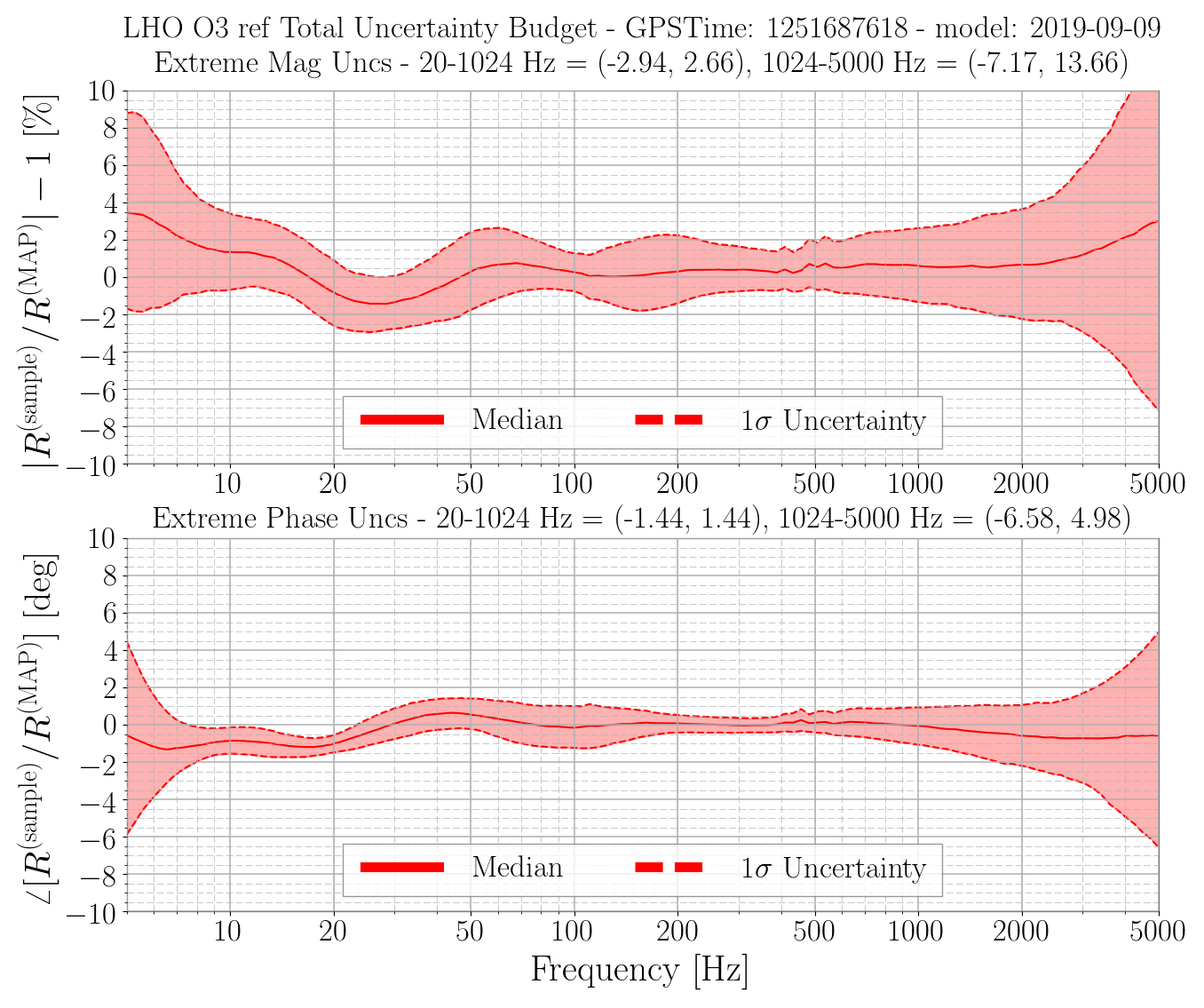
ling.sun@LIGO.ORG - posted 14:39, Wednesday 25 September 2019 - last comment - 14:36, Thursday 03 October 2019(52132)
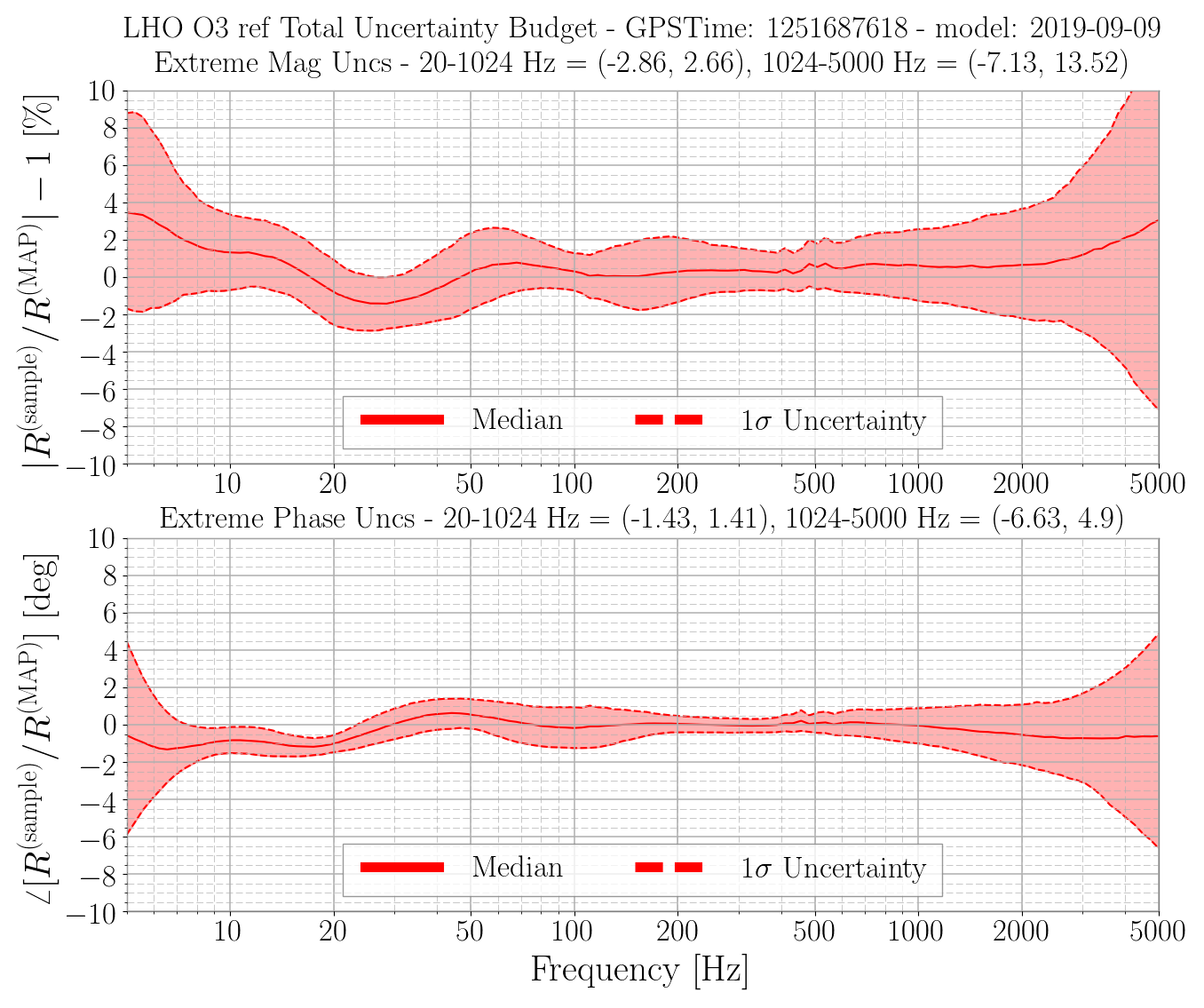
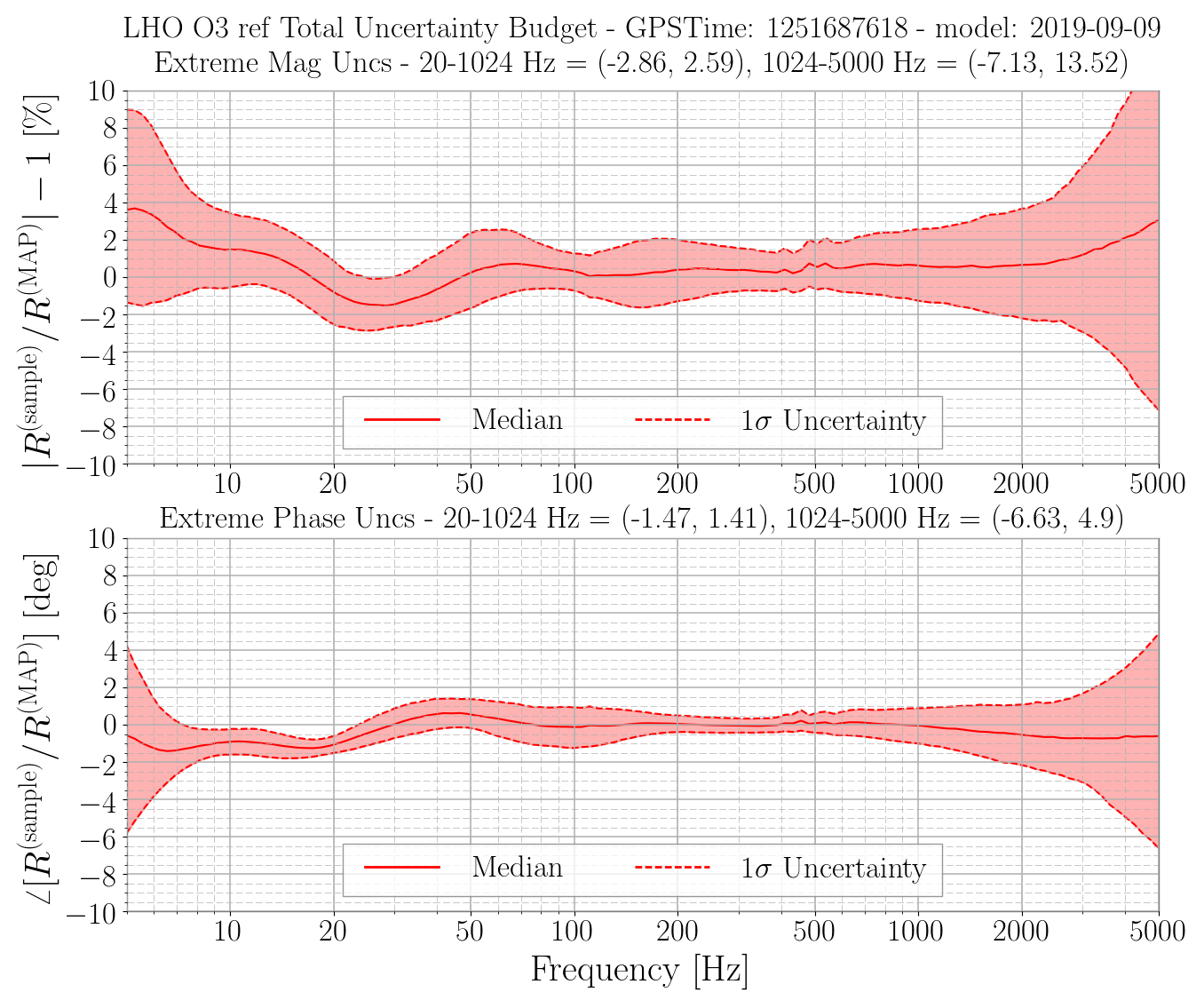
Process all valid LF+HF meas for 0909 model and update uncertainty estimate

Lilli S, Jeff K,

All valid low-fre and high-freq meas for the new 0909 model are processed together (including 0821, 0828, 0904x2, 0909x2, 0916 LF meas, and 0903 HF meas).

The sensing GPR fitting results are attached in the pdf files.

The script used to generate the GPR fitting is:
^trunk/Runs/O3/H1/Scripts/Uncertainty/process_allmeas_includingPCALXHFdata_writeGPRHDF5_model20190909-C.py

The resulting hdf5 file is:
^trunk/Runs/O3/H1/Results/Uncertainty/O3_H1_C_GPR_20190909_nofsQcorr_fmin20Hz_lengthscaleZp5_withPCALXHFdata.hdf5

The uncertainty plot was generated using this command line:

python3 RRNom.py --IFO=LHO --HDF5_A_MCMCresults=/ligo/svncommon/CalSVN/aligocalibration/trunk/Runs/O3/H1/Results/Uncertainty/O3_H1_A_MCMC_20190404.hdf5 --HDF5_A_GPRresults=/ligo/svncommon/CalSVN/aligocalibration/trunk/Runs/O3/H1/Results/Uncertainty/O3_H1_A_GPR_20190909_multi.hdf5 --HDF5_C_MCMCresults=/ligo/svncommon/CalSVN/aligocalibration/trunk/Runs/O3/H1/Results/Uncertainty/O3_H1_C_MCMC_20190904_nomconfig_fmin20Hz_finaltrial.hdf5 --HDF5_C_GPRresults=/ligo/svncommon/CalSVN/aligocalibration/trunk/Runs/O3/H1/Results/Uncertainty/O3_H1_C_GPR_20190909_nofsQcorr_fmin20Hz_lengthscaleZp5_withPCALXHFdata.hdf5 --modelPath=/ligo/svncommon/CalSVN/aligocalibration/trunk/Runs/O3/H1/params/ --modelFilename=modelparams_H1_20190909 --IFOmodel=modelPars --outDir=/ligo/svncommon/CalSVN/aligocalibration/trunk/Runs/O3/H1/Results/Uncertainty/ --plot1SigmaUncs --sampleNumber=1000 --seed=1234 --version=ref --gpsTime=1251687618

The online uncertainty code will start to use this new hdf5 for 0909 model.

Images attached to this report
Non-image files attached to this report
Comments related to this report
ling.sun@LIGO.ORG - 10:03, Thursday 26 September 2019 (52146)

The last LF measurement before the break taken on 0925 was added to the GPR fitting. The fitting results are shown in the attached pdfs. The uncertainty budget slightly improves compared to the results posted yesterday. Here only one set of HF data is included (only the 0903 set is valid for the new model 0909). The HF part can be further improved when more HF data sets are added.

Images attached to this comment
Non-image files attached to this comment
jeffrey.kissel@LIGO.ORG - 10:28, Friday 27 September 2019 (52160)
I've re-run the RRNom.py command that Lilli indicates above, but have added the "--saveSummaries flag such that text files representing the curves above are saved:
python3 RRNom.py --IFO=LHO --HDF5_A_MCMCresults=/ligo/svncommon/CalSVN/aligocalibration/trunk/Runs/O3/H1/Results/Uncertainty/O3_H1_A_MCMC_20190404.hdf5 --HDF5_A_GPRresults=/ligo/svncommon/CalSVN/aligocalibration/trunk/Runs/O3/H1/Results/Uncertainty/O3_H1_A_GPR_20190909_multi.hdf5 --HDF5_C_MCMCresults=/ligo/svncommon/CalSVN/aligocalibration/trunk/Runs/O3/H1/Results/Uncertainty/O3_H1_C_MCMC_20190904_nomconfig_fmin20Hz_finaltrial.hdf5 --HDF5_C_GPRresults=/ligo/svncommon/CalSVN/aligocalibration/trunk/Runs/O3/H1/Results/Uncertainty/O3_H1_C_GPR_20190909_nofsQcorr_fmin20Hz_lengthscaleZp5_withPCALXHFdata.hdf5 --modelPath=/ligo/svncommon/CalSVN/aligocalibration/trunk/Runs/O3/H1/params/ --modelFilename=modelparams_H1_20190909 --IFOmodel=modelPars --outDir=/ligo/svncommon/CalSVN/aligocalibration/trunk/Runs/O3/H1/Results/Uncertainty/ --plot1SigmaUncs --sampleNumber=1000 --seed=1234 --version=ref --gpsTime=1251687618 --saveSummaries

The text files are now committed to the repo here:
/ligo/svncommon/CalSVN/aligocalibration/trunk/Runs/O3/H1/Results/Uncertainty/
    2019-09-26_O3_LHO_GPSTime_1251687618_ref_RelativeResponseUncertainty_FinalResults.txt
    2019-09-26_O3_LHO_GPSTime_1251687618_ref_RelativeResponseUncertainty_MinMax.txt

ling.sun@LIGO.ORG - 14:59, Friday 27 September 2019 (52164)

Now I've added the last set of A meas (0925) to the hdf5 file: ^trunk/Runs/O3/H1/Results/Uncertainty/O3_H1_A_GPR_20190909_multi.hdf5. The resulting uncertainty budget is attached.

The GPR script is: ^trunk/Runs/O3/H1/Scripts/Uncertainty/process_allmeas_writeGPRHDF5_model20190909-A.py

The RRNom command is the same as above.

The txt summary files are ^trunk/Runs/O3/H1/Results/Uncertainty/2019-09-27_O3_LHO_GPSTime_1251687618_ref_RelativeResponseUncertainty_FinalResults.txt and 2019-09-27_O3_LHO_GPSTime_1251687618_ref_RelativeResponseUncertainty_MinMax.txt

Images attached to this comment
jeffrey.kissel@LIGO.ORG - 14:36, Thursday 03 October 2019 (52286)
To be consistent with the file name convention established in Chunks 1 and 2, I've changed the name of the script that produces the GPR estimate and committed the file name change:
/ligo/svncommon/CalSVN/aligocalibration/trunk/Runs/O3/H1/Scripts/Uncertainty/
    process_allmeas_writeGPRHDF5_meas20190828-20191001_withHF_model20190909-C.py
H1 CAL
ling.sun@LIGO.ORG - posted 08:45, Wednesday 25 September 2019 - last comment - 15:20, Friday 27 September 2019(52124)
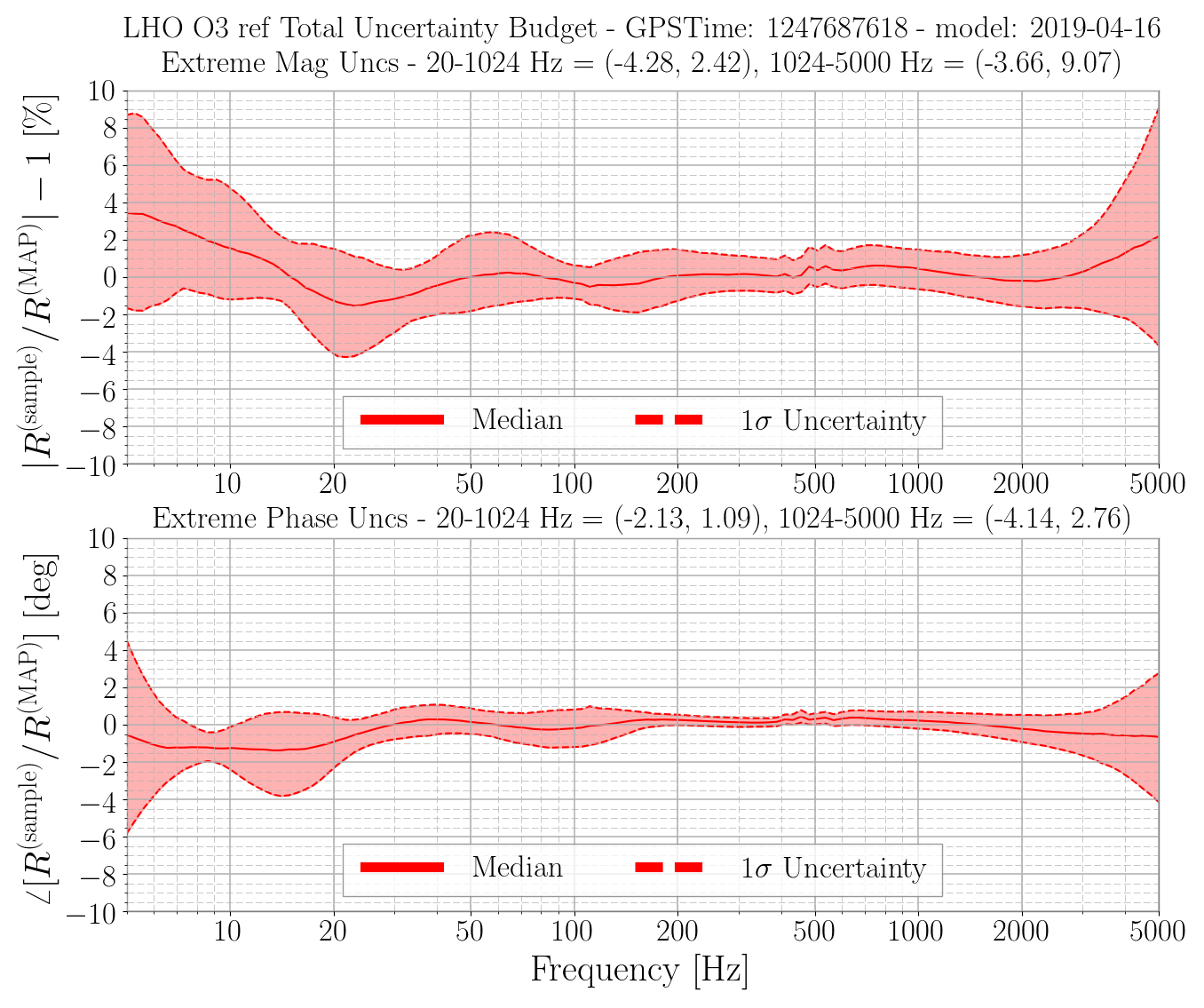
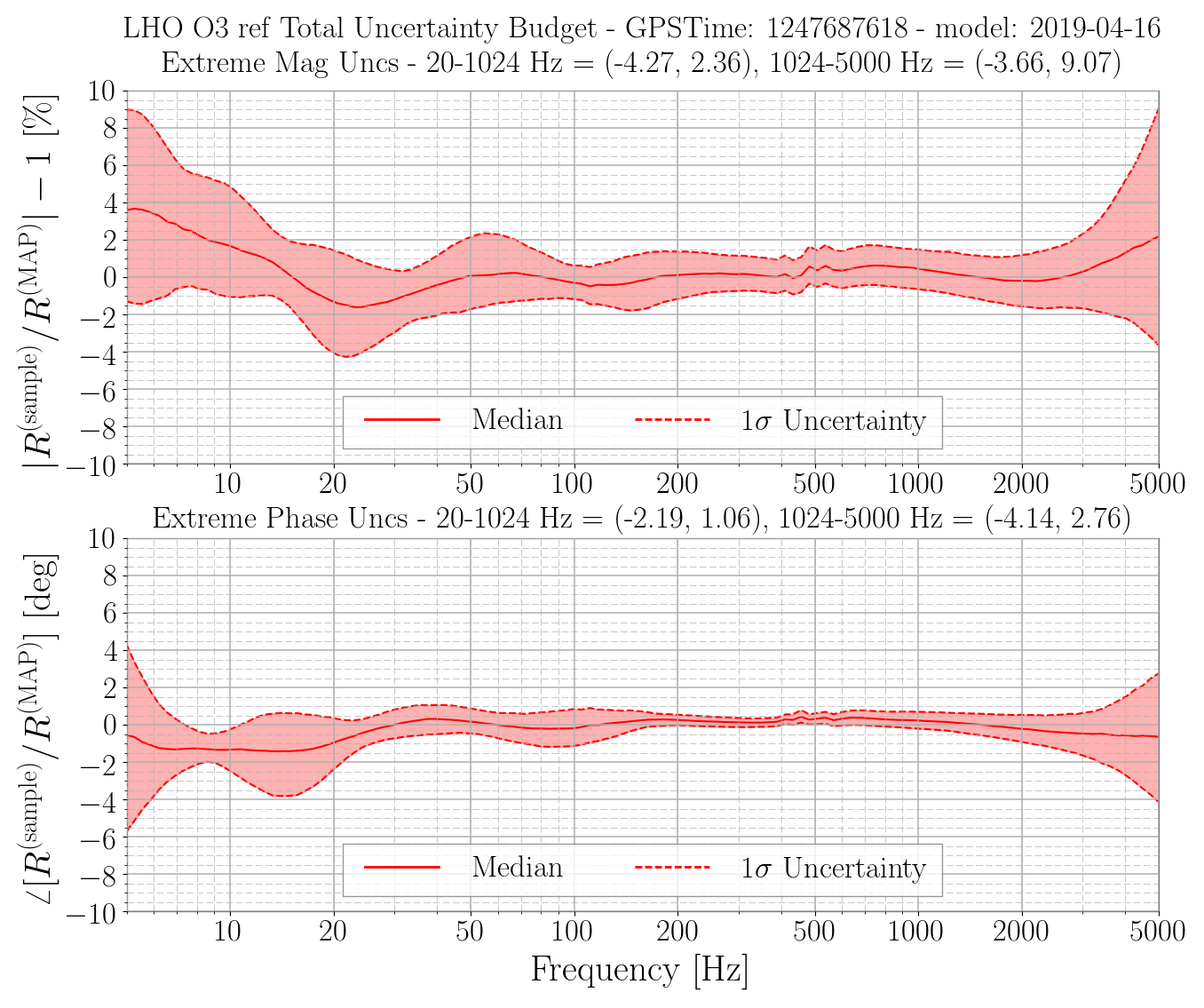
Uncertainty budget for the 2nd chunk of O3a (0611-0828), including all valid LF+HF measurements (H1 model 0416)

Lilli S, Jeff K

We have processed all valid measurements for the observing period from 0611 (powered up to 37W) to 0828 (fixed SRC deturning), including high freq data. New GPR hdf5 files are generated, and the uncertainty budget is reestimated.

The actuation and sensing GPR fitting results are attached in the pdf files:
A_GPR_allmeas0327-0904_model0416.pdf
C_GPR_allmeas0328-0828_model0416.pdf

The scripts used to generate the GPR fittings are:
^trunk/Runs/O3/H1/Scripts/Uncertainty/process_allmeas_writeGPRHDF5_model20190416-A.py
^trunk/Runs/O3/H1/Scripts/Uncertainty/process_allmeas_writeGPRHDF5_meas20190328-20190828_withHF_model20190416-C.py

The resulting hdf5 files are:
^trunk/Runs/O3/H1/Results/Uncertainty/O3_H1_A_GPR_20190416_meas0327-0904.hdf5
^trunk/Runs/O3/H1/Results/Uncertainty/O3_H1_C_GPR_20190416_meas0328-0828_withHFafter0611_nofsQcorr_fmin30Hz_lengthscaleZp5.hdf5

The uncertainty plot was generated using this command line:
python3 RRNom.py --IFO=LHO --HDF5_A_MCMCresults=/ligo/svncommon/CalSVN/aligocalibration/trunk/Runs/O3/H1/Results/Uncertainty/O3_H1_A_MCMC_20190404.hdf5 --HDF5_A_GPRresults=/ligo/svncommon/CalSVN/aligocalibration/trunk/Runs/O3/H1/Results/Uncertainty/O3_H1_A_GPR_20190416_meas0327-0904.hdf5 --HDF5_C_MCMCresults=/ligo/svncommon/CalSVN/aligocalibration/trunk/Runs/O3/H1/Results/Uncertainty/O3_H1_C_MCMC_20190404.hdf5 --HDF5_C_GPRresults=/ligo/svncommon/CalSVN/aligocalibration/trunk/Runs/O3/H1/Results/Uncertainty/O3_H1_C_GPR_20190416_meas0328-0828_withHFafter0611_nofsQcorr_fmin30Hz_lengthscaleZp5.hdf5 --modelPath=/ligo/svncommon/CalSVN/aligocalibration/trunk/Runs/O3/H1/params/ --modelFilename=modelparams_H1_20190416 --IFOmodel=modelPars --outDir=/ligo/svncommon/CalSVN/aligocalibration/trunk/Runs/O3/H1/Results/Uncertainty/ --plot1SigmaUncs --sampleNumber=1000 --seed=1234 --version=ref --gpsTime=1247687618

NOTE: Please see the 3rd pdf file showing the GPR fitting with all available HF meas (three additional sets 0515, 0531, and 0610 compared to the results above). The 0610 (lasting from 0610 to 0618) data set (green dots with large systematics in the upper right corner) is obviously problematic because it includes the power up on 0611. Hence we decided to throw it away. We did not include 0515 and 0531 data sets either since they were taken before the power up and did not match the IFO configuration during 0611-0828 (in fact including them or not does not impact the final results).

Images attached to this report
Non-image files attached to this report
Comments related to this report
ling.sun@LIGO.ORG - 15:20, Friday 27 September 2019 (52165)

For chunk 2 (0611-0828), I've also added the 0925 A meas to A GPR since actuation does not change over the full period. The fitting results are in the pdf file.

The script used to generate the GPR fitting is updated:
^trunk/Runs/O3/H1/Scripts/Uncertainty/process_allmeas_writeGPRHDF5_model20190416-A.py

The resulting hdf5 file is:
^trunk/Runs/O3/H1/Results/Uncertainty/O3_H1_A_GPR_20190416_meas0327-0925.hdf5

The uncertainty plot was generated using this command line:
python3 RRNom.py --IFO=LHO --HDF5_A_MCMCresults=/ligo/svncommon/CalSVN/aligocalibration/trunk/Runs/O3/H1/Results/Uncertainty/O3_H1_A_MCMC_20190404.hdf5 --HDF5_A_GPRresults=/ligo/svncommon/CalSVN/aligocalibration/trunk/Runs/O3/H1/Results/Uncertainty/O3_H1_A_GPR_20190416_meas0327-0925.hdf5 --HDF5_C_MCMCresults=/ligo/svncommon/CalSVN/aligocalibration/trunk/Runs/O3/H1/Results/Uncertainty/O3_H1_C_MCMC_20190404.hdf5 --HDF5_C_GPRresults=/ligo/svncommon/CalSVN/aligocalibration/trunk/Runs/O3/H1/Results/Uncertainty/O3_H1_C_GPR_20190416_meas0328-0828_withHFafter0611_nofsQcorr_fmin30Hz_lengthscaleZp5.hdf5 --modelPath=/ligo/svncommon/CalSVN/aligocalibration/trunk/Runs/O3/H1/params/ --modelFilename=modelparams_H1_20190416 --IFOmodel=modelPars --outDir=/ligo/svncommon/CalSVN/aligocalibration/trunk/Runs/O3/H1/Results/Uncertainty/ --plot1SigmaUncs --sampleNumber=1000 --seed=1234 --version=ref --gpsTime=1247687618

Images attached to this comment
Non-image files attached to this comment
Displaying reports 38441-38460 of 89074.Go to page Start 1919 1920 1921 1922 1923 1924 1925 1926 1927 End