Displaying reports 41741-41760 of 88752.Go to page Start 2084 2085 2086 2087 2088 2089 2090 2091 2092 End
Reports until 07:22, Saturday 13 April 2019
H1 SUS (GRD, SUS)
cheryl.vorvick@LIGO.ORG - posted 07:22, Saturday 13 April 2019 - last comment - 07:26, Saturday 13 April 2019(48457)
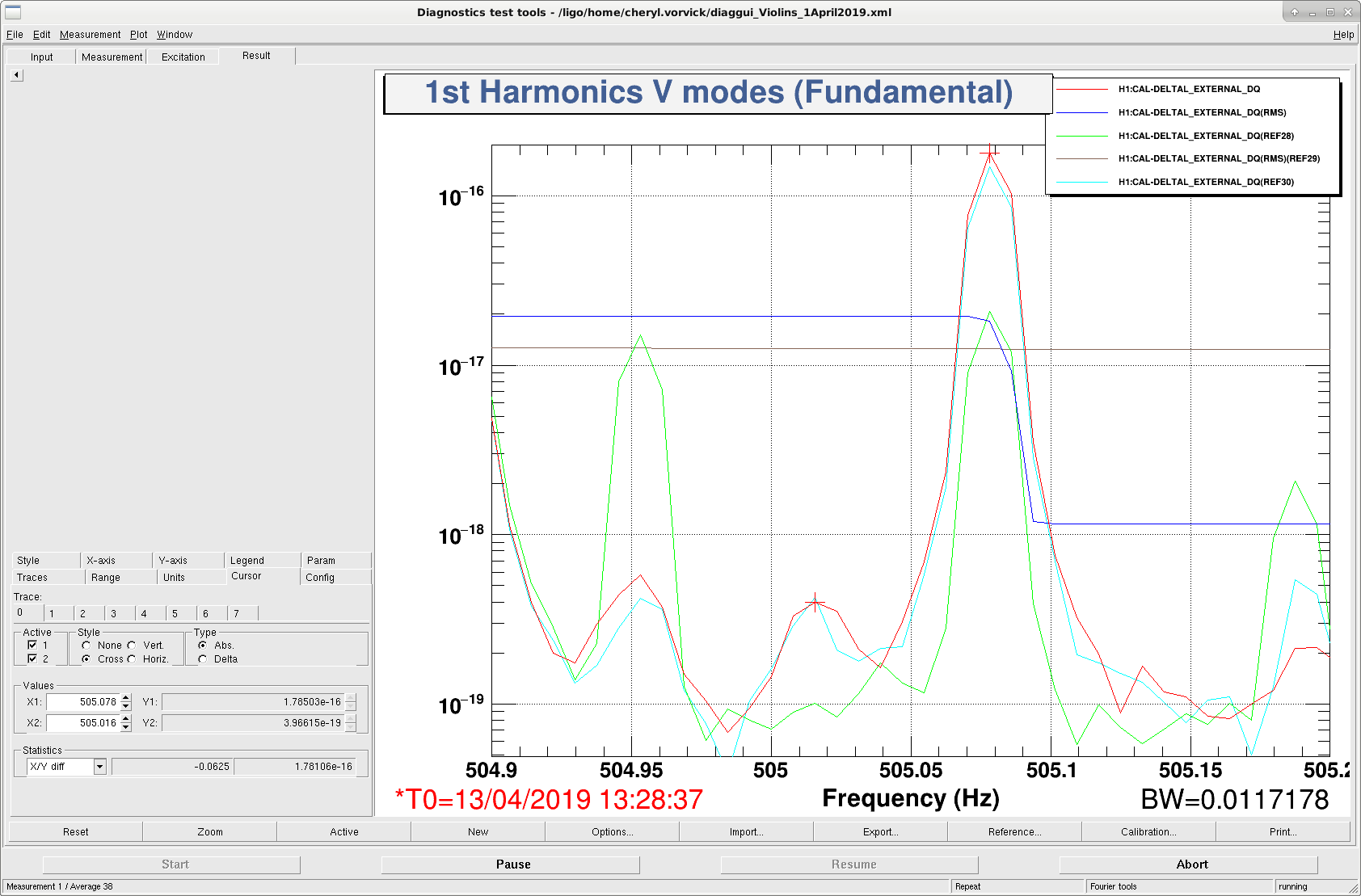
Violin Mode 2 on ETMY is ringing up

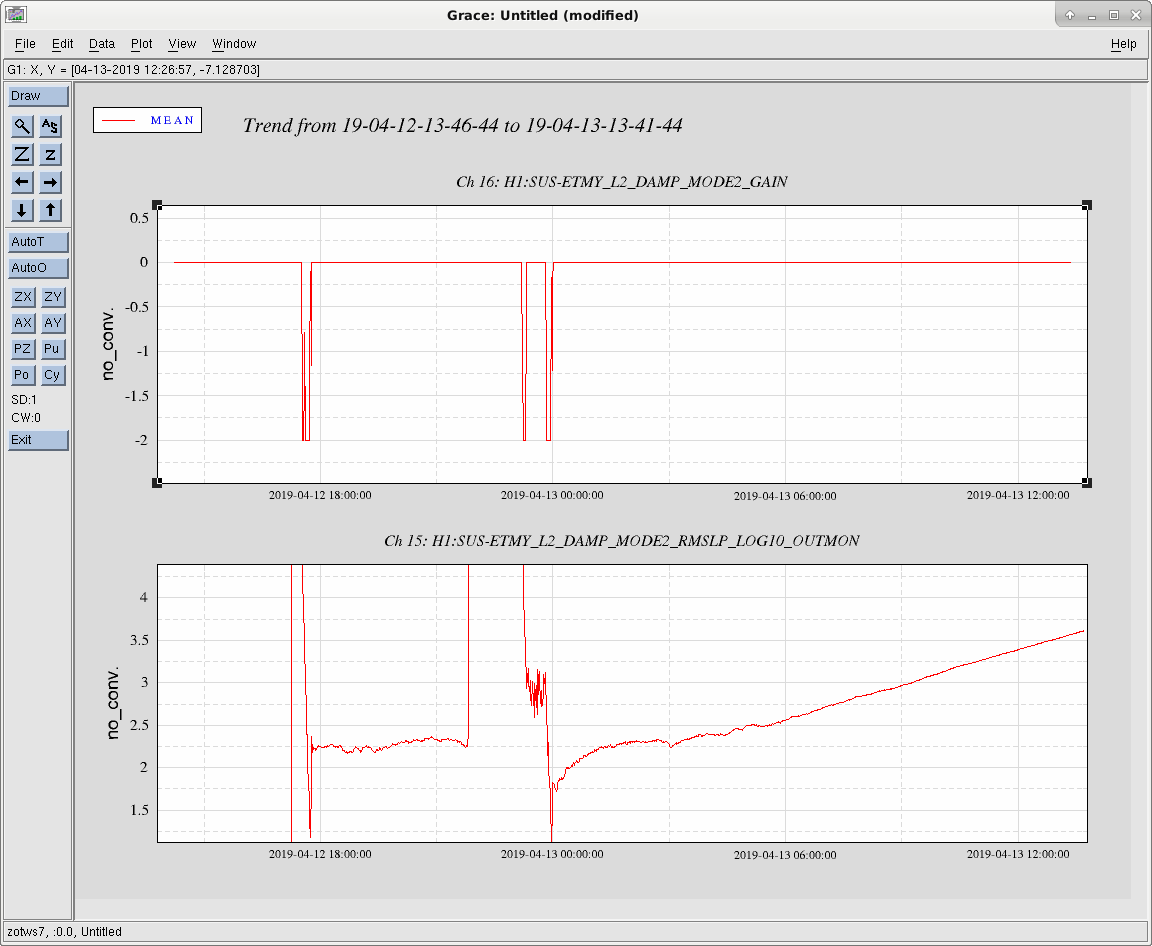
ETMY violin mode2 has been growing, and the RMS is currently at 3.64, so heading to 4.0, and the peak in Cal_Delta is at 1.7e-16 and growing, however, I can't type in a gain to damp the mode.  My first try the gain was loaded for a few seconds and then turned back to zero.  Very soon this will be big enough to cause problems.   I don't see any other Operators that have taken H1 out of Observe to damp.

Images attached to this report
Comments related to this report
cheryl.vorvick@LIGO.ORG - 07:26, Saturday 13 April 2019 (48458)

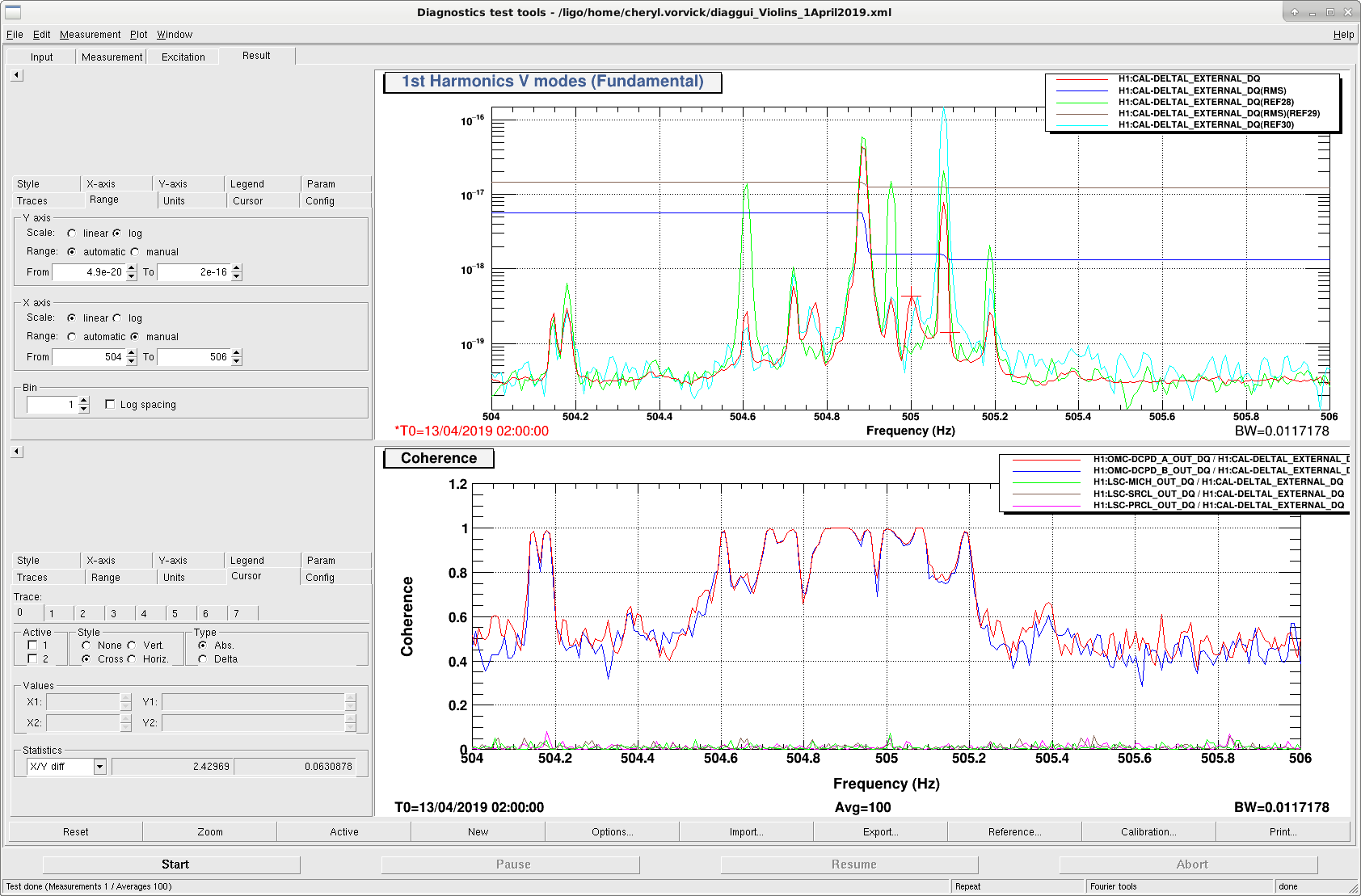
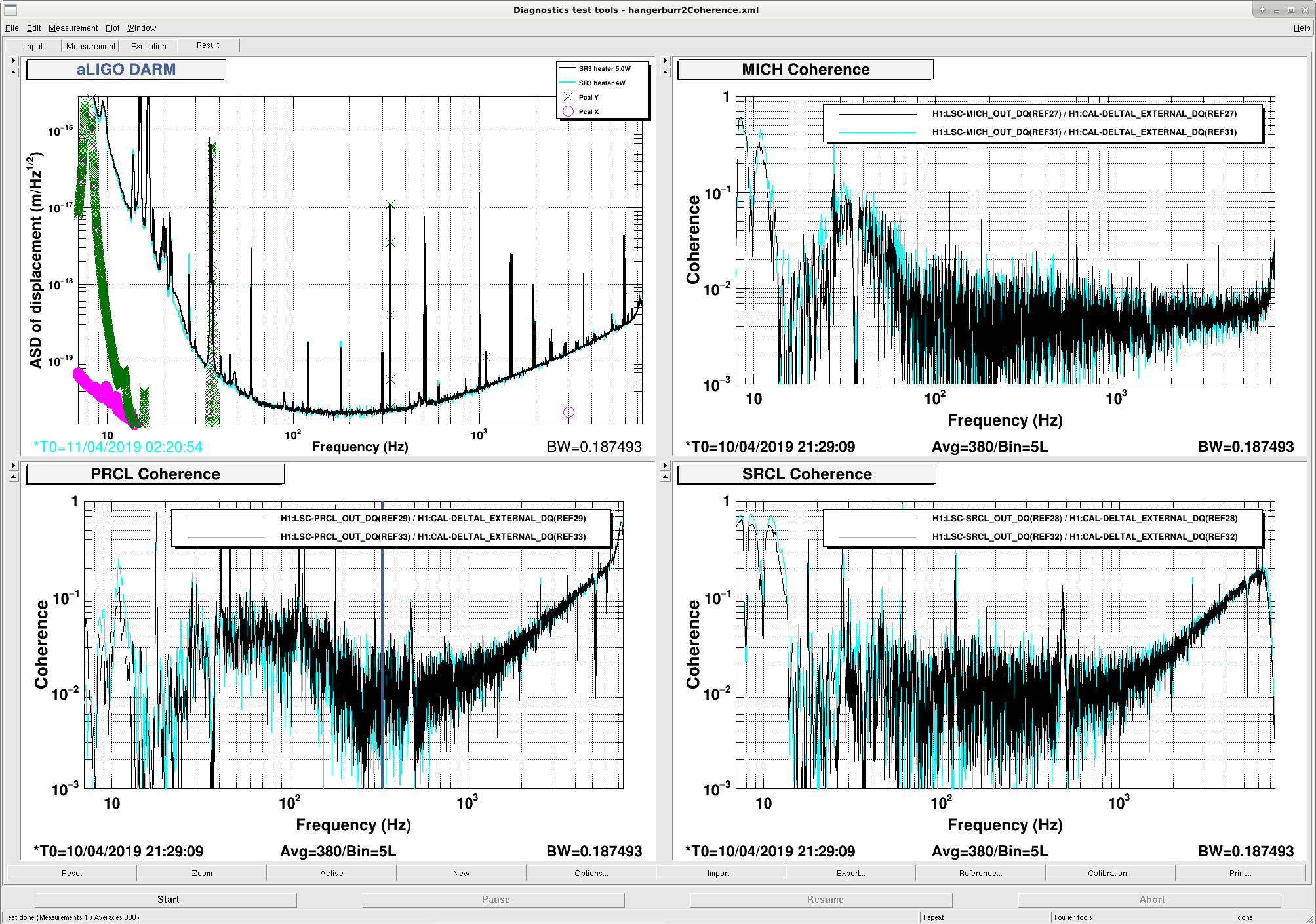
Coherence around the violins, 12 hours ago, and 2 hours ago, same lock.

Images attached to this comment
H1 General
cheryl.vorvick@LIGO.ORG - posted 00:07, Saturday 13 April 2019 (48456)
OPS Owl Transition

TITLE: 04/13 Owl Shift: 07:00-15:00 UTC (00:00-08:00 PST), all times posted in UTC
STATE of H1: Observing at 107Mpc
OUTGOING OPERATOR: TJ
CURRENT ENVIRONMENT:
    Wind: 11mph Gusts, 9mph 5min avg
    Primary useism: 0.04 μm/s
    Secondary useism: 0.54 μm/s
QUICK SUMMARY:  locked for 7 hours, useism is trending downwards

LHO General
thomas.shaffer@LIGO.ORG - posted 00:00, Saturday 13 April 2019 (48452)
Ops Eve Shit Summary

TITLE: 04/13 Eve Shift: 23:00-07:00 UTC (16:00-00:00 PST), all times posted in UTC
STATE of H1: Observing at 107Mpc
INCOMING OPERATOR: Cheryl
SHIFT SUMMARY: useism has grown to 0.4um/s. On a 8 hour lock but had a few planned commissioning activities in the beginning of the shift.
LOG:

H1 ISC
sheila.dwyer@LIGO.ORG - posted 18:47, Friday 12 April 2019 (48454)
tried OMC dither, reverted

Jenne, Sheila

We tried to move the OMC ASC to the dither servos, we were in low noise with the dithers on from about 0UTC April 13th until 1:21 UTC, but we have now reverted to using the QPDs because we saw that the optical gain was decreased by using the dithers.  We will have to come back to why these are not working.

The first time that we tried to transition to the dithers while DARM was locked on RF, the OMC unlocked.  The second time, we were able to engage the servos but they had a very slow oscillation (~15 minutes) and we could see signals in the Q quadratures.  We transitioned back to the QPD servos and introduced offsets.  We phased the dither demods to reduce the signals in Q while the offsets were on, and closing the servos brought the OMC transmission back up (once we removed out offsets).  

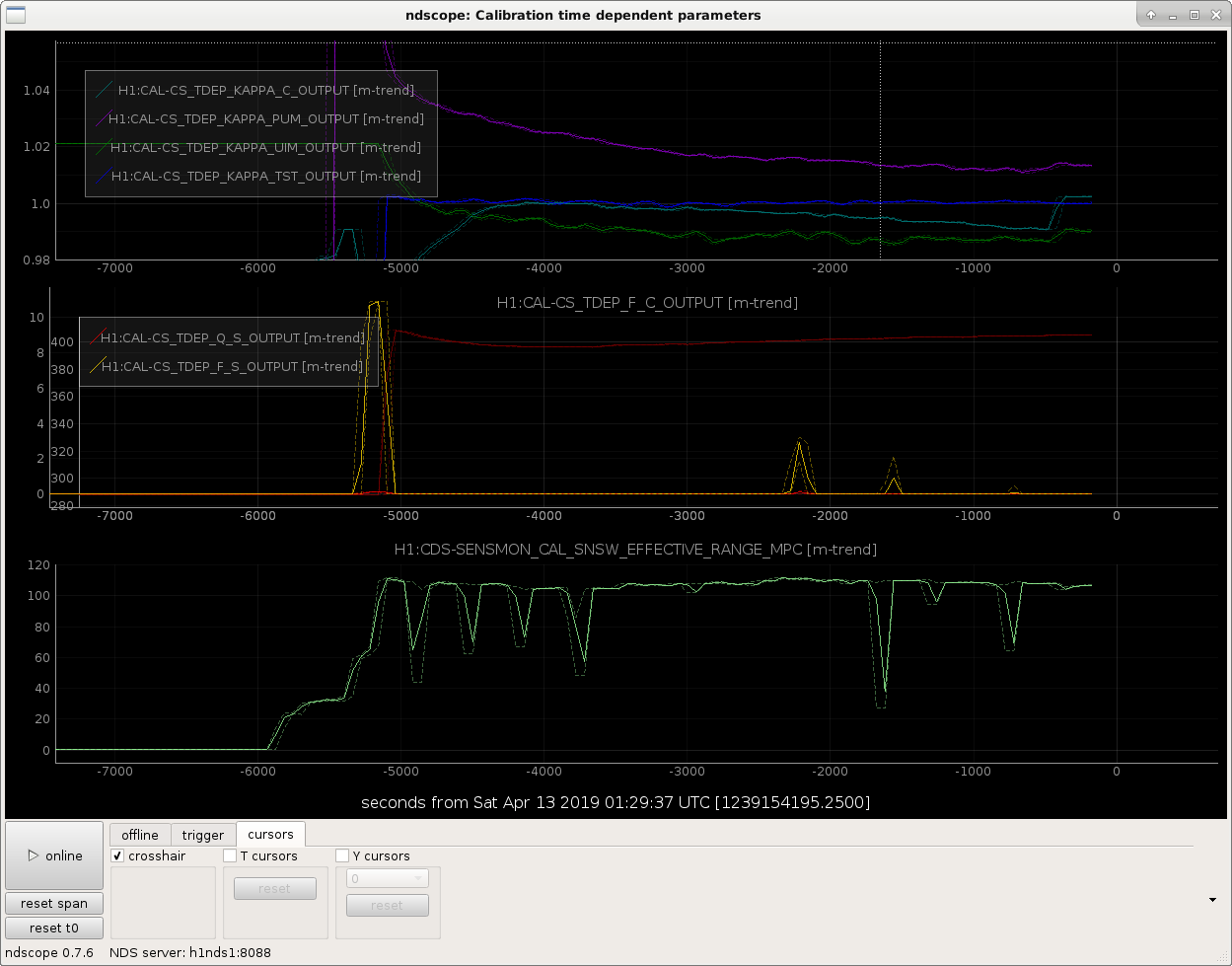
However, watching the trend of kappa_c over the first hour of the lock we can see that the optical gain was low and getting worse, in other locks kappa_c is consistently between 1 and 1.02, in this lock it started at 1 and dropped to 0.99.  at about -200 seconds in the attachment you can see that the optical gain goes right back to 1 when we dropped out of observing to swtich back to the QPD alignment servos.  It also seems that kappa_uim and kappa_pum respond to the change in OMC alignment, which seems funny.  


Images attached to this report
H1 ISC
jenne.driggers@LIGO.ORG - posted 17:03, Friday 12 April 2019 (48450)
ETM spot moves

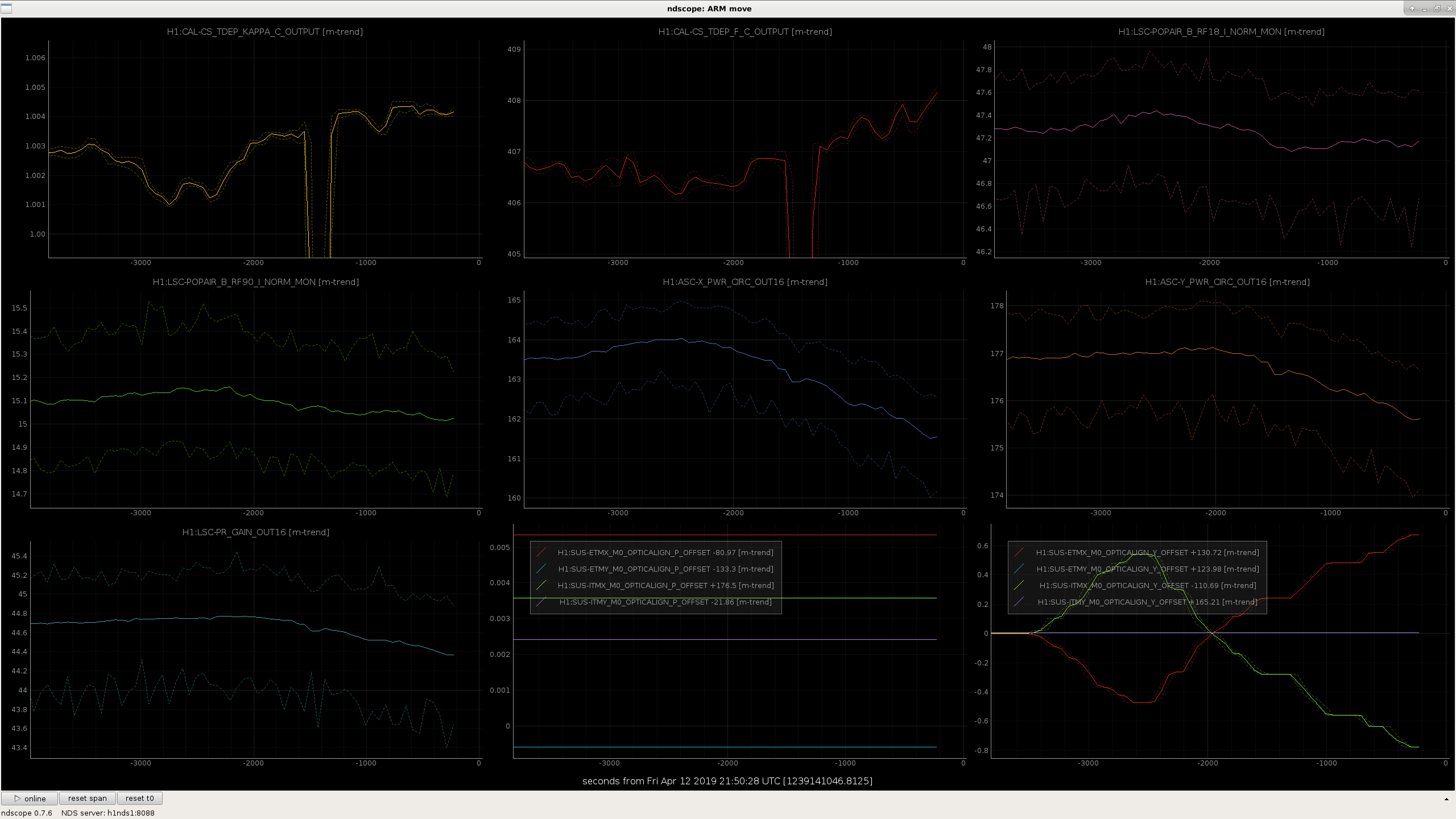
ETM spot moves, phase 1.  These spot moves are *very* slow, and so are happening while we are in Observing. 

I began at 20:52:15 UTC by turning off the ADS loops that control the ETM spots on both arms (pit and yaw, 4 and 5).  I left on the PRM->ITMY spot loop. 

I moved X Soft in yaw, since Anamaria et al. said that that was the most interesting one, back in March (alog 47606).  Since the spot on ITMY is still servoed, the spot on ITMX should be roughly the same the whole time, thus primarily making an ETM spot move. 

At 21:28 UTC I roughly hand tuned the ETMX Y2L gain, putting it to 5.5 from the 4.95 value it had been, then continued moving the Xarm in yaw.

At 21:36 UTC, I roughly hand tuned both ETMs Y2L gains, putting EX to 5.9 and EY to 1.8 from the 2.03 value it had been, then continued moving the Xarm in yaw.

At about 21:50 UTC, I *tried* to hand-tune the A2L gains, but typed a bad number into EY pitch, and things didn't go well for the IFO :(  Travis is bringing it back online though.

In the attached screenshot, you can see several metrics as well as the slider values for the optics.  In the bottom right corner you can see that I went one direction for a while, then turned around.  The circulating powers seemed to like the first direction better, but the calibration values for kappa_c and f_c both prefer the second direction pretty clearly.  The Xarm circulating power could be decreasing a bit because we are very nearly starting to fall off of one of the transmission QPDs.  But, the Yarm and PR gain also start to go down, which is somewhat surprising, and certainly real.

Georgia points out that, yet again, the circulating powers seem to be telling us the opposite thing from the kappa_c and f_c, which is somewhat frustrating.  

I will come back to this once we're locked later.

In total, though we didn't budget commissioning time for this, since I caused a lockloss and then we used the lockloss for the on-the-board but target-of-opportunity commissioning of the OMC ASC back to dithering, we were out of observing for 2.38 hours.

Images attached to this report
LHO General
thomas.shaffer@LIGO.ORG - posted 16:19, Friday 12 April 2019 (48451)
Ops Eve Shit Transition

TITLE: 04/12 Eve Shift: 23:00-07:00 UTC (16:00-00:00 PST), all times posted in UTC
STATE of H1: Lock Acquisition
OUTGOING OPERATOR: Travis
CURRENT ENVIRONMENT:
    Wind: 15mph Gusts, 9mph 5min avg
    Primary useism: 0.07 μm/s
    Secondary useism: 0.38 μm/s
QUICK SUMMARY: Relocking after a lock loss from before my shift. useism is rising, nearing the 90th percentile line.

H1 General
travis.sadecki@LIGO.ORG - posted 16:01, Friday 12 April 2019 (48441)
Ops Day Shift Summary

TITLE: 04/12 Day Shift: 15:00-23:00 UTC (08:00-16:00 PST), all times posted in UTC
STATE of H1: Lock Acquisition
INCOMING OPERATOR: TJ
SHIFT SUMMARY:  Currently relocking.
LOG:

15:46 Christina and Nichole to MY

16:20 Kyle to MY

18:15 Kyle back

H1 General
travis.sadecki@LIGO.ORG - posted 14:50, Friday 12 April 2019 (48448)
Lockloss at 21:48 UTC

Cause is known, but I'll refrain from using names.

H1 OpsInfo (GRD)
sheila.dwyer@LIGO.ORG - posted 14:30, Friday 12 April 2019 - last comment - 14:54, Friday 12 April 2019(48446)
three guardian changes that need loading

Next time we are out of observing, it would be good to reload the guardians for IMC_LOCK, ALS_COMM, and OMC_LOCK.

Travis reminded us again about the annoying configuration difference that keeps coming up in the MC2_M2 Lock filter.  In inital alingment there is a more aggressive low pass used for MC2 when we are locking the X arm with IR.  The DOWN state of ALS COMM was setting this back to the less aggressive low pass used for locking in the main state, but the DOWN state of ALS COMM isn't necessarily re-requested after an initial alignment is done if ALS_COMM is already in DOWN.  This is the drawback of having 4 different gaurdians that set the state of one filter, but in this case it would be hard to avoid.  I've added an only_on statement to the IMC_LOCK guardian so that this should be reset there everytime the IMC relocks, and also copied the statement that sets this up in ALS_COMM from DOWN to PREP_FOR_HANDOFF.  This should make sure that it is set correctly each time. 

For the OMC guardian, I had tried to change the setting for the OMC ASC MASTER gain to 0.02 last night and TJ had loaded that guardian at the lockloss.  However, the gain was reset again in the state which is meant for changing the ASC over to the dithers (currently commented out).  This morning Travis and I set it by hand to the lower gain before going to observe.  I made a parameter in omcparams that is a flag indicating if we are using the dither asc or not, and now the mastergain will be set according to that flag.  The guardian was making changes to these gains in slow steps, but we have been manually doing it in single steps which hasn't caused any issues so the guardian is now doing single steps.  

Comments related to this report
travis.sadecki@LIGO.ORG - 14:54, Friday 12 April 2019 (48449)

I reloaded these after the recent lockloss.  Complete.

H1 General
travis.sadecki@LIGO.ORG - posted 10:58, Friday 12 April 2019 (48445)
Observing at 17:57 UTC

Did an Initial Alignment after EQs rang down sufficiently.  No issues relocking, other than SRC_ALIGN preferring Sheila's button clicks over mine.

H1 SEI
hugh.radkins@LIGO.ORG - posted 09:49, Friday 12 April 2019 (48443)
Wind Fence Bottom Panel catches a few tumbleweeds

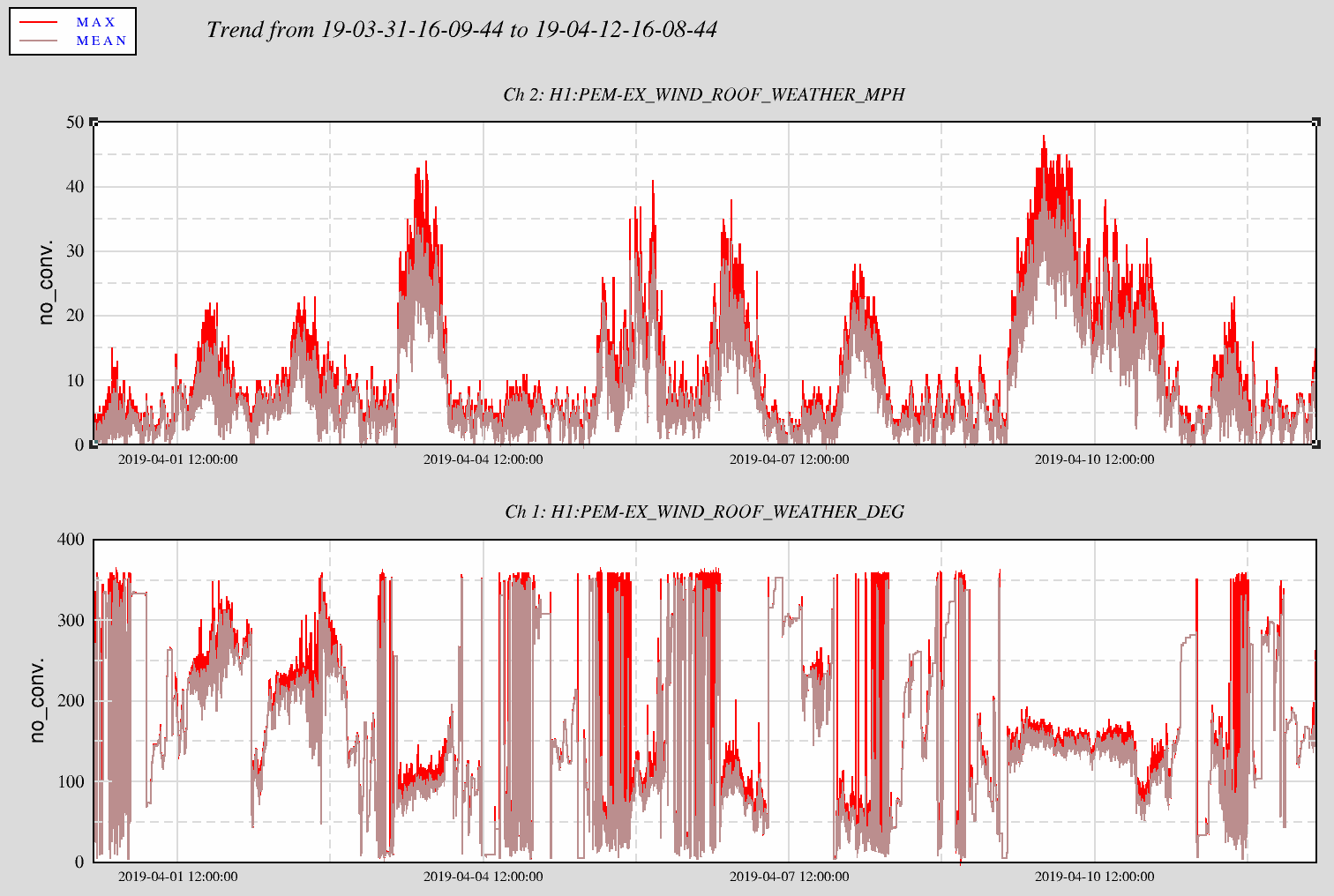
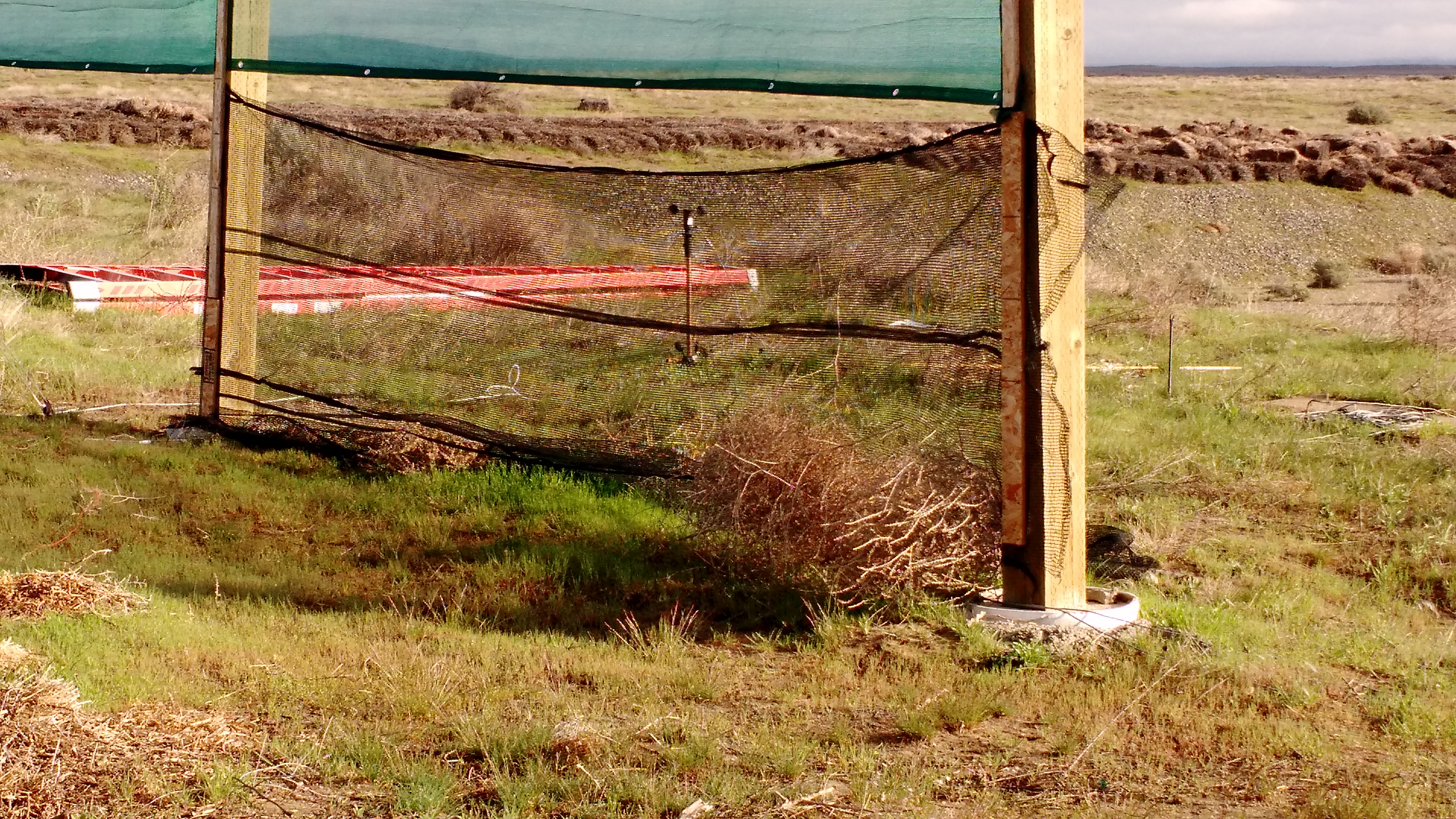
On March 19, half of the proto-type wind fence was extended down to the ground.  We've had a few strong wind events since then and most events tend to get the tumbleweeds tumbling.  But, on 3 and 10 March, there were stronger and longer events (see first attachment) with gusts over 30mph and sustained winds over 20 & 25 mph for 10 & 18 hours respectively.  During these events the wind direction was from ~90° to ~150° ; 90 is normal to fence and 135 would be "NW".  So the second event may have cleaned the fence some but there still remains a few albeit the panel is only 15' wide so how many can it hold anyway.  Photo of the fence from this morning attached too.  Notice that the top edge of the lowest panel is not attached to the bottom of the above panel; this may have allowed some weeds to escape.  I think this shows that over time, the bottom panel will tend to accumulate tumbleweeds.

Images attached to this report
H1 AOS
travis.sadecki@LIGO.ORG - posted 08:47, Friday 12 April 2019 (48442)
Ops Day Shift Transition

TITLE: 04/12 Day Shift: 15:00-23:00 UTC (08:00-16:00 PST), all times posted in UTC
STATE of H1: Earthquake
OUTGOING OPERATOR: Cheryl
CURRENT ENVIRONMENT:
    Wind: 12mph Gusts, 6mph 5min avg
    Primary useism: 0.33 μm/s
    Secondary useism: 0.24 μm/s
QUICK SUMMARY:  More EQs still arriving.  Earth is angry this morning.

H1 CDS
david.barker@LIGO.ORG - posted 08:36, Friday 12 April 2019 - last comment - 21:59, Friday 12 April 2019(48440)
h1edc generated 5 CRC errors overnight, increased delay to 5mS

On Tuesday we increased the mx_stream delay for h1susauxh34 from 1mS to 3mS. At 04:29:09 and 04:29:31 PDT this morning we got 5 CRC errors in total. I have just increased the delay from 3mS to 5mS while H1 is unlocked and reset the CRC counter to zero.

Comments related to this report
david.barker@LIGO.ORG - 21:59, Friday 12 April 2019 (48455)

Unfortunately a pair of h1edc CRC errors this afternoon at 14:48:49 PDT.

H1 General
cheryl.vorvick@LIGO.ORG - posted 08:00, Friday 12 April 2019 (48439)
OPS Owl Summary:

TITLE: 04/12 Owl Shift: 07:00-15:00 UTC (00:00-08:00 PST), all times posted in UTC
STATE of H1: Earthquake
INCOMING OPERATOR: Travis
SHIFT SUMMARY: Great until a series of EQs
LOG:

Origin Time
UTC
Mag Latitude
degrees
Longitude
degrees
Depth
km
A
M
  Flinn-Engdahl Region Name
2019-04-12 14:51:30 5.6 6.56°S 148.60°E 10 A   New Britain Region, P.N.G.
2019-04-12 14:28:41 4.7 14.12°N 51.62°E 10 A   Eastern Gulf of Aden
2019-04-12 12:23:07 6.0 15.34°S 173.01°W 33 A   Tonga Islands
2019-04-12 12:12:13 5.1 1.80°S 122.69°E 10 A   Sulawesi, Indonesia
2019-04-12 11:40:49 6.7 1.88°S 122.60°E 10 C MT Sulawesi, Indonesia


H1 ISC (ISC)
craig.cahillane@LIGO.ORG - posted 17:47, Thursday 11 April 2019 - last comment - 10:30, Friday 12 April 2019(48426)
Kappa C goes like inverse DARM optical gain (i.e. the wrong way)
Last night we moved the SR3 heater, and while doing this we found that kappa C (which is supposed to be proportional to DARM optical gain) went the opposite way of the range.

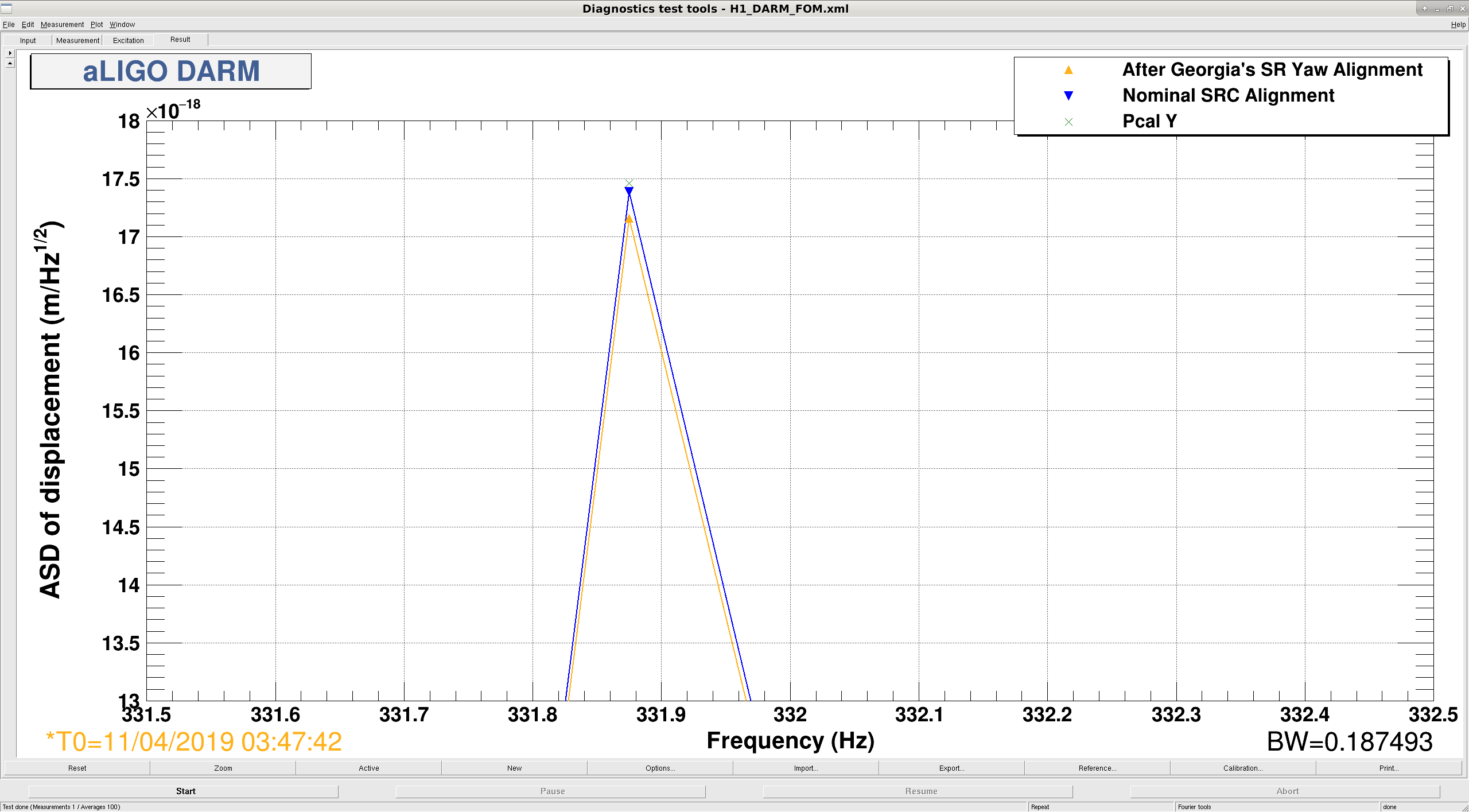
In particular, when Georgia moved the SRC alignment in yaw, we saw kappa C increase by about 1%.  This made us think we were winning with DARM response.

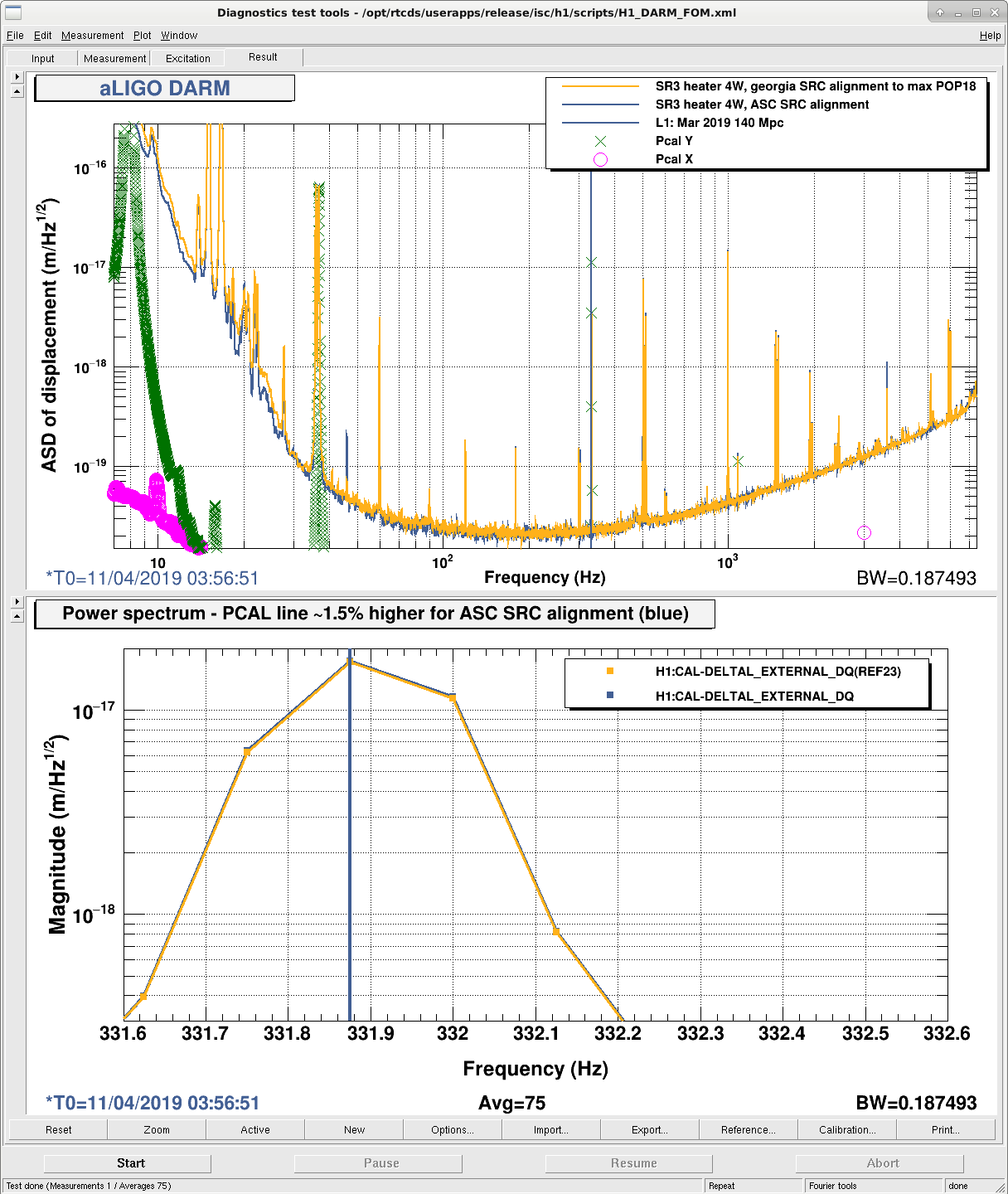
However, when we looked at the DARM spectrum we found that the response to the 331.7 Hz PCAL line had gone down.  Since the PCAL line signal had not changed, this means that the DARM optical gain actually decreased.

This means that kappa C is going like inverse DARM optical gain.  According to documentation (T1700106), kappa C ought to be proportional to optical gain.
Images attached to this report
Comments related to this report
sheila.dwyer@LIGO.ORG - 10:30, Friday 12 April 2019 (48444)

Lili, Danny, Sheila

Last night we looked through the front end calculation of this one step at a time, and indeed the front end does estimate that the DARM response to PCAL at 331Hz is increasing at this time.  Lili has now convinced Danny and I that this is all right, that the reported change in cavity pole frequency and kappa_c are together correctly explaining the change in the magnitude of the sensing function as measured by the 331Hz line.

Ignoring the optical spring, the expression for the (normalized) time dependent part of the sensing function is kappa_c/(1+if/f_c), which I think is what the quantity called S1 in the front end is representing.  The magnitude of S1 increased from 0.765 to 0.775 from 2019/04/11 03:48:47 UTC to 2019/04/11 04:07:59 UTC during the SRC alignment test show in the attached screenshot (48406)  This is pretty well explained by plugging the reported cavity pole increase from 377 to 407 Hz and the decrease in kappa_c from 1.02 to 1, this would result in an increase in the magnitude of the sensing function at 331Hz even though it is a decrease in kappa_c.  


H1 CAL
jenne.driggers@LIGO.ORG - posted 16:03, Thursday 11 April 2019 - last comment - 14:30, Friday 12 April 2019(48421)
Calibrated compensated-for-time-dependence DARM spectrum ready for use

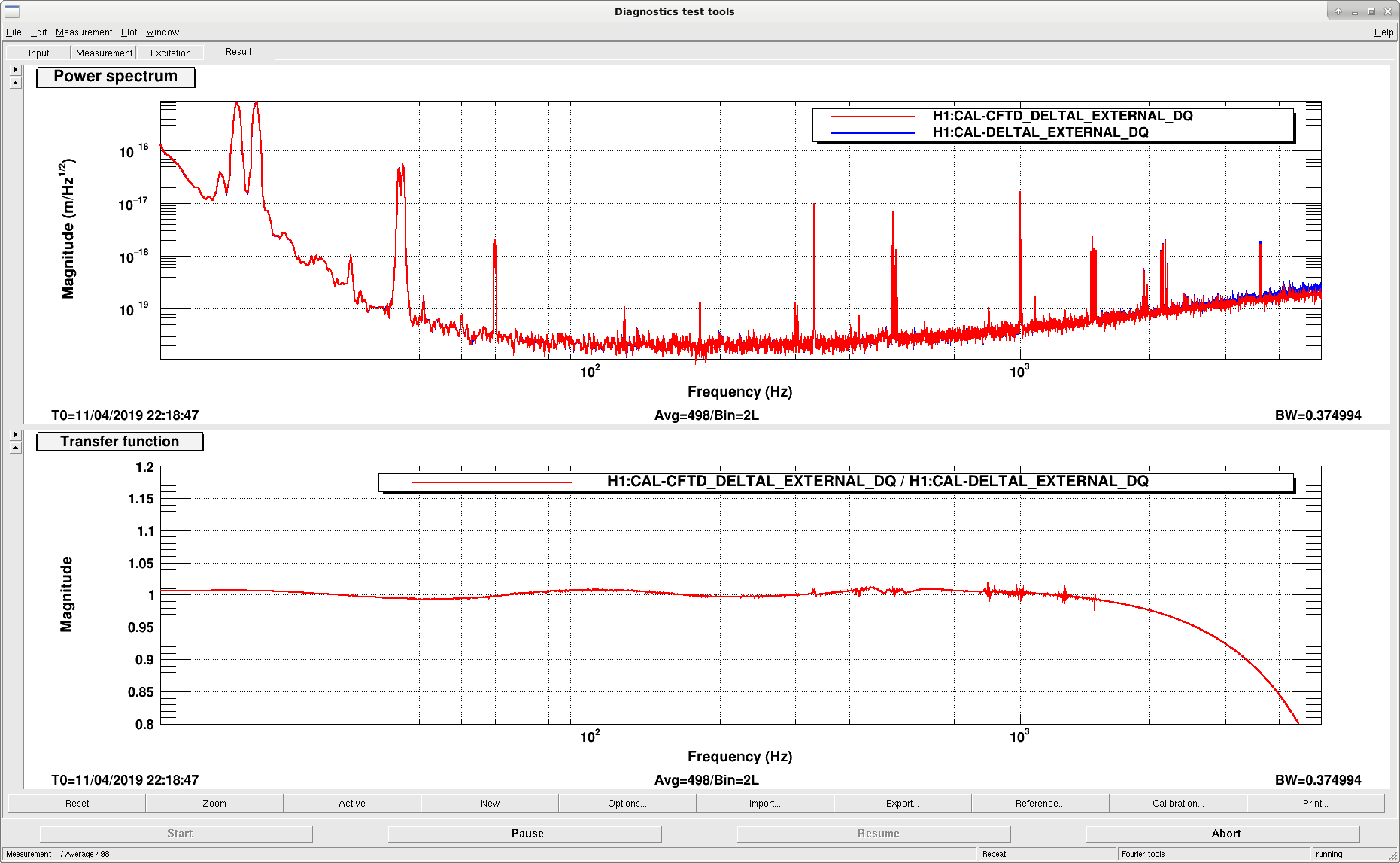
After all the latest model and fitting work by JeffK and Lilli, Jeff installed the appropriate inverse sensing filter (same as for 'usual' darm, but doesn't have the cavity pole in it, and also doesn't have some high freq stuff, since those get take care of in series just after the filter). 

I had been confused at that time, and wondered why the CFTD inverse sensing filter bank also had a whitening filter in it, so Jeff turned it off.  After further looking around today, I discovered that really it's just that the CFTD path does the whitening in a different place than in the 'usual' path for some numerical precision reasons, so we really did need that whitening filter on.  So, with the updated inverse sensing filter, and the whitening filter correctly on now, and also the integer number of delay cycles set to 9 to match the 'usual' DARM path, the CFTD version of DARM seems to be ready for use.

It looks like there is some discrepancy at high frequencies that I don't yet understand, but otherwise I think we can use the CFTD version for references when we are doing tests.

Images attached to this report
Comments related to this report
evan.goetz@LIGO.ORG - 14:30, Friday 12 April 2019 (48447)
The high frequency issue is also seen at L1 and has to do with the way the the EPICS control zpk filter has been coded and differs from a FOTON IIR filter. See documentation from Joe's implementation here: https://dcc.ligo.org/LIGO-G1801581
H1 TCS (AOS, AWC, ISC, TCS)
georgia.mansell@LIGO.ORG - posted 23:28, Wednesday 10 April 2019 - last comment - 18:58, Monday 22 April 2019(48406)
SR3 heater steps down

Craig, Danny, Georgia

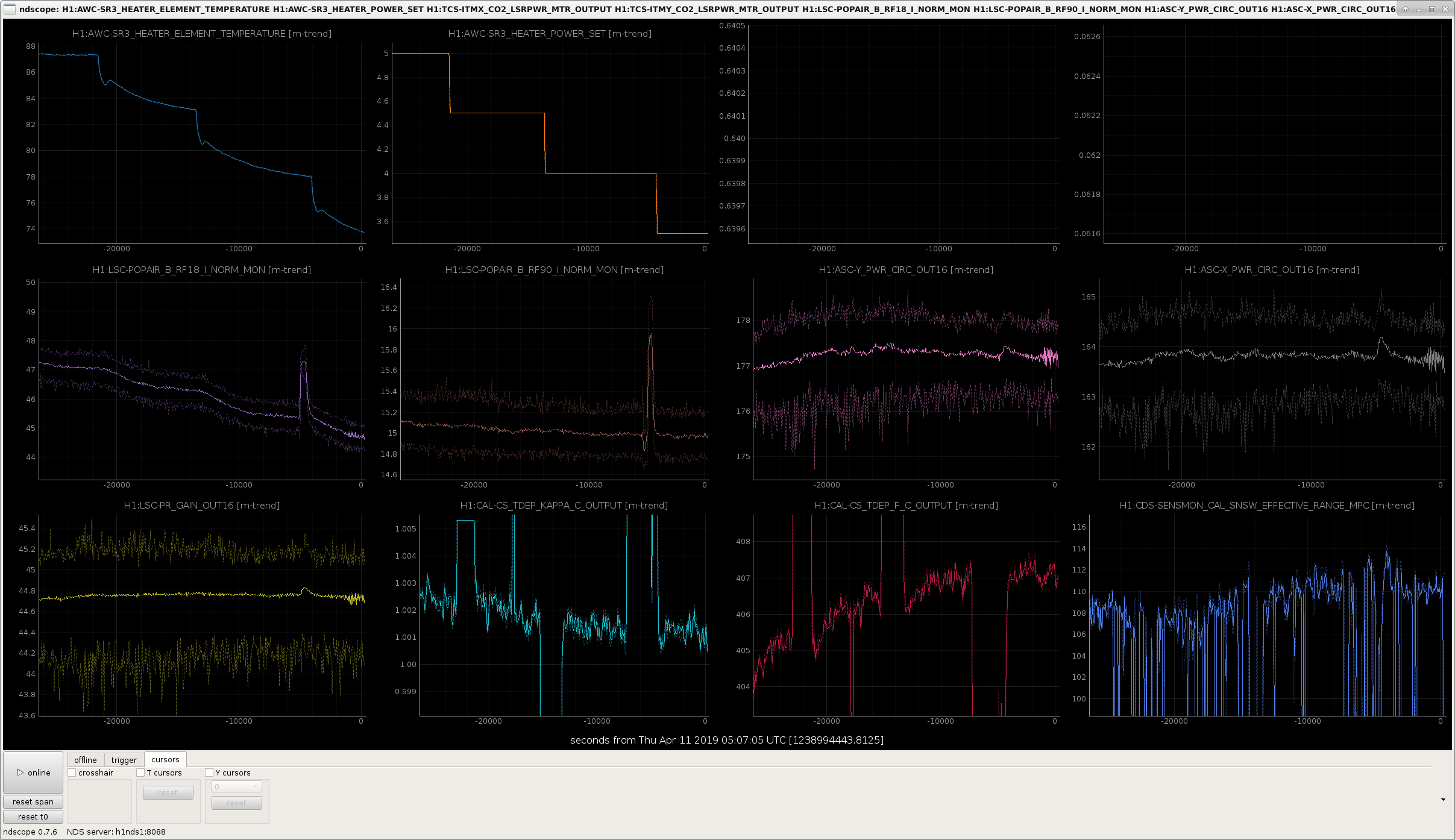
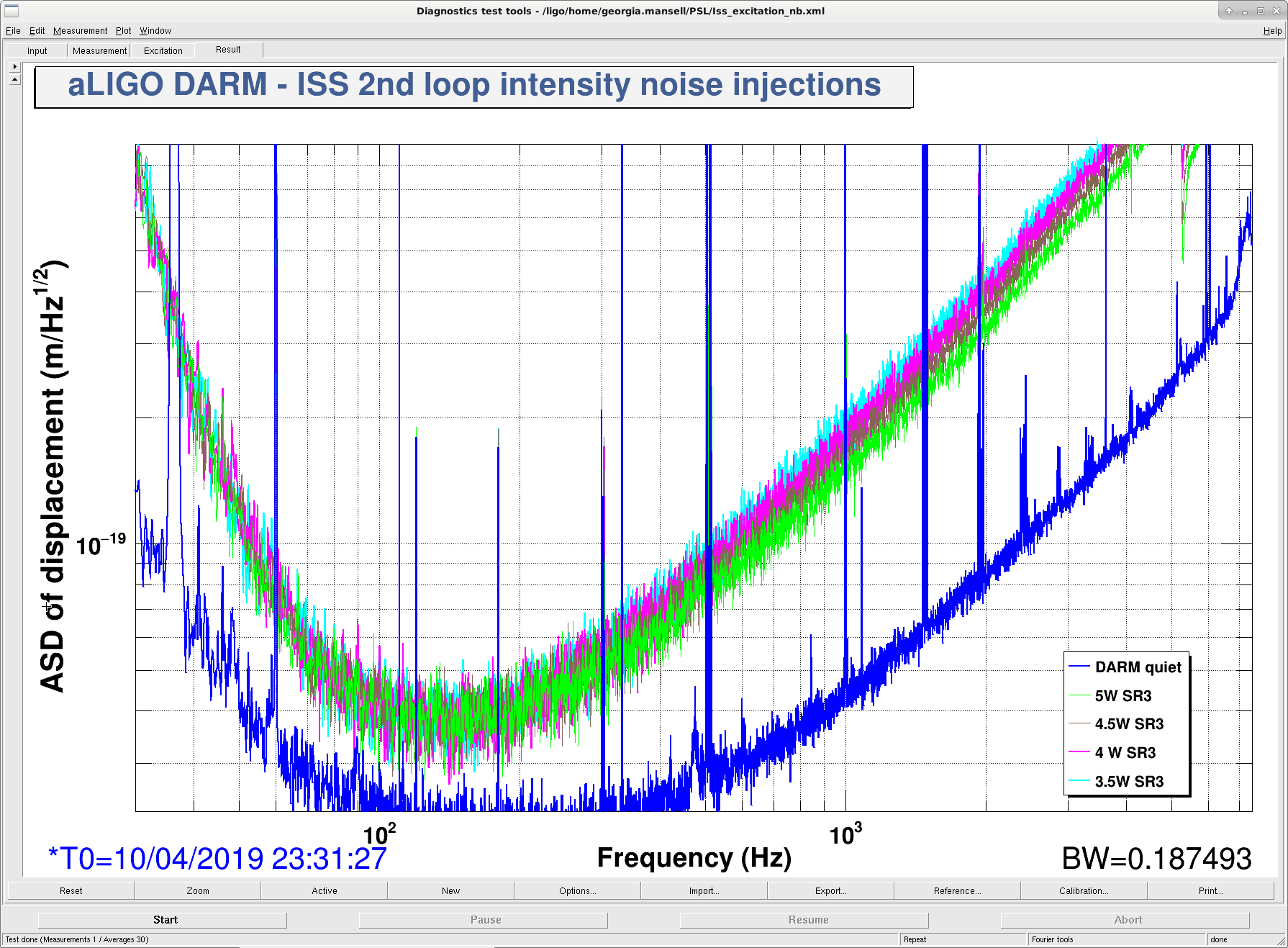
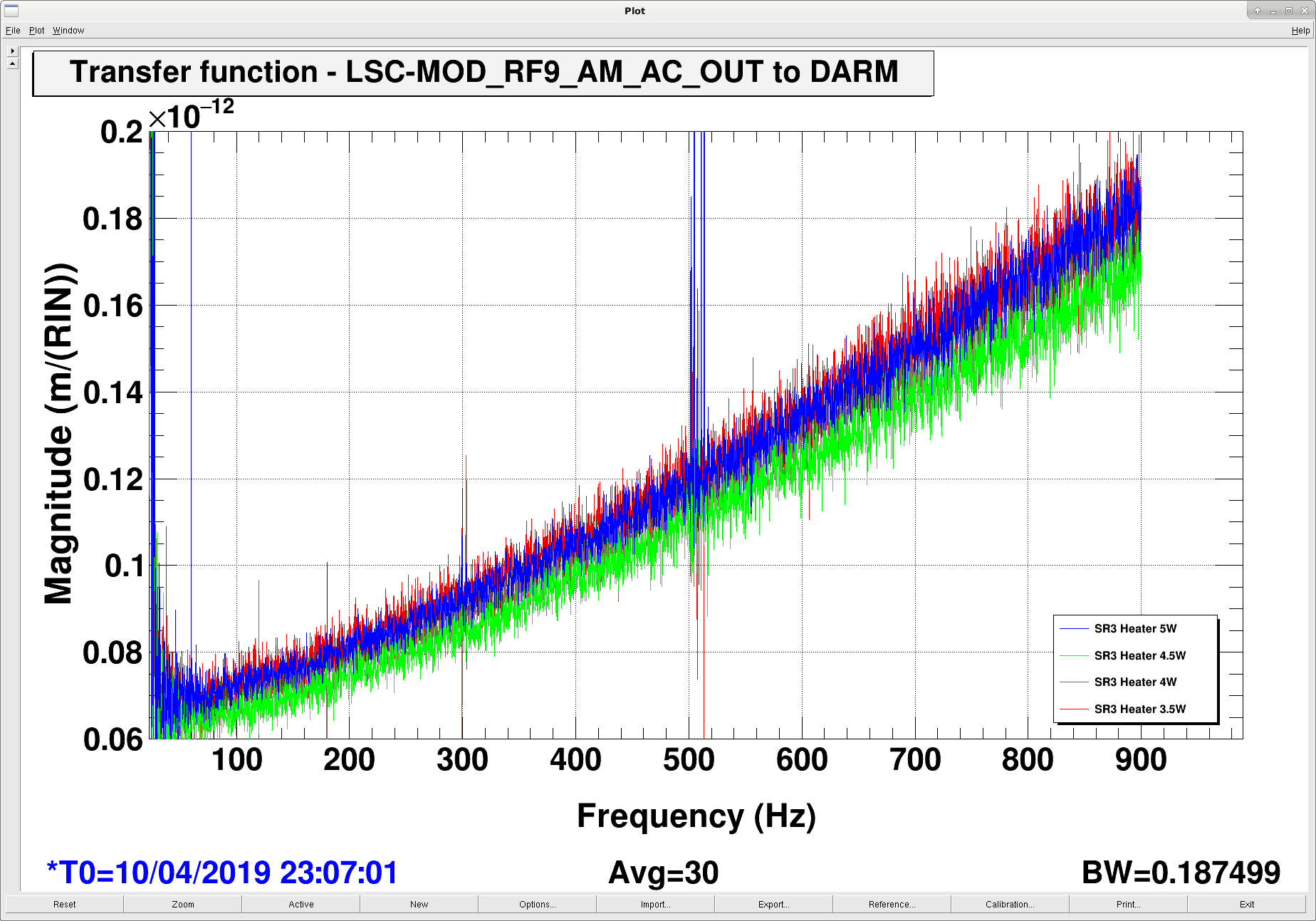
Today we stepped the SR3 heater down in 0.5 W steps, from 5W to 3.5W, according to plan. Here's what we found as we reduced the heating on SR3:

Buildups, cavity pole

These values are shown in the first attachment, The kick in many signals just before we stepped down to 3.5 W is explained below.

DARM plant and laser noise couplings

We also monitored the DARM plant, frequency noise coupling, intensity noise coupling, and RF9 RIN coupling at each step.

SRC ASC

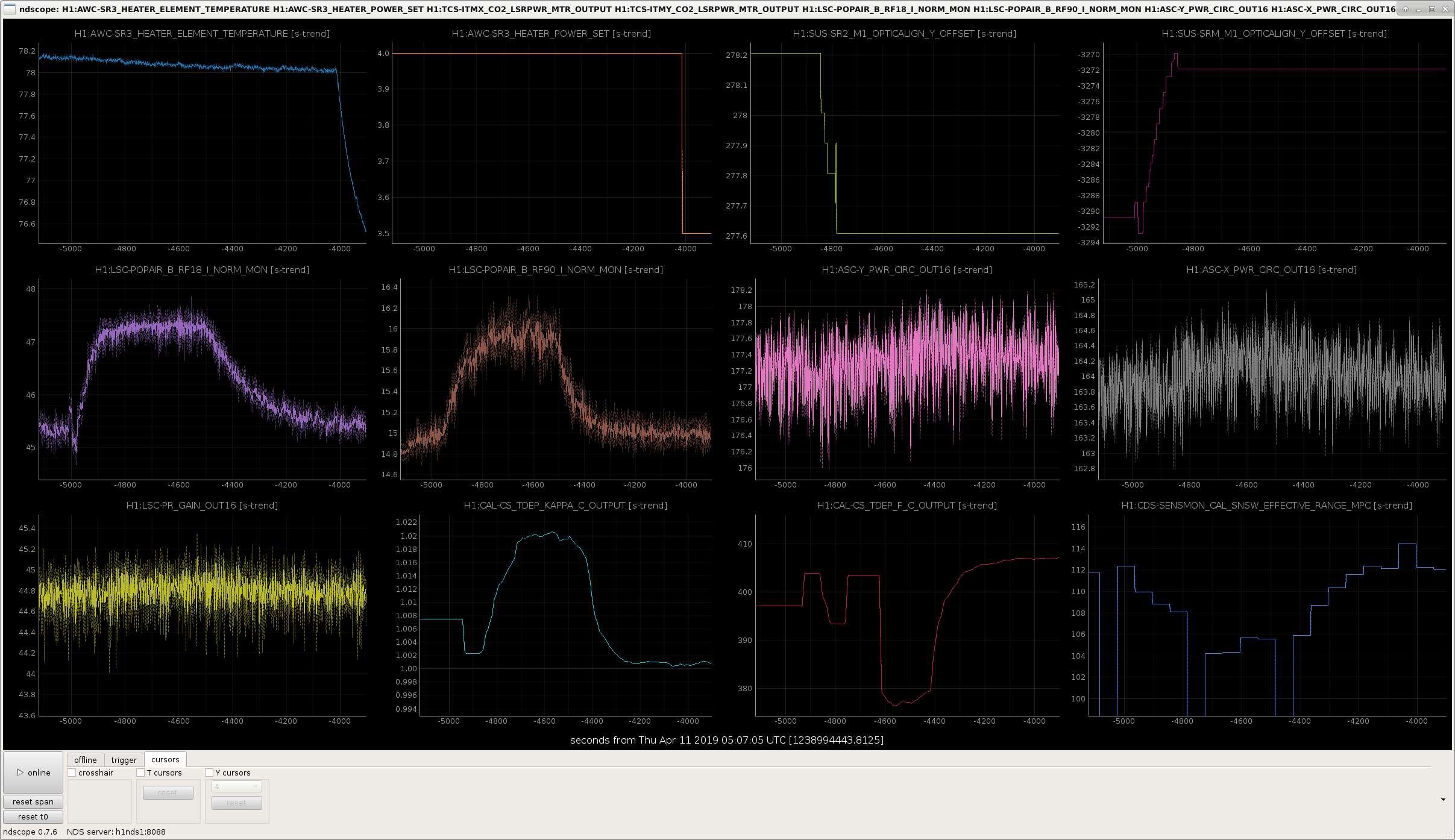
While we were sitting at 4W on the SR3 heater we checked for detuning in the SRC ASC. This is the big peak in RF18 and RF90 in the first attachment; the 4th attachment is zoomed in during this time. We opened the loops and moved the sliders (top right plots), found nothing too interesting in pitch, but while aligning yaw we saw:

We were surprised that the optical gain increased, that doesn't seem to hang together with the other pieces of information here. Maybe we should consider operating with 4W on the SR3 heater, and re-phasing the SRC ASC for this. [Edit: notes for attachment 4: at t = -4500s we turned the SRC ASC back on, which is why the alignment went back to its nominal level. The calibration lines were off before t = -4800s, and the calibration values before this time are not to be trusted.)

Other notes:

Images attached to this report
Comments related to this report
georgia.mansell@LIGO.ORG - 18:46, Thursday 11 April 2019 (48428)

We now understand that the increasing Kappa_C corresponded to a decrease in optical gain. So we were misaligning the SRC when we were aligning it by hand. The fact that RF18 was able to be improved with a misaligned SRC suggests there's room for improvement in the beamsplitter or PRC alignment. 


We have made some DARM spectra from times during our SR3 heater test, and SRC alignment test.

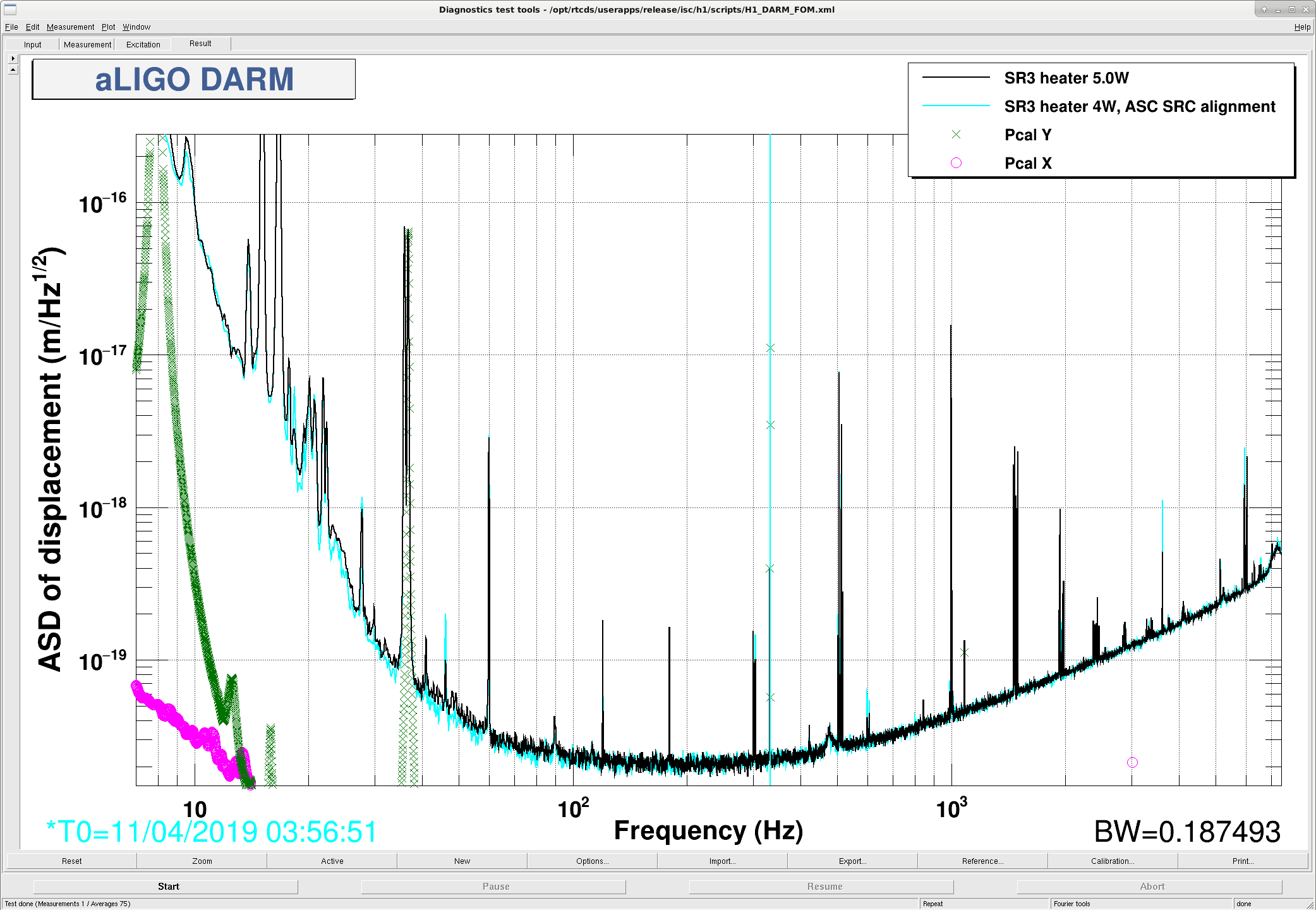
First attachment shows DARM with the SR3 heater at 5W (black) compared to 4W (cyan), showing definite improvement in the bucket, which explains our range increase. A similar spectrum at 3.5 W on the SR3 heater sits somewhere in between these two. 

Second attachment shows DARM with SR3 heater at 4W, with the normal alignment (blue), and when we opened the SRC ASC loops and "aligned" by hand, maximising POPAIR_B_RF18 (yellow). It seems like I can undo the SR3 heater improvement by misaligning the SRC...


Images attached to this comment
craig.cahillane@LIGO.ORG - 18:40, Friday 12 April 2019 (48453)
The DARM plant did not change very much over the period of the SR3 heater move.  
I measured the DARM plant 4 times, at SR3 power of 5W, 4.5W, 4W, and 3.5W.  The DARM plant did not change very much this time.  

According to some MCMC fits:
Optical Gain = 3.20 +- .28 × 106 cts/m   (<0.8 % uncertainty)
DARM pole    = 417.80 +- 15 Hz          (4 % uncertainty)
Delay        = 5.31 +- 1.7 × 10⁻⁵ s     (33 % uncertainty)
Spring Freq  = -5.12 +- 1.6 Hz          (32 % uncertainty)
Spring Q     = 37.11 +- 4.7             (13 % uncertainty)


This is a different result than the SR3 heater move at 30W input power.  We moved the SR3 heater by less this time (from 5W to 3.5W rather than from 0 to 5 W before).  We would also like to test the DARM plant for SRCL offset and DARM offset changes.

Also the frequency noise coupling to DARM did not change.  Will post plots later once they are correct.
Non-image files attached to this comment
craig.cahillane@LIGO.ORG - 20:09, Monday 15 April 2019 (48511)
Posted DARM ASDs, calibrated frequency ASDs, and frequency coupling TF plots.

DARM calibration: 
6 zeros at 30 Hz, 6 poles at 0.3 Hz, gain of 1

Frequency Calibrations: Same as 46864.  See attached freqCals.txt.

Comparison to 30 W coupling: 45831.

Before, we had a dip in the freq-to-DARM coupling at around 30 Hz where the radiation pressure and contrast defect effects destructively interfered.  Now that effect seems to have flattened out. (Plot 3 in the PDF)

Over the SR3 heater test cooling from 5W to 3.5W, it seems our freq-to-DARM coupling increases by a few percent, but does not change too radically.


Non-image files attached to this comment
georgia.mansell@LIGO.ORG - 18:58, Monday 22 April 2019 (48677)

Sheila was thinking the SR3 heater improvement could be attributed to the changing MICH and SRCL feed forward. I had a look at the coherence between DARM and MICH/PRCL/SRCL during the SR3 heater test, comparing a time at 5W (black) and a time at 4W (cyan), and am not convinced the coupling changed significantly. If anything the MICH coherence is worse at 4W than 5W in our frequency band of interest (20-60 Hz).

Images attached to this comment
Displaying reports 41741-41760 of 88752.Go to page Start 2084 2085 2086 2087 2088 2089 2090 2091 2092 End