[Patrick, Chandra]
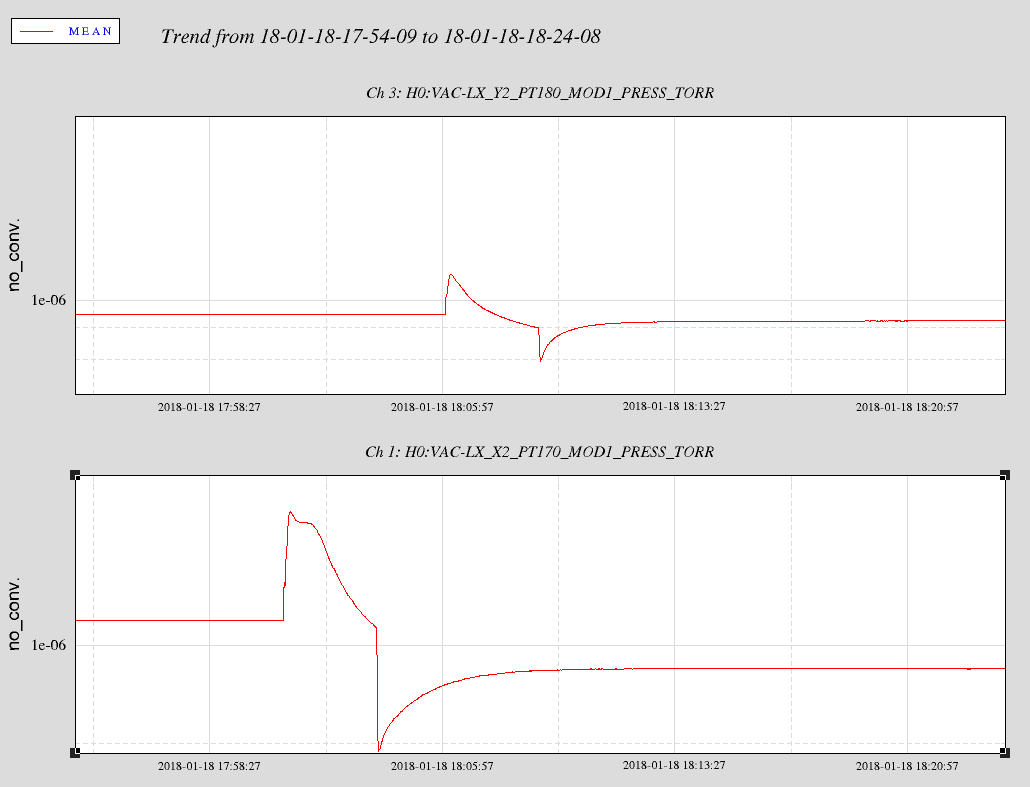
Following up-to-air vent, we degassed filaments in hot cathode pressure gauges, PT-170 & PT-180, for 2-4 minutes, via software.
Richard informed me that the laser had tripped this morning. I reset the laser without any problems.
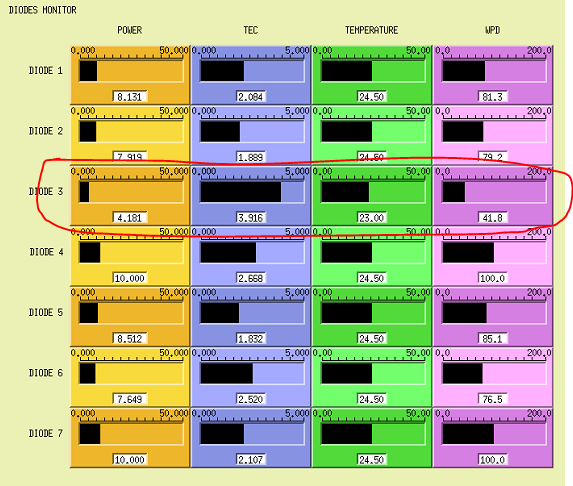
I increased the current for head 1 to the maximum of 60A and increased the diode temperature for
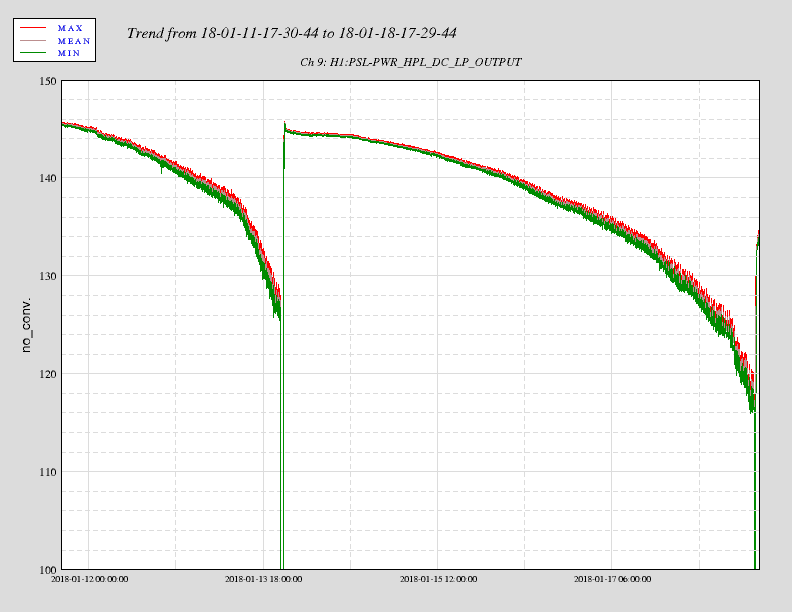
diode 3 to 23 degC. The output of diode box 1 has taken a bit of a dive since the weekend. So much
so that I would start to become concerned that the thermal lens in the NdYAG rod isn't what it should
be to make the resonator stable.
At this point in time, we have two options as I see it, depending on commissioning constraints:
i. replace the diode box
ii. revert to low power mode
Both would take about half a day to do.
I have not turned the power watchdogs back on.
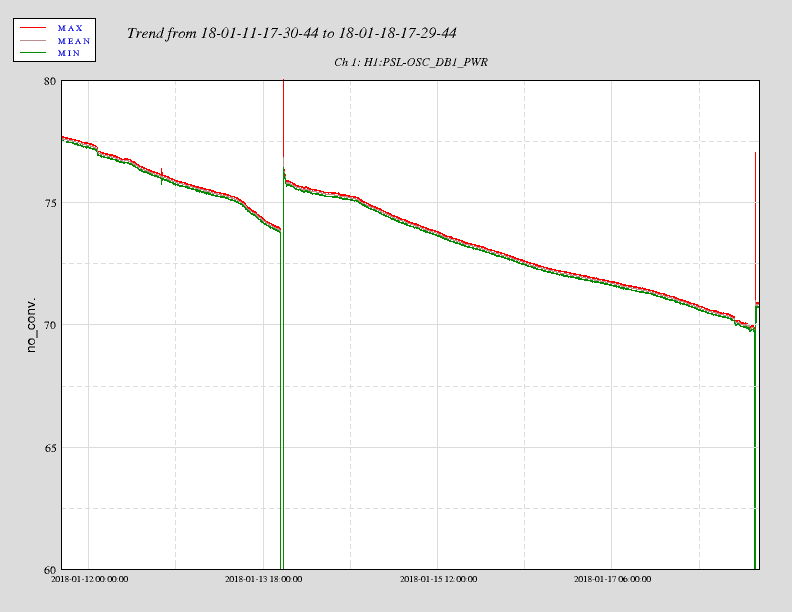
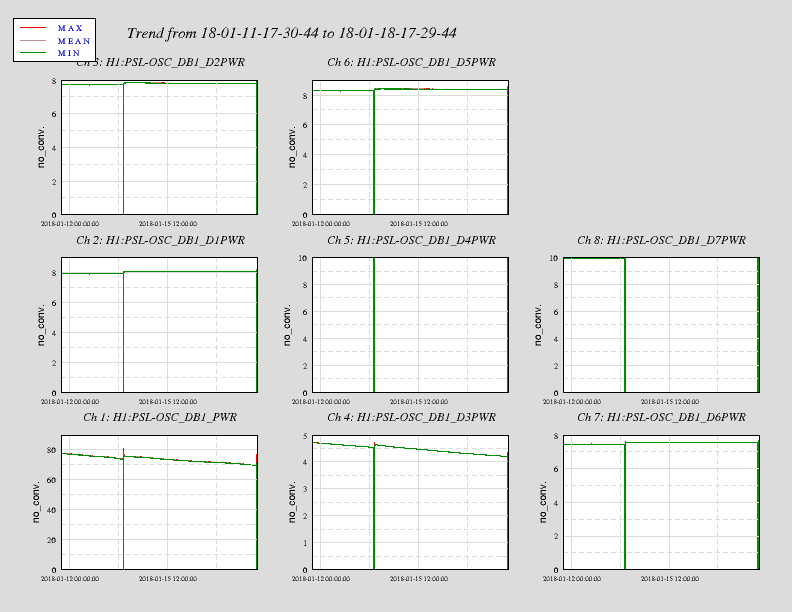
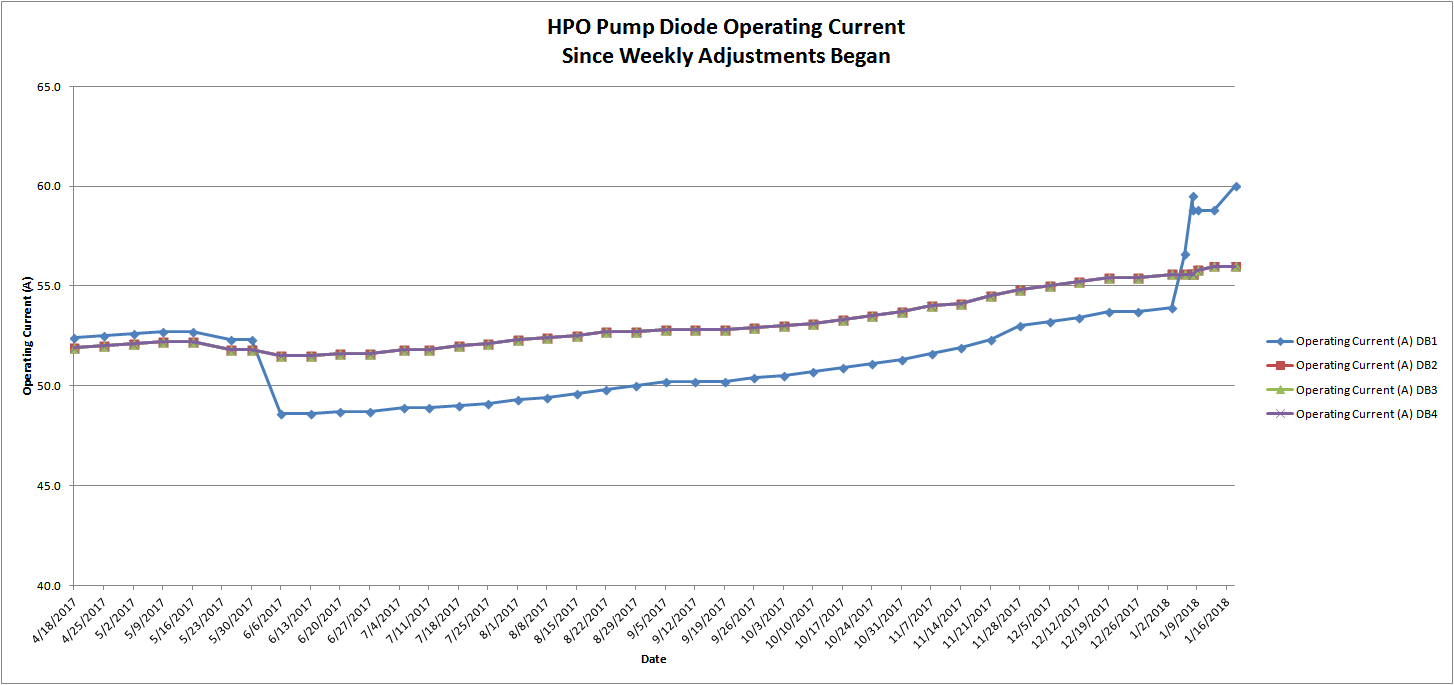
Attached is a trend of the DB operating current increases, starting in April 2017. The ongoing failure of DB1 can be seen in the large operating current increases that have been required over the last 2 weeks to keep the laser running. The life of DB1 has been slightly extended by adjusting its operating temperature in lieu of adjusting its operating current, hence the flat spot near the end of the graph.
The power of diode 3 in DB1 has dropped by 50% of its original power. The TEC is already at the maximum of its performance. You should lower the temperature further and observe the performance of the HPO. The current for the diode boxes can be higher than 60A, if you enter the value directly and do not work on the plus and minus button. The diode itself will not last much longer.
If your trying to stretch out the lifetime I seem to recall that you can actually run these diodes up to 65A in a pinch
848 channels added. 868 channels removed. H1:TCS-ETMX_HWS_SOFTWARE_ERROR_CODE unmonitored. List attached.
[Sheila, TVo, Jenne]
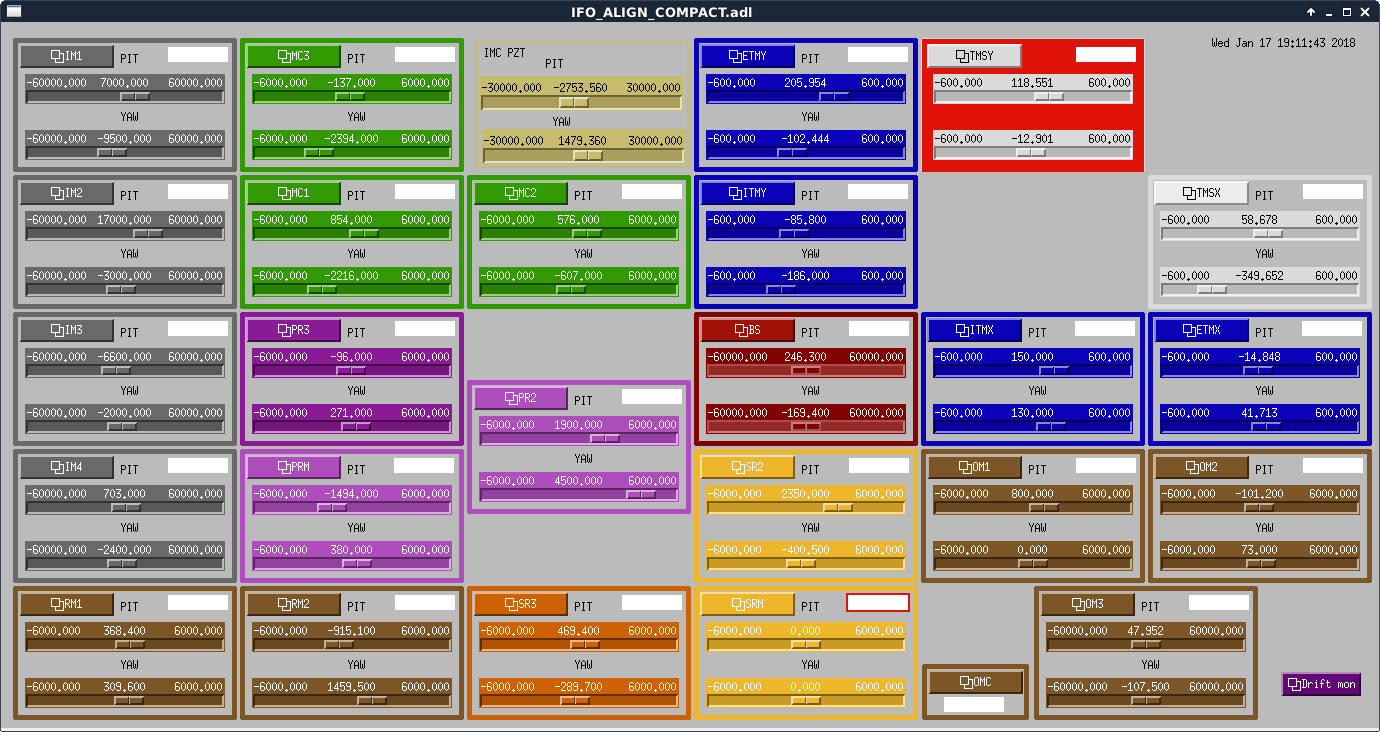
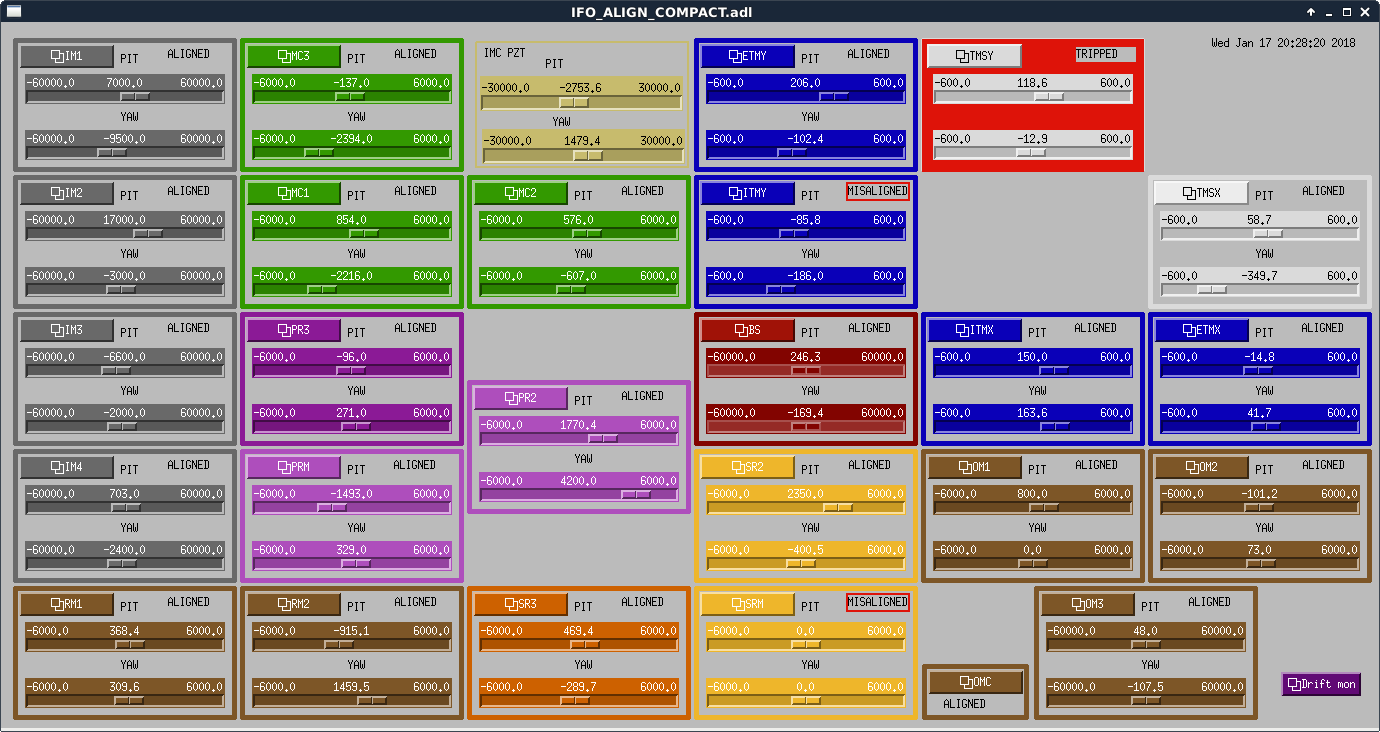
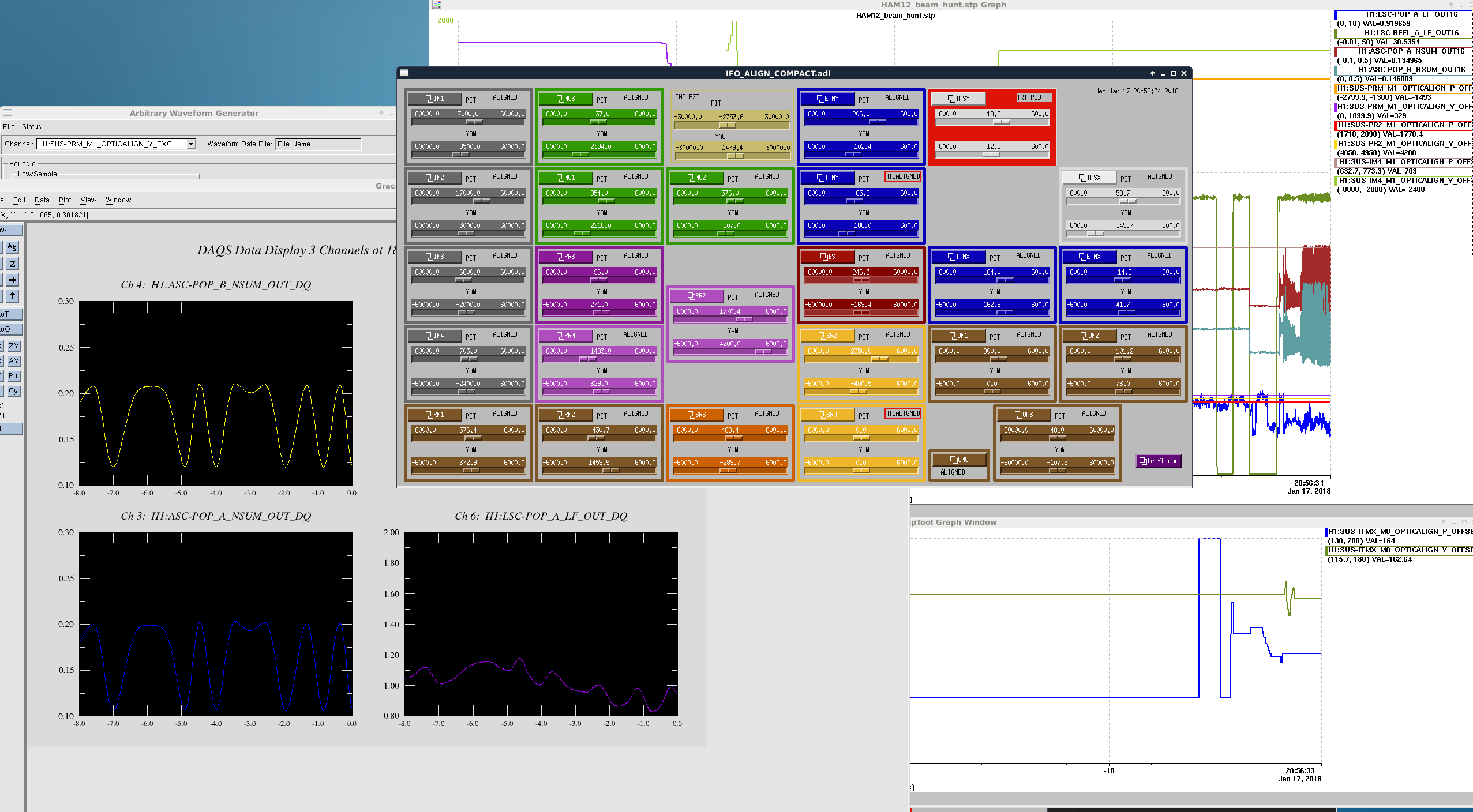
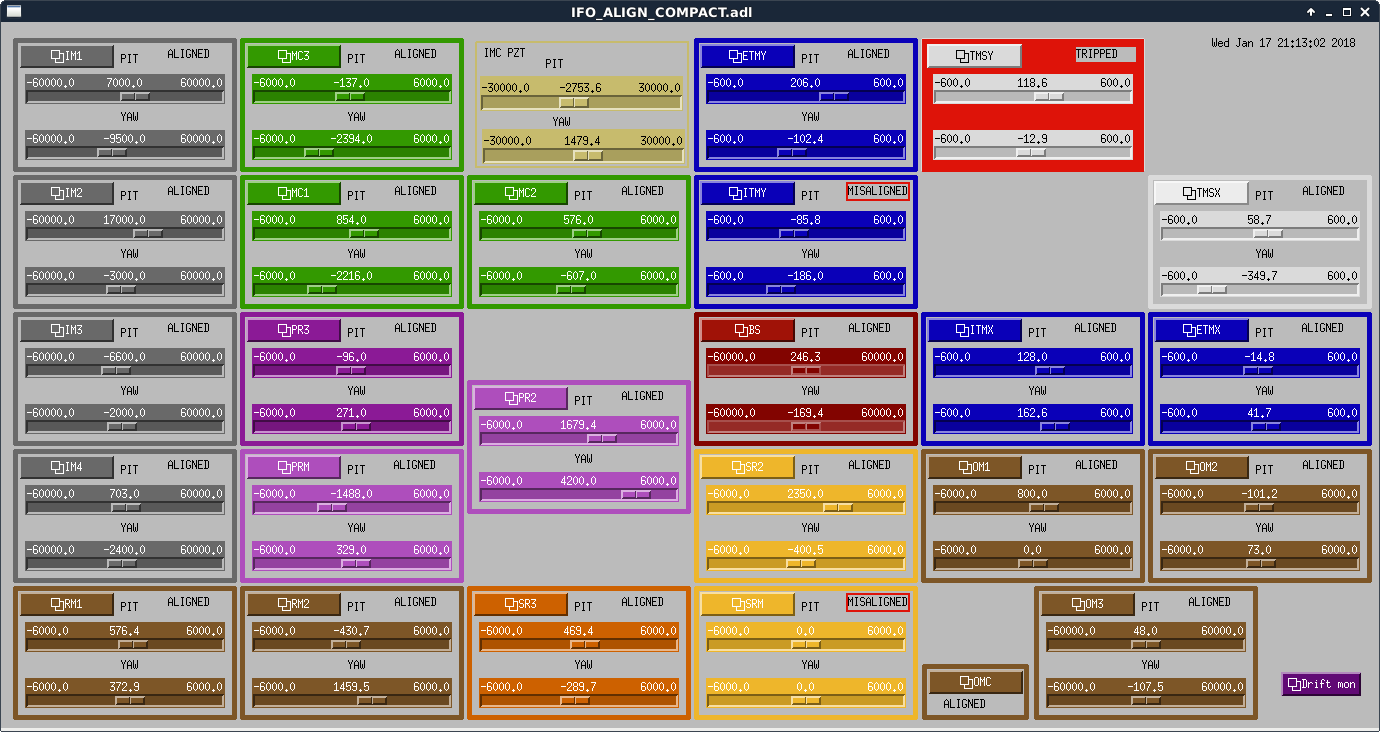
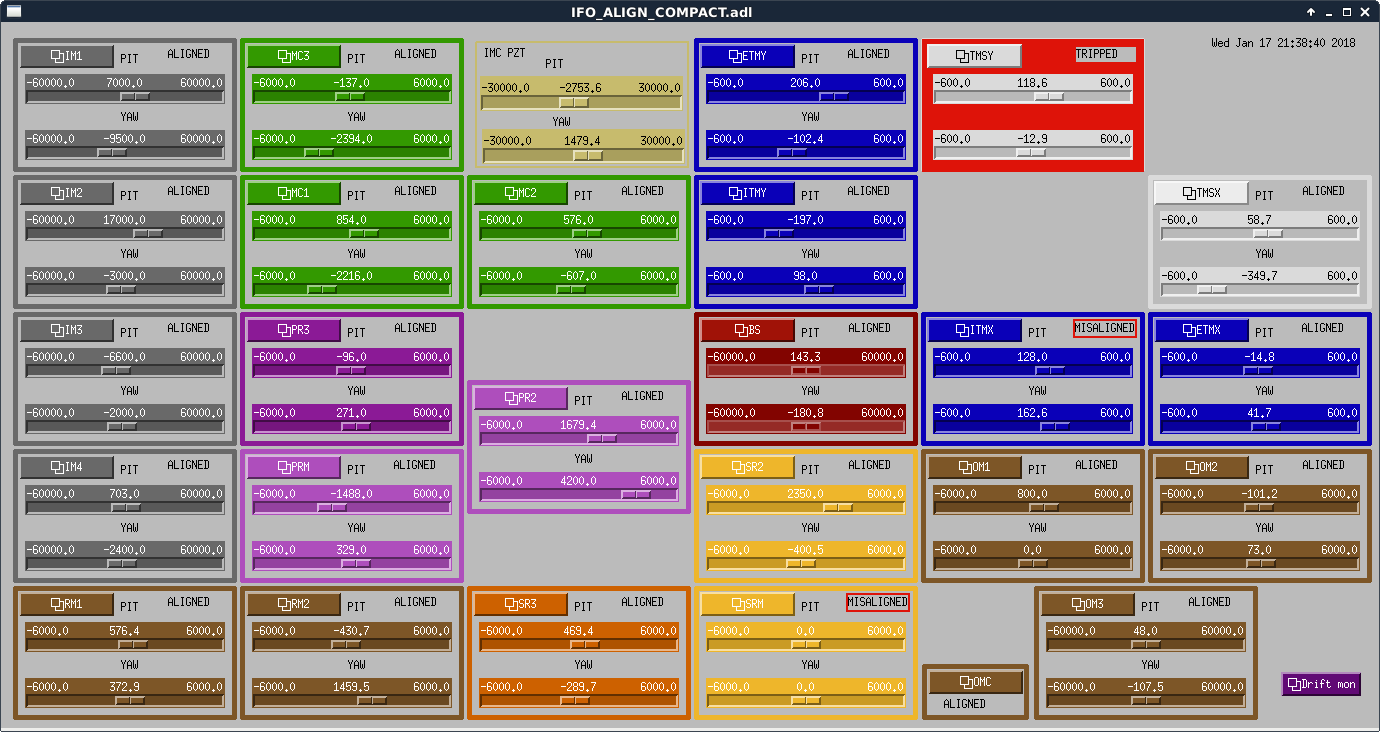
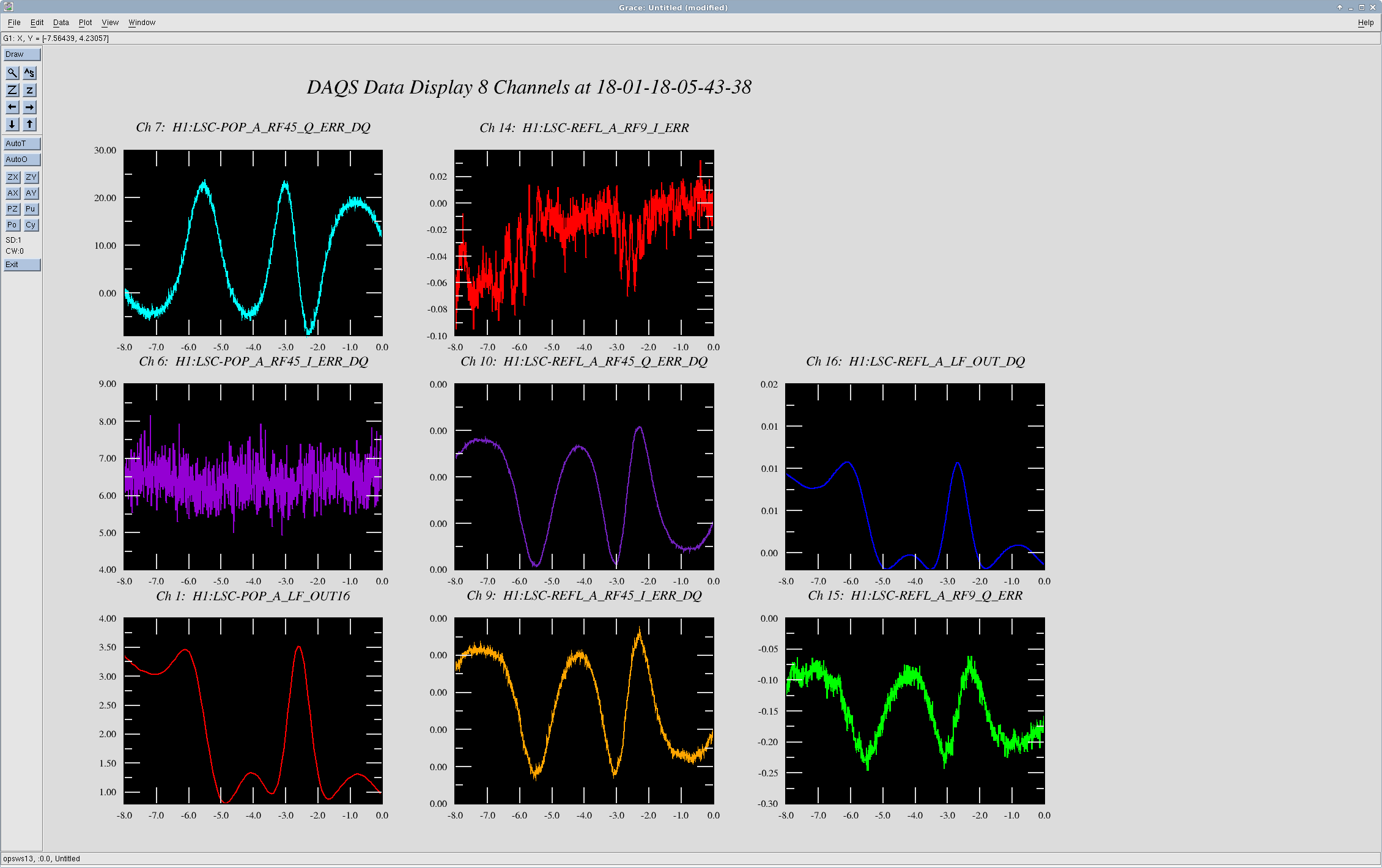
Today was an exercise in trying to get PRX aligned, so that we trusted our input beam and were on our way to being ready to align the HAM6 table. So far, we think that we have the beam aligned to ITMX, and that ITMX is aligned well enough to retroreflect the beam. We have not, however, been able to see flashes for PRX. We are seeing fringing on the REFL camera, and on REFL_RF9_I. Hoooray! (This is a little bit stream-of-consciousness...we were definitely totally absolutely going home several hours ago)
Plan for going forward:
Note from Cheryl: There is some scattered light somewhere near the output of the Faraday. She has a photo looking in one of the viewports, and it's clear that there's light in places where we don't want light. Her suggestion was that perhaps the input beam is too close to a mirror near the output of the Faraday, and we're clipping. Her proposed check was moving IM1 to see if that scattered light glow (as seen on the PRM camera view that she set up) changed. Moving by a few thousand counts on IM1 didn't change the PRM camera image, so I'm not sure that it's the Faraday or the input beam we're having a problem with. We'll continue checking on this in parallel with the main alignment work.
We don't have analog cameras for POP, SR2. They might be unplugged? And I guess we need some CDS help to get the BS camera back. It would be helpful for alignment if we could have those all working tomorrow.
Note to ourselves: Tomorrow we will try to do SRY alignment to get down to HAM6.
The gain selection doesn't seem to work for the Sqz Fiber Trans PD.
The signal is not reaching the AUX 7 chassis at HAM 6. The following voltages were observed on the chassis.
Each of these signals originates at the same terminal, EL2124 in slot13 of Squeezer Control Chassis 3.
Best guess, either software initialization failure or a bad terminal.
edit: Or incorrectly connected power supply!
TVo noticed a moment ago, while we're trying to align the central part of the IFO, that the BS suspension was moving a lot. A quick look showed that the oplev is quite far off the center of the QPD, and it looks like the servo is kicking the BS around a bunch. For now, I've turned off the oplev damping on the BS suspension, but we should look into this in the near future (maybe we just need to center the oplev - are we still holding off on this for any known reason?).
Opened FRS Ticket 9737.
WP 7295
Two PCX 200V power supplies were installed in VDD-C2 power rack and are being used to provide ±180V to the TTFSS unit on ISCT6 enclosure. New junction box was installed on top of SQZ-R1 rack and output ran to squeezer bay.
F. Clara, P. King, R. McCarthy, E. Merilh
Between yesterday and today, Travis and I finished staging the weld room at EY:
- Finalized "furniture" layout
- Wiped all equipment down
- Worked through some power issues - need something from Richard, working on it
- Discovered the wrong blue duct jack Genie SUS lift was brought down - correct one brought down by Bubba this am
We also got the suspension to the point where we are really ready to put it on the install repair arm tomorrow morning first thing and bring it out for further disassembly:
- Staged in-chamber tools and pans
- Installed temp catch trays, face shields and added fiber guarding parts
- Pulled off all top mass BOSEMS and dropped the top mass down to make slack in wire segment below, used top stage to do this
- Pulled suspended lower cables up the reaction chain
- Removed a few large panels of flooring in the chamber in order to remove the sus structure sleeve, replaced the floor panels (note, found a bolt and nut under the flooring - also wiped the chamber bowl flooring many times to remove lots of particulate that looked mostly shiny, or PEEK, or viton)
- Adjusted all masses so that there was slack and removed the wire segment joint to the top of the UIMs
- Locked down all masses
- Laced up cables to arm elevator and tested functionality
We should be ready to start the extraction tomorrow morning, barring telecons, etc.
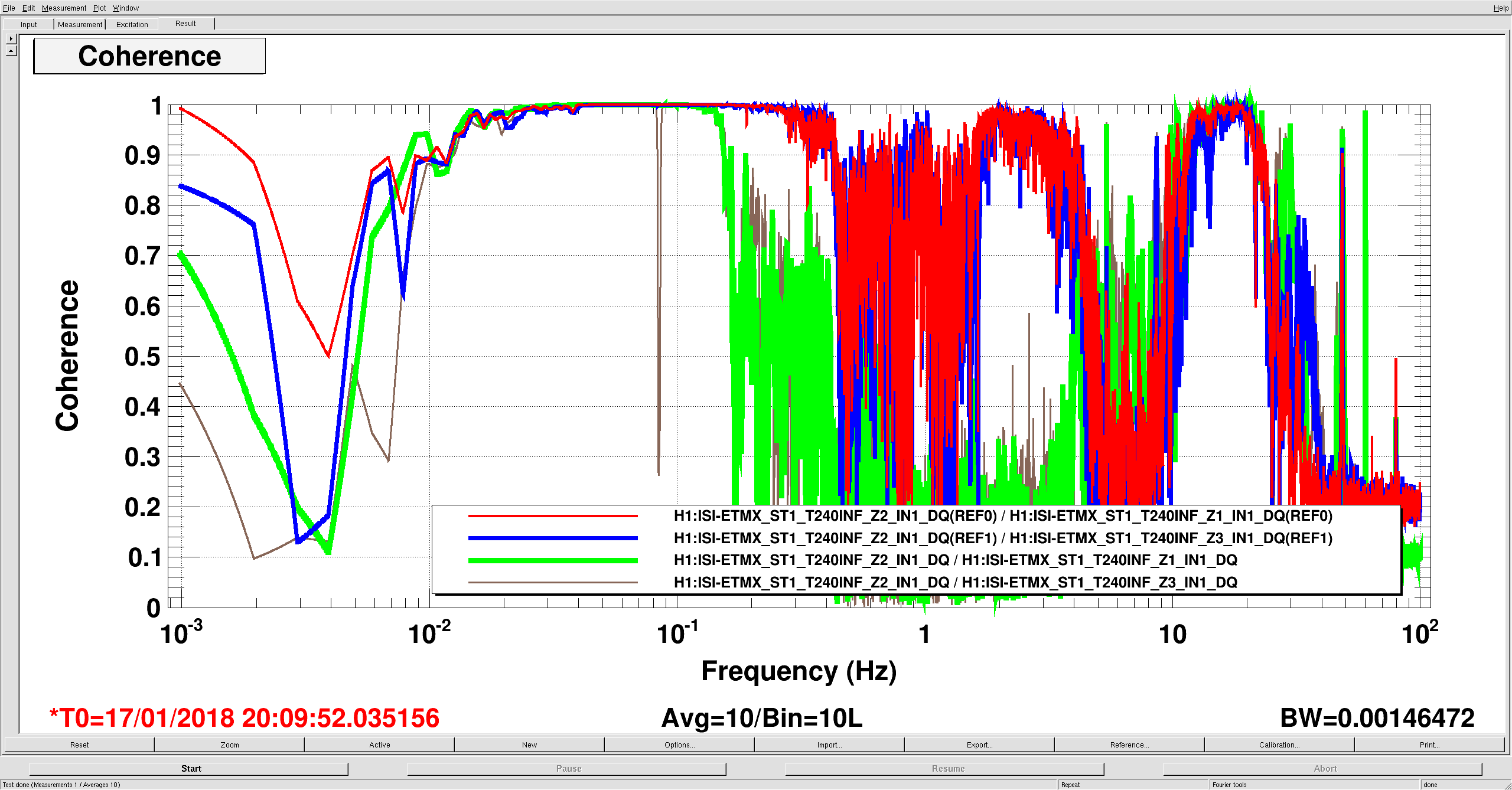
Following the work I did in alog 40109 , this morning I tried a couple of other things. I put the ISI in damped state, and turned off the suspension damping loops, this didn't change anything. After, that, I restored the suspensions, recentered the T240s (with the buttons on the BIO screen) then drove to the end station and power cycled the 3 T240 chassis for the ISI (I left the box for the ground sensor alone). This seems to have fixed the 85mhz line in Z3. Looking at the coherence between the 3 sensors seems to be the easiest way to see if the line is still there, see attached plot. Red (Z2-Z1) and blue(Z3-Z2) are a measurement taken after the chassis power cycle, green (Z2-Z1) and brown (Z3-Z2) are from before. The dip at 85mhz in the brown line (caused by, I assume, the excess noise in Z3) is gone in the blue. I'll monitor, but I hope to never see this again...
I was tired of getting a DCUID and trying to figure out the model name or vice versa, so I added some argument parsing to /opt/rtcds/userapps/release/sys/common/guardian/cdslib.py
Example usage after aliasing cdslib='python /opt/rtcds/userapps/release/sys/common/guardian/cdslib.py':
thomas.shaffer@zotws8:~$ cdslib -h
usage: cdslib.py [-h] [-p] [model]
positional arguments:
model Give the model name or dcuid # and it will return the
compliment.
optional arguments:
-h, --help show this help message and exit
-p, --printmodels Print the total list of the all models and their dcuids.
thomas.shaffer@zotws8:~$ cdslib 117
h1calcs
thomas.shaffer@zotws8:~$ cdslib h1calcs
117
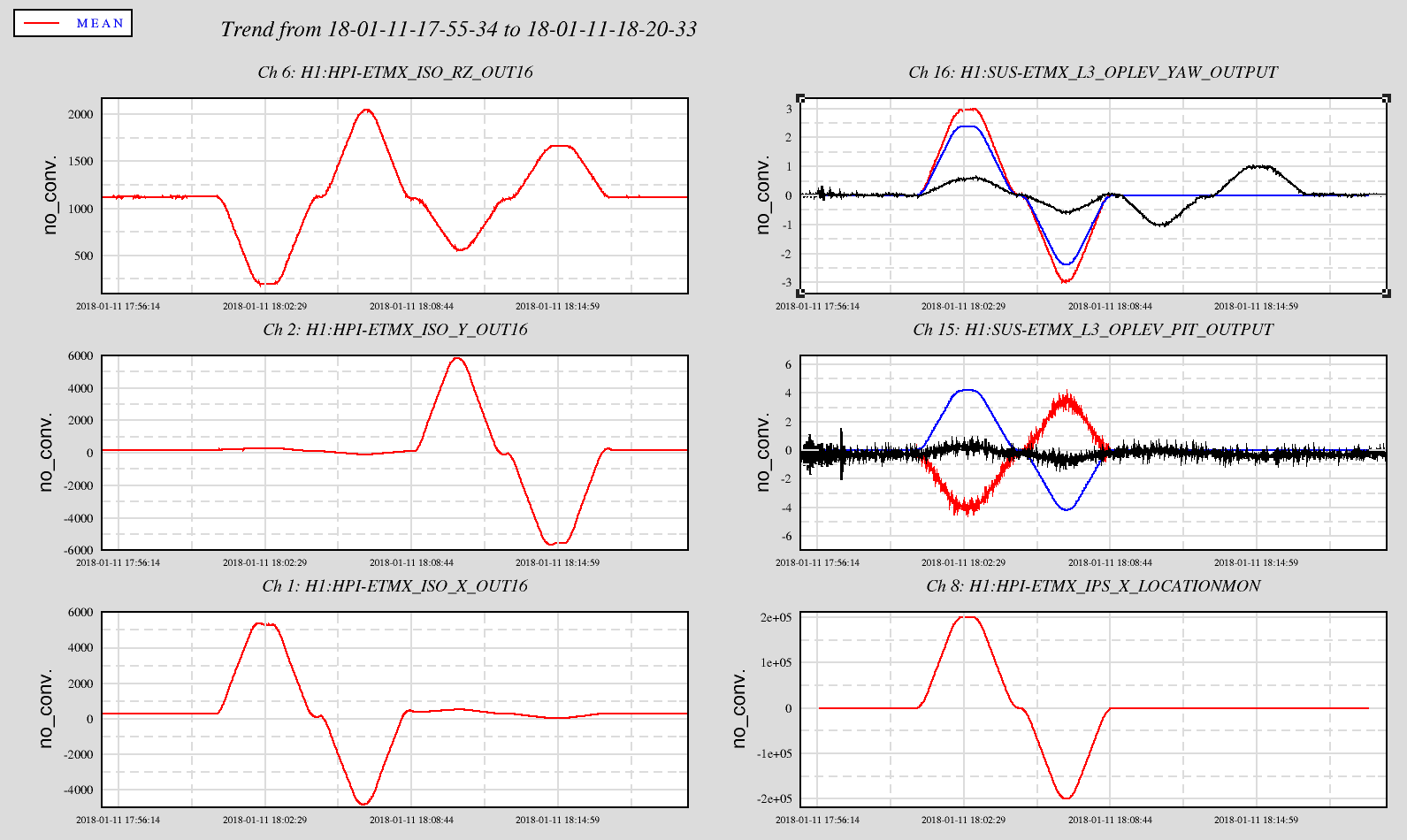
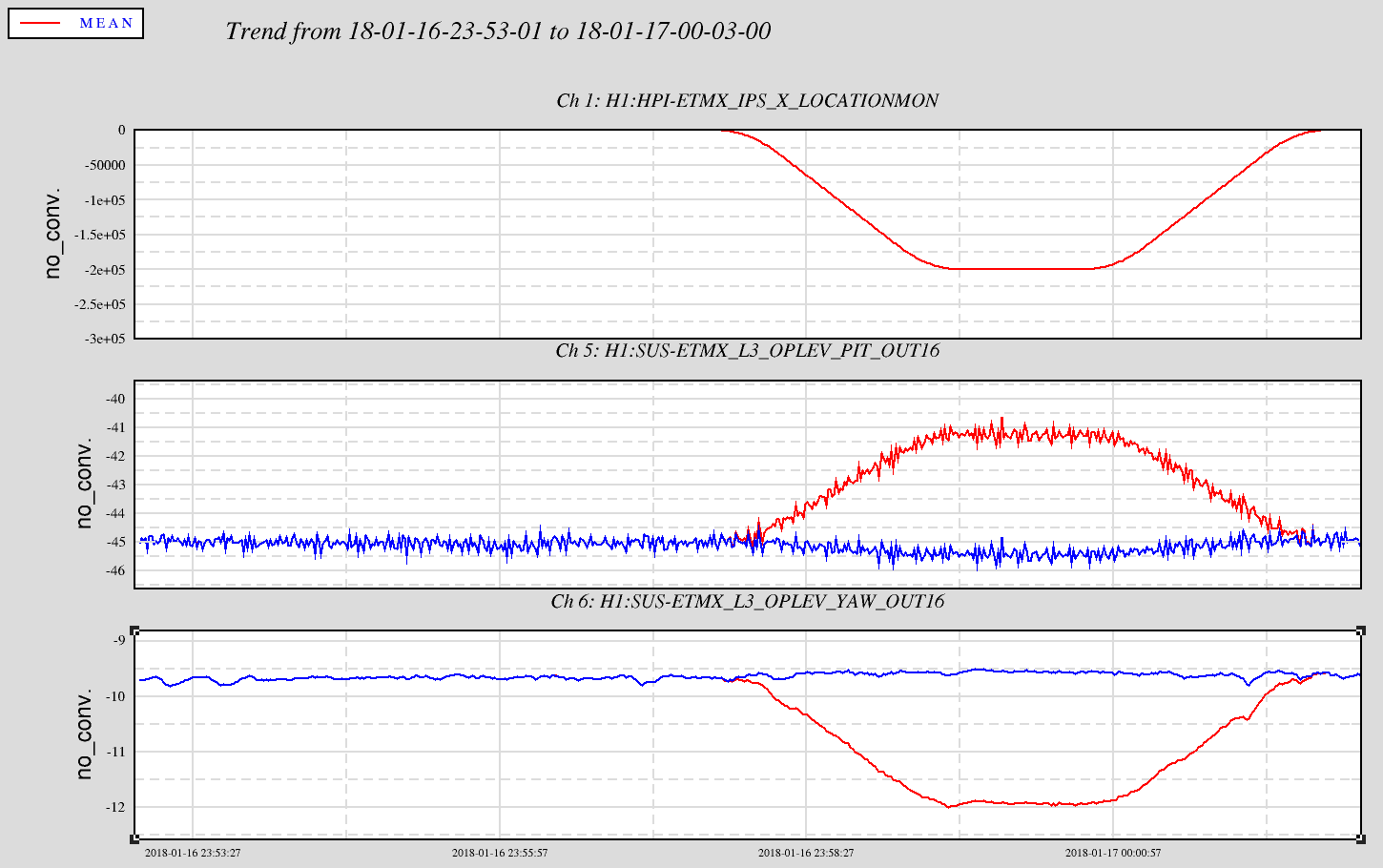
Look forward to having a locked IFO with ASC signals to further confirm but this has reduced the length to angle coupling by a factor of 5 for X and a factor of 10 for Y (assuming the Len2Ang coupling coefficients in E1200836 are correct!) This difference is only because the coupling was worse for Y. The residual with a 200um stroke is now ~0.1urad for both X & Y drive.
See the first attachment for the before picture--this is a repeat from aLog 40106. That log details the production of the residual Optic motion due to the X & Y stroke shown in the upper right two graph with the black trace being the residual after the length to angle coupling is removed.
Running a couple strokes of sufficient amplitude gave enough info to compute a zero coupling coefficient for the HEPI X & Y to RZ.
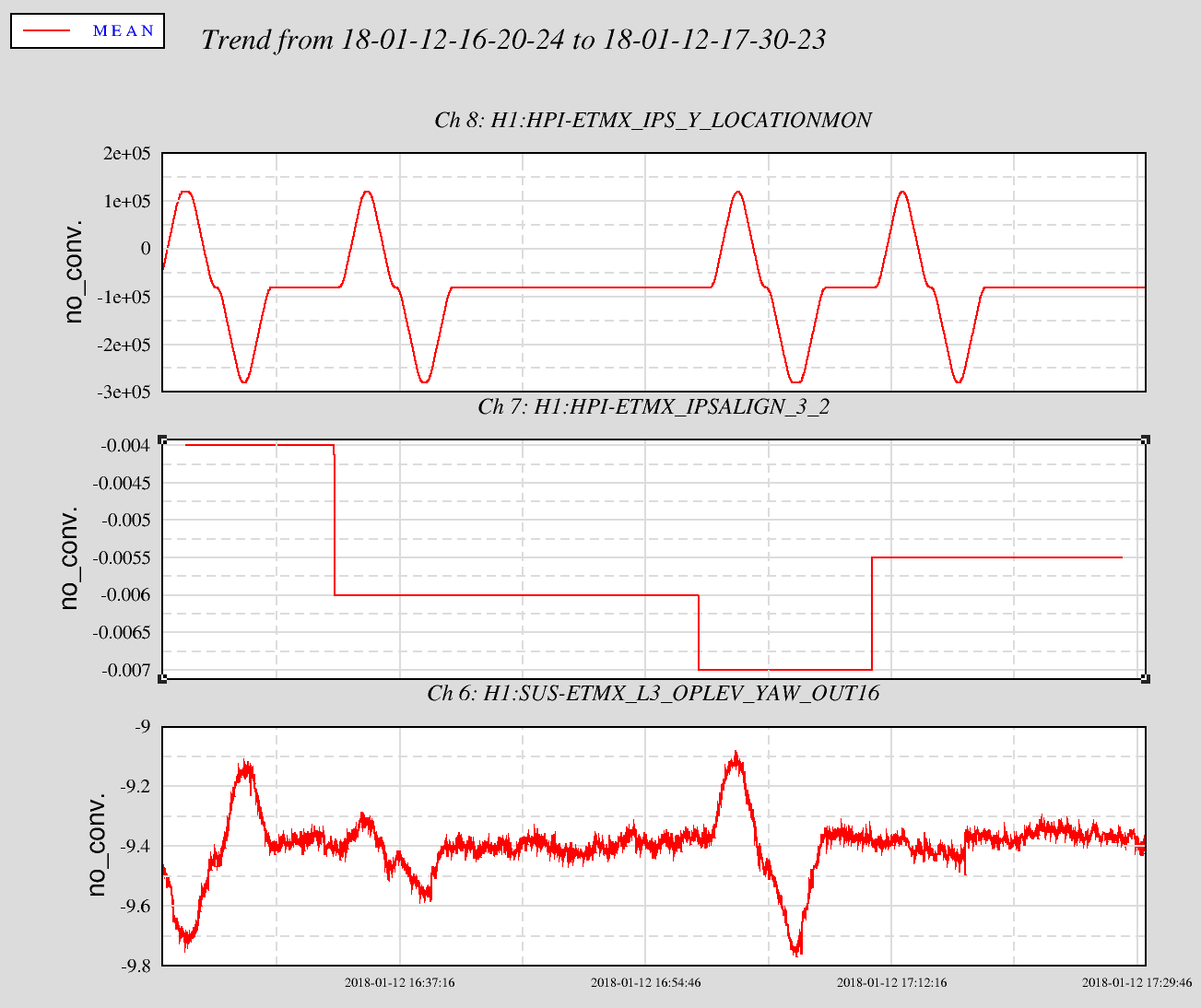
The 2nd attachment shows some tests with various IPSALIGN values for Y motion. There is no oplev len2ang coupling in this DOF. Final value of -0.0055 reduces the Y to RZ fairly completely.
The 3rd attachment has just the final result using 0.0031 for the X to RZ IPSALIGN value. The red traces are the X drive and the OpLev outputs. The blue traces are after the OpLev len2ang coupling removed. Can't do anything about Pitch but the YAW is pretty much gone.
These values have been accepted into SDF. Will do ETMY when possible.
Our local copy of the Seismon code has been running pretty well for the last several months, but one of the python epics scripts has been crashing ~ once a week. Typically, it's pretty easy to recover : ssh in to the hwinj2 machine and restart the crashed code. This week, more of the seismon earthquake code had crashed, which is new, but I'm assuming this had something to do with the computer restarts yesterday. When I was fixing this, I finally got smart enough to ask for some help on the more routine crash, and Michael Coughlin suggested add some try-except loops to the epics code. So, before the lines 209 & 239 were both:
(eq_file, eq_gps, eq_mag, p_arr, s_arr, r20_arr, r35_arr, r50_arr, rvel, gps0, gps1, lat, lng, dist, depth, azimuth, dum, location, ifo) = line.split()
These lines are now:
try:
(eq_file, eq_gps, eq_mag, p_arr, s_arr, r20_arr, r35_arr, r50_arr, rvel, gps0, gps1, lat, lng, dist, depth, azimuth, dum, location, ifo)
= line.split()
except:
continue
Still running so far. I'll keep an eye on it.
I've also added a troubleshooting section to Dave's seismon wiki page, https://cdswiki.ligo-wa.caltech.edu/wiki/seismon . I think these instructions I added under LHO Troubleshooting should be enough to recover the code from most of the failures I've seen so far.
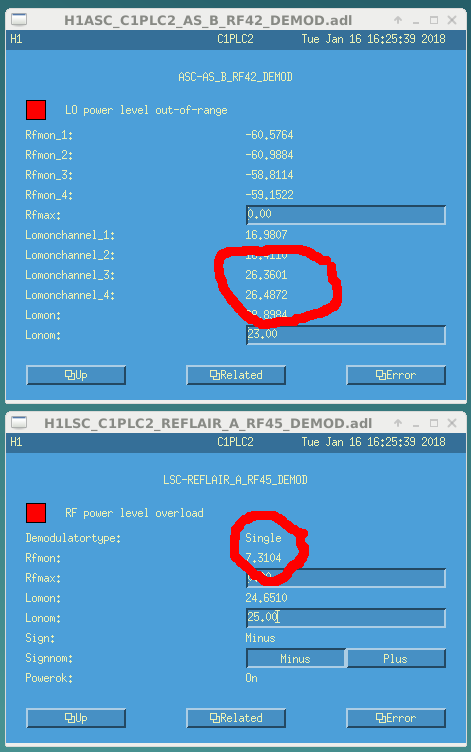
Some strange readbacks in ASC-AS_B_RF42_DEMOD_LOMONCHANNLE_3/4 and LSC-REFLAIR_A_RF45_DEMOD_RFMON.
ASC-AS_B_RF42_DEMOD_LOMONCHANNEL_3/4
We traced the issue to the beckhoff terminal in H1 EtherCAT Corner 4, Slot 9 (H1 Demod M) Channel 4B looks like it has an offset and is possibly a bad terminal.
LSC-REFLAIR_A_RF45_DEMOD_RFMON
We found a 46MHz oscillation on this signal. Daniel power cycled the LSC RFPD Interface (S1200460) and the oscillation went away.
H1 SQZ 42.375MHz
This signal is good but the power ok bit is not being read. I verified that the OK bit is active, but the Beckhoff terminal is not receiving it. Will replace terminal next maintenance day. Corner 6 Slot 3, RF Amp 7.
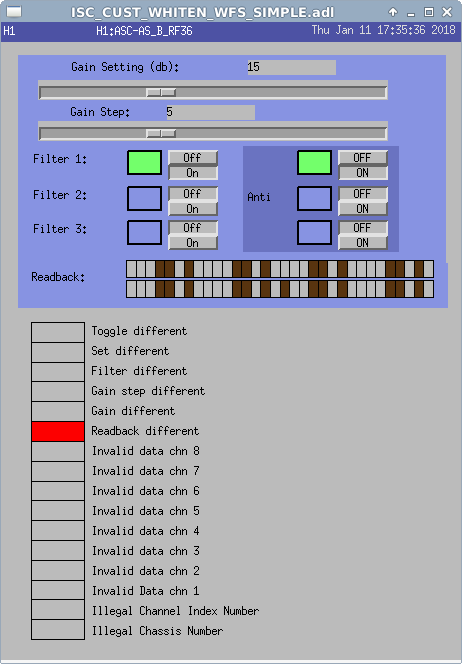
Keita noticed just now that there is a readback error on AS B 36 whitening gain. We should fix this before we start needing AS WFS.
I verified that this signal was not working on Friday the 12th. Tuesday the 16th when we looked at this signal it was working again, no action taken.