Displaying reports 82441-82460 of 86340.Go to page Start 4119 4120 4121 4122 4123 4124 4125 4126 4127 End
Reports until 13:25, Tuesday 28 August 2012
H2 SUS
keita.kawabe@LIGO.ORG - posted 13:25, Tuesday 28 August 2012 - last comment - 12:00, Friday 31 August 2012(4007)
ETMY POS to cavity length and oplev measurements from yesterday

We measured the transfer functions to the cavity length from M0 POS, L1 POS and L2 POS, when the cavity was locked and only M0 was damped.

At the same time we also measured the transfer functions from the same actuation points to the OPLEV signals.

Two main goals of this were:

1. To see if L2 stage (penultimate mass) drive was working fine. There has been speculations but no definitive answer.

2. To provide a set of measured data for SUS so hierarchical control effort could be accelerated.


Anyway, if you're only interested in the plots see attached. Frequency points are kind of sparse and not even (the former is constrained by time, the latter is by the fact that I'm throwing away low coherence data).

Plots as well as data files etc. are all under /ligo/home/controls/keita.kawabe/OAT_2012/ETM_M0_L1_and_L2_POS_to_L3

Everything was checked into svn: /ligo/svncommon/SusSVN/sus/trunk/QUAD/H2/ETMY/Common/Data/2012-08-27_H2SUSETMY_M0_L1_L2_POS_to_L3

[Update 13:30-ish 28/Aug/2012]

The plots are now normalized by the L2L element of the drivealign matrix, as that was 1 for M0 and L2 (as it should be) but 10 for L1 for whatever reason.

Non-image files attached to this report
Comments related to this report
keita.kawabe@LIGO.ORG - 13:30, Tuesday 28 August 2012 (4009)

Two things that are obvious from the plots:

(Updated 13:30-ish Pacific, 28/Aug/2012) 1. L2 drive is working. It is about a factor of 120 or so weaker than L1, and L1 is about a factor of 6 weaker than M0 (see page 1).

1. L2 drive is working. It is about a factor of 12 or so weaker than L1, and L1 is about a factor of 60 weaker than M0 (see page 1).

2. Cavity length to angle coupling could be problematic at resonances (see page 4). At DC for M0, it seems to be 0.1rad/m in a ball park, and and even if we feed back 1um RMS this is 0.1urad RMS, which sounds OK.

keita.kawabe@LIGO.ORG - 10:59, Tuesday 28 August 2012 (4010)

One thing that is not obvious from the plot:

For L2 drive, I had to use a ridiculously large excitation (+-120000 counts, half about a quarter of the range of 18bit DAC considering the output matrix of 0.25) with ridiculously long integration time (e.g. 160 seconds) to get a good coherence for f>1Hz. The background noise is too large.

This practically means that, as others pointed out, L2 is going to be railing if the ALS signal is fed back to L2 with a UGF of 1 Hz.

0.1Hz might be possible, but 1Hz, not likely.

keita.kawabe@LIGO.ORG - 13:32, Tuesday 28 August 2012 (4012)

Other things:

When the measurement was done, L2 stage driver FM2/3/5/6/7 were on while FM1 was off.

EUL2OSEM output matrix elements for M0 (for two lower face coils F2 and F3) were (0.5, 0.5).

EUL2OSEM output matrix elements for L1 and L2 (for all four coils) were both 0.25*(1, 1, 1, 1).

keita.kawabe@LIGO.ORG - 06:57, Friday 31 August 2012 (4047)

Update Aug/31/2012

In the above entry,

"When the measurement was done, L2 stage driver FM2/3/5/6/7 were on while FM1 was off."

this was  incorrect but I cannot edit it any more, it seems. It should read


" L2 stage driver FM2/3/6/7/8 were on while FM1 was off." 

jeffrey.kissel@LIGO.ORG - 12:00, Friday 31 August 2012 (4053)
J. Kissel, B. Shapiro

I attached plots comparing Keita's transfer functions to what I expect from the model. Executive summary: 5 of the 9 transfer functions measured match my model exquisitely -- All L to L TFs, and the TOP to TST, and PUM to TST L to P TFs. Of the remaining TFs: I don't expect the model to predict the L to Y coupling well at all, but I'm still baffled as to why the UIM to TST L to P transfer function doesn't match up. 

Comments / questions / concerns welcome. I really haven't yet been able to get a warm and fuzzy feeling about a lot of this data. So, take it with a grain of salt.

You'll notice that among the series of plots is the predicted maximum range for each stage. Please don't read too much into these numbers, I haven't yet verified them against Norna's numbers (see T1100595), taking into to account the differences between her numbers and mine (mostly the maximum range of the coil driver, updated to use the real, recently measured, transconductance of the coil drivers times the 10 [V] DAC range.) BUT I know that frequency response is accurate, because it uses the latest and greatest measured responses. 

Notes / Details:
- There are fudge factors that I don't yet understand. They're explicitly called out in the legend, but they're summarized here:

                  %L  P  Y
driveAlignGain = [-1 -1 -1;... % M0
                  -5 -5 -5;... % L1
                   1  1  1];   % L2
meas(iStage,iDOF).tf = meas(iStage,iDOF).tf / driveAlignGain(iStage,iDOF);
 
As Keita mentions, I expect the L1/UIM fudge factor to be 10 not 5, from the driveAlign gain. 
I'm NOT really that surprised that we got the sign wrong on M0 and L1, but I don't know yet where it lies.

- The modeled M0-only damping loops are not *exactly* representative of what Matt tuned a month or 3 ago, but they should be close enough. I expect the overall gain to be different, and I expect the low frequency bump filters to be different, but otherwise they should match pretty well.
Non-image files attached to this comment
H1 IOO
giacomo.ciani@LIGO.ORG - posted 10:35, Tuesday 28 August 2012 - last comment - 15:20, Thursday 18 October 2012(4004)
HAUX: towards testing
[Alex, Cheryl, Deepak, Giacomo]

Yesterday we put the optics in all four HAUX:
HAUX SN006: IM1 = SM1-05
HAUX SN007: IM2 = PMMT1-04
HAUX SN008: IM3 = PMMT2-02
HAUX SN009: IM4 = SM2-01

Cheryl and Deepak are now trained in the art of HAUX open-heart surgery! :-)

We also put all cables in place: sat-amp->field cable->adapter cable (fake vacuum feed-through)->extension (just dummies, the final ones are already in the chamber)->quadpuss (finals).
16 OSEMs were connected and tweaked (by moving the LED and/or PD plates) to obtain a open light value of at least 25k. Only two of them (S/N: 211 & 491) were unable to reach 25k (reading just above 20k), and were replaced with 2 of the 4 spares to be on the safe side. The other two (S/N: 230 & 212) were not tested at all.

A list of OSEM assignment and measured open light value follows:

---> IM1
Cable S/N:  S1105084
A (UL)  S/N: 204  OLV: 29000
B (LL)  S/N: 454  OLV: 27000
C (UR)  S/N: 199  OLV: 26000
D (LR) S/N: 262  OLV: 29000

---> IM2
Cable S/N:  S1105082
A (UL)  S/N: 237  OLV: 25000
B (LL)  S/N: 427  OLV: 29000
C (UR)  S/N: 468  OLV: 26000
D (LR) S/N: 450  OLV: 28000

---> IM3
Cable S/N:  S1105078
A (UL)  S/N: 377  OLV: 25000
B (LL)  S/N: 292  OLV: 26000
C (UR)  S/N: 404  OLV: 26000
D (LR) S/N: 309  OLV: 26000

---> IM4
Cable S/N:  S1105083
A (UL)  S/N: 189  OLV: 27000
B (LL)  S/N: 403  OLV: 29000
C (UR)  S/N: 436  OLV: 27000
D (LR) S/N: 239  OLV: 26000

We measured the OSEMs noise in open light position (and exposed to ambient light... not sure how much this impacts performance), as a sanity check and reference. See attached figure (left/right are just two different groups of 8 OSEMs; bottom graphs show the coherence of each OSEMs with he first one, as a check for common noise).

Also, we finished alignment of 2 HAUX (SN006 = IM1 and SN008 = IM3), except for DC pitch balancing, inserted the OSEMs, clamped them down to the table and covered them with a HxTS fabric cover for some night measurements. As we don't have actuation yet, we just let the suspensions swing all night (2012/08/28 from 3:00 to 13:00 UTC should be quiet time). Attached is a PSD taken during this time.
Images attached to this report
Comments related to this report
giacomo.ciani@LIGO.ORG - 15:20, Thursday 18 October 2012 (4482)

I realized this isn't clear from my post: the OSEMs' noise was measured with offset (irrelevant) and gain set to normalize the reading to +-15000 (as usual). So the units are "normalized DAC values/sqrt(Hz)".

H1 SUS
jeffrey.garcia@LIGO.ORG - posted 10:07, Tuesday 28 August 2012 - last comment - 10:44, Tuesday 28 August 2012(4006)
H1 MC2 measurements
Quick state-of-health measurements on H1 SUS MC2 are being run this morning to investigate rubbing issues.
Comments related to this report
jeffrey.garcia@LIGO.ORG - 10:44, Tuesday 28 August 2012 (4008)
Measurements will resume after the H1 I/O chassis swaps ongoing.
H2 SEI
hugh.radkins@LIGO.ORG - posted 07:32, Tuesday 28 August 2012 (4005)
HAM ISI Assembly #3 in Storage Can Stripped of Sensors, Cables & Wall Mass
Jim Mitchell Greg Hugh
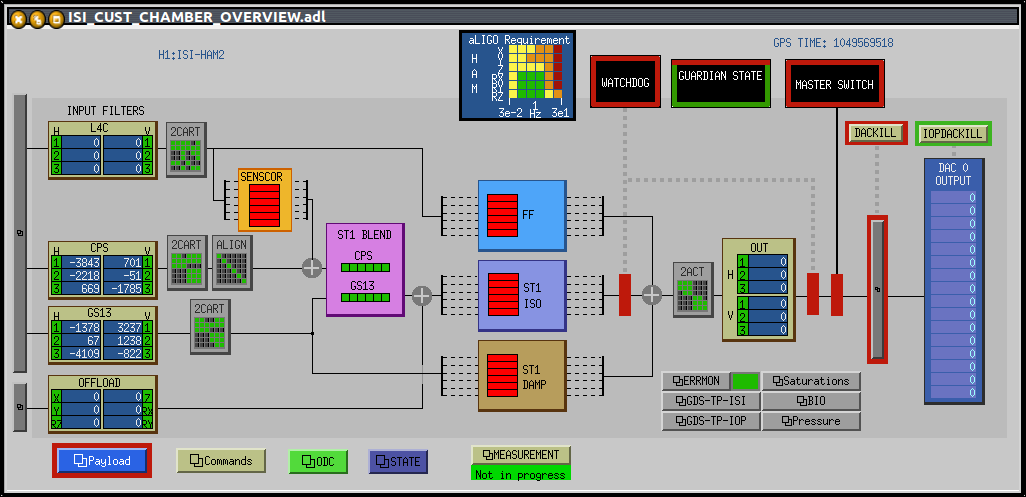
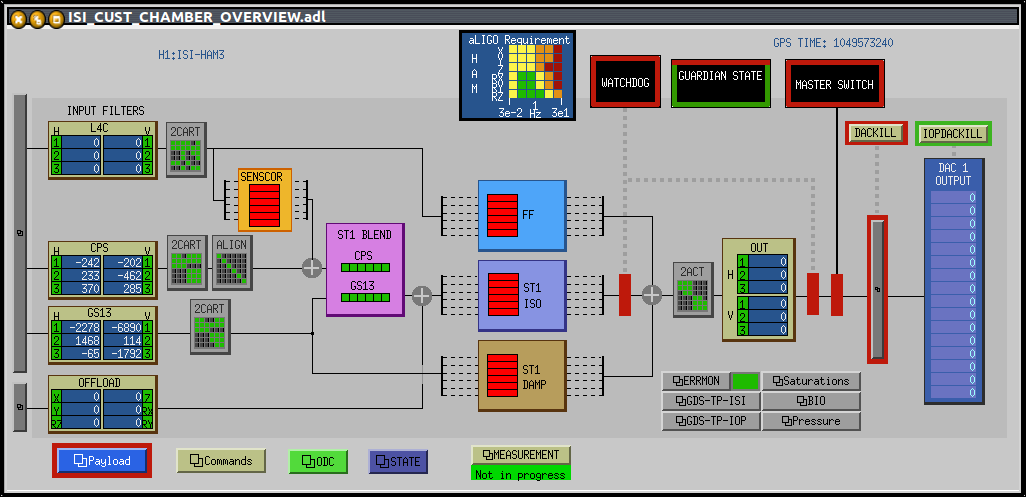
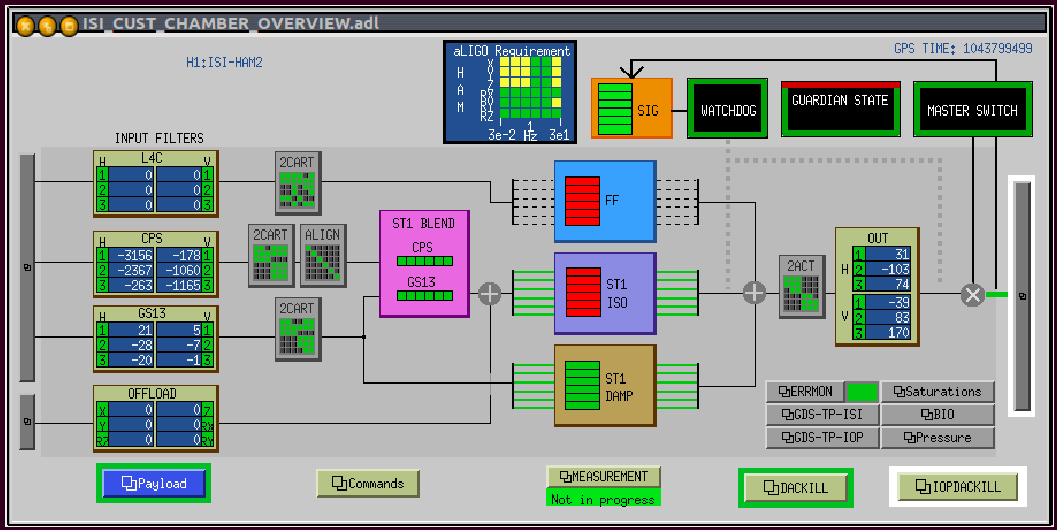
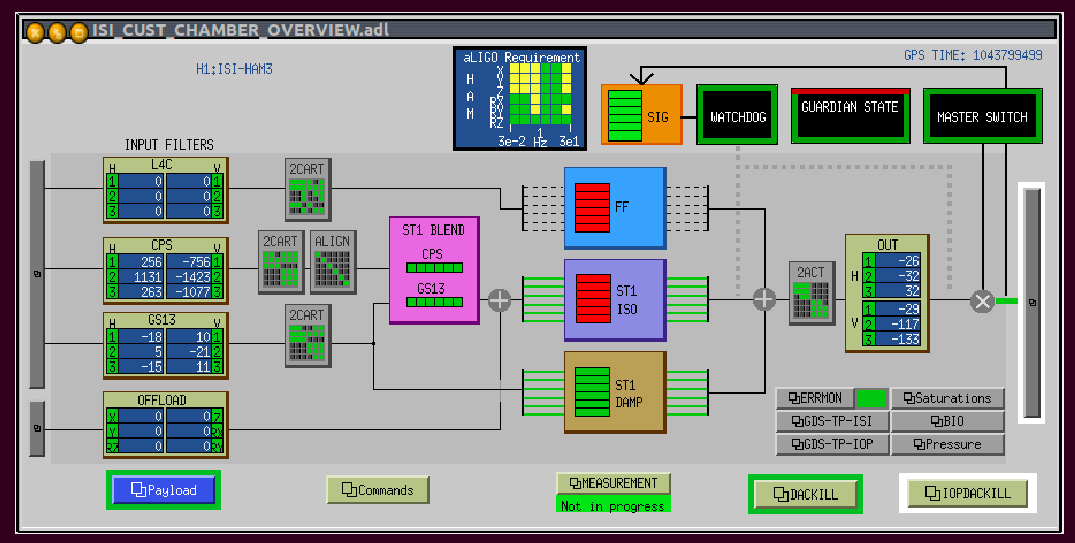
Per work permit, the canned ISI#3 was craned west close to the East Test Stand Cleanroom.  The can was cleaned, the lid removed and the cleanroom rolled over.  Cables, wall mass, and GS-13s were removed; this assembly was completed before cable plans were finalized and before there was a LIGO India.  The walls have been replaced and the ISI is ready for closing back up in the can.
LHO General
patrick.thomas@LIGO.ORG - posted 19:24, Monday 27 August 2012 (4003)
plots of particle counts
Attached are plots of dust counts > .5 microns in particles per cubic foot.
Non-image files attached to this report
H1 SUS
jeffrey.garcia@LIGO.ORG - posted 17:29, Monday 27 August 2012 (4002)
H1 SUS MC1 & MC3 MEDMs populated
The H1 SUS MC1 & MC3 MEDMs were populated with the standard matrix elements, filter modules, and basic configuration for an HSTS suspension. The H1MC1 open light values   and open light values for H1MC3 were copied over from X1 testing.  The open-light values for the H1MC3 M2 & M3 stages are copied over from the H1MC2 values. The correct open light values need to be recorded for the H1MC3 M2 & M3 OSEMs.

Safe-state snapshot files were committed to the CDS SVN locally under:
     '/opt/rtcds/userapps/release/sus/h1/burtfiles/$(optic)'

with filenames:
     "h1sus$(optic)_safe.snap"

The appropriate soft-links were created in the directories: 
     '/opt/rtcds/lho/h1/target/h1sus$(optic)/h1sus$(optic)epics/burt/'
 
with the default filename "safe.snap" for each optic for use by the RCG code when restarting models.
LHO General
patrick.thomas@LIGO.ORG - posted 16:49, Monday 27 August 2012 (3996)
Ops Summary
~9:30 - 10:16: Michael R. to mid Y, end Y, check on laser safety signs
10:18: HAM 4 door installed
Monthly Hanford Emergency Testing phone alert
Hugh, Eric: HEPI work
Filiberto: Cabling near HAM 1,2
Rerouting of cable for dust monitor at location 8 in the LVEA (in clean room for suspension assembly near HAM 3) required brief disconnection of the dust monitor.

Work permits:
Bubba: Install north door on HAM 4, this will be with 4 bolts only to hold door in place.
Doug: Install pipe bridge table at BSC2/HAM3.
Hugh: Crane canned ISI west next to clean room. Remove lid, roll clean room over. Extract cabling & maybe GS-13s. Reverse.
Richard: Install sleeves in conduits between MSR and LVEA. This requires removal of existing wiring, pulling new duct work in then reinstalling fibers.
H1 IOO
david.feldbaum@LIGO.ORG - posted 11:05, Monday 27 August 2012 (3999)
FI alignment in the H1 PSL

On Friday I reattached the omega-straps to the FI. The operation went very smoothly, and the magnet securely rests on all points of contact (see photos).

After that Mike and I have moved the granite block under the FI to allow beamscans to be made on the edge of the optical table. We did it by first moving the periscope to a clean cart, leaving 3 alignment posts to determine the position of the FI. We then moved the granite block, and finally reinstalling the FI the to positioning posts.

I have setup an output periscope by stealing the bottom ALS periscope mirror. The final setup is shown in the attached .png file. The list of moved mirrors in the current setup:

OSA and OSA mount are moved out of the beam path

IO_AB_L4 is moved out of the beam path

IO_AB_M12  moved to position (170;3) to serve as 1st turning mirror in FI testing path

IO_AB_M8 moved to (170;31) as the 2nd turning mirror

A HWP obtained from Rick is in (180;31)

IO_AB_M10 moved to (186;31)

2" mirror from eLIGO HAM7  at (186;45)

2" mirrors from eLIGO comprize pol-preserving periscope (182;45)

The beam passes through the FI (locked at an angle), and is eventually dumped on a water-cooled 300 W power meter at (132; 148)

The output periscope presently does not contain a TOP mirror. This will need to alternate between a 180 deg reflector for alignment, and a ~1% beamsplitter for thermal measurements.

ALS_M4 mirror was moved to (146;48) to act as the bottom periscope mirror.

IO_AB_M13 moved to (146; 53) as the beam camera mirror.


I have partially assembled the FI HWP rotator assembly, including the 16 roll-bearings and springs. However the springs are attached only on the top, and the motor itself is not in place.

I have also placed a temporary 1" siskiu mount on a set of clean washers for the alignment of DKDP. DKDP itself is not yet installed.

The optical alignment itself is in the same state as on Thursday, with both s- and p-pol beams leaving the FI.

Images attached to this report
Non-image files attached to this report
LHO General
robert.schofield@LIGO.ORG - posted 10:32, Monday 27 August 2012 (3997)
Investigations of excess magnetic coupling

Summary: We found that the magnetic coupling to ITMY was about the same when HEPI, ISI and SUS were off and the voice coils were disconnected, suggesting that the coupling was to passive systems such as permanent magnets.  We also found that the coupling was about the same at ETMY as at ITMY. Injection experiments suggest that magnetic coupling takes place at multiple levels of the suspension.

We recently found that magnetic injections produced motions of ITMY that, when scaled linearly, suggested that ambient magnetic fields would produce motions that were at least 3 orders of magnitude too large at 11.5 and 60 Hz (here). 

Coupling levels similar with HEPI, ISI, and SUS off

This past week, we found that this coupling is not to cables or coils for the active systems. We repeated the injection after disconnecting all SUS cabling to ITMY at the output side of the satellite modules, all ISI actuator cabling at the back of the three coil driver modules, and shut down HEPI. We monitored the effects of the magnetic injection using the optical lever, which we realigned because ITMY was no longer biased. Figure 1 shows that the observed coupling was about the same as when the cables were connected and the ISI and SUS loops were working in the normal OAT configuration. This suggests that, at least at 3.5 Hz, coupling is to passive elements (e.g. magnets) and not to cables or connectors.

Coupling consistent with linearity

We tested for linearity at 3.5 Hz, finding that a 2.98 fold decrease in the injected magnetic field reduced the optical lever signal by a factor of 3.00. The uncertainty, due to background, was a couple of percent, so these results are consistent with linear coupling.

Signal not from coupling at optical lever

To make sure that the optical lever signal was not produced by magnetic field coupling to the optical lever electronics, we set up the injection coils by the optical lever, making the magnetic fields at the optical lever, the cabling, the optical lever electronics, and the I/O chasis, which are set up near the optical lever, orders of magnitude larger than for our injections at BSC8. The 3.5 Hz optical lever signal was much smaller in this configuration, indicating that we had been seeing real motion of the test mass. This observation is supported by the lack of a signal when the laser beam spot is off of the optical lever diode.

Coupling similar at ETMY

We then moved our injection setup to Y-end and found that coupling to ETMY was similar to that for ITMY. Figure 2 shows the predicted levels of motion from the ambient background for both ITMY and ETMY. To calculate the approximate motion that we observed for out injections, multiply by 1e-4 T/ 3e-11T (injection/ambient) for points up to 11.5 Hz, and 1e-4/5e-9 for the 63 Hz point (used to predict 60 Hz amplitude). The arm cavity was dropping lock about every 20 minutes this week, so we could not integrate for long periods, and we only have arm cavity length points for 2 and 3.5 Hz at ITMY and 2Hz at ETMY. 

Coupling seems to occur at multiple levels of the suspension

In an attempt to narrow down the coupling sites, we injected 11.45 Hz signals into the length damping loops of ETMY M0, L1 and L2, and compared the 11.45 Hz actuator injection signal to the 11.5 Hz magnetic injection signal at each of the suspension levels. We reasoned that if the magnetic coupling was mainly at a particular suspension level, e.g., L1, then the actuator injection and the magnetic injection peaks would be most similar at each of the suspension levels when the actuator injection was into the same SUS level that the magnetic injection coupled to. Figures 3 shows BOSEM, AOSEM or optical lever signals at each of the four SUS levels for an H2:SUS-ETMY_L2_TEST_L_EXC injection (20,000 counts) at L2. The figure shows that the relative sizes of the actuator injection and the magnetic injection peaks are different at all of the other levels than they are at the injection level, L2.  This suggests that magnetic coupling occurs at levels other than L2. A repeat of this procedure with injections at M0, and L1 also suggested that magnetic coupling was present at multiple levels.

Caveats

1) The test that coupling was not to cables took place at 3.5 Hz at ITMY. The ETMY magnetic coupling at multiple levels of SUS, just discussed, could be explained by coupling to cables, if the coupling mechanism were different at ETMY 11.5 Hz than at ITMY 3.5 Hz. Arguing against this is the very similar coupling levels at 11.5 Hz for ETMY and ITMY (see Figure 2).

2) Linearity was only studied at ITMY at 3.5 Hz, and may not apply to the coupling mechanism at ITMY, 63 Hz, or even at  ETMY, 11.5 Hz.

My Suggestions

1) The investigation was hindered by the long integration times required to see the small signal. Increasing the injections to greater than 1e-4 T would help. Also, investigations will become easier as we become more sensitive to motions and when arm locks last longer.

2) 11.5 Hz is, of course, right at the edge of the detection band, so the observations at 63 Hz may be more worrisome. As sensitivity increases, we can investigate the coupling at 63 Hz, which may not be due to the same mechanism as at 11.5 Hz, e.g., may not be linear.

3) ETMY and ITMY both have damping magnets. We should investigate the ECD magnet-free suspensions when they are installed.

4) It may be easier to continue some investigations off-line at, e.g. LASTI, where we might pull magnets etc. and monitor motion using an optical lever.

5) I and others have been considering mechanisms that might enhance coupling. Eddy currents in metal components can convert uniform AC magnetic fields into fields with gradients that I think are proportional to the diameter of the component faces. One possibility is that eddy currents induced in fixed metal components that are near to and about the same diameter as movable permanent magnets are increasing the field gradients that the magnets are subjected to. For example, eddy currents generated by ambient fields in the copper next to eddy current damping magnets may increase the ambient field gradients and the resulting force on the permanent magnets. High field gradients from eddy currents might also defeat attempts to cancel magnetic forces from ambient fields by stacking magnets in opposite pole orientations. 


Robert Schofield, Maggie Tse, Richard McCarthy

Non-image files attached to this report
H1 SUS
betsy.weaver@LIGO.ORG - posted 08:24, Monday 27 August 2012 - last comment - 10:29, Monday 27 August 2012(3994)
MC2 Phase 3a-ish testing

With the HAM3 doors shut, but no vacuum, I am running some MC2 TFs on and off over the next day.

Comments related to this report
mark.barton@LIGO.ORG - 10:29, Monday 27 August 2012 (3998)
Mark B. and Betsy

We took L, T and V TFs for MC2. All three have the peaks that should be present showing up fairly clearly, but obvious extra peaks that shouldn't be there, suggesting something wrong, so we gave up on taking more TFs.
H1 SUS
betsy.weaver@LIGO.ORG - posted 08:23, Monday 27 August 2012 (3993)
Ground loop transfer function comparison on HAM3 MC2

Last week, we ran a transfer function of MC2 Top BOSEMs with some of it's cables intentionally grounded (shorted them with a small section of wire to metal in the chamber).  The attached plot shows the grounded longitudinal TF trace (blue) with the non-grounded trace (red), as well as the "nominal" trace taken during Phase 2b (black).  We do not see much difference in the noise between the grounded and non-grounded traces.  Note, the red and blue were taken with the purge on and soft covers off so the peaks are flattened a bit due to air damping.

Non-image files attached to this report
H1 IOO
giacomo.ciani@LIGO.ORG - posted 22:24, Sunday 26 August 2012 (3992)
HAUX: optic FC and more
[Betsy, David F, Filiberto, Giacomo]

Friday we have completed a few operation to get ready for starting HAUX testing on monday:
- the old FC has been removed from the install optics and new one has been applied, covering the entire HR face and about 50% (diameter) of the AR face. No peek tab. The FC used is supposed to be red, but so light that it appears almost clear when applied in a layer. However, it belongs to the last shipment of FC sent to Betsy by Margot, so should be good. The spare optics were left untouched.
- the HAUX were wrapped in foil, double bagged (we decided not to use any barrel) and moved from the staging building to the chamber-side cleanroom in the LVEA, awaiting optic installation on Monday.
- the MEDM model has been checked, BURT restored and the filters installed: it seems to work fine (for what we can tell without OSEMs attached) and it now has the same setting as the one at LLO.
- field cables where laid between sat-maps and chamber-side cleanroom, but we ended up not having time to connect anything to them. Binary I/O is not yet enabled (will be on Monday).
H2 SUS
szymon.steplewski@LIGO.ORG - posted 22:42, Friday 24 August 2012 - last comment - 14:32, Monday 27 August 2012(3989)
measured H2 mechanical suspension resonances

In July 2012 the top masses of the quadruple suspensions ITMY and ETMY were excited in order to obtain power spectra from the 24 OSEM sensor readback channels (6 on main chain top, 6 on reaction chain top, 4 on L1 stage, 4 on L2 stage).  From these measurements the frequencies of 22 (between 0.1 - 6.0 Hz) out of the 24 mechanical resonances were found.  These have been recorded in the aLIGO wiki https://lhocds.ligo-wa.caltech.edu/wiki/mark.barton/ResonanceTest

This wiki page is designed so that when the resonant frequencies of the other suspensions (HSTS , HLTS, BS) or other quadruple suspension resonances are measured they can be easily added to this catalogue of known measured and predicted frequencies. The idea is to have a list of identified features in the spectra of certain known channels, as was done in iLIGO: http://blue.ligo-wa.caltech.edu:8000/iLIGO/H1_Resonances (LVC login). The list may prove useful to aLIGO commissioners or detector characterization scientists trying to track down glitches.

The data and templates for these measurements resides in:

/ligo/svncommon/SusSVN/sus/trunk/QUAD/H2/ETMY/SAGL2/2012-07-25_top_actuation_ETMY_4times_power.xml

/ligo/svncommon/SusSVN/sus/trunk/QUAD/H2/ITMY/SAGL2/2012-07-25_top_actuation_test.xml
Comments related to this report
mark.barton@LIGO.ORG - 04:35, Saturday 25 August 2012 (3990)
Mark B.

Note that while the wiki page https://lhocds.ligo-wa.caltech.edu/wiki/mark.barton/ResonanceTest has been stocked with real SUS data, it is a prototype at an address intended to be temporary and will almost certainly be moved, if it's not reworked as something else entirely, e.g., a full-on database. Do please kick the tires and give me feedback. If you already have data you'd like to add, that could be useful as a test but please ask first. All care will be taken to preserve submissions made during the prototyping period, but there are no guarantees. A further alog comment will be posted here when it's ready for prime time, hopefully in a few days.
mark.barton@LIGO.ORG - 14:32, Monday 27 August 2012 (4000)
The page has now gone live at its production address: 

https://lhocds.ligo-wa.caltech.edu/wiki/Resonances . 

It's intended for recording all LHO resonances (including H1 and H2=OAT, but not L1 or I1).

Note that it now has two script-generated subpages,

https://lhocds.ligo-wa.caltech.edu/wiki/Resonances/SortedBy_fmeas
https://lhocds.ligo-wa.caltech.edu/wiki/Resonances/SortedBy_ftheory

with the same data sorted by f_meas and f_theory. 

The Python scripts used are described at

https://lhocds.ligo-wa.caltech.edu/wiki/Resonances/Scripts

and the scripts themselves are in the attachments.
H1 AOS
thomas.vo@LIGO.ORG - posted 14:27, Friday 24 August 2012 - last comment - 15:26, Monday 27 August 2012(3980)
Output Mode Cleaner Baffle Assembly and Install
Lisa Austin, Rodney Haux, Scott (Apollo), Thomas Vo

We finished installing the aperture baffles for MCA2 and MCB2 this morning, and tightened up all the fasteners. This completes the entirety of our install for the output mode cleaner baffle.  

We were unable to screw in one button head cap screw on the MCA2 side due to alignment issues, pictures will be posted soon. Lisa Austin has documented this.
Comments related to this report
lisa.austin@LIGO.ORG - 09:04, Monday 27 August 2012 (3995)
On Thursday we chased the 3 tapped holes where there was resistance while in chamber with a clean #10-32 tap and cleaned/flushed with alcohol.

All hardware was attached, missing button head screw mentioned by Thomas Vo was installed.

Photos available on ResourceSpace at https://ligoimages.mit.edu/?c=1139&k=98338475ad
douglas.daniel@LIGO.ORG - 15:26, Monday 27 August 2012 (4001)
It was noticed that the 10-32 holes that needed to be chased with a tap, had inadequate countersinks at the top of the holes for easy lead in and centering of screw installation. 
H2 SEI
vincent.lhuillier@LIGO.ORG - posted 12:22, Friday 24 August 2012 - last comment - 21:43, Sunday 26 August 2012(3978)
Sensor correction - HEPI BSC8

I have implemented the sensor correction at HEPI-BSC8. Sensor correction improves the isolation performances of the HEPI in the X, Y and Z directions. In attachment, spectra of the L4C installed in the HEPI boots are presented in different configurations:

There is no plots in the uncontrolled configuration (Robert S wants to keep the cavity locked).

Non-image files attached to this report
Comments related to this report
peter.fritschel@LIGO.ORG - 17:42, Friday 24 August 2012 (3981)

Ugh -- no units on the vertical scales. Noise at 1 Hz goes down from ~100 to ~10; wish I knew what that means.

vincent.lhuillier@LIGO.ORG - 21:43, Sunday 26 August 2012 (3991)

The spectra are measured before blending the L4Cs with the position sensors. The units are (nm/s)/sqrt(Hz) above 1Hz. To get the calibration in nm, you need to invert the idealized L4C (3 zeros at 0Hz and a pair of complex conjugate poles at 1Hz with a 45deg phase).

Even if there is no plots of the uncontrolled HEPI, the isolation provided by the controller without the sensor correction is visible in the blue curve (“V shape feature”). The isolation is defined by the blend filters (LP) of the position sensors (first segment of the “V” – Blend at 800mHz) and the super sensor suppression (second segment of the “V” – UGF at 10Hz).
When the STS-2 (ground) signal is added to the position sensors (sensor correction), it is like having a seismometer (STS-2) in the HEPI boot (TF from ground to top of the pier close to 1 below 10Hz). Now, the super sensor is an inertial sensor above 40mHz. With the sensor correction (red curves), the actual suppression follows the super sensor suppression. Consequently, the isolation improvement is visible in the 40mHz to 3 Hz frequency band.

H1 IOO
giacomo.ciani@LIGO.ORG - posted 21:52, Wednesday 22 August 2012 - last comment - 11:01, Tuesday 28 August 2012(3952)
HAUX build: structures ready
[Giacomo, Deepak]

After spending Monday collecting (chasing?) missing parts and Tuesday installing helicoils, today we were able to start (and finish!) some real assembly work. In particular we assembled:
- 6 HAUX towers, complete of almost all accessories
- 12 pairs of blades supports (including blades already paired for each suspension)
- 6 optic holders (excluding the magnets retro-fits)

We encountered virtually no problem. The quality of the attached picture is bad, but should be good enough to show the progress.

Tomorrow we will likely spend some time re-applying FC to the optics; then we'll proceed to the final steps of the assembly.

I'll refrain from optimistic forecasts about the completion of the job... :-)
Images attached to this report
Comments related to this report
giacomo.ciani@LIGO.ORG - 11:01, Tuesday 28 August 2012 (4011)
Sorry, numbers here are clearly wrong (proven by the pictures!). Correct ones:
- 5 HAUX towers, complete of almost all accessories
- 10 pairs of blades supports (including blades already paired for each suspension)
- 6 optic holders (excluding the magnets retro-fits) 
Displaying reports 82441-82460 of 86340.Go to page Start 4119 4120 4121 4122 4123 4124 4125 4126 4127 End