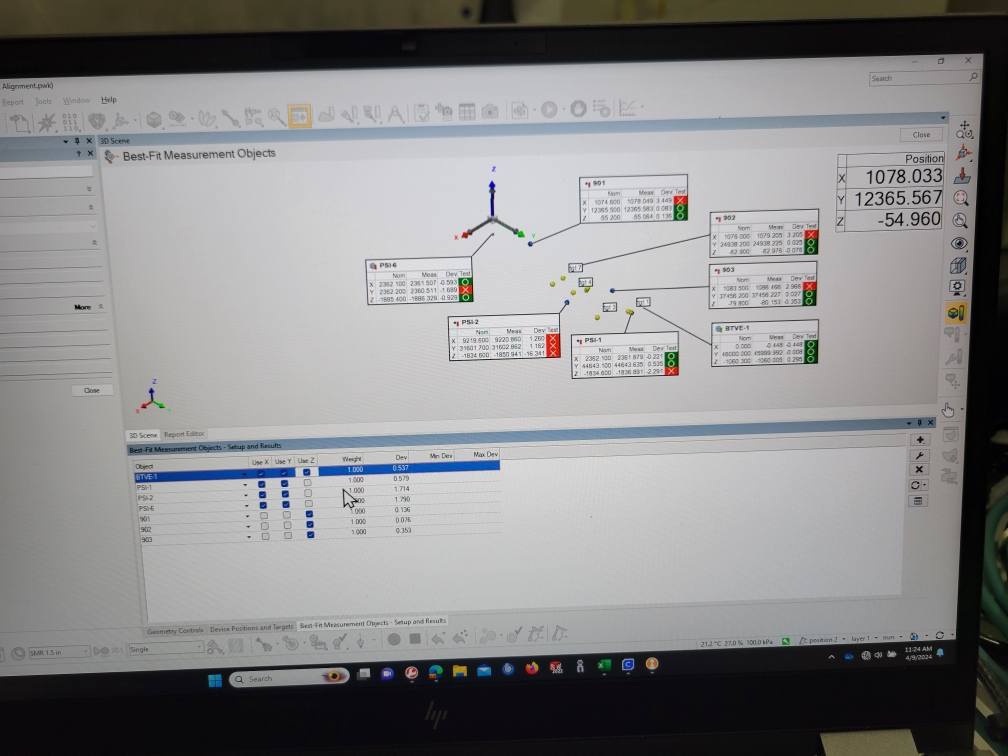
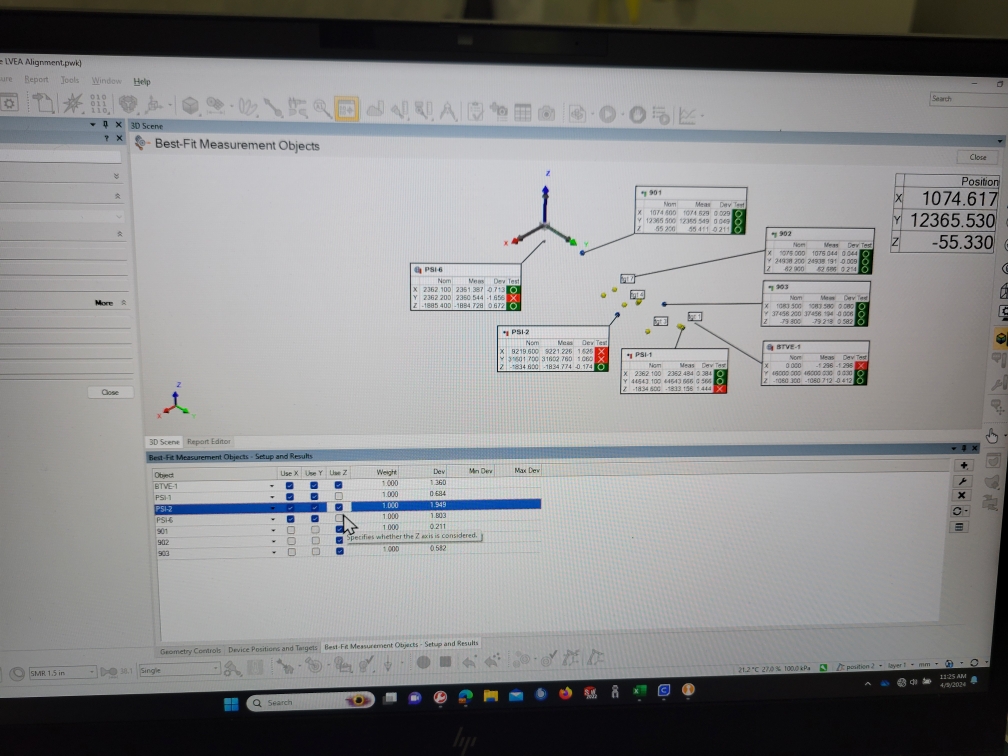
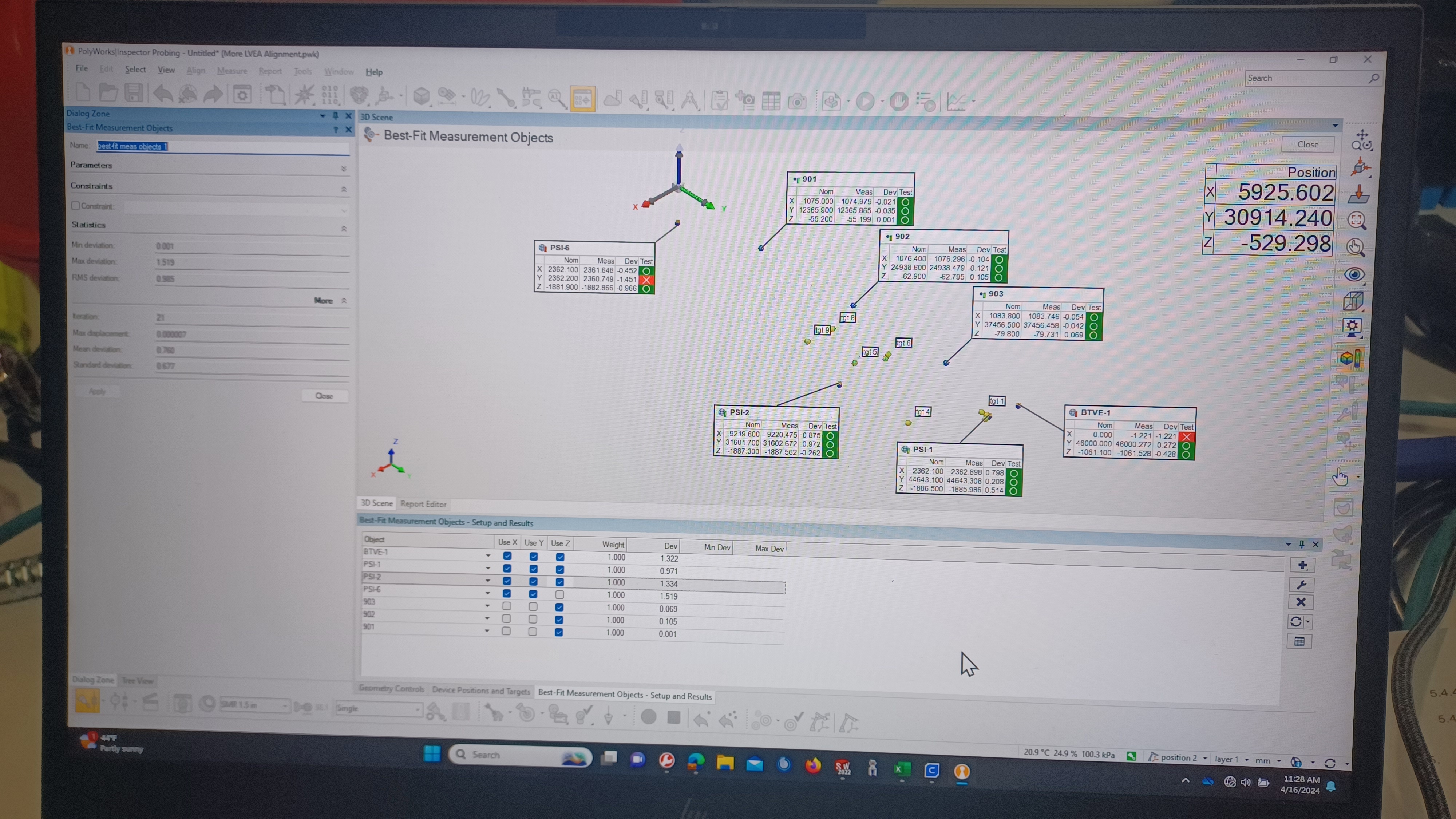
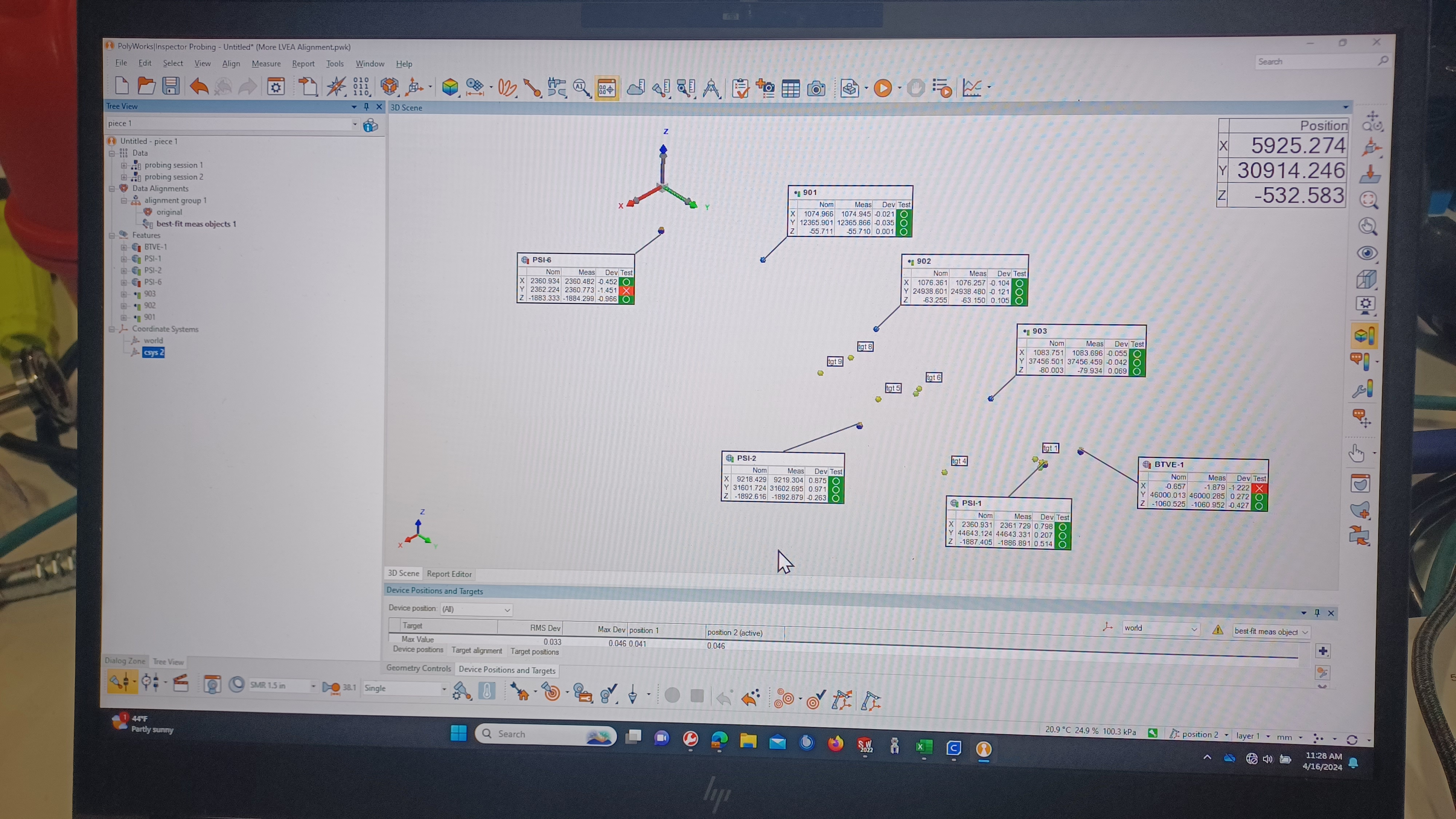
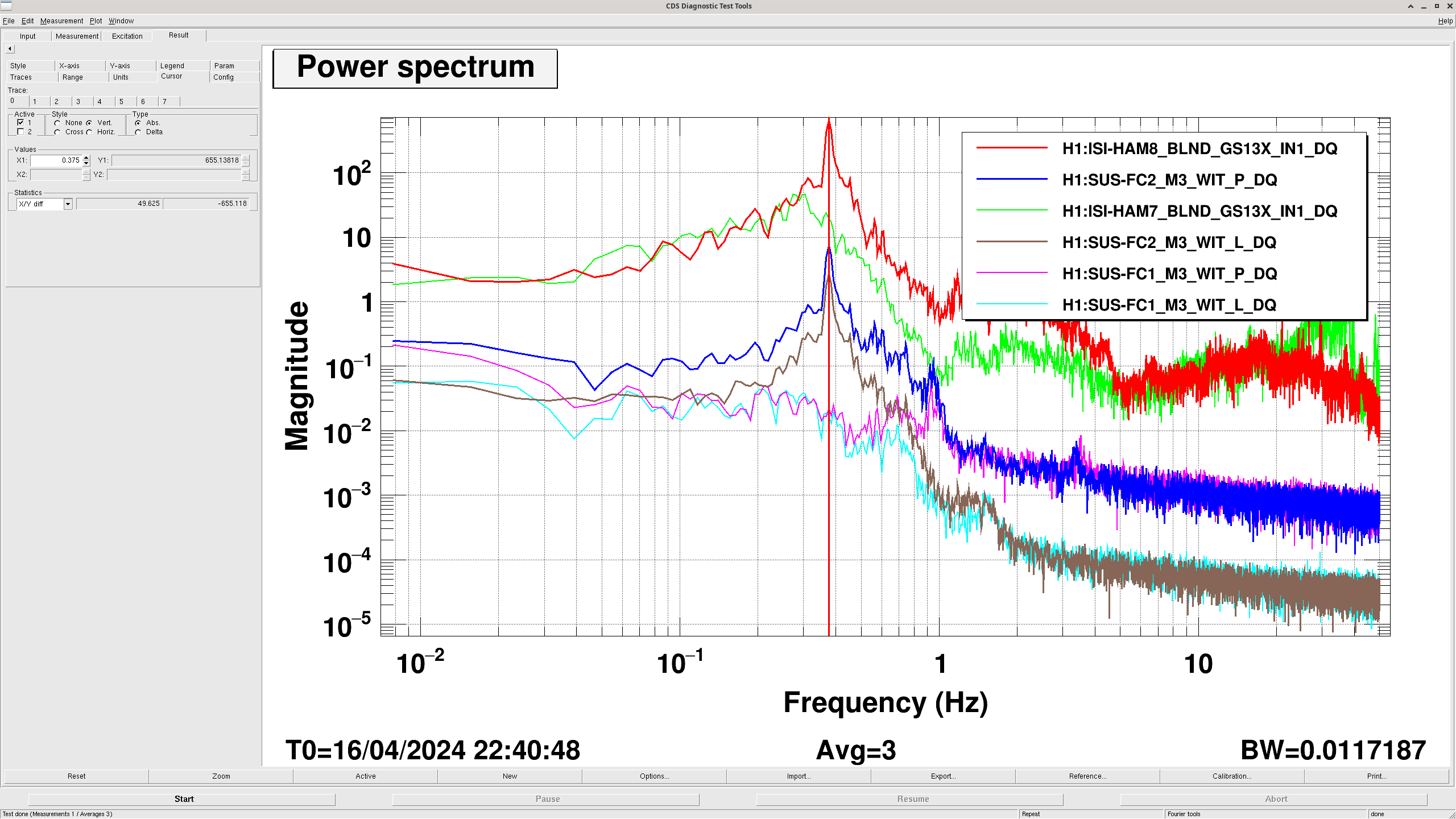
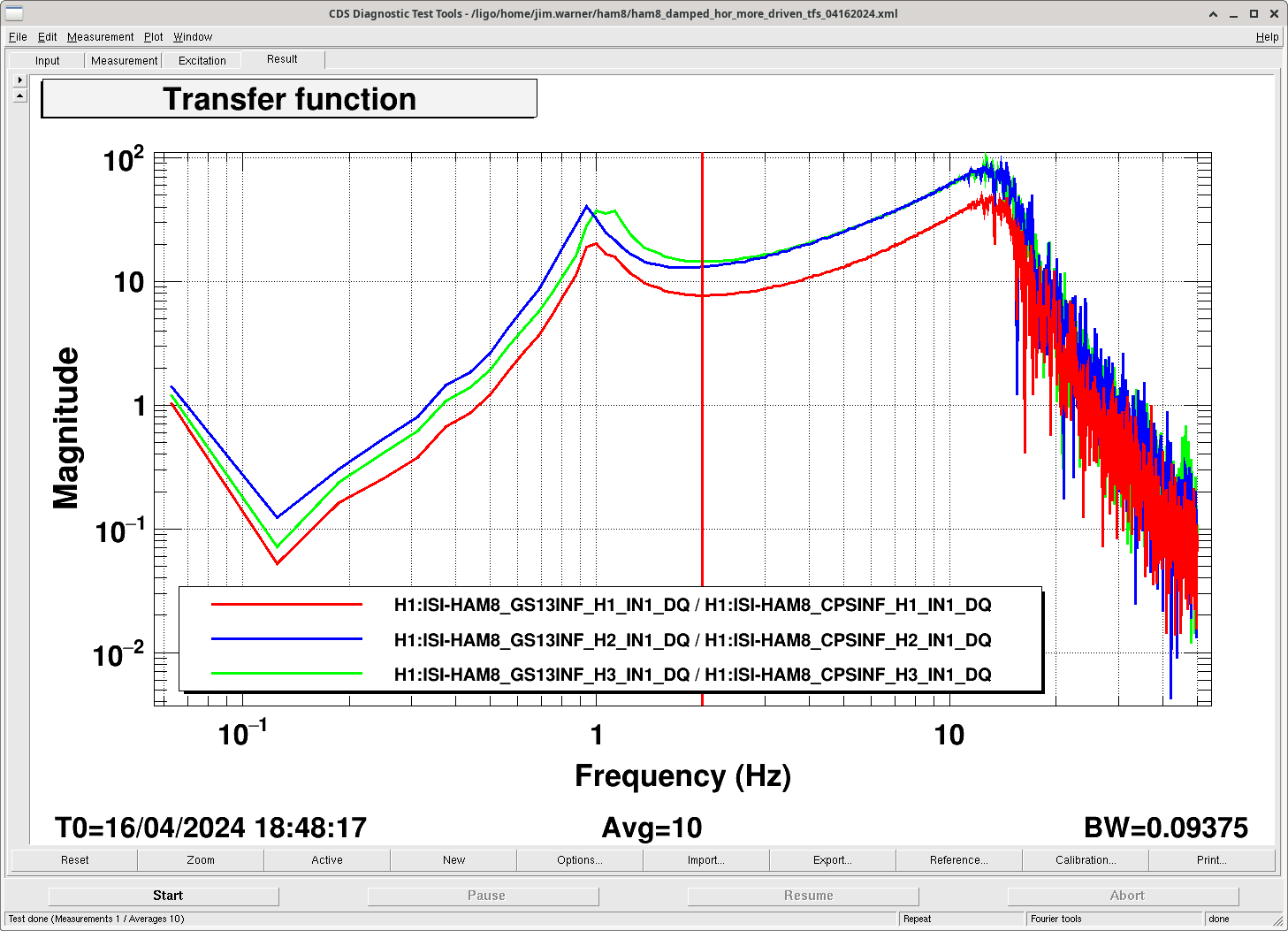
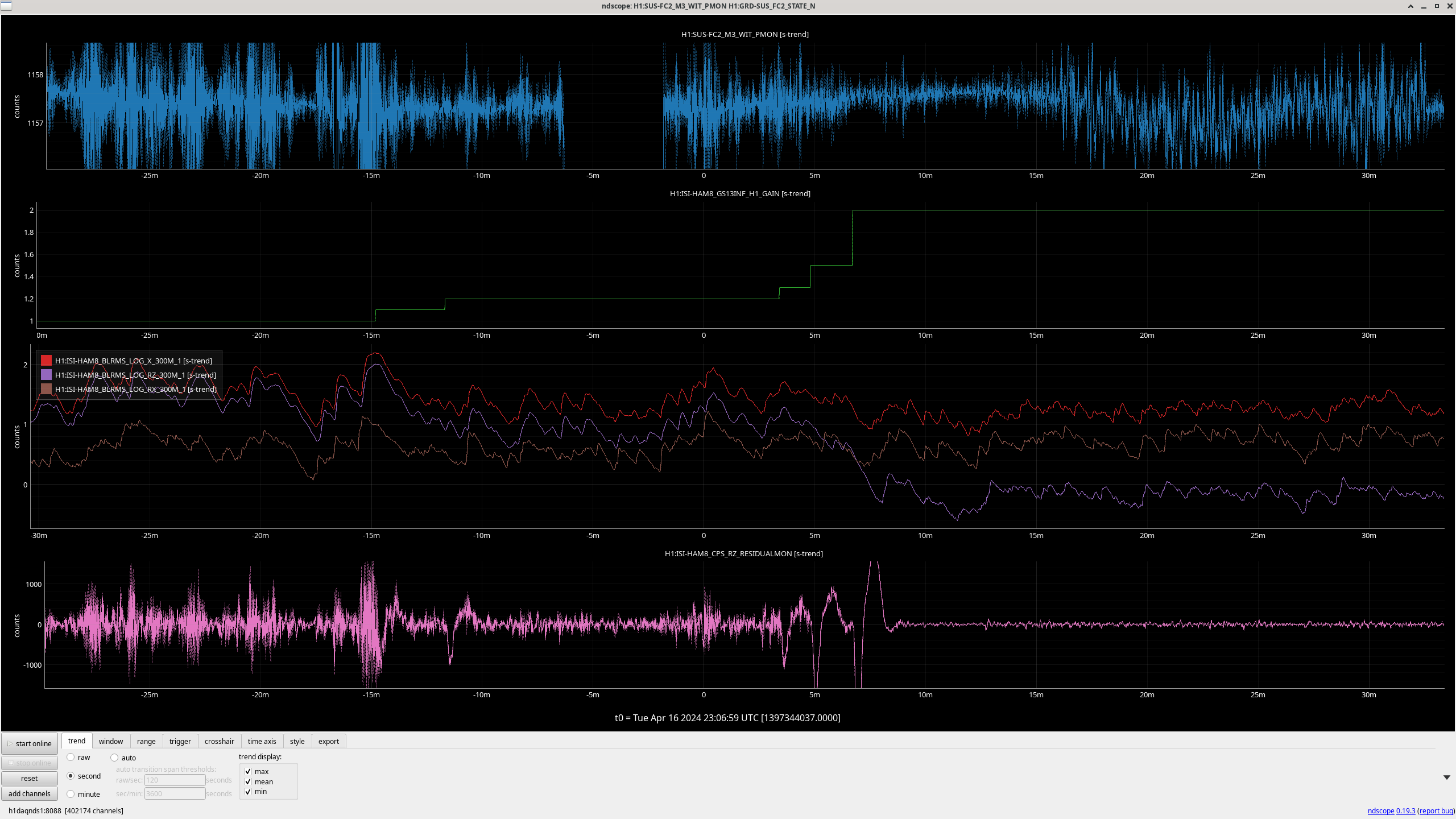
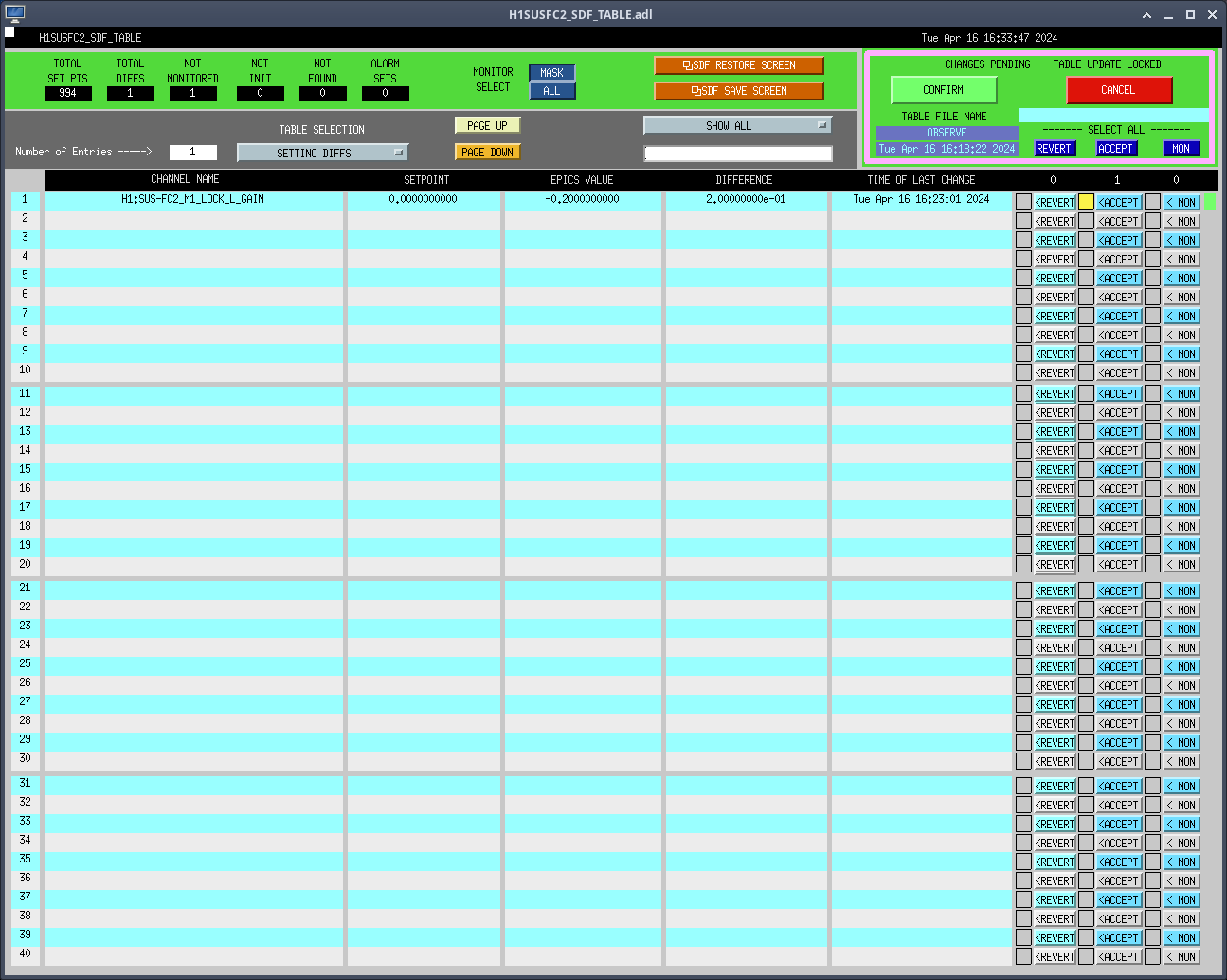
WP 11696 Betsy and I replaced the two HAM6 +X cameras removed in alog75425. Guillotines also removed will need to be reinserted if camera alignment needs to be adjusted.
Fri Feb 23 08:05:09 2024 INFO: Fill completed in 5min 6secs
Jordan confirmed a good fill curbside.
TITLE: 02/23 Day Shift: 16:00-00:00 UTC (08:00-16:00 PST), all times posted in UTC
STATE of H1: Planned Engineering
OUTGOING OPERATOR: None
CURRENT ENVIRONMENT:
SEI_ENV state: Maintenance
Wind: 3mph Gusts, 2mph 5min avg
Primary useism: 0.02 μm/s
Secondary useism: 0.26 μm/s
QUICK SUMMARY: 6.3M earthquake from the pacific rolled through overnight. nothing tripped. Slow controls still in red.
Today's activities: - HAM7 pumpdown status: ~8.5E-7 Torr - Corner pumpdown: ~7.4E-7 Torr, ~51 hours after the HV pumping started - EX pumpdown status: 3E-8 Torr. The GV will remain closed during FAC works (1-2 weeks) - At the EX RGA the bakeout temperature is ramping up; in the upcoming days the HAM7 and HAM8 RGAs will also be baked, as per WP #11713 - The inner annulus system of GV5 was valved in to the main annulus system - The hardware was prepared for the newest version Relay Tube's installation, which will be done tomorrow
Nutsinee, Daniel, Naoki
As reported in 75902, the SHG IR injection power was 180mW and the SHG GR power was only ~40mW after PMC install. To increase the SHG IR injection power, we replaced the 50:50 BS to split the SHG path and CLF/seed path with 70:30 BS. After the replacement, the IR power is 400mW before BS, 270mW for SHG path, and 130mW for CLF/seed path. After we optimized SHG alignment with pico and optimized the SHG temperature, the SHG GR power reached 60mW with 230mW SHG IR injection. This is consistent with what we had before in 67172.
The OPO can be locked with LOCKED_CLF_DUAL. The pump ISS control mon is a bit low ~3.8 so we need to align the pump AOM and fiber. We also need to align the seed fiber.
Attached an updated power budget and a SHG scan. After setting the SHG crystal temperature to 34C this morning, the SHG mode mismatch became worse (70% mode matched instead of 80%) on the floor so I reverted to crystal temperature back to ~36C. The normalized current on the SHG BBPD was increase from 0.288mA to ~0.4 mA. SHG common mode board gain is reduced by 3dB to compensate for the factor of 1.4 higher SHG trans. In addition to the BS2 that was replaced with a 30/70 we also replaced BS11 with a 10/90 (R=10%). PMC trans diode sits at the 10% pick off. The diode hasn't been recalibrated.
CLF path has been aligned. AOM1 has about 30% 1st order throughput and AOM2 has about 50% 1st order throughput. At the nominal AOM1 ISS drive point we are capable of sending about 1.5mW to the fiber coupler (we dump most of that power at the moment. Old 1/2 waveplate setting.). We are sending ~10mW into AOM1. Haven't tried to lock the CLF yet.
We also optimized the pump alignment into the fiber. Although that probably wasn't necessary. As Naoki mentioned we were able to lock the OPO with no issues but some optimization required.
Seed has a very small fiber throughput but at least there's something to look at. Optimizing that one tomorrow.
To do list tomorrow:
- Optimize seed and pump fiber throughput. Maybe optimize LO as well if we have the time although we probably won't need this any time soon.
- Lock CLF
- Calibrate PMC trans PD
Ps. I stole the BNC to HV adapter from the OPO PZT driver and forgot to return it...
TITLE: 02/22 Day Shift: 16:00-00:00 UTC (08:00-16:00 PST), all times posted in UTC
STATE of H1: Planned Engineering
INCOMING OPERATOR: None
SHIFT SUMMARY: CDS switch upgrade cleanup finished, corner station high voltage supplies were turned back on, SQZ table work and pumpdown continue.
LOG:
| Start Time | System | Name | Location | Lazer_Haz | Task | Time End |
|---|---|---|---|---|---|---|
| 19:22 | SAF | LVEA is Laser SAFE | LVEA | NO | LVEA is Laser SAFE | 03:59 |
| 16:02 | FAC | Karen, Kim | FCES | n | Tech clean | 17:11 |
| 16:55 | CDS | Jonathan, Tony, Erik | Mech room | n | FMCS, VAC switch work | 18:41 |
| 17:04 | IAS | Jason, Ryan C | LVEA - BG | n | Beam tube surveying | 20:56 |
| 17:35 | - | Betsy, Randy, Travis | LVEA - W | n | Clean room and quad container move | 18:21 |
| 17:35 | VAC | Jordan | EX | n | RGA | 18:41 |
| 17:36 | VAC | Janos | LVEA | n | Checking on turbos | 20:54 |
| 17:51 | OMC | Jeff | CR | n | DCPD meas. | 18:26 |
| 18:22 | SQZ | Julian, Camilla | Opt Lab | n | SHG work | 20:23 |
| 18:24 | VAC | Gerardo, Jordan | FCES | n | Look at purge compressor | 19:37 |
| 18:27 | FAC | Kim | H2 encl | n | Tech clean | 18:28 |
| 19:15 | SQZ | Nutsinee | LVEA - SQZ | LOCAL | SQZ table work | 21:23 |
| 19:17 | FAC | Mitchel | EX | n | Wind fence check | 19:52 |
| 19:42 | VAC | Jordan | EX | n | RGA | 20:00 |
| 20:33 | FIT | Camilla, Jeff | X-arm | n | Jogging | 21:23 |
| 21:16 | PCAL | Tony | PCal Lab | LOCAL | PCal work | 21:31 |
| 21:21 | VAC | Jordan | EX | n | RGA | 21:40 |
| 21:24 | EE | Fil | LVEA | n | Turn on HV at HAM7 | 21:48 |
| 21:25 | IAS | Jason, RyanC | LVEA | n | Beam tube surveying | 23:25 |
| 21:51 | SQZ | Nutsinee, Daniel, Naoki | LVEA - SQZ | LOCAL | SQZ PMC work | Ongoing |
| 22:07 | OPS | Betsy | LVEA | n | Checking on HAM6 cameras and shutters | 22:11 |
| 22:11 | FAC | Randy | LVEA | n | Talk to Jason | 23:09 |
| 22:19 | SQZ | Camilla, Julian, Fil | Optics Lab | LOCAL | SHG work | 23:36 |
| 23:08 | VAC | Gerardo, Jordan | LVEA | n | Checking purge air at GV5 | 23:59 |
| 23:10 | VAC | Travis | MY | n | Looking for pump cart | 23:36 |
| 23:29 | CDS | Fil | FCES, EX, EY | n | Installing SEI chassis, picking up parts | Ongoing |
The following power supplies in the corner station were powered on:
1. PZT High Voltage
2. Fast Shutter High Voltage (field chassis was enabled)
3. SR3 Heater
4. ITMX/Y Ring Heaters
The high voltage bypass on HAM6 and HAM7 was removed, see alog 75805.
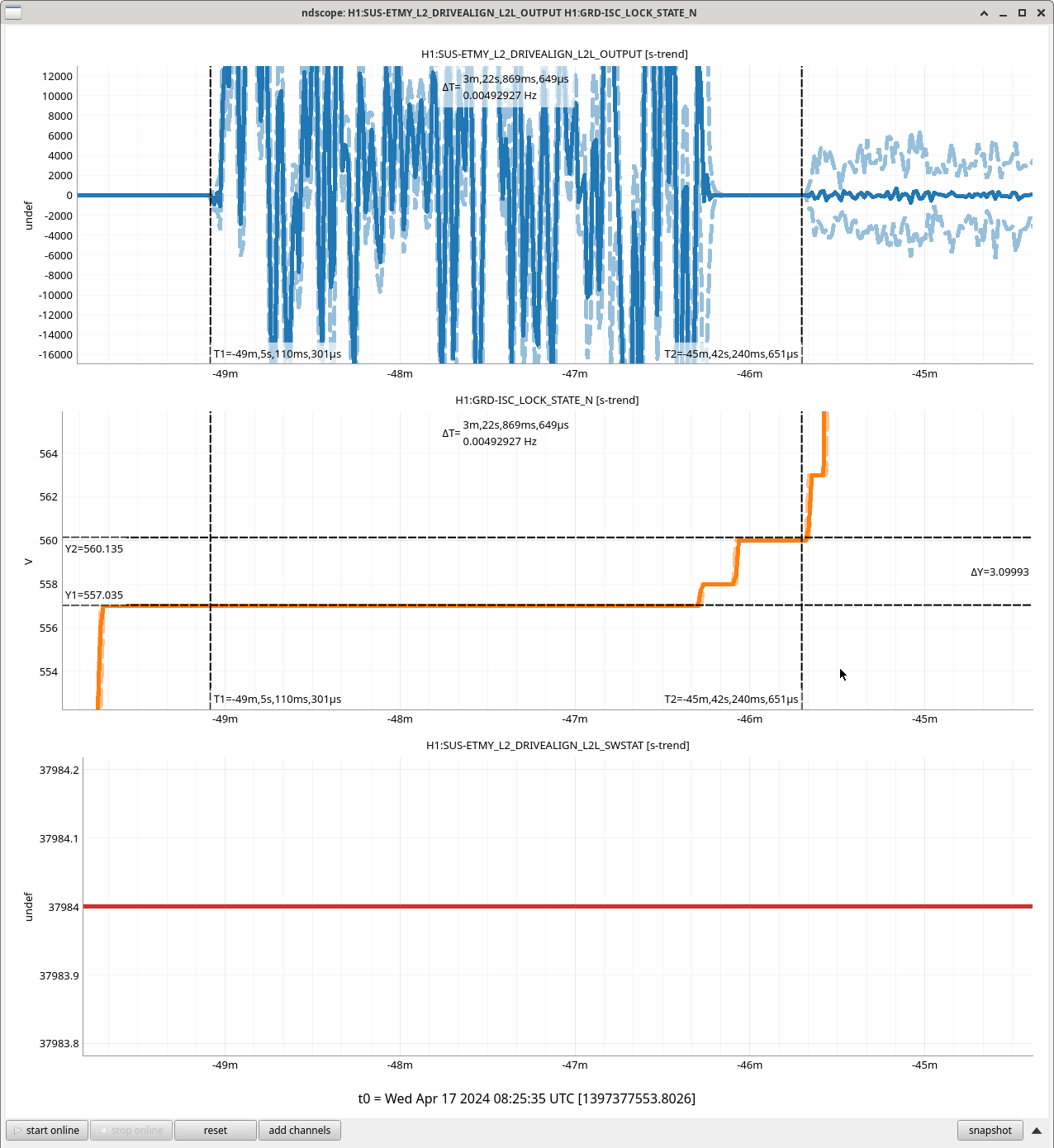
With the CDS and Beckhoff work yesterday some large numbers got into the CHILLER_SET_POINT filters which requested a low setpoint for CO2X, the laser faulted and turned of when it got to 15degC at 22:06UTC yesterday. This morning I turned it back on and set H1:TCS-ITMY_CO2_CHILLER_SERVO_GAIN_GAIN from 1 to 0 (as in alog 75715) to stop any feedback form the laser being off gong to the chiller).
TJ and I plan to make sure the H1:TCS-ITMX_CO2_PZT_SERVO_GAIN_SW2R is correctly turned on and off in the Guardian code when the CO2 lasers are taken DOWN to avoid this in future.
This is correctly turned off in DOWN but the Beckhoff work on this day changed the settings (plot) and we did not rerun the DOWN state. TJ has added a detector to TCS_ITM{X,Y}_CO2 guardians to rerun DOWN state if H1:TCS-ITMX_CO2_PZT_SERVO_GAIN_OUTPUT goes >1000. Usually below 100 but has an intergrator that can act strangely on Beckhoff channel changes. Tested and loaded in both X and Y.
Today, we opened the large ISI storage conatiner that housed 4 QUAD Upper Structure assemblies, 2 Baffle Down-tube assemblies, and 2 TransMonSus lower structures. It all looked great! The wires and blades showed no signs of any rusting, the container and parts looked very clean and organized. All clamped down as last left years ago. Nothing found unexpected.
We are working in the West Bay of the LVEA, so the parts are all currenly exposed in the large cleanroom there (which is ON).
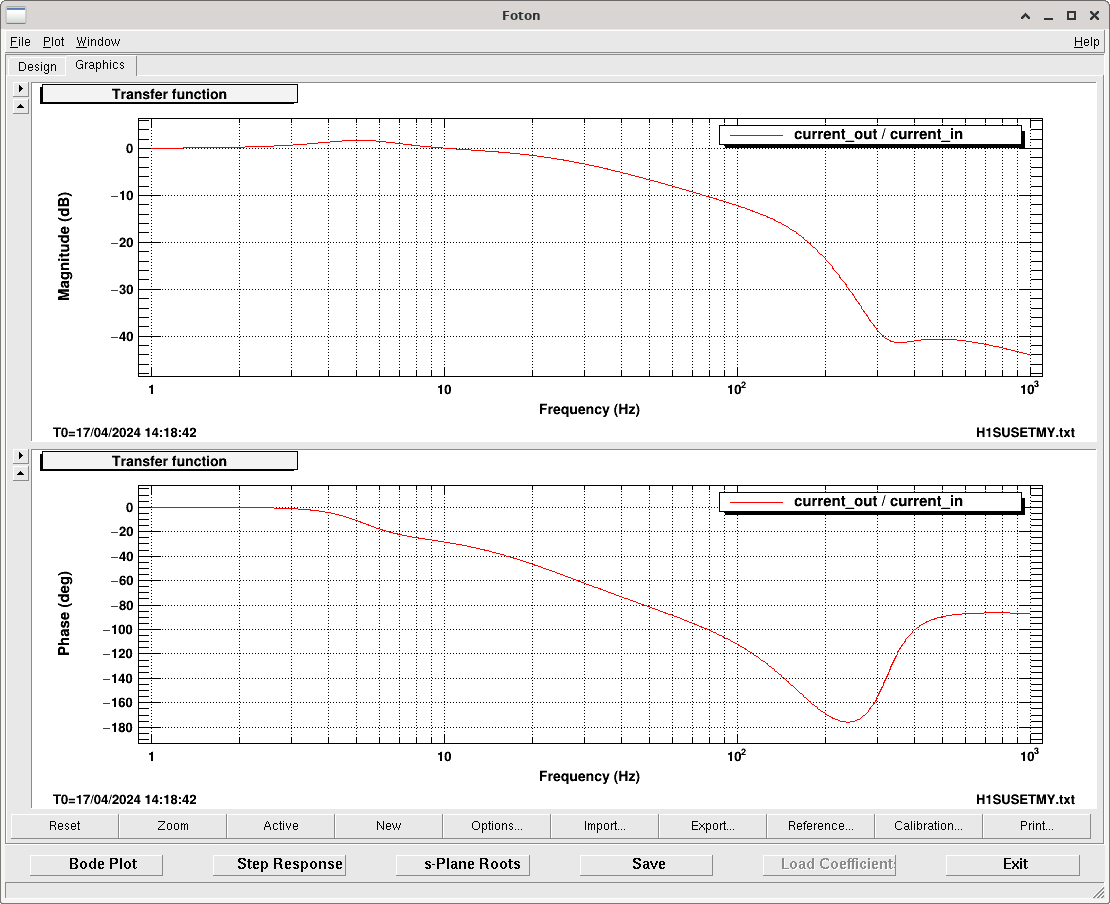
I've added a new "TCS TRENDS" button on the sitemap > OPS > WEEKLIES medm. This opens up two monthly ndscope trends (from /opt/rtcds/userapps/release/tcs/h1/templates/ndscope/famis), one for CO2 and the other for HWS. Explanation of the channels plotted below.
Thu Feb 22 08:06:46 2024 INFO: Fill completed in 6min 42secs
TITLE: 02/22 Day Shift: 16:00-00:00 UTC (08:00-16:00 PST), all times posted in UTC
STATE of H1: Planned Engineering
OUTGOING OPERATOR: None
CURRENT ENVIRONMENT:
SEI_ENV state: Maintenance
Wind: 3mph Gusts, 2mph 5min avg
Primary useism: 0.05 μm/s
Secondary useism: 0.23 μm/s
QUICK SUMMARY: Calm morning, prep for HAM8 work today and some cleanup from CDS switch work yesterday.
Current issues:
Corner station HEPI pump controller EPICS IOC does not connect, we suspect network port issue with h1hpipumpctrll0. This is the reason for the 31 disconnected channels on the EDC.
Camera servers will be rebooted today to get all the digital cameras back online.
FMCS connection to the corner station maintenance building and chiller not operational, mech room switch replacement scheduled this morning.
Jonathan, Erik, Dave, Tony, Ryan, Patrick, Dan Today we transitioned to all the new switches in the MSR. The order was: sw-msr-ops - this is the workstation and FOM switch sw-msr-server3 - auxillary servers, epics gateways, WAP controller sw-msr-server2 - auxillary servers, back channel connections from the file servers sw-msr-core - the main core network Dan Moraru came up to help us make sure the file servers where is a safe state when before we touched switches related to them. On the network side we ran into a few configuration issues but have been able to fix those. A few ports didn't get put on the right vlan, that was fixed. We need to enable directed broadcasts on a number of networks to allow the EPICS channel access broadcasts to go through. The fmcs epics ioc machine had a bad default gateway, we had to correct that before it would work (we do not know why or how it worked yesterday). Some issues with loose cables that were causing connectivity issues for fmcs. Tony, Ryan, and Dave did some work on cleaning out old items from the racks. We removed an old fujitsu switch, a broken qlogic switch, the old (dead) router, some retired servers, and the old sw-msr-ops, sw-msr-spare, sw-msr-server1, sw-msr-server3 switches. Tomorrow we will remove the old core switch and do more cleanup. We may have short outages, of some systems, but do not expect a general outage. The mx, my, and mechancial room switches are passing data, but we are not able to log into them. They were working on the test bench last week. I have racked up a test switch and connected it to the core (via a temporary link on port 48) to try and replicate the setup of these switches and get this issue figured out. We went through the configuration of all the icx switches and made sure that we had a consistent spanning tree setup. This should help clear up some odd network issues we have seen in the past. We also moved the connection to the file servers directly onto the core switch. We had front end system crashes today. Dave or Erik will add a comment detailing those issues. Dave restarted the EDCU while we were doing recovery of the front end systems to force it to reconnect to EPICS channels while we worked on issues with the fmcs ioc.
h1seib1 h1seib3 h1seih7 h1asc0 h1lsc0 h1oaf0 all crashed at approximately 20:00 UTC while switches were being swapped out in the MSR.
h1susey h1seiey hsusex, historically touchy front ends, crashed while recovering the others. h1seiey got into a bad state, continuously logging dolphin errors whcih disrupted the timing of the models and had to be restarted.
After recovering the front ends, a dolphin timing glitch was trigged when "unfencing" dolphin ports. The glitch affected models across the corner station. Models on h1susb123, h1sush2a h1sush34 h1sush56 had to be restarted.
I just ran a script that sweeps SHG crystal temperature. This test requires TTFSS, PMC, and SHG locked. PLEASE DO NOT TOUCH THE SQUEEZER. PLEASE WALK GENTLY NEAR SQZT0. The duration of the script is ~2hrs. Star time is 16:40.
The script sets the crystal temperature from 29C - 41C at 0.5C increment. We hope to replicate the phase matching curve done by a SURF student Nathan Zhao (P1400193 Fig 23). The script can be found in /opt/rtcds/userapps/trunk/sqz/h1/scripts/SHGphasematch.py
Here's our Sinc function. Not sure what's going on with the dip in the middle but I believe we have been operating at a good place (the right peak, ~36C). Although after the temperature scan the green production didn't come back to where it started. I moved the crystal temperature to the middle of the sinc function to confirm that the conversion efficiency really went down. I then moved the crystal temperature to the left peak of the sinc function (~34 C) and managed to recover 10mW of green.
Something else is drifting as well and it seems to have nothing to do with me. PMC PZT ran out of range this morning so I expanded the scan range down to 0V temporary (the current lock triggered at ~25 V). SHG PZT is still drifitng as I'm writing this alog while the green conversion goes down with it. For now I decidede to park the crystal temperature at 33.78C. Changes accepted in the SDF.
Attached a plot with SHG red transmission.
Naoki, Camille, Julian, Rahul
Summary: We measured beam profiles in HAM7 and HAM6 using the SQZ beam, after the PSAMs offloading work from 75677 75709 and the alignment work from 75732. We noticed that there is a lot of astigmatism on the beam in HAM6, but not in the HAM7 location that we were able to reach with the profiler.
Details:
In HAM6 we measured at three locations marked by the letters a,b,c in the sketch that Julian will attach. The red lines in the sketch show the irises.
Location 6A is 1.75 inches from the iris, Location 6B is 2 inches from the iris (closer to OM1). At location 6C we measured the beam in reflection off OM1, 23.25 inches after OM1. (The fast shutter is further in the -Y direction in chamber than what is shown in the CAD drawing). We also would like to measure at position 6D, once the second iris is removed.
We also measured beam profiles on the -X side of the HAM7 table, location 7A is 6.25" in the +X direction (closer to ZM5) from the iris, 7B is 8.25" from the iris in the + X direction, and location 7C is 12" from the iris in the +X direction. We weren't able to move the profiler further into the chamber without blocking the beam heading towards FC1.
We measured 13.5% widths, with A1 as the vertical axis and A2 as horizontal.
| location | ZM4 PSAMs strain gauge [V] (PZT request [V]) | ZM5 PSAMs [V] | A1 Width [um] (standard deviation) | A2 Width [um] (standard deviation) |
| 6B | 0.82 (0) | -4.14 (0) | 1392 (8.7) | 1573 (9.9) |
| 6B | 4.38 (100) | -4.14 (0) | 1406 (7.3) | 1584 (6.3) |
| 7B | 4.39 (100) | -4.14 (0) | 2001 (6.4) | 2017 (6.1) |
| 7B | 1.0 (0) | -4.14 (0) | 1928 (5.6) | 1924 (5.9) |
| 7B | 0.98 (0) | -0.52 (100) | 2200 (8.2) | 2212 (9.4) |
| 7B | 4.31 (100) | -0.52 (100) | 2276 (9.5) | 2303 (9.3) |
| 7B | 8.49 (200) * | -0.52 (100) | 2363 (11.0) | 2412 (13.8) |
| 7B | 8.53 (200) | 3.57 (200)* | 2611 (9.0) | 2691 (7.2) |
| 7B | 5.74 (100) * | 3.59 (200) | 2539 (13.7) | 2603 (18.1) |
| 7A | 5.72 (100) * | 0.64 (100) | 2387 (13.5) | 2446 (13.1) |
| 7C | 5.715 (100)* | 0.63 (100) | 2374 (11.0) | 2415 (9.5) |
| 6A | 5.7 (100) * | 0.625 (100) | 2074 (9.9) | 1611 (7.4) |
| 6C | 5.7 (100) | 0.612 (100) | 1670 (10.2) | 1618 (7.0) |
* strain guage still drifting
Stll left to do:
Useful distances from Don:
Don Griffith sent us some useful distances in HAM7 which are useful for interpreting these measurements, based on the CAD model that he updated in in March 2022 based on the as built photos of HAM7 (D1900365-v1).
Attached are new and final sketches (these should be used for future analyses) of the beam profiler positions with distances.
Note: we measured a distance in HAM7 from the edge of the table to ZM5 of 1841.5mm, whereas Don Griffith CAD model shows a distance of 1822.7mm.
Attached are screenshots of the beam profile measurements. The screenshots are labeled to indicate position, ZM4 voltage, and ZM5 voltage.
Attached is the sketch of HAM6 and pictures of the beam profiler position.
Sheila, Naoki
We measured several distances as follows.
From first iris to OM1 in HAM6: 53.75''
From ZM5 to second iris in HAM7: 68.5''
From edge of table to second iris in HAM7: 4''
Then we removed the irises in HAM6 and measured the beam profile at the position of second iris, which is 13.5'' from OM1.
A1: 1285 (6.7)
A2: 1426 (9.2)
We also measured the seed power at several locations. The seed coming out of HAM7 is 1.05 mW and the seed in HAM6 is 0.71 mW, which makes sense since the SRM reflectivity is 68%. The seed reflected by OPO without dither lock in SQZT7 is 30.5 mW.
We tried to take a photo of the beam and the ruler in ZM5, but it was difficult to read the ruler by camera or our eyes so we roughly measured the beam position in the baffle of ZM5. The hole diameter of the baffle in ZM5 is ~3 cm and the beam is ~1 cm below the top of the hole so the beam in ZM5 is higher than the center of the hole of the baffle.
The beam profile measurement in 75770 was done at 6D in this figure. The ZM4 and ZM5 PSAMs strain gauge [V] (PZT request [V]) are as follows.
ZM4: 5.68 (100)
ZM5: 0.52 (100)
Kevin, Sheila, Evan, Vicky
Summary: SQZ-OMC mode scans with hot OM2, and PSAMS 120/120 vs. 200/200. From this data, we should get single-bounce SQZ-OMC mode-matching with hot OM2, check SQZ readout losses (AS port throughput), and measure OMC losses via cavity visibility when locked/unlocked to the squeezer beam. With hot OM2, in sqz single bounce, SQZ-OMC mode-matching looks a bit better with PSAMS 120/120 than 200/200.
We'll ask Jennie W. to help us fit these SQZ-OMC mode scans. She can fit the double-peak in the 2xHOM, to give an accurate measure of SQZ-OMC mode-matching with hot OM2 and these two PSAMS settings. Here is just naively calculating mismatch from the relative power in TEM20 (TEM20/(TEM00 + TEM10/01 + TEM20)), and then calculating the total power not in TEM00 (ie 1-TEM00/(TEM00 + TEM10/01 + TEM20)), to get the following estimates on SQZ-OMC mode matching:
PSAMS 120/120, scan: 10/24/23 19:46:53 UTC + 200 seconds.
--> mismatch ~ TEM20/peak_sums ~ 2%. Total incl. mismatch + misalignment: 1-tem00/peak_sums ~ 8%.
PSAMS 200/200, scan: 10/24/23 19:04:57 UTC + 200 seconds.
--> mismatch ~ TEM20/peak_sums ~ 5%. Total incl. mismatch + misalignment: 1-tem00/peak_sums ~ 12%.
We will follow-up with analysis on OMC loss measurements based on cavity visibility, more accurate SQZ-OMC mode mismatches from these scans, and checking single-bounce SQZ powers through the AS port.
---------------------------------------------------------------------------
Notes:
---------------------------------------------------------------------------
Some relevant alogs, as we try to piece together the SQZ-IFO, IFO-OMC, and SQZ-OMC mode matchings:
Thanks to Vicky for helping me update the code to work for SQZ measaurements I had some trouble fitting these in the past as the fitting code was not subtracting off the dark current on the measurements, this doesn't matter so much for mode scans using the PSL as this has a much higher power through the OMC than the SQZ beam (16mA on the DCPDs vs. 0.5 mA on the DCPDs).
For the first measurement taken on 24th October 2023, hot OM2, PSAMS (ZM4 at 120V, ZM5 at 120V).
I used 70s of data taken starting at 1382212031.
See attached plots of the mode scan with identified peaks, and the carrier 02 peaks fitted as a sum of lorentzians.
The blue line shows the data zoomed in to the C02 peak. Th red line shows the sum of lorentzians using the fitted parameters of both centre frequencies, both amplitudes, and the half-width at half-maximum of an individual peak.
The purple line shows the lorentzian sum as a function of the initial fitting parameters.
The fitted mode spacing is 149.665 - 149.153 MHz = 0.512 MHz, which is less than the expected HOM spacing 0.588 MHz from this entry which uses the original measurements by Koiji in Table 25.
The mode-mismatch is 0.0062 + 0.0071 /( 0.0062 + 0.0071 + 0.45) = 2.9 % for the 02 modes with the lower frequency mode (horizontal I think) being higher in magnitude.
Code to do run mode scans is OMCScan_nosidebands6.py and fit the data is in fit_two_peaks_no_sidebands6.py located in labutils/omcscan git reposiotory on /dev branch, ran using labtutils conda enrvironment at labutils gitlab).
Run OMCscan_nosidebands6.py with
python OMCscan_nosidebands6.py 1382212031 70 "PSAMS 120/120, SQZ-OMC 1st scan" "single bounce" --verbose -m -p 0.008 -o 2
And also it is neccessary to hard code in the C02 mode being the 5th largest mode and 01 being the third largest in order to get a good fit as the sidebands are off.
Inside OMCscan_nosidebands6.py
find the module:
def identify_C02(self):
then change the lines shown after:
#set frequency to be that of third largest peak.
to read:
third_larg = np.argsort(self.peak_heights)[-3]#third largest is 01.
fourth_larg = np.argsort(self.peak_heights)[-5]#fifth largest is 02
For the second measurement taken on 24th October 2023, hot OM2, PSAMS (ZM4 at 200V, ZM5 at 200V).
I used 80s of data taken starting at 1382209515.
See attached plots of the mode scan with identified peaks, and the carrier 02 peaks fitted as a sum of lorentzians.
The blue line shows the data zoomed in to the C02 peak. Th red line shows the sum of lorentzians using the fitted parameters of both centre frequencies, both amplitudes, and the half-width at half-maximum of an individual peak.
The purple line shows the lorentzian sum as a function of the initial fitting parameters.
The fitted mode spacing is 149.757 - 149.204 = 0.552 MHz, which is less than the expected HOM spacing 0.588 MHz from this entry which uses the original measurements by Koiji in Table 25.
The mode-mismatch is 0.019 + 0.016 / (0.016 + 0.019 + 0.42) = 0.054 = 5.4 % for the 02 modes with the lower frequency mode (horizontal I think) being higher in magnitude.
Code to do run mode scans is OMCScan_nosidebands7.py and fit the data is in fit_two_peaks_no_sidebands7.py located in labutils/omcscan git reposiotory on /dev branch, ran using labtutils conda environment at labutils gitlab).
Run OMCscan_nosidebands7.py with
python OMCscan_nosidebands7.py 1382209515 80 "PSAMS 200/200, SQZ-OMC 2nd scan" "single bounce" --verbose -m -o 2
And also it is neccessary to hard code in the C02 mode being the 4th largest mode and 01 being the third largest in order to get a good fit as the sidebands are off.
Inside OMCscan_nosidebands7.py
find the module:
def identify_C02(self):
then change the lines shown after:
#set frequency to be that of third largest peak.
to read:
third_larg = np.argsort(self.peak_heights)[-3]#third largest is 01.
fourth_larg = np.argsort(self.peak_heights)[-4]#fourth largest is 02