Closes WP 11276. List of added channels: H0:FMC-FCES_AHU1_COLD_COIL_TEMP_DEGF H0:FMC-FCES_AHU1_FAN_SPEED H0:FMC-FCES_AHU1_HEPA_PRESS H0:FMC-FCES_AHU1_MIXED_TEMP_DEGF H0:FMC-FCES_AHU1_PRESS H0:FMC-FCES_AHU1_RELIEF_FAN_AIRFLOW_CFM H0:FMC-FCES_AHU1_RETURN_TEMP_DEGF H0:FMC-FCES_AHU1_SUP_FAN_AIRFLOW_CFM H0:FMC-FCES_AHU1_SUP_TEMP_DEGF H0:FMC-FCES_AUX_OSA_TEMP_DEGF H0:FMC-FCES_AUX_OUTSIDE_HUMIDITY H0:FMC-FCES_AUX_SPACE_HUMIDITY H0:FMC-FCES_AUX_SPACE_PRESS H0:FMC-FCES_AUX_SPACE_TEMP_DEGF H0:FMC-FCES_AUX_SUP_TEMP_DEGF H0:FMC-FCES_H2O_TANK_LEVEL H0:FMC-FCES_VEA_OSA_TEMP_DEGF H0:FMC-FCES_VEA_OUTSIDE_HUMIDITY H0:FMC-FCES_VEA_SPACE_HUMIDITY H0:FMC-FCES_VEA_SPACE_PRESS H0:FMC-FCES_VEA_SPACE_TEMP_DEGF H0:FMC-FCES_VEA_SUP_TEMP_DEGF H0:FMC-FCES_AHU1_RELIEF_FAN_STATUS H0:FMC-FCES_AHU1_SUP_FAN_STATUS H0:FMC-FCES_AUX_MAIN_FAN_STATUS H0:FMC-FCES_H2O_TANK_LOW_LEVEL_ALARM H0:FMC-FCES_VEA_MAIN_FAN_STATUS H0:FMC-FCES_AHU1_COLD_COIL_TEMP_DEGC H0:FMC-FCES_AHU1_MIXED_TEMP_DEGC H0:FMC-FCES_AHU1_RETURN_TEMP_DEGC H0:FMC-FCES_AHU1_SUP_TEMP_DEGC H0:FMC-FCES_AUX_OSA_TEMP_DEGC H0:FMC-FCES_AUX_SPACE_TEMP_DEGC H0:FMC-FCES_AUX_SUP_TEMP_DEGC H0:FMC-FCES_VEA_OSA_TEMP_DEGC H0:FMC-FCES_VEA_SPACE_TEMP_DEGC H0:FMC-FCES_VEA_SUP_TEMP_DEGC
WP 11274
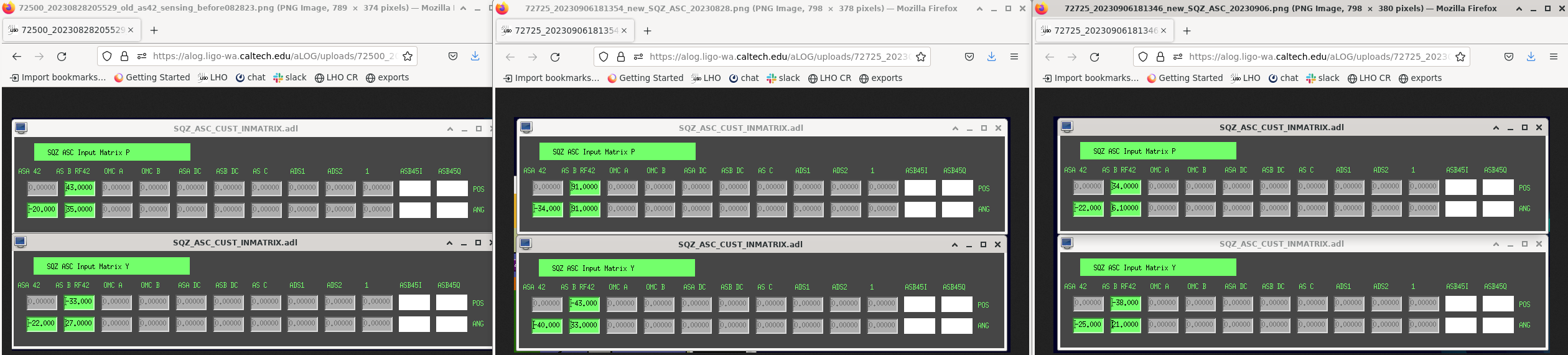
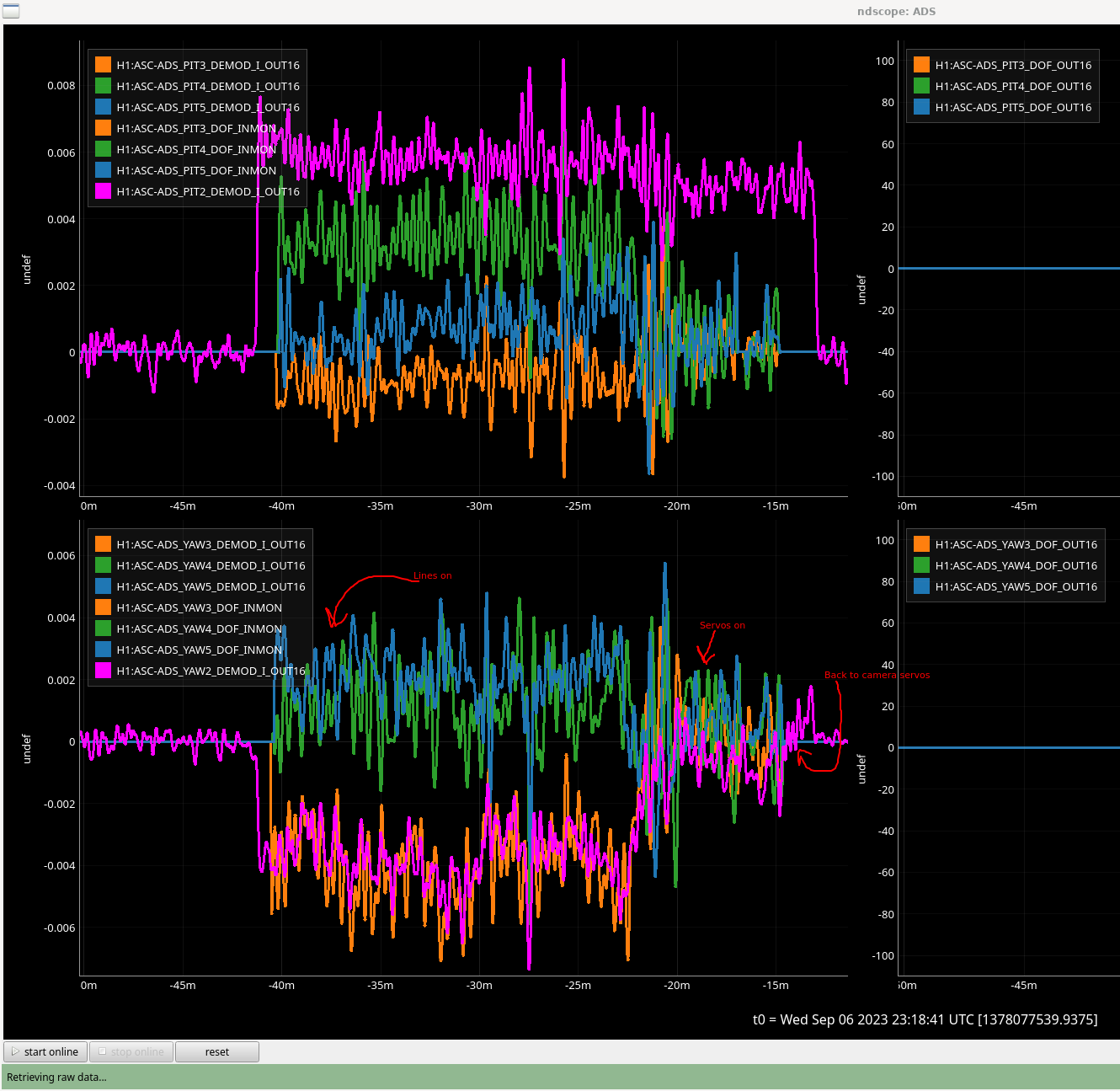
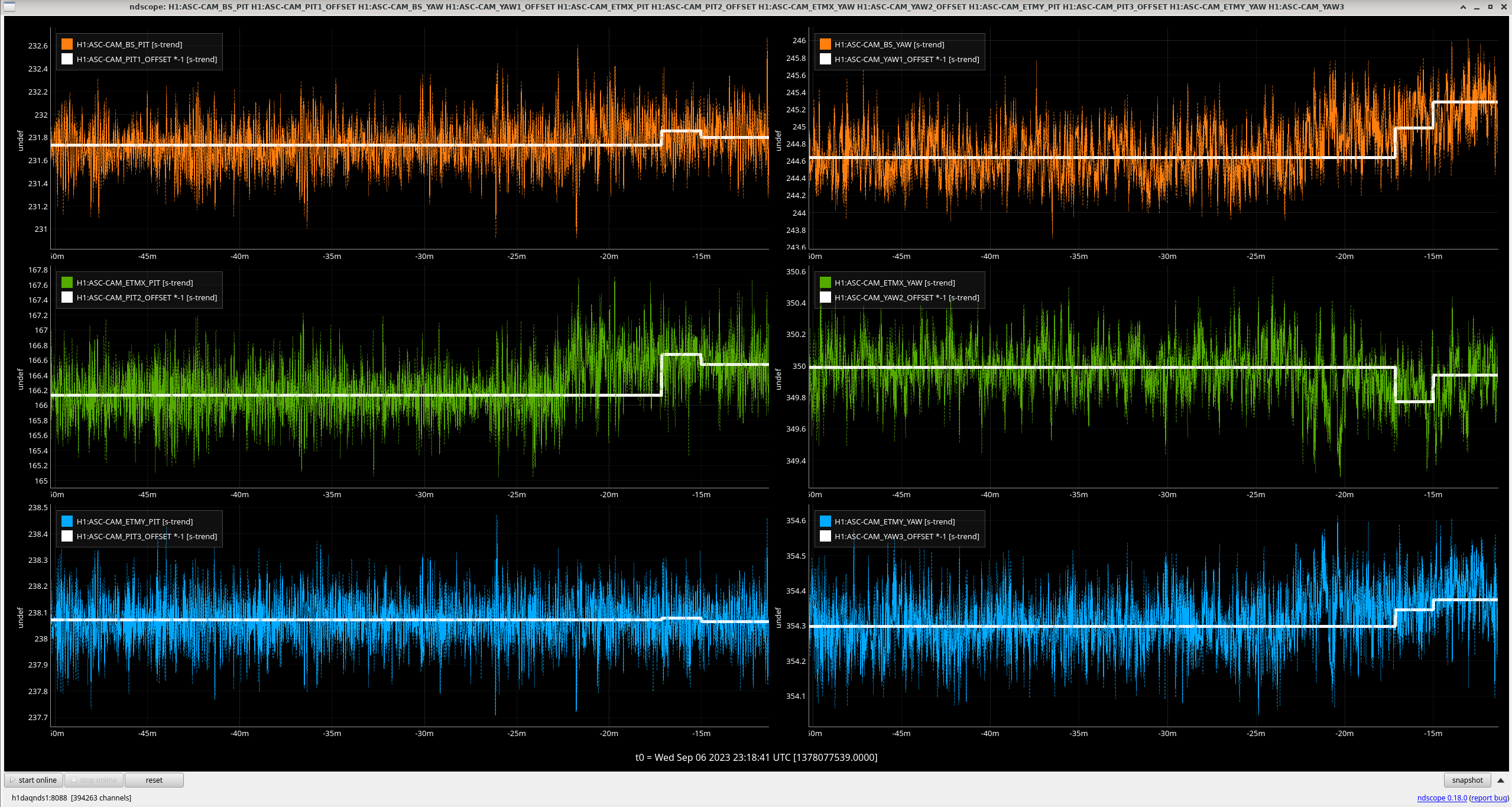
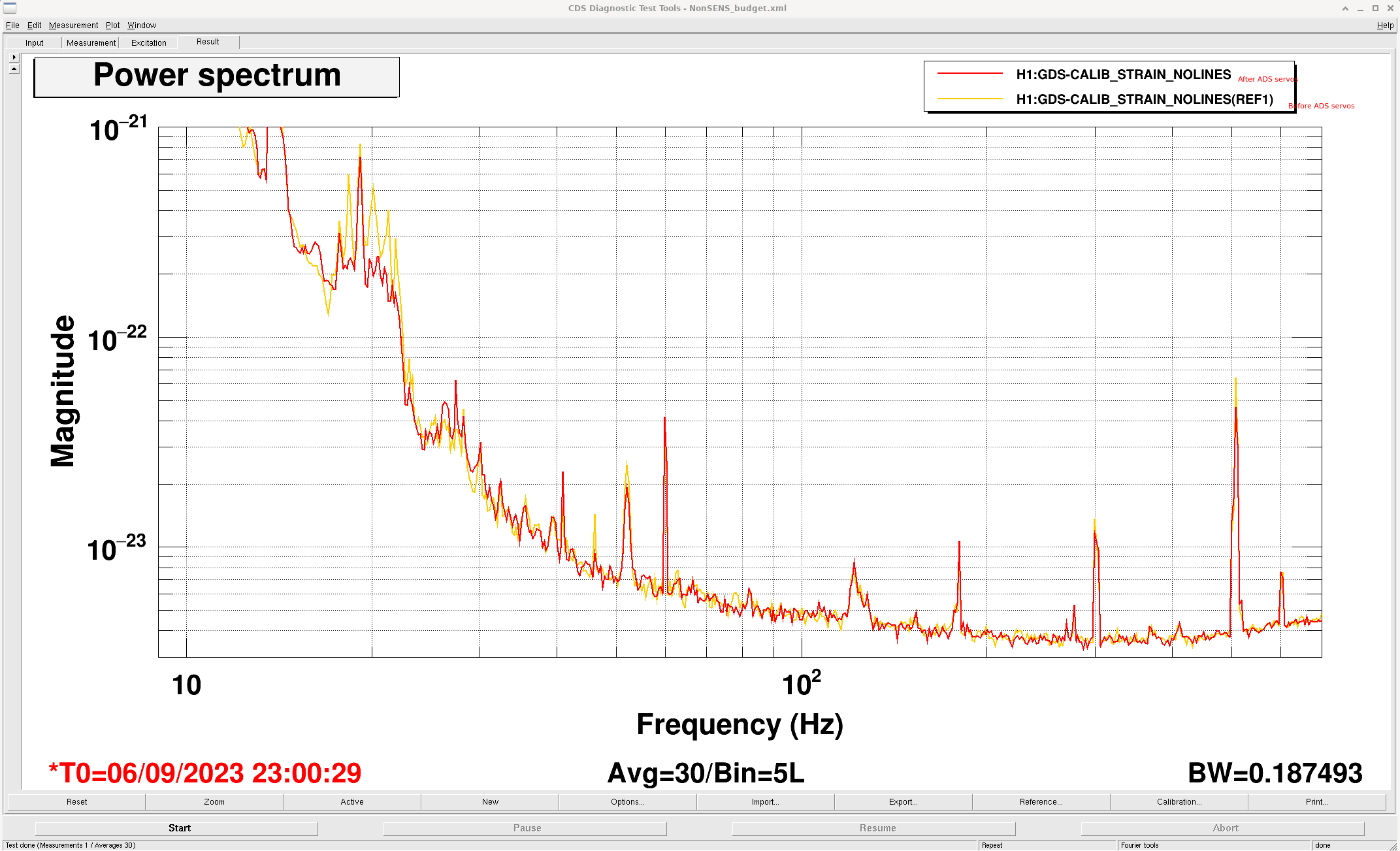
Betsy transitioned to laser hazard. The OMC HAM6 camera was replaced. Betsy/Sheila realigned new camera using local laptop. Betsy transitioned back to laser safe.
Afterwards Patrick/Dave/Erik updated the server/software. Camera housing is a smaller version of our standard camera enclosure. The network cable on the rear of the camera hits the back of the housing.
New Camera Basler ACA720-290gm
Old Camera Basler ACA640-120gm
D. Barker, F. Clara, S. Dywer, P. Thomas, B Weaver
Per WP11286 in response to ALOG70818
We installed the spare S1302233 Baffle PD Amplifier directly below the installed Baffle PD Amplifiers into SUS R5 in the Biergarten. ITMX is S1400066 and ITMY was S1400065 but we swapped functionality to the spare we just mounted below it (this rack is mostly empty).
If there are issues with the spare we can immediately swap functality back to the old unit. If the spare fixes the issues, we will recover the old unit and perform a post mortem. As there was no laser light during install we could not verify functionality while on the floor.
M. Pirello, F. Mera
We seem to see some signal on this pd now, unlike before. Interestingly, the pd seems a fair amount of light during the ISC_LOCK state of Move_Spots. Clearly we are moving through a place with high scatter, best to avoid.
I pulled the ITMY Baffle PD Amplifer S1400065 and moved the replacement S1302232 up to occupy positions 11 & 12 to the right of the ITMX Baffle PD Amplifier. Post mortem on S1400065 showed that one of the internal cables was loose, this has been fixed and all cables pull tested. S1400065 has been included in the spares inventory.
This completes WP11286
Vicky, Sheila
Vicky pointed out that the pump fiber rejected power was getting up to 0.7mW, we adjusted the polarization by taking the OPO guardian to locked clf dual no ISS, then adjusting the half and quarter wave plates. The rejected power is now about 0.3mW.
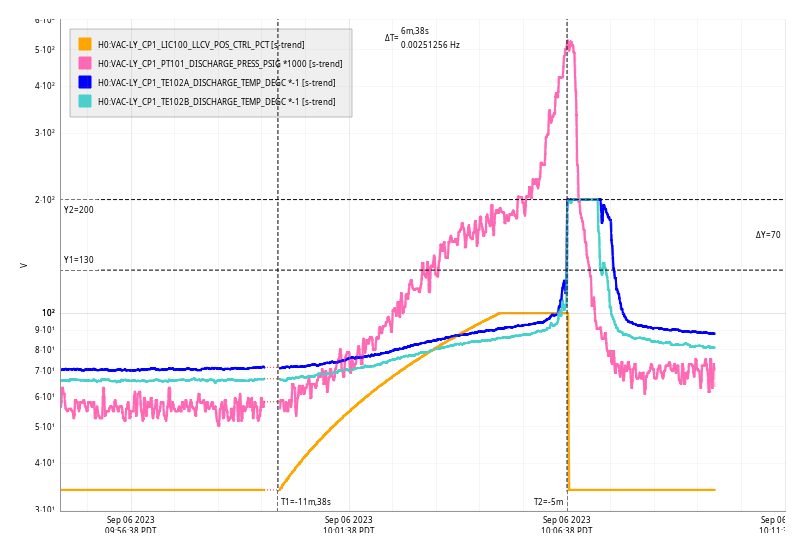
Closes WP 11250. The WP was only for h0vacly but I thought it prudent to check the other machines as well. The only other vacuum machine running VS 2019 that I found was h0vacmr, so I turned them off there as well. Screenshots attached of clicking through the errors on h0vacly and of where I turned off the automatic update setting.
For reference: alog 70203.
It seems that the OMC single bounce mode matching is better with hot OM2 than it was with the similar measurement 70409
Daniel turned off the sidebands and manually aligned the locked OMC.
I used an adpated version of the OMCscan class to fit the spectrum up to 20/02 carrier modes. The scan went through two free spectral ranges so I just used the first 60s to make the analysis easier, and assuming that within this 60s of data the third smallest clear peak was 20, and the fourth one was 10 mode.
The fitted spectra is attached.
Then I used an adapted version of fit_two_peaks.py to fit a sum of two lorentzians to the 20 and 02 carrier modes, the fit is shown in the second graph.
We expect the HOM spacing to be 0.588 MHz as per this entry and DCC T1500060 Table 25.
The spacing for the modes measured is 0.549 MHz.
From the heights of the two peaks this suggests mode-mismatch of the OMC to be C02+C20/C00 = (0.457mA+0.629mA)/(16.39mA+0.457mA+0.629mA) = 6.2% mode mis-match.
From the locked/unlocked powers on the OMC REFL PD the visibility on resonance is 1-(1.84mW/22.6mW) = 92% visibility.
If the total loss is 8%, this implies that the other non-mode-matching losses are roughly 1.4%.
To run the OMC scan code go to
/ligo/gitcommon/labutils/omc_scan/ and run
python OMCscan_nosidebands2.py 1371921531 60 "Sidebands off, 10W input, hot OM2" "single bounce" --verbose --make_plot -o 2
in the labutils conda environment and on git branch dev.
To do the double peak fitting run:
python fit_two_peaks_no_sidebands2.py
in the labutils conda environment and on git branch dev.
This was a single bounce scan off ITMX, with 0.44W on the ring heater upper and lower segments, and no CO2.
Using Jennie's mode mismatch of 6.2%, we can use the ratio of locked vs unlocked reflected power to estimate the OMC losses, finesse and transmission for a perfectly mode matched beam.
I've used a time when the fast shutter was blocked from 70409 to subtract the dark offset the refl diodes, this gives reflected power on resonance of 22.61mW, reflected power off resonance of 1.85mW.
The power in the mode mismatch is reflected_power_off_resonance * 6.2% = P_mm 1.4mW
Visibility for the 00 mode is (refl_on_resonance - P_mm)/(refl_off_resonance - P_mm) = 2.1%
The attached script uses this visibility to find the loss using:
def Refl_fraction(r_loss):
on_res = (r1 - (t1**2 * r1 * r_loss)/(1-r1**2*r_loss))**2
off_res = (r1 + (t1**2 * r1 * r_loss)/(1+r1**2*r_loss) )**2
return on_res/off_res
with r1 = sqrt(reflectivity of the input output mirrors) = sqrt(1-7690e-6) from T1500060 page 143, and r_loss = sqrt(1-round trip losses). With a visibilty of 2.1% this gives us a round trip loss of 2616ppm. If true this level of loss would imply a finesse of 351, well lower than previous measurements: 69707. This would imply that the transmission of the OMC cavity for a 00 mode is 73%.
Koji pointed out that infering losses from the visibility as I did above is very sensitive to the HOM content, and including the first order modes above would have resulted in a different value of OMC losses.
As an alternative approach, I adapted a mathematica notebook that Koji shared to use the transmitted power along with the visibility, and infer higher order mode content and cavity transmission by making an assumption about the DCPD QE.
One confusing point about using these reflected power measurements is that we have to correctly take into account that the beam which arrives at the OMC REFL path has reflected twice off the QPD pick off beamsplitter. (So, the incident power on the REFL diode = incident power on OMC breadboard/ R_pick_off^2)
The results we get for cavity losses (and higher order mode content) depend on what we assume for DCPD QE with this method. Below are the results of the attached script run with a QE of 1 and a QE of 96%, this only makes a small change in the higher order mode content we infer, and that small change in HOM also causes a small change in what we infer for the total efficiency of the OMC breadboard in the two cases.
Power on refl diode when cavity is off resonance: 22.612 mW
Incident power on OMC breadboard (before QPD pickoff): 23.052 mW
Power on refl diode on resonance: 1.848 mW
Measured effiency (DCPD current/responsivity if QE=1)/ incident power on OMC breadboard: 81.6 %
assumed QE: 96.0 %
power in transmission (for this QE) 19.598 mW
HOM content infered: 8.069 %
Cavity transmission infered: 93.376 %
predicted efficiency () (R_inputBS * mode_matching * cavity_transmission * QE): 81.616 %
omc efficency for 00 mode (including pick off BS, cavity transmission, and QE): 88.780 %
round trip loss: 540 (ppm)
Finesse: 396.346
assumed QE: 100 %
power in transmission (for this QE) 18.814 mW
HOM content infered: 7.903 %
Cavity transmission infered: 89.479 %
predicted efficiency () (R_inputBS * mode_matching * cavity_transmission * QE): 81.616 %
omc efficency for 00 mode (including pick off BS, cavity transmission, and QE): 88.620 %
round trip loss: 886 (ppm)
Finesse: 388.021
Here are the results of the June 27 2023 mod depth up down test 60 W: Power-recycling gains for sidebands and carrier9 MHz PRG = 68.7 45 MHz PRG = 30.2 Carrier PRG = 50.6Reflection ratios for sidebands and carrier9 MHz reflection ratio = 0.219 45 MHz reflection ratio = 0.214 Carrier reflection ratio = 0.064It appears the carrier PRG and PRG9 is recovered significantly compared to 75 W alog 69023, or 78 W alog 68696. The PRG45 is also higher, but it's hard to trust that POP A LF 45 is telling us anything super robust with < 1% of the power there coming from 45. The carrier PRG is higher at 60 W than at 25 W in alog 68696 after MOVE_SPOTS, which is unusual but the total PRG is also higher now (Total PRG = 50.6). Table of relative powers:
| Channels | 9 MHz | 45 MHz | Carrier |
|---|---|---|---|
| H1:IMC-PWR_IN_OUT16 | 0.013 | 0.015 | 0.971 |
| H1:IMC-IM4_TRANS_NSUM_OUT16 | 0.013 | 0.015 | 0.972 |
| H1:LSC-REFL_A_LF_OUT16 | 0.042 | 0.046 | 0.912 |
| H1:LSC-REFL_B_LF_OUT16 | 0.040 | 0.043 | 0.917 |
| H1:LSC-POP_A_LF_OUT16 | 0.018 | 0.009 | 0.973 |
| H1:ASC-POP_A_NSUM_OUT16 | 0.017 | 0.009 | 0.974 |
| H1:ASC-POP_B_NSUM_OUT16 | 0.017 | 0.009 | 0.974 |
| H1:ASC-AS_C_NSUM_OUT16 | 0.164 | 0.499 | 0.337 |
| H1:ASC-OMC_A_NSUM_OUT16 | 0.167 | 0.547 | 0.286 |
| H1:ASC-OMC_B_NSUM_OUT16 | 0.177 | 0.620 | 0.203 |
| H1:ASC-X_TR_A_NSUM_OUT16 | 0.005 | 0.007 | 0.988 |
| H1:ASC-X_TR_B_NSUM_OUT16 | 0.005 | 0.007 | 0.988 |
| H1:ASC-Y_TR_A_NSUM_OUT16 | 0.005 | 0.007 | 0.988 |
| H1:ASC-Y_TR_B_NSUM_OUT16 | 0.005 | 0.007 | 0.988 |
SUS charge measurements killed it when transitioning back to ETMX.
Closes FAMIS 19664, last done in alog 70708. BSC all look the same as last week, I didn't check the HAM plots.
TITLE: 06/27 Owl Shift: 07:00-15:00 UTC (00:00-08:00 PST), all times posted in UTC
STATE of H1: Preventive Maintenance, Been in NLN for 14h40.
SHIFT SUMMARY: Lots of Observing time overnight and some interesting results from the OM2 TSAMS test, see alog 70849.
LOG: IFO still locked with In-lock charge Measurements ongoing, once they are finished we'll take SEI_ENV to MAINTENANCE.
| Start Time | System | Name | Location | Lazer_Haz | Task | Time End |
|---|---|---|---|---|---|---|
| 12:00 | ISC | Sheila | Script | N | Out of Observing for DARM offset test and OM2 TSAMS increase 70849 | 12:05 |
| 14:04 | ISC | Sheila | Script | N | DARM offset test 70849 | 14:09 |
| 14:11 | SQZ | Camilla | CR | N | No SQZ time 70855 | 14:16 |
| 14:19 | COMM | Craig | Remote | N | Mod depth up-down test | 14:21 |
| 14:26 | CAL | Camilla | CR | N | BB Calibration Measurement 70854 | 14:30 |
| 14:31 | PEM | Camilla | CR | N | PEM_MAG_INJ - started at a later time tagging PEM | 14:53 |
| 14:32 | FAC | Bubba | LVEA | N | Plugging in | 14:48 |
| 14:56 | FAC | Karen, Kim | LVEA | N | Technical Cleaning | ????? |
| 14:59 | SUS | Camilla | CR | N | In-lock Charge Measurements - started at a later time | 15:15 |
TITLE: 06/27 Day Shift: 15:00-23:00 UTC (08:00-16:00 PST), all times posted in UTC
STATE of H1: Preventive Maintenance
CURRENT ENVIRONMENT:
SEI_ENV state: CALM
Wind: 9mph Gusts, 7mph 5min avg
Primary useism: 0.02 μm/s
Secondary useism: 0.06 μm/s
QUICK SUMMARY: Measurements are almost done, SUS charge going right now, and maintenance work has started. Still locked at 13hrs 35 min and 145Mpc!
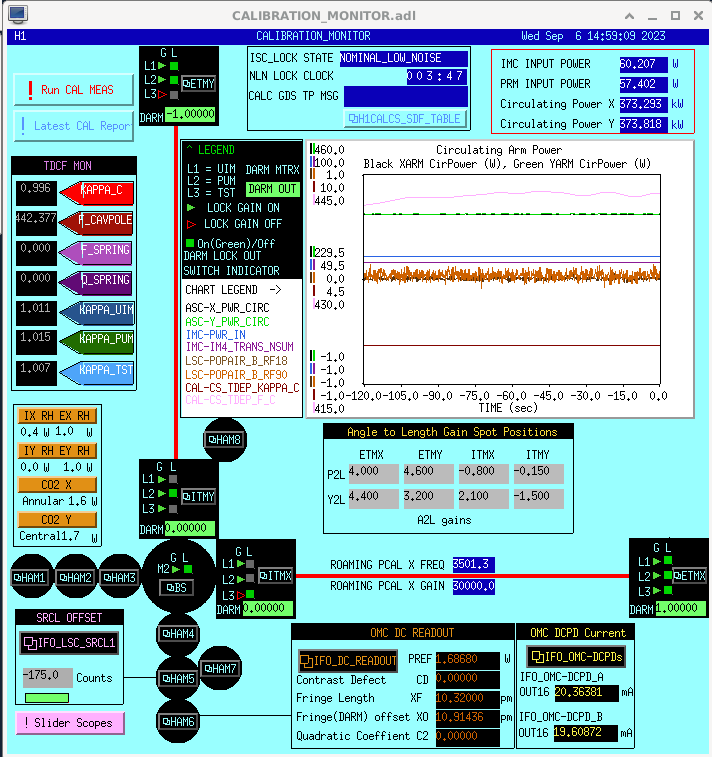
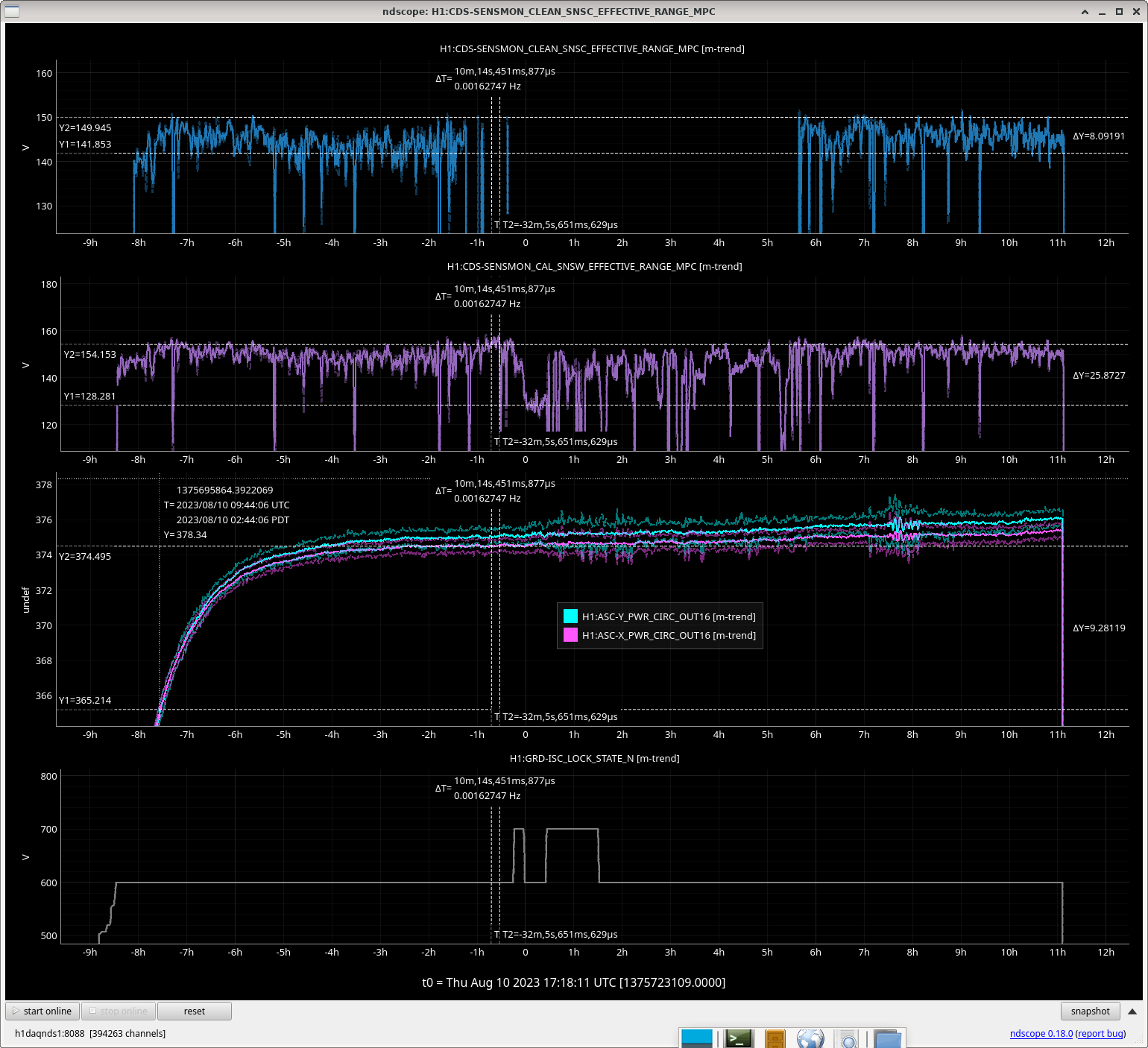
As kappa_c is changing with OM2 TSAMS being turned on, 70849, we took a Broadband Calibration Measurement at 14:24 UTC. Screenshot of IFO beforehand attached.
bb output: /ligo/groups/cal/H1/measurements/PCALY2DARM_BB/PCALY2DARM_BB_20230627T142443Z.xml
this xml can be plotted using /ligo/home/louis.dartez/projects/20230627/plot_cal_bb.py
Out of Observing 12:00 to 12:05UTC for DARM Offset Steps as described in 70835, back in Observing now with H1:AWC-OM2_TSAMS_POWER_SET set to 4.6, sdf accepted for 2 hour test.
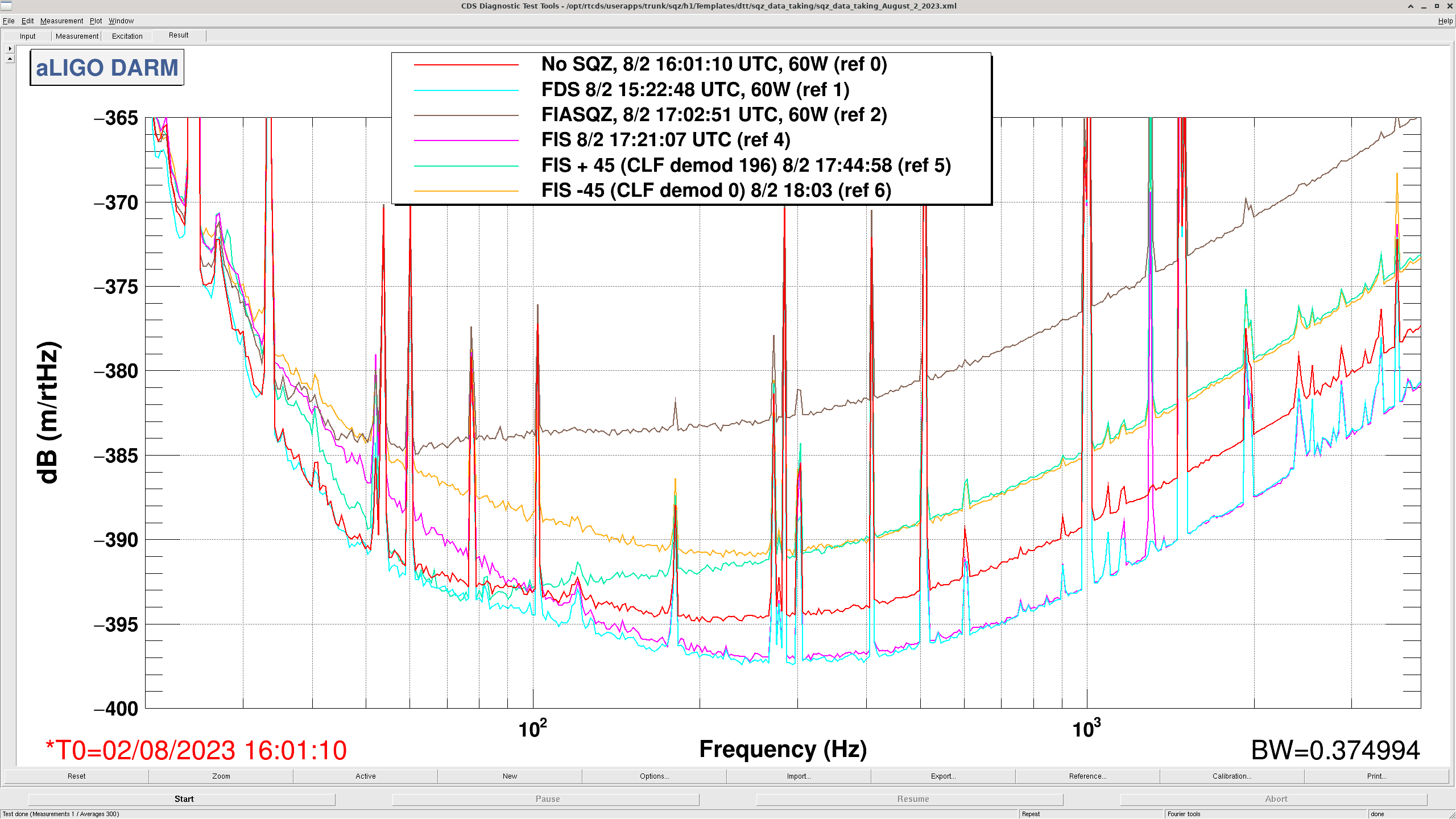
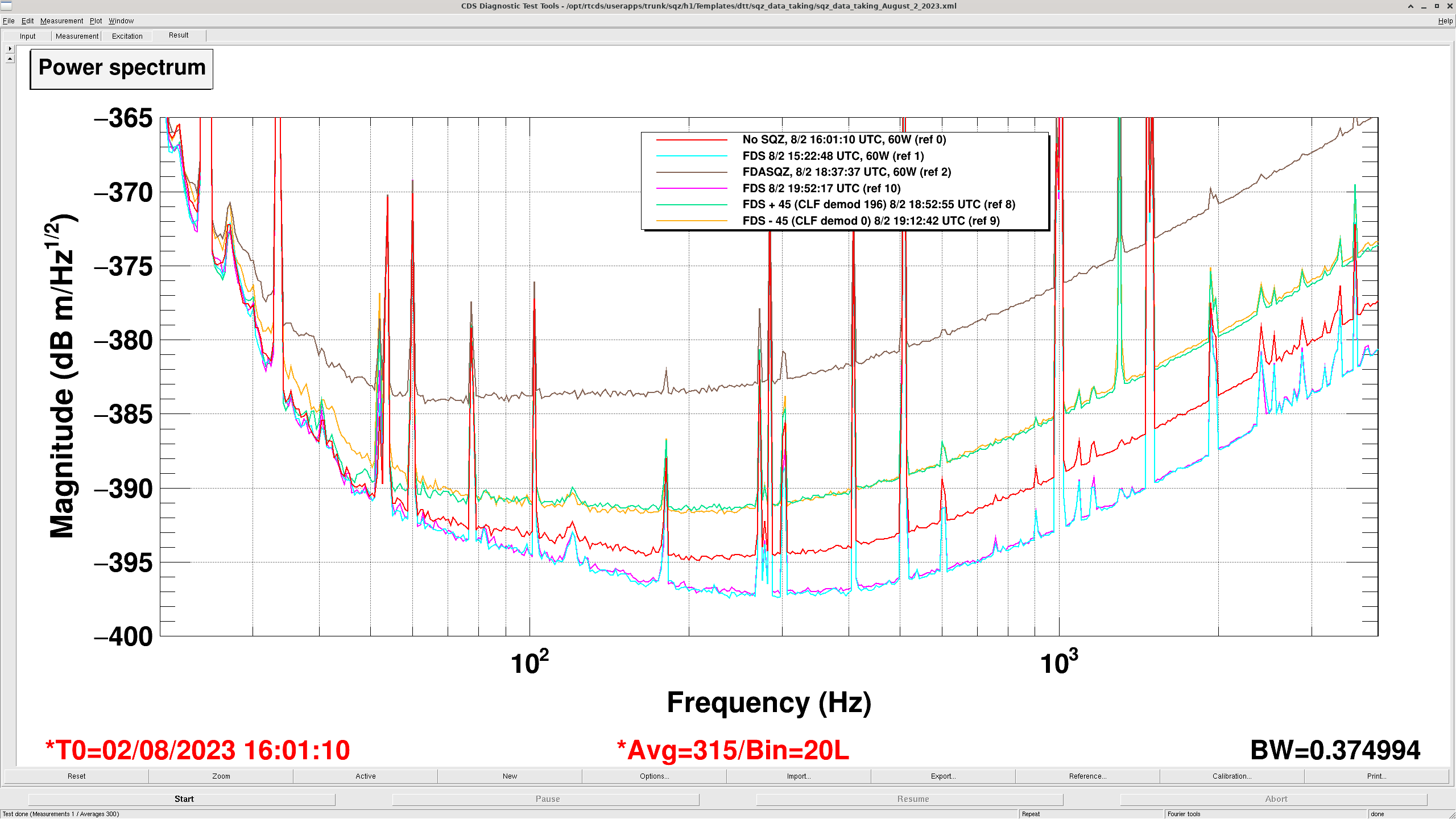
As OM2 warms up, our Kappa C is dropping, and reported range increasing, see plot. Our SQZ BLRMs are reporting better squeezing around 100Hz, visible in DARM too, see attached. Unsure if this is real or due to the calibration changing...
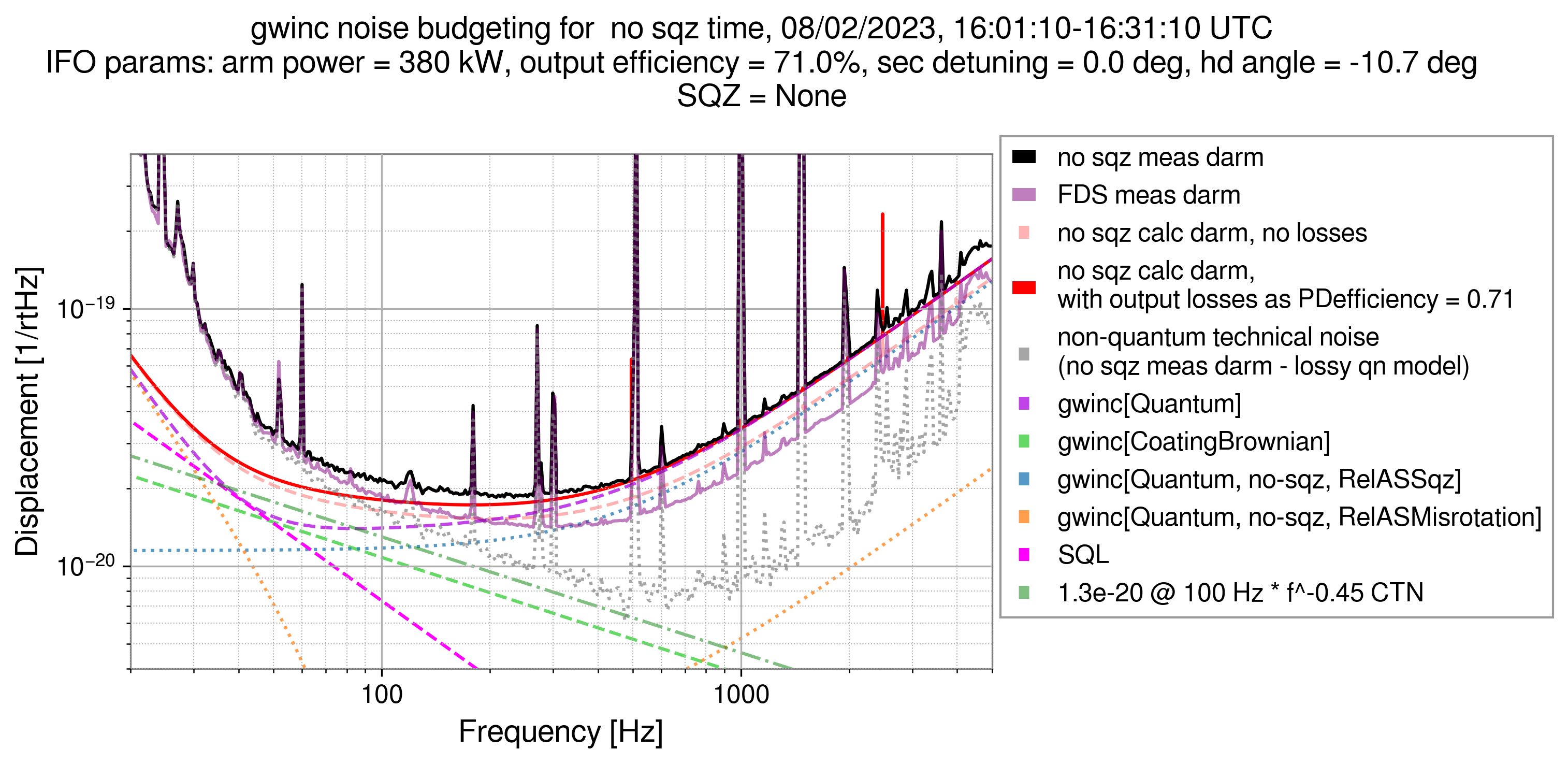
No SQZ time with hot OM2 was taken 14:11 to 14:16 UTC. Plot attached.
Optical gain seem to have reduced by ~2%, cavity pole higher by ~3Hz.
Looking closer at the sqz vs. no-sqz times from Camilla, at hot vs. cold OM2 settings, here are some things I notice:
Coherences for a time with lower range (OM2 cold) and higher range (OM2 hot):
https://ldas-jobs.ligo-wa.caltech.edu/~gabriele.vajente/bruco_GDS_1371896710_lower_range/
https://ldas-jobs.ligo-wa.caltech.edu/~gabriele.vajente/bruco_GDS_1371906344_higher_range/
Coherence with jitter is reduced with the hot OM2. Also there is some brodband improvement.
SRCL coherence is slighlty larger when the range is higher, so there might be even more improvement to be gained with a retuned FF.
Also, CHARD_P has larger coherence, while CHARD_Y is slightly better, so I guess the optimal A2L must have changed
Tagging CAL.
This is when the OM2 TSAMS heater first gets turned ON during O4.
As Camilla indicates, the "ON" button was hit -- i.e. H1:AWC-OM2_TSAMS_POWER_SET was set to 4.6 V at
2023-06-27 12:04:02 UTC (05:04:02 PDT)
-- yes, at 5a in the morning on Tuesday prior to Maintenance day; she was on OWL shifts during O4, prior to when owl shifts became remote/on-call.
WE were
back in observing by 2023-06-27 12:05:30 UTC (05:05:30 PDT).
The thermistors on the TSAMS heater unit took much longer to thermalize, with
- H1:AWC-OM2_TSAMS_THERMISTOR_1_TEMPERATURE taking *days* to reach equilibrium 33.0 [deg C].
- H1:AWC-OM2_TSAMS_THERMISTOR_2_TEMPERATURE taking *hours* to reach equilibrium at 56.60 [deg C].
Indeed the calibration measurements taken on Tuesday 2023-06-28 01:50 UTC (2023-06-27 18:50 PDT -- see LHO:70902 and LHO:70908), the lock and observation stretch *after* the above mentioned turn on segment was taken in the middle of the THERMISTOR_2_TEMPERATURE thermalization.
The TSAMS heater remained ON until 15 days later on 2023-07-12 14:48:47 UTC -- LHO:71285.
Reduced the baffle PD gain in ETMX PD 1 to 0dB from 20dB (H1:AOS-ETMX_BAFFLEPD_1_GAIN), since it was pegged at 10V.
ETMX baffle PDs 2, 3 and 4 are ok and gain at 20dB.
ETMY baffled PD 1 is close to saturation and gain is 20dB.
ETMY baffle PDs 2 and 3 have a gain of 0dB and show very small signals. Could be increased to 20dB.
ETMY baffle PD 4 saturates at the begining of a lock. Gain could be decreased to 0dB.
ITMX baffle PD 1 gain at 0dB, 20dB for all others, signal ok.
The ITMY baffle PD 3 readout seems broken since at least January 2022; maybe related to this upgrade.
All gains at 20dB, signals for all but PD 3 seem ok.
The attached trend plot shows all baffled PDs at 75W and 60W input. The transition happens near -5d in the plot. The power reduction is as high as a factor of 2 but typically much less.
Daniel has also taken it as an action item to work with an operator to ensure that the gain changes are handled nicely by the baffle PD script, since we use PDs 1 and 4 on each test mass to help us align the green beam if we cannot see flashes. Daniel's suggestion is to have the script increase the gain values to what they had been, and then after the script completes, return them to the lower values that they have now. This should allow the PDs to be useful for both the pre-initial alignment, as well as be useful when in full lock.
Changed and restored the baffled PD gain in the baffleAlign.py script (function alignToBafflePD). Needs testing.
Script tested
Vibration coupling has increased since early in the O3-O4 break, both input jitter coupling and scattering noise. Jitter coupling at the PSL increased by a factor of about 5 between 2021/05/12 (just after TM replacement), when IMC-PWR-IN indicates we were running at 46 W, and 2023/03/17 when we were running at 60 W, just before the increase to 75W (https://alog.ligo-wa.caltech.edu/aLOG/index.php?callRep=68036 ).
Scattering noise from the cryobaffle at EX increased dramatically between 2020/09/14 when we were running at 38W, and during PEM injections this May when we were at 75W (https://alog.ligo-wa.caltech.edu/aLOG/index.php?callRep=69578 ). Scattering noise also increased at the LLO EX cryobaffle (https://alog.ligo-la.caltech.edu/aLOG/index.php?callRep=65641 ).
We have speculated that this increase in coupling is associated with the power increases and might be a general tendency. It might be caused by increased thermal distortion of test mass surfaces around coating defects, resulting in a greater fraction of light scattered and higher vibration coupling through retro-reflected scattered light. Greater thermal distortions associated with defects might also make the arms less symmetrical, reducing common mode rejection of input noise and increasing vibration coupling at the PSL. An alternative hypothesis is that we increased clipping or vignietting when power increased.
The drop in power this week provides an opportunity to test the correlation between power and vibration coupling, and to test it with evaluations right before and after a power change, rather than the years intervening between the measurements referenced above.
Jitter coupling dropped by a factor of roughly two with the reduction in power from 75W to 60W
Figure 1 (3 pages) shows a comparison of the predicted contribution of background vibration to DARM made during PEM injections in May, when we were running at 75 W, versus 60W from this week. While the difference varies across the spectra, I would say the average reduction in jitter coupling is about a factor of two.
The coupling at 60W is simiar to the coupling at 60W measured in March, before we went to 75W,
The amplitude of scattering peaks from EX cryo-baffle decreased by a factor of 3 with the reduction from 75W to 60W
Figure 2 shows that, for similar velocities of the beam tube supporting the cryo-baffle, the amplitude of scattering peaks at harmonics of 4Hz dropped by a facor of about 3 with the decrease in power.
Coupling of the EX cryo-baffle did not strongly limit us at 75 W, though it was close; at 60 W an increase in motion by about a factor of 2.5 causes peaks to show in DARM
An important question for the eventual return to 75W is whether we were limited by cryobaffle scattering in the 20-40 Hz region at 75W or whether some other noise dominated. Figure 3 (two pages) shows, on page one, that, at 75W, an increase in motion of about 1.5 was needed for the peaks to show clearly in DARM. On the second page, a 1000-average spectrum at 75 W does not clearly show peaks at harmonics of 4Hz, supporting the argument that some other noise source dominated in this band.
Figure 4 shows that, at the new 60 W setting, an increase in motion by a factor of 2.5 is now needed for peaks to show in DARM. Thus the 4Hz peaks may show during high winds, off-road traffic within a couple of km, and other activities that increase ground motion at 4 Hz by at least 2.5.
Is there a visible difference in the pattern of scattered light at different powers?
Figure 5 shows photographs taken in 2019 (38W) and 2023 (75W) of ETMX during high-sensitivity operation. I don’t see any obvious changes in the light pattern but there is perhaps relatively more light lighting up the cage at 75W, consistent with an increased fraction of light scattered out of the beam.
Peter, Wen
We took a look at the arm cavity baffle PD before/after powering down. These PD are registering low-angle scatter, which includes higher-order spatial modes of the beam scattered from possible thermal deformation of the test mass. The power measured on the baffle PD (after IFO thermalized) depends on the arm power, beam spatial position relative to each baffle, and distance between beam spot center and point absorber if there are any. The measured PD power (dark offset subtracted) are summarized in the table below.
| Variable | Measured value @ 75W [a.u.] | Measured value @ 60W [a.u.] | Normalized PD power @ 75 W / Normalized power @ 60 W |
| Input power on PRM | 71.2 | 57.3 | |
| PRG | 47.1 | 50.4 | |
| ITMX PD1 | 2.47 | 1.77 | 1.20 |
| ITMX PD2 | 0.033 | 0.027 | 1.05 |
| ITMX PD3 | 0.061 | 0.052 | 1.00 |
| ITMX PD4 | Saturated | 0.080 | N/A |
| ETMX PD1 | Saturated | Saturated | N/A |
| ETMX PD2 | 0.068 | 0.055 | 1.06 |
| ETMX PD3 | 0.034 | 0.026 | 1.12 |
| ETMX PD4 | 0.645 | 0.346 | 1.60 |
| ITMY PD1 | 0.96 | 0.66 | 1.24 |
| ITMY PD2 | 0.070 | 0.055 | 1.09 |
| ITMY PD3 | Dead | Dead | N/A |
| ITMY PD4 | 0.26 | 0.21 | 1.06 |
| ETMY PD1 | Saturated | 0.85 | N/A |
| ETMY PD2 | 0.016 | 0.014 | 0.98 |
| ETMY PD3 | 0.044 | 0.041 | 0.92 |
| ETMY PD4 | 0.95 | 0.80 | 1.02 |
The normalized PD power is computed by (Measured PD power) / (input*PRG*270/2). There's more round-trip loss in ppm when the IFO was operating at higher power (last column number > 1) for the X arm. Y arm doesn't see as much of a difference as X arm. This agrees with our knowledge that ITMX has point absorbers. However, the uncertainties of the results are large, since we are assuming that the beam position doesn't change before/after powering down. Note that PD1 and PD4 are much closer to the beam spot center (see llo54050) and have much higher SNR than PD2 and PD3. However, 3 of total 8 PD are saturated.
The time series of the baffle PD are shown here: ITMX, ETMX, ITMY, ETMY.
WP 11173
Rack 1 – Electronics Bay
Rack 2 – FE Rack (Receiving area)
Continued with troubleshooting of the EY rack temperatures. On May 4th, (alog 69322), we swapped the field rack 1 and rack 2 cabling on the End Link Chassis. Issue followed field cabling not Beckhoff channel. This morning I reverted the cable swapp and moved cables from ports 1&2 to 3&4. Internal cabling from rear panel to EL3202 terminal was re-wired.
All connections on both temperature sensors (RTP PT100) were re-landed to make sure all connections were making solid contact. A new field cable and temperature sensor was staged in the electronics bay incase it is needed for more troubleshooting.
The M12 connectors (ports 1&2) were replaced on the End Link Chassis. The field and internal chassis cabling was moved from ports 3&4 back to ports 1&2.