TITLE: 06/26 Owl Shift: 07:00-15:00 UTC (00:00-08:00 PST), all times posted in UTC
STATE of H1: Observing at 135Mpc
SHIFT SUMMARY:
LOCK#1: Lockloss occurred 3min after L1, yet there were no EQs (as seen in multiple fast-EQ websites).
LOG:
Smooth shift with H1 approaching 6.5hrs of lock. Ground motion and winds have been fairly constant (& quiet).
TITLE: 06/26 Owl Shift: 07:00-15:00 UTC (00:00-08:00 PST), all times posted in UTC
STATE of H1: Observing at 138Mpc
CURRENT ENVIRONMENT:
SEI_ENV state: CALM
Wind: 12mph Gusts, 9mph 5min avg
Primary useism: 0.02 μm/s
Secondary useism: 0.04 μm/s
QUICK SUMMARY:
Receiving an observing H1 (2.5+hrs locked) and only slight breezes on-site (gusts touching 10mph).
Observation: yesterday the Picket Fence only had 2 signals, but today it has the customary 6.
TITLE: 06/25 Eve Shift: 23:00-07:00 UTC (16:00-00:00 PST), all times posted in UTC
STATE of H1: Observing at 138Mpc
SHIFT SUMMARY:
- Arrived with H1 locked and in observing as of 11:21
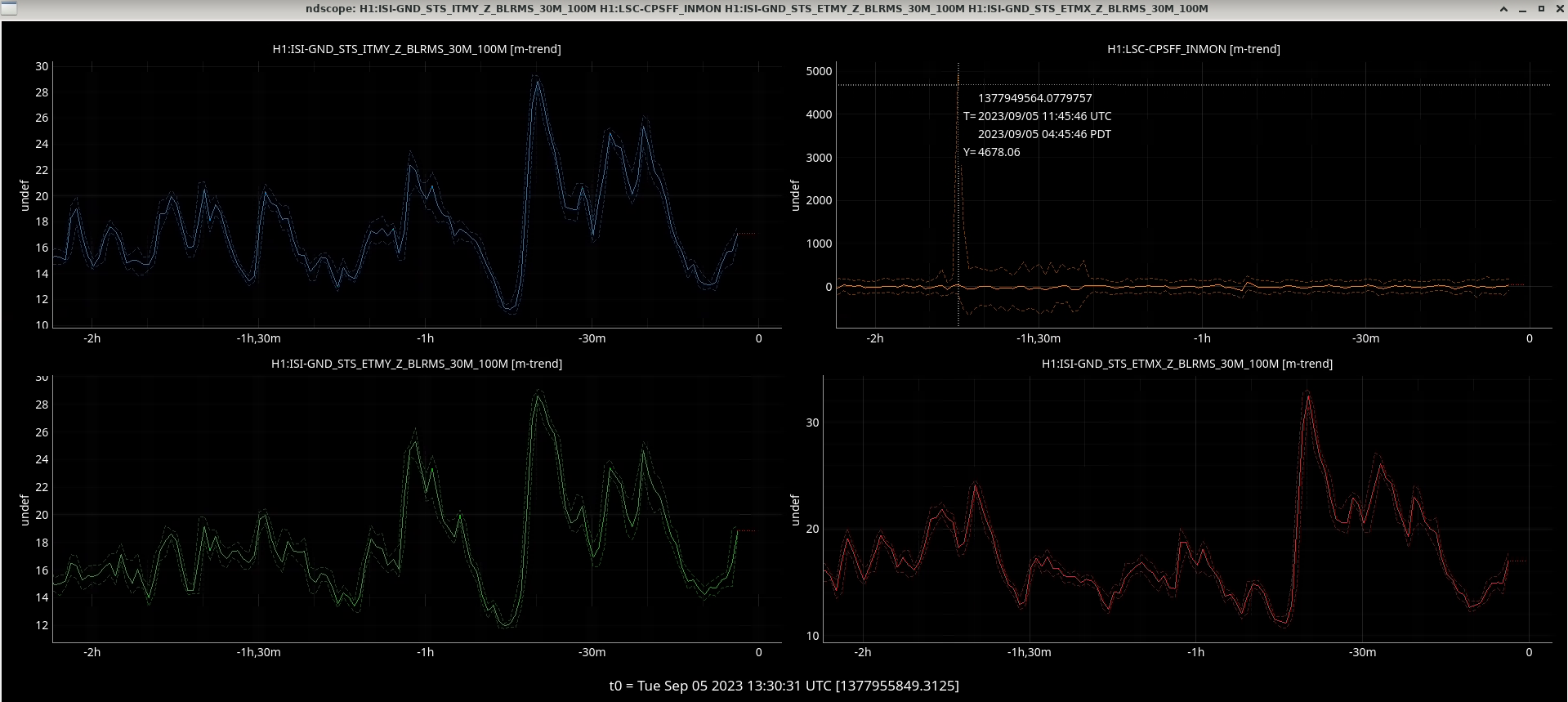
- EX saturation @ 23:46
- Lockloss @ 3:31 UTC
- Relocking was all automated - though I did take the guardian steps past MAX POWER slowly as we have been having issues losing lock at full power but before NLN (though in retrospect, I should have tried locking normally first to see if this still is an issue...)
- Acquired NLN @ 4:35, OBSERVING @ 4:39
- EX saturations @ 5:35/6:02
- Passing H1 to Corey locked and observing - going on 2.5 hours
LOG:
No log for this shift.
LOCKLOSS @ 3:31 - can rule out any seismic activity and probably any ASC ringups. Not 100% about the LSC loops.
H1 has been locked and in observing for 15.5 hours. All appears stable and seismic/winds have been low.
Vibration coupling has increased since early in the O3-O4 break, both input jitter coupling and scattering noise. Jitter coupling at the PSL increased by a factor of about 5 between 2021/05/12 (just after TM replacement), when IMC-PWR-IN indicates we were running at 46 W, and 2023/03/17 when we were running at 60 W, just before the increase to 75W (https://alog.ligo-wa.caltech.edu/aLOG/index.php?callRep=68036 ).
Scattering noise from the cryobaffle at EX increased dramatically between 2020/09/14 when we were running at 38W, and during PEM injections this May when we were at 75W (https://alog.ligo-wa.caltech.edu/aLOG/index.php?callRep=69578 ). Scattering noise also increased at the LLO EX cryobaffle (https://alog.ligo-la.caltech.edu/aLOG/index.php?callRep=65641 ).
We have speculated that this increase in coupling is associated with the power increases and might be a general tendency. It might be caused by increased thermal distortion of test mass surfaces around coating defects, resulting in a greater fraction of light scattered and higher vibration coupling through retro-reflected scattered light. Greater thermal distortions associated with defects might also make the arms less symmetrical, reducing common mode rejection of input noise and increasing vibration coupling at the PSL. An alternative hypothesis is that we increased clipping or vignietting when power increased.
The drop in power this week provides an opportunity to test the correlation between power and vibration coupling, and to test it with evaluations right before and after a power change, rather than the years intervening between the measurements referenced above.
Jitter coupling dropped by a factor of roughly two with the reduction in power from 75W to 60W
Figure 1 (3 pages) shows a comparison of the predicted contribution of background vibration to DARM made during PEM injections in May, when we were running at 75 W, versus 60W from this week. While the difference varies across the spectra, I would say the average reduction in jitter coupling is about a factor of two.
The coupling at 60W is simiar to the coupling at 60W measured in March, before we went to 75W,
The amplitude of scattering peaks from EX cryo-baffle decreased by a factor of 3 with the reduction from 75W to 60W
Figure 2 shows that, for similar velocities of the beam tube supporting the cryo-baffle, the amplitude of scattering peaks at harmonics of 4Hz dropped by a facor of about 3 with the decrease in power.
Coupling of the EX cryo-baffle did not strongly limit us at 75 W, though it was close; at 60 W an increase in motion by about a factor of 2.5 causes peaks to show in DARM
An important question for the eventual return to 75W is whether we were limited by cryobaffle scattering in the 20-40 Hz region at 75W or whether some other noise dominated. Figure 3 (two pages) shows, on page one, that, at 75W, an increase in motion of about 1.5 was needed for the peaks to show clearly in DARM. On the second page, a 1000-average spectrum at 75 W does not clearly show peaks at harmonics of 4Hz, supporting the argument that some other noise source dominated in this band.
Figure 4 shows that, at the new 60 W setting, an increase in motion by a factor of 2.5 is now needed for peaks to show in DARM. Thus the 4Hz peaks may show during high winds, off-road traffic within a couple of km, and other activities that increase ground motion at 4 Hz by at least 2.5.
Is there a visible difference in the pattern of scattered light at different powers?
Figure 5 shows photographs taken in 2019 (38W) and 2023 (75W) of ETMX during high-sensitivity operation. I don’t see any obvious changes in the light pattern but there is perhaps relatively more light lighting up the cage at 75W, consistent with an increased fraction of light scattered out of the beam.
Peter, Wen
We took a look at the arm cavity baffle PD before/after powering down. These PD are registering low-angle scatter, which includes higher-order spatial modes of the beam scattered from possible thermal deformation of the test mass. The power measured on the baffle PD (after IFO thermalized) depends on the arm power, beam spatial position relative to each baffle, and distance between beam spot center and point absorber if there are any. The measured PD power (dark offset subtracted) are summarized in the table below.
| Variable | Measured value @ 75W [a.u.] | Measured value @ 60W [a.u.] | Normalized PD power @ 75 W / Normalized power @ 60 W |
| Input power on PRM | 71.2 | 57.3 | |
| PRG | 47.1 | 50.4 | |
| ITMX PD1 | 2.47 | 1.77 | 1.20 |
| ITMX PD2 | 0.033 | 0.027 | 1.05 |
| ITMX PD3 | 0.061 | 0.052 | 1.00 |
| ITMX PD4 | Saturated | 0.080 | N/A |
| ETMX PD1 | Saturated | Saturated | N/A |
| ETMX PD2 | 0.068 | 0.055 | 1.06 |
| ETMX PD3 | 0.034 | 0.026 | 1.12 |
| ETMX PD4 | 0.645 | 0.346 | 1.60 |
| ITMY PD1 | 0.96 | 0.66 | 1.24 |
| ITMY PD2 | 0.070 | 0.055 | 1.09 |
| ITMY PD3 | Dead | Dead | N/A |
| ITMY PD4 | 0.26 | 0.21 | 1.06 |
| ETMY PD1 | Saturated | 0.85 | N/A |
| ETMY PD2 | 0.016 | 0.014 | 0.98 |
| ETMY PD3 | 0.044 | 0.041 | 0.92 |
| ETMY PD4 | 0.95 | 0.80 | 1.02 |
The normalized PD power is computed by (Measured PD power) / (input*PRG*270/2). There's more round-trip loss in ppm when the IFO was operating at higher power (last column number > 1) for the X arm. Y arm doesn't see as much of a difference as X arm. This agrees with our knowledge that ITMX has point absorbers. However, the uncertainties of the results are large, since we are assuming that the beam position doesn't change before/after powering down. Note that PD1 and PD4 are much closer to the beam spot center (see llo54050) and have much higher SNR than PD2 and PD3. However, 3 of total 8 PD are saturated.
The time series of the baffle PD are shown here: ITMX, ETMX, ITMY, ETMY.
TITLE: 06/25 Day Shift: 15:00-23:00 UTC (08:00-16:00 PST), all times posted in UTC
STATE of H1: Observing at 136Mpc
SHIFT SUMMARY:
Uneventful shift, no alarms, winds starting to pick up but not by much, arm ground motion has been elevated this weekend 0.03 to 0.01 bandwidth
One glitch, EX saturation at 17:42
Handing off to Austin
LOG:
No log for this shift
TITLE: 06/25 Eve Shift: 23:00-07:00 UTC (16:00-00:00 PST), all times posted in UTC
STATE of H1: Observing at 137Mpc
CURRENT ENVIRONMENT:
SEI_ENV state: CALM
Wind: 14mph Gusts, 11mph 5min avg
Primary useism: 0.02 μm/s
Secondary useism: 0.04 μm/s
QUICK SUMMARY:
- H1 has been locked for 11:30
- CDS/DMs ok, seismic motion is low
Overall Features:
Specific Day Notes:
COMPUTING NOTE: H1 MCTUBE beam tube motion [Y] graph and several others on those same pages are not autoscaling properly on some summary pages example
The full report is available here: DQShiftLHO20230612
We've been locked for 7:44, current range of 138Mpc, calm weather.
Sun Jun 25 10:09:47 2023 INFO: Fill completed in 9min 46secs
TITLE: 06/25 Owl Shift: 07:00-15:00 UTC (00:00-08:00 PST), all times posted in UTC
STATE of H1: Observing at 137Mpc
SHIFT SUMMARY:
Lock#1: (08904-0914)
Lock #2: (0918-0920) Lockloss at FIND IR
Lock #3: (0921-1017) Tried PRMI, but could not lock (even after trying to fix misalignments seen in pitch flashes).
Lock #4: (1019-1121)
LOG:
TITLE: 06/25 Day Shift: 15:00-23:00 UTC (08:00-16:00 PST), all times posted in UTC
STATE of H1: Observing at 139Mpc
CURRENT ENVIRONMENT:
SEI_ENV state: CALM
Wind: 6mph Gusts, 4mph 5min avg
Primary useism: 0.01 μm/s
Secondary useism: 0.04 μm/s
QUICK SUMMARY:
Taking over from Corey
Locked for 3:44
CDS/VAC/Dust/Wind looks good
(specifics in Summary Alog draft)
An hour into the shift (803utc), H1 lost lock due to a M6.0 Earthquake from Tonga (made it through S&P waves, but the R3.5 wave did us in).
Needed to wait atleast an hour to have the Green Y-Arm be stable enough to engage ASC after the seismic noise dissipated.
Really waivered on whether to run an Initial Alignment, but decided NOT to since DRMI flashes didn't look bad. But it did take a couple of attempts to get DRMI locked (definitely needing CHECK MICH FRINGES, PRMI, & helpful tweaks to the PRM & SRM were needed). After this, have made it through DRMI w/o intervention.
60W Locking Data Points
With only a handful of Locking Data Points for H1 in the new 60W Configuration from this week---due to the LONG locks, wanted to add more data points. Last night's long lock (2) issues at LASER NOISE SUPPRESSION (ISS 2nd Loop changes apparently helped). For Austin's locking post-CDS-crash, he also lost lock at LASER NOISE SUPPRESSION, but also at earlier states such as TRANSITION FROM ETMX. My first post-EQ lockloss was also at TRANSITION FROM ETMX. :(
I'm currently going very slowly from state-to-state with ISC_LOCK from MAX POWER on up, and keeping an eye on anything peculiar. Currently holding at DAMP VIOLINS FULL POWER (as Austin did) to wait for violin settings to be engaged.
Well, that was uneventful. :)
Took baby steps for the latter steps of ISC_LOCK with fears of another late-stage lockloss, but there were no issues!
And once at Nominal Low Noise, only had to wait a few seconds until I could take it to OBSERVING (@1121). So I have taken OBSERVATORY MODE from EARTHQUAKE to OBSERVING; where we were in EARTHQUAKE from roughly 803-1121utc.
TITLE: 06/25 Owl Shift: 07:00-15:00 UTC (00:00-08:00 PST), all times posted in UTC
STATE of H1: Observing at 137Mpc
CURRENT ENVIRONMENT:
SEI_ENV state: CALM
Wind: 11mph Gusts, 10mph 5min avg
Primary useism: 0.01 μm/s
Secondary useism: 0.04 μm/s
QUICK SUMMARY:
Just got the rundown from Austin's shift (woo! I'm glad that didn't happen during mine!) and have a nice observing H1 which currently stands at 3.5+hrs. (The thing with our new long locks is that we have few data points with acquisition now. So, all the grief & notes from acquisition are clues to help acquisition in the future.)
Was a little breezy walking in, but gusts are at or below 10mph. Will keep an eye on PSL Dust Monitors (alarming w/ wind?) and the nuc30 DARM (recently crashing).
TITLE: 06/24 Eve Shift: 23:00-07:00 UTC (16:00-00:00 PST), all times posted in UTC
STATE of H1: Observing at 135Mpc
SHIFT SUMMARY:
- Lockloss caused by a timing error on IOPSEIH45 - alog
- After lockloss I began an initial alignment and changed the PSL 2nd loop output value
- After initial alignment, I lost lock a few times trying to get DRMI to offload, but was able to get it to catch after a few tries - but then lost lock at DRMI to POP
- 1:27 - 5.4 EQ from Tonga, then a 5.3 from Japan @ 1:36
- After multiple locklosses at higher power, I decided to take it VERY slow past the MAX POWER states
- Back to NLN @ 3:43 UTC, OBSERVE @ 3:49
- PSL DM 101 continuously alarming due to high local winds
- DARM on nuc30 is disappearing every now and again, forcing me to restart the DTT
- Ran into a CALEX SDF diff once at NLN, since it is a tramp value I decided to just accept it and if need be, can be reverted on Monday - Tagging CAL
LOG:
No log for this shift.
After recovery from the electronics failure and doing an alignment shortly after, I have been having issues trying to relock H1, at first not being able to offload DRMI and now losing lock at full power (LASER NOISE SUPPRESSION and TRANSITION FROM ETMX), unsure what is causing this. For all locklosses I have had when we were at 60 W input power, there were DCPD saturations right before the lockloss.
Following the recent lockloss, I have followed Ryan S. instructions to try and get the slow offset servo (H1:PSL-ISS_SECONDLOOP_REFERENCE_SERVO_OUT16) to 0. I tried to do this by adjusting the H1:PSL-ISS_THIRDLOOP_OUTPUT_OFFSET. I first tried offsetting the servo value, the servo was at -322, so I set the output to +322, which made the servo value worse. I then tried going in the positive direction which seemed to have made it better. After doing some back and forth moving the output, I was finally able to get the servo to ~-0.3 by setting the output to 949 - screenshot attached. I then cleared the history on the servo overview. Just in case we need to revert later, the original value for the output was +1272.