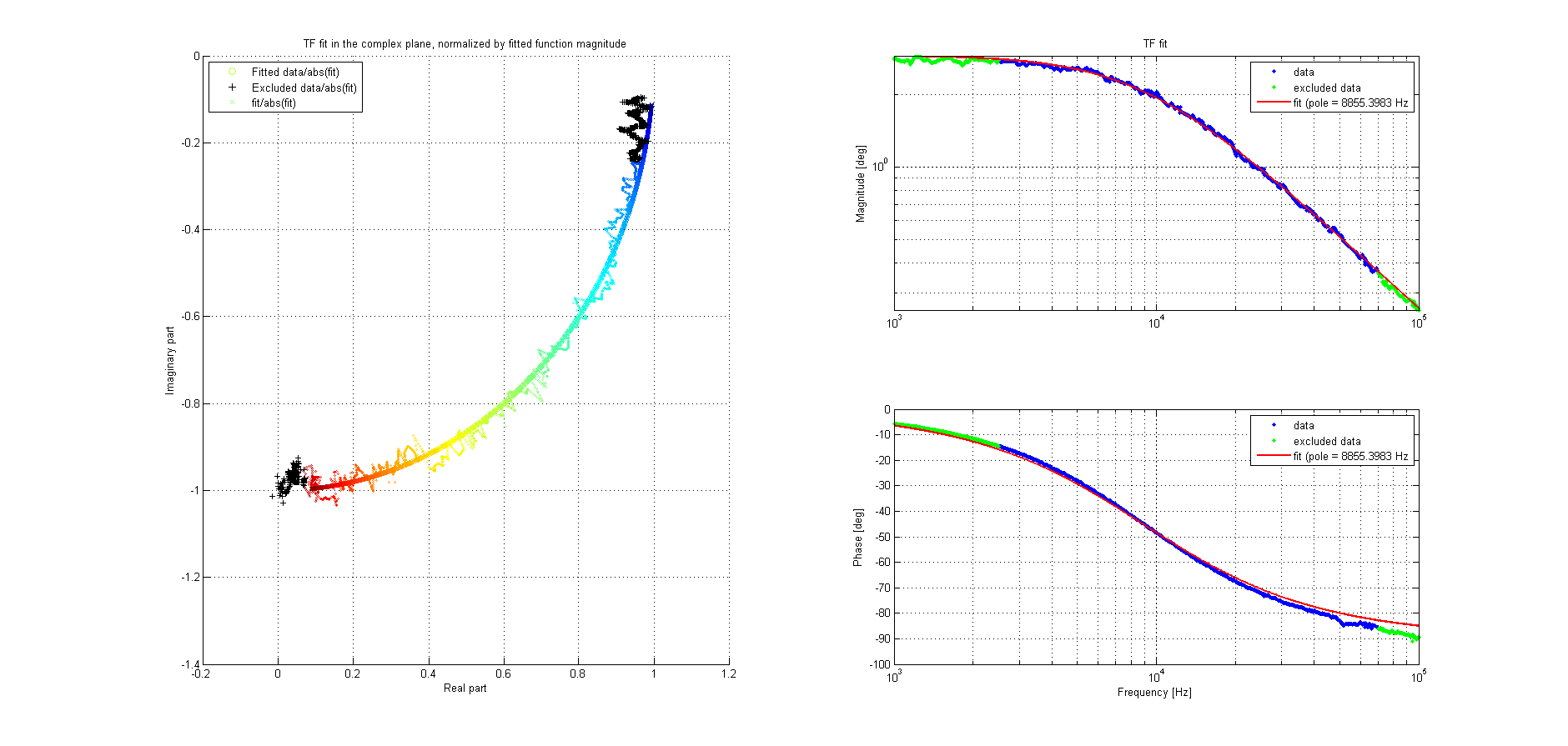
I measured the power going into the AOM to be 32.6mW but only got 5.8mW into the EOM. After adjusting M24 to improve the pointing into the AOM we now get 18.4mW at the EOM. However, the rest of the FSS path is now misaligned and will have to be worked on. The ref cav still flashes so it's fortunately not too far off.
HughR, GregG, JimW, Today, finally, all vertical HEPI actuators were attached at HAM3. We will need verification from IAS, but at this point the position does not seem too terribly disturbed. Only a few thousands here and there based on what our dial indicators tell us. Most of the piers have very little room between the "back" side of the actuator and the pier (< 1mm), which will make things very, very messy if we need to re-locate the ground side of the actuators in the future (i.e. off-load the springs, shift the housings and then redo the alignment). Tomorrow, or whenever is convenient for One Arm people, we'll attempt to attach the horizontal actuators.
Andres R, Betsy B, and Jeff B took the transfer function for Phase 1b testing of the HSTS MC1 suspension. This data has been plotted and is ready for review.
To assist with reviewing the MC1 (HSTS) suspension, please find attached below a plot showing a comparison of all HSTS suspensions measured at LHO and LLO, to date (allhstss_2012-07-16_AllHsts_ALL_ZOOMED_TFs.pdf). Note that, these M1-M1 transfer functions were all obtained at Phase 1b of testing. Power spectra have been taken with damping loops both ON and OFF for each stage (2012-07-17_1300_X1SUSMC1_M*_ALL_Spectra.pdf). Power spectra plots, with both damping ON and OFF have been produced, which compare all LHO HSTS measurements for PR2, MC1 and MC2 (allhstss_2012-07-17_ALL_Spectra_Don.pdf and allhstss_2012-07-17_ALL_Spectra_Doff.pdf). Note that, the comparison power spectra provided for MC2 M3 AOSEMs, show an elevated noise floor at high frequencies above 100 Hz. A similar issues has also been observed for suspensions attached to the LLO triple test-stand, which was rectified by going chamber-side. In addition, power spectra for specific degrees of freedom (L, P and Y) can be more conveniently compared across multiple stages (M1, M2 and M3) of the same suspension in the final plots found below (allhstss_2012-07-17_X1SUSMC1_M1M2M3_Spectra_ALL_Don.pdf). All data, results, and scripts I have committed to the sus SVN as of this entry. This ensures all measurements have been taken required to complete Phase 1b testing.
For further reference, I have added power spectra plots comparing LHO MC1, with the LLO MC3 suspension. Results from all three phases for the MC3 suspension are shown as follows:- Blue trace = LLO MC3 Phase 1b (X2SUSMC3 2012−05−01_1600) Green trace = LLO MC3 Phase 2b (L1SUSMC3 2012−06−28_1600) Red trace = LLO MC3 Phase 3a (L1SUSMC3 2012−07−02_1400) Cyan trace = LHO MC1 Phase 1b (X1SUSMC1 2012−07−17_1300)
With septum-separated VE volumes vented, the ion pump controller achieves mid-scale current (with HAM3 East and West doors removed and with their annulus ports plugged with rubber stoppers).
M. Evan, J. Betzwieser, (J. Kissel) See LLO aLOG 3850, for details, but this may be why we've been having so much trouble with driving from the L2 Stage. This bug fix has not been implement yet on the LHO system, as we're waiting for the incoming updates from J. Kissel.
The following work was installed/powered last Friday: End Y H2 Electronics Rack (Receiving area entering EY) 1. 2 Magnetometers and 2 filter units 2. 1 Microphone 3. 1 Accelerometer and 1 Endevco Unit Two Kepco Power supplies were installed in the DCC Power Rack to power PEM units. LVEA ITMY Racks (Between BSC8 and Y arm manifold): 1. 3 Magnetometers 2. 3 Microphones 3. Accelerometers and 1 Endevco Unit
The ETM optical lever shows interference fringes when the TM is subject to a large longitudinal drive. I guess this will go away when the front surface beam is found, but it is something to look for on all the optical levers to be sure that we don't add noise from longitudinal motion.
Whenever you guys (ISC) are ready, I can go in and fix that.
A quick check of ITMY (push in a length offset and remove it) show no signs of fringes.
Due to an apparent increase in noise when the cavity was well aligned, we (Bram and Matt) suspected that some of the 532nm light retro-reflected from the cavity was getting into the laser and causing problems. To test this, we added a second faraday after the laser on the ALS table (ISCTEY) and realigned the beam. This appears to have had the desired effect (see plots), but in the process we discovered that some work will be needed to understand the REFL RF photodector, as it seems to be overfilled and its alignment may change our noise floor.
We also found clear fringes in the cavity error signal (PDH_IMON) even with the ITM misaligned. The fringe velocity is senstive to motion of the ASL table, and to the state of the HEPA fan on the table. These fringes are only a few mV, but they may be a noise source and will need to be investigated further.
In the lower plot of figure 1, the signal being plotted is REFL_PWR_MON_OUT. This signal comes from the PD which monitors the light reflected from the cavity.
The cavity is locked and operating normally as of 3:00 UTC (20:00 local). The ISCTEY HEPA fan is off.
The addition of a Faraday in the green laser path has reduced the operating power by about 20%, so REFL_PWR_MON_OUT between 5000 and 8000 indicates that the cavity is locked and reasonably aligned.
The cavity alignment degraded as the force applied to M0 on the ETM increased to the maximum value (200k in L, or 100k on each BOSEM). It was locked and well aligned for the first hour, and stayed locked for 10 hours (until 13:00 UTC) before the ETM hit the limits.
I tripped the EY HEPI the cavity locking process. I am not aware of a reset to 'working' scipt.
EY ISI and SUS where tripped as well. On both I resetted the watchdog and the daqkill .. all is well.
Example of "broken":
controls@opsws4:~ 7$ tdswrite -sw H2:HPI-ETMY_ISO_HP INPUT OFF
ERROR: can't read from H2:HPI-ETMY_ISO_HP_SW1R
controls@opsws4:~ 0$ ezcaswitch H2:HPI-ETMY_ISO_HP INPUT OFF
readback H2:HPI-ETMY_ISO_HP_SW1 not accessible
This make scripting difficult.
The cavity is locked and operating normally as of 4:15 UTC (21:15 local). The ISCTEY HEPA fan is off.
Attached are plots of dust counts > .5 microns in particles per cubic foot.
Robert and Maggie hooked up new ACC, MIC and MAG signals in both the LVEA and EY. At EY new signals were attached both to the h2pemey front end and the h2pemeyaux (Newtonian Noise) front end.
I build new models for h2peml0, h2pemey and h2pemeyaux and restarted them on the front ends h2tcsl0, h2pemey, h2pemeyaux respectively.
I then restarted the H2 DAQ to get the new channels into the frame.
More detail will follow, but we determined how to get the length to pitch decoupling filter (jsut a confirmation), and using the Quad models we generated the length-to-pitch decoupling filter, for placement in the 'DriveAlign Matrix' in the M0 path.
The frequency dependent response is -Length-to-Pitch / Pitch-to-Pitch (with a gain factor).
Using plotallquad_dtttfs.m and quad_l2p.m in /ligo/svncommon/SusSVN/sus/trunk/QUAD/Common/MatlabTools, I generated Dl2p_2012_07_13.mat. Is has a frequency vector and the coupling vector.
I modified the script to include the M0 Long-2-Pitch and the Pitch-2-Pitch transfer functions as well.