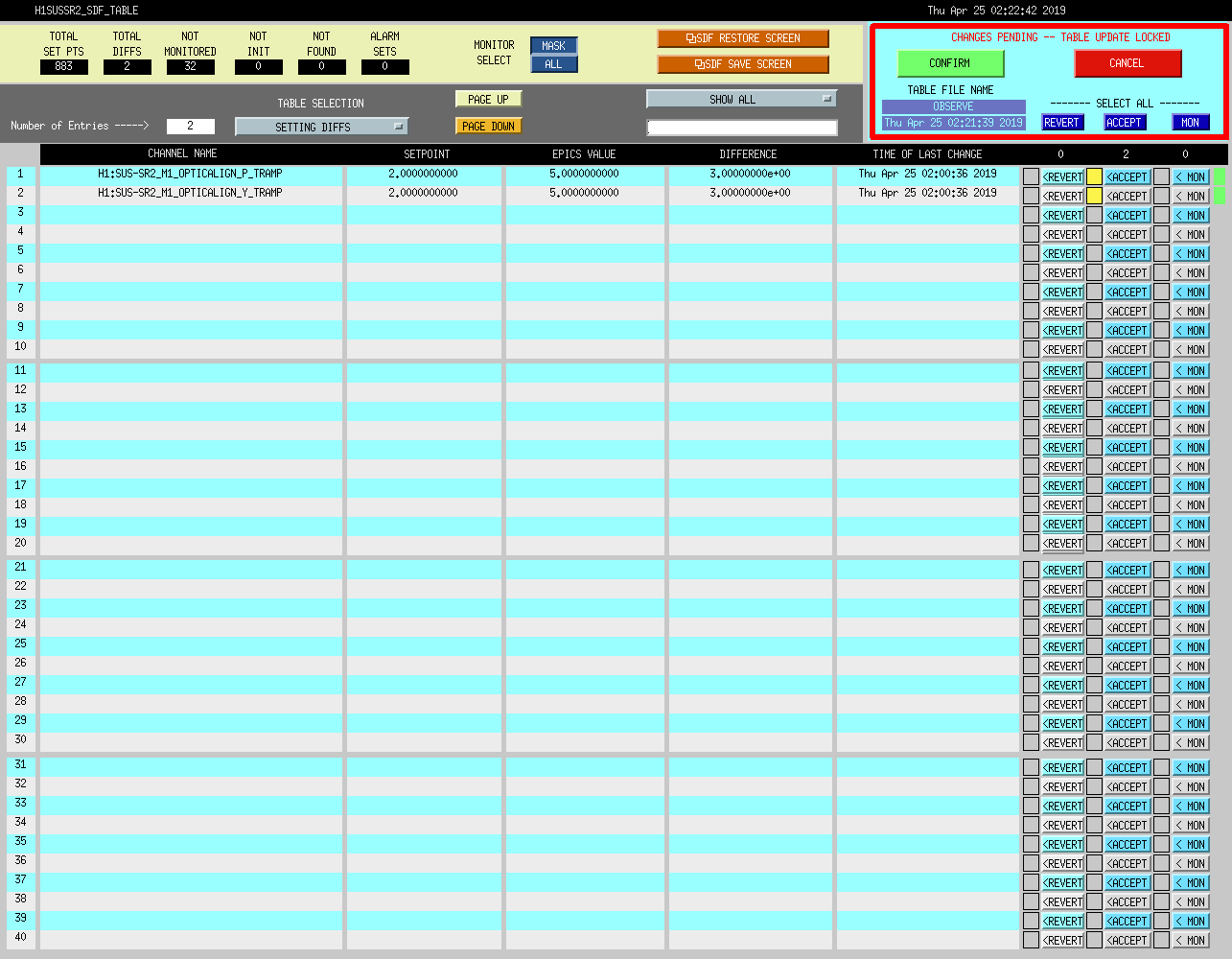
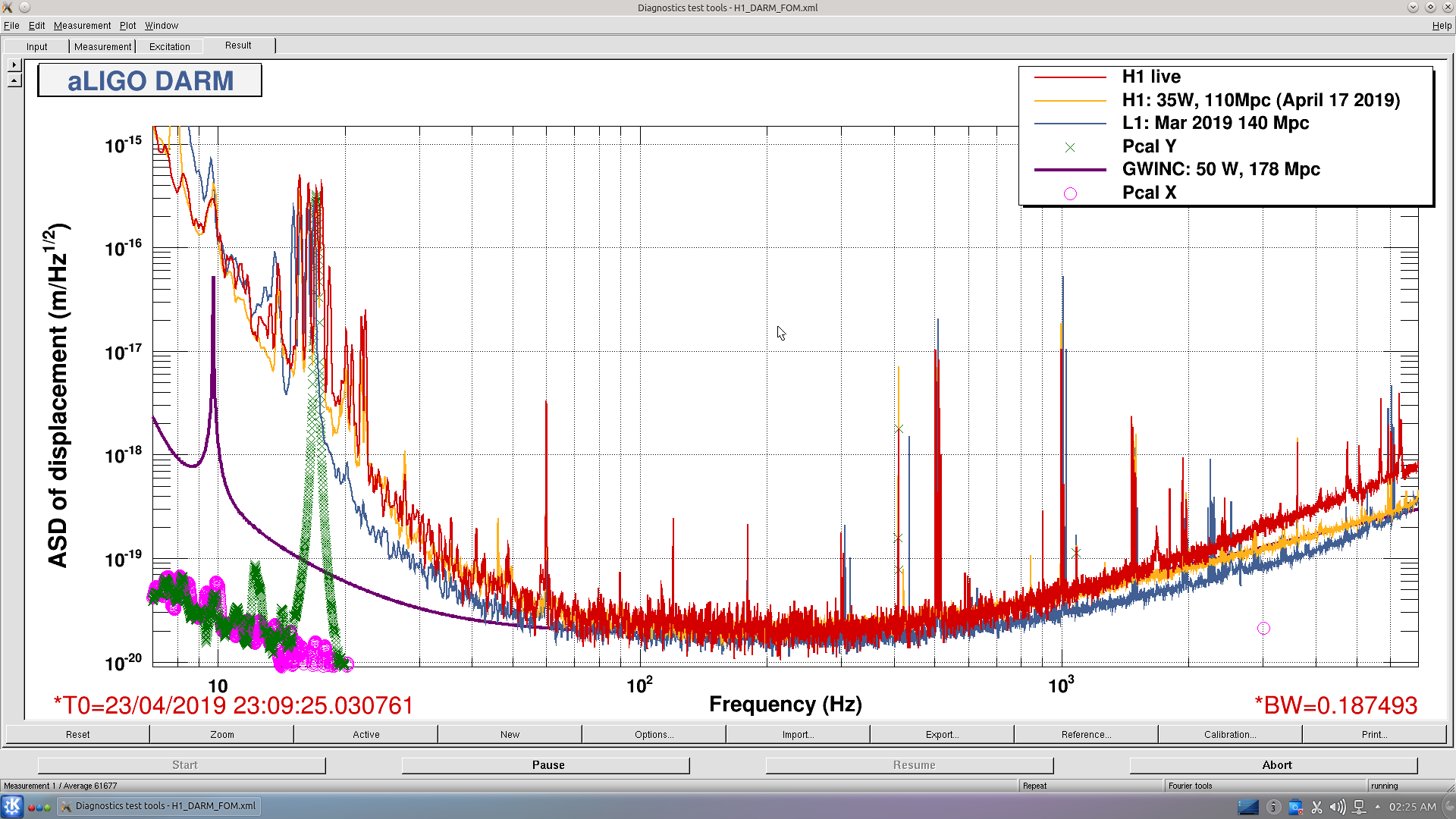
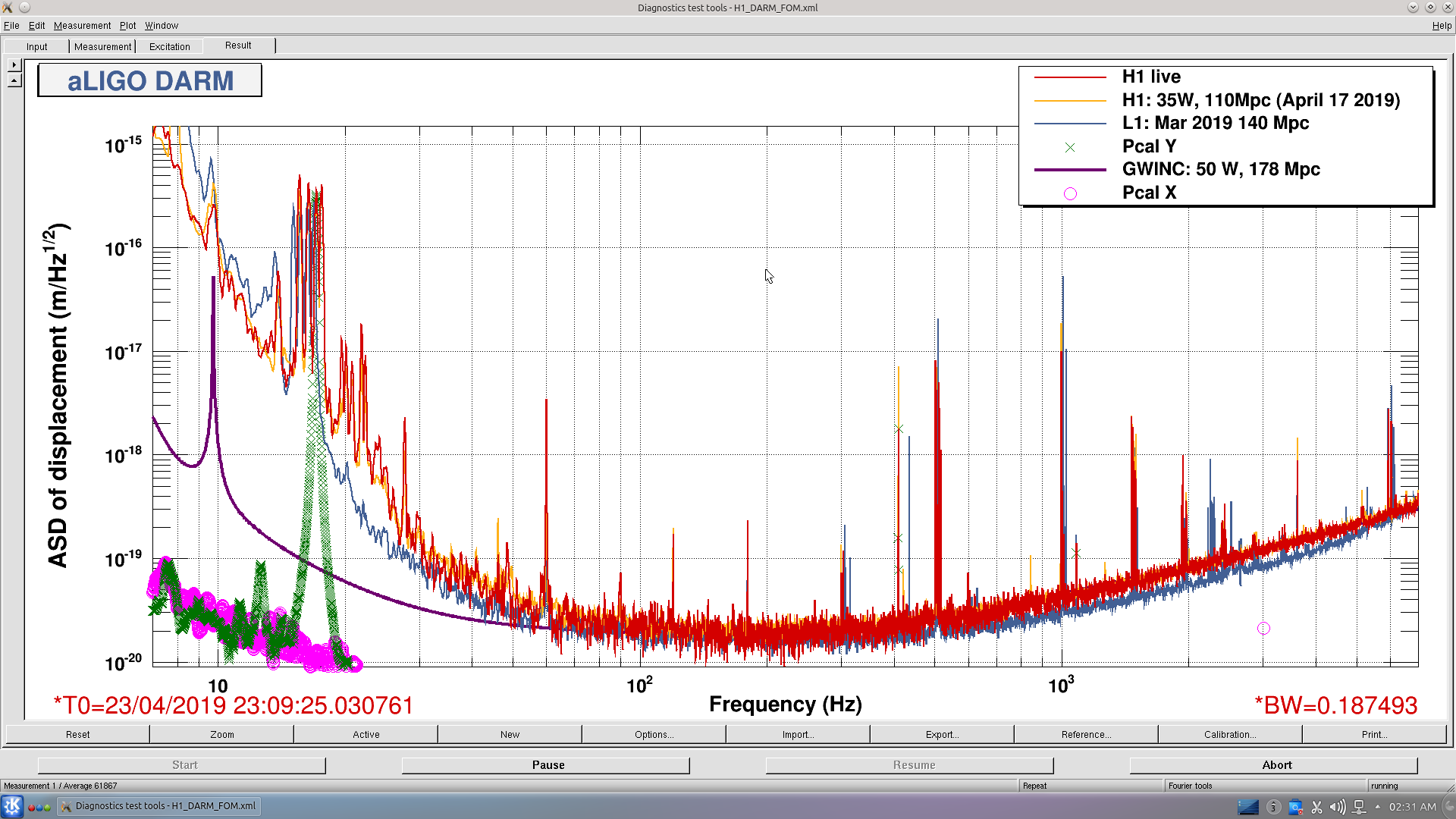
The notification of ALS fiber polarization percentage is still super annoying. I just changed DIAG_MAIN to only report on the ALS fiber polarization when we're acquiring lock. It will not put up a message when we're in NomLowNoise anymore.
Last night, due to some guardian fast EZCA connection errors (alog 48744 and comment), Georgia and Corey had to manually turn on the BS pitch offloading. Since Ed was unable to load the new version of the guardian that has the fast EZCA parts removed (alog 48747), he ran the old code and seems to have gotten a very similar error. It looks like he accepted the SDF diffs (alog 48753), including the fact that BS offloading of pitch to the top mass is off. So, at least for the entirety of this lock so far, we've been running without any pit offloading for the BS top mass. Things seem okay for now (current lock is 7.75 hours and going), so I'm not going to turn it on just yet.
TITLE: 04/25 Day Shift: 15:00-23:00 UTC (08:00-16:00 PST), all times posted in UTC
STATE of H1: Observing at 111Mpc
OUTGOING OPERATOR: Ed
CURRENT ENVIRONMENT:
Wind: 5mph Gusts, 4mph 5min avg
Primary useism: 0.01 μm/s
Secondary useism: 0.09 μm/s
QUICK SUMMARY: H1 has been locked for about 6 hours
TITLE: 04/25 Owl Shift: 07:00-15:00 UTC (00:00-08:00 PST), all times posted in UTC
STATE of H1: Observing at 65Mpc
INCOMING OPERATOR: Cheryl
SHIFT SUMMARY:
LOG:
7:55 Lockloss (7:12:50 in duration)- re-aligned arms and re-loaded ALIGN_IFO & ISC_DRMI
https://ldas-jobs.ligo-wa.caltech.edu/~lockloss/index.cgi?event=1240214168
re-loaded code change failed -saved as .bak and replaced ISC_GEN_STATES.py back to previous version'
re-lock failed again at CHECK_AS_SHUTTERS - EZCA Connection Error
8:44 GraceDB phone call
8:49 Attempting re-lock
8:57 previous trouble spot is passed
9:21 NLN - accepted SDF diffs (see below)
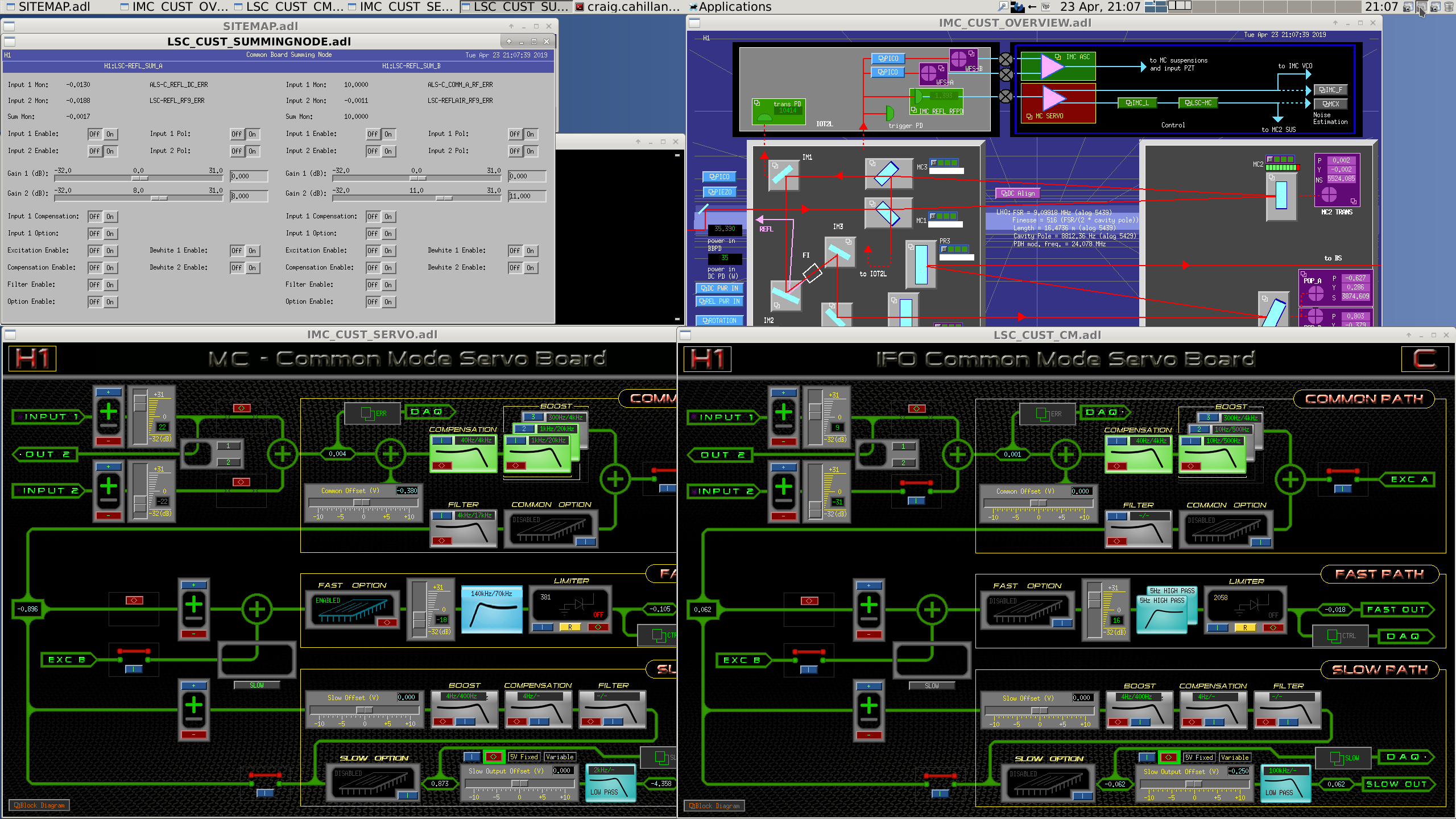
09:24 H1 Observing- HF noise was elevated for a bit (see below) after RF9 levels were back to around 47 cts. and INPUT1 Gain on CMServo was set to +12.
9:26 HF noise seems to have quieted back to H1 reference levels.
TITLE: 04/25 Owl Shift: 07:00-15:00 UTC (00:00-08:00 PST), all times posted in UTC
STATE of H1: Observing at 110Mpc
OUTGOING OPERATOR: Corey
CURRENT ENVIRONMENT:
Wind: 11mph Gusts, 9mph 5min avg
Primary useism: 0.01 μm/s
Secondary useism: 0.10 μm/s
QUICK SUMMARY:
Got briefed on the BS M1 Lock FIlter issue as per aLog 48744 and the ensuing comment by Georgia.
TITLE: 04/24 Eve Shift: 23:00-07:00 UTC (16:00-00:00 PST), all times posted in UTC
STATE of H1: Lock Acquisition
INCOMING OPERATOR: Ed
SHIFT SUMMARY:
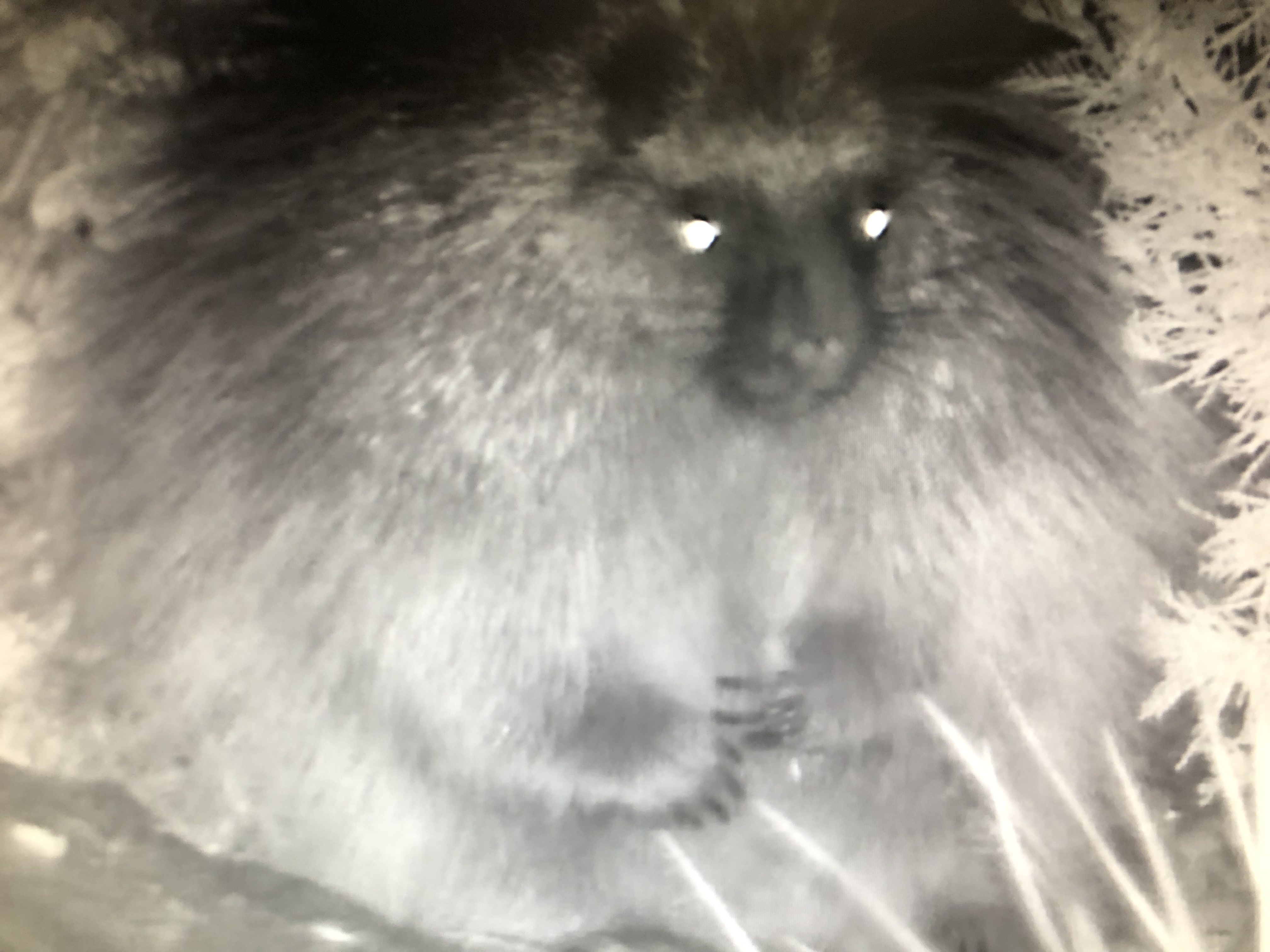
Notes: Seismically quiet. Porcupine spotted around the OSB nibbling on the bushes (photos attached).
Georgia made a Guardian change requiring a couple of LOADs for a couple of nodes at the next lockloss (& when Guardian is not actively logging through states---i.e. it has a green box). See her alog.
Overflows for H1SQZ & H1OAF prior when locking (Sheila cleared these earlier).
ALSx Polarization > 25% DIAG_MAIN notifications flashing on/off most of the night (as it has most of the week).
LOG:
Sheila, Nutsinee
Today we took some time to map out CLF angle vs. sqz/asqz in detail. We also tried to measured phase noise at 45deg but at a quick glance we didn't seem to observe any phase noise. We didn't get to the asqz/sqz measurement at two different nlg (measurement 3). These are the list of time for reference.
#Measurement #1
SQZ angle rotation: this is where we moved CLF phase delay ~3 deg at a time until the end of the slide bar.
start time 17:32:40 UTC
stop time 18:07:53 UTC
CLF sign flipped 18:12:02 UTC, and the angle rotation repeated, this time we moved ~6 deg at a time.
start time 18:12:52 UTC
stop time 18:33:00 UTC
Measurement #2
45 deg phase noise measurement
start time 19:00:35 UTC
stop time 19:34:12 UTC
Best SQZ time
start 19:35:37 UTC
stop 19:55:37 UTC
During measurement #2 the low pass of OAF BLRMS 7 and SQZ BLRMS were modified so that the pole was at 100Hz. The change has been reverted.
During the phase mapping we also found that we weren't operating at the optimal CLF phase. We moved it to the good place (~150deg) and gained 2-3 Mpc from that.
The Sun has set, and we have been in OBSERVING for almost 2hrs. Currently in a GRB Stand-Down state (and chatted with LLO & Virgo operators). And the useism is dipping even lower (our range is hovering around 112Mpc).
(Georgia, Corey)
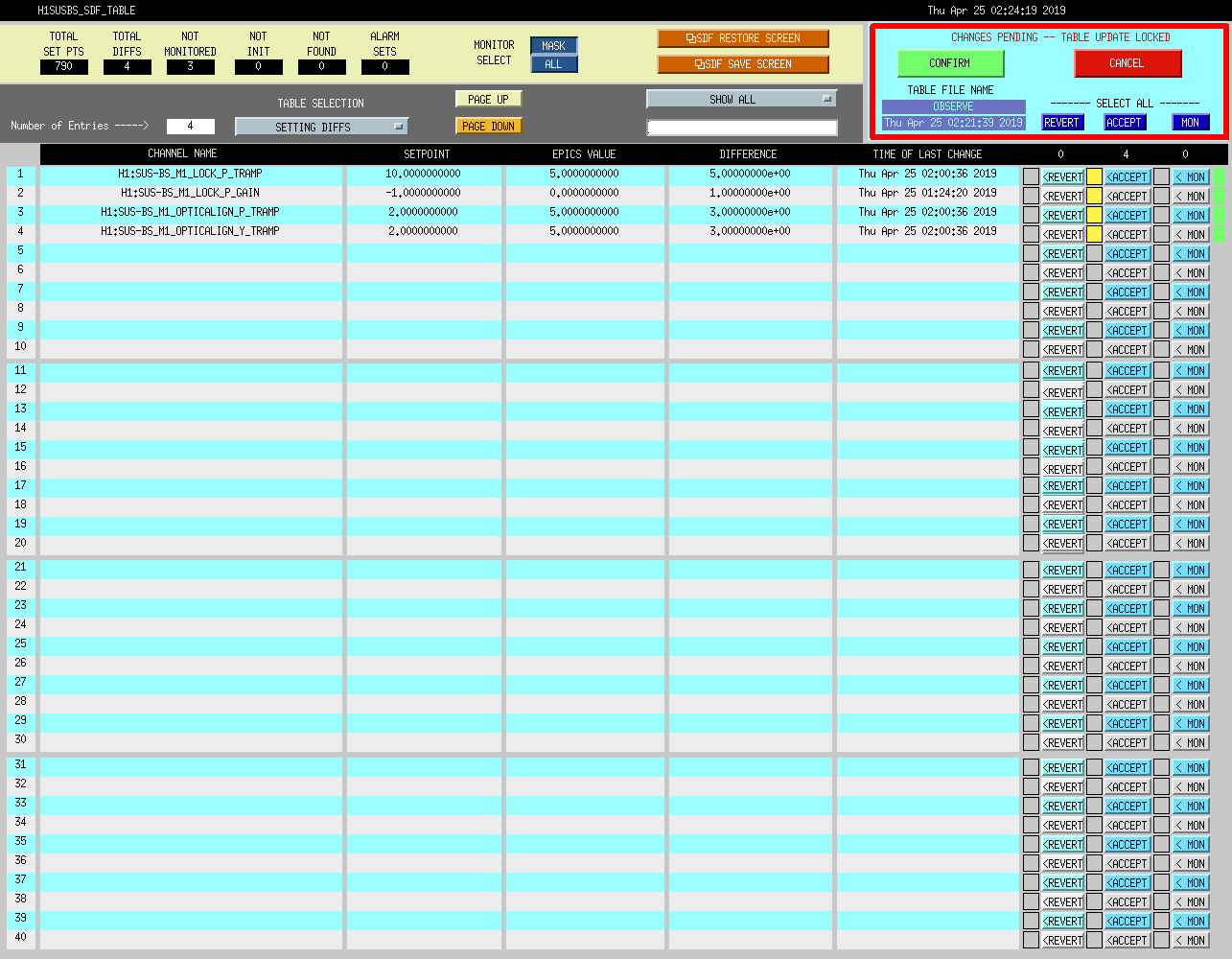
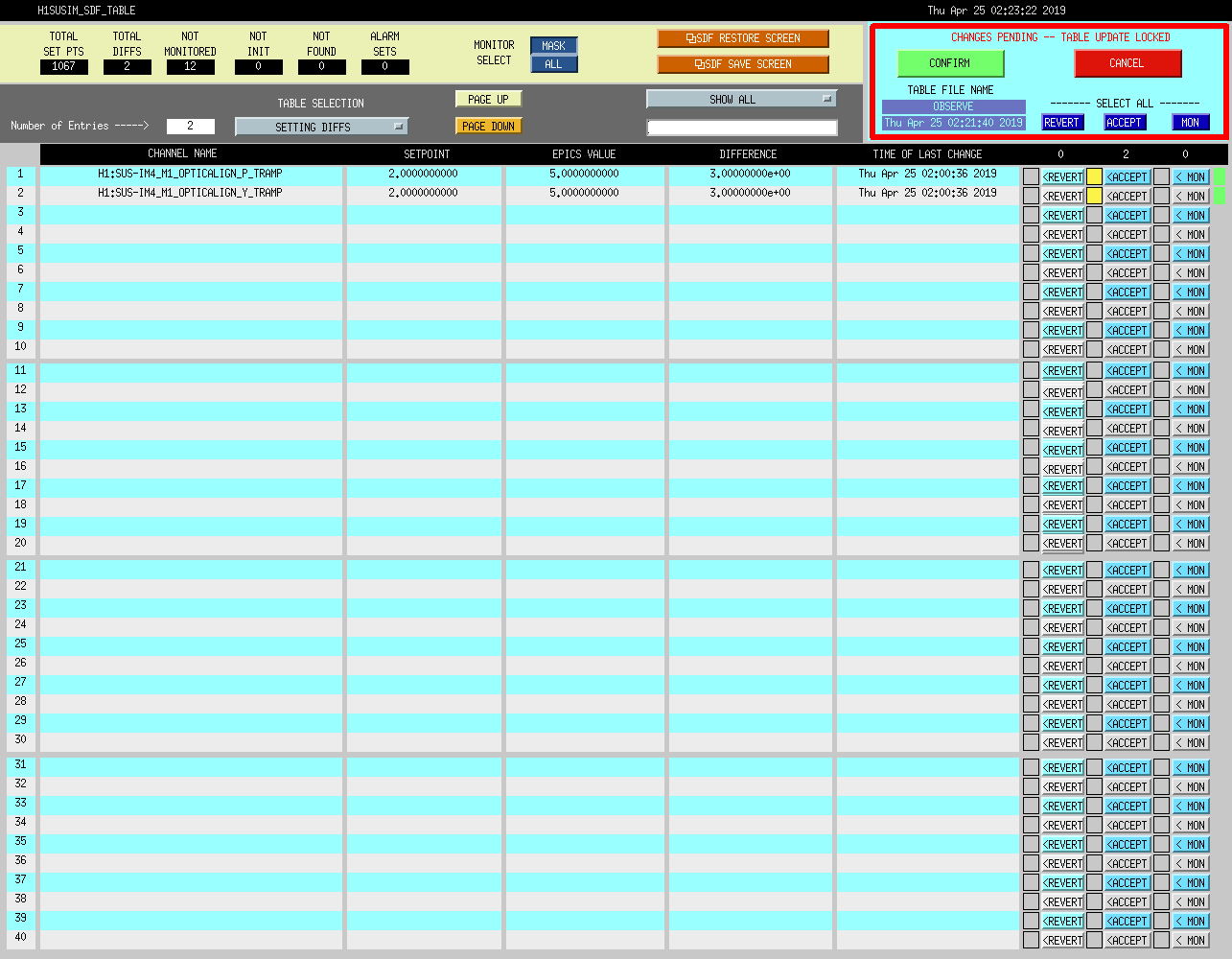
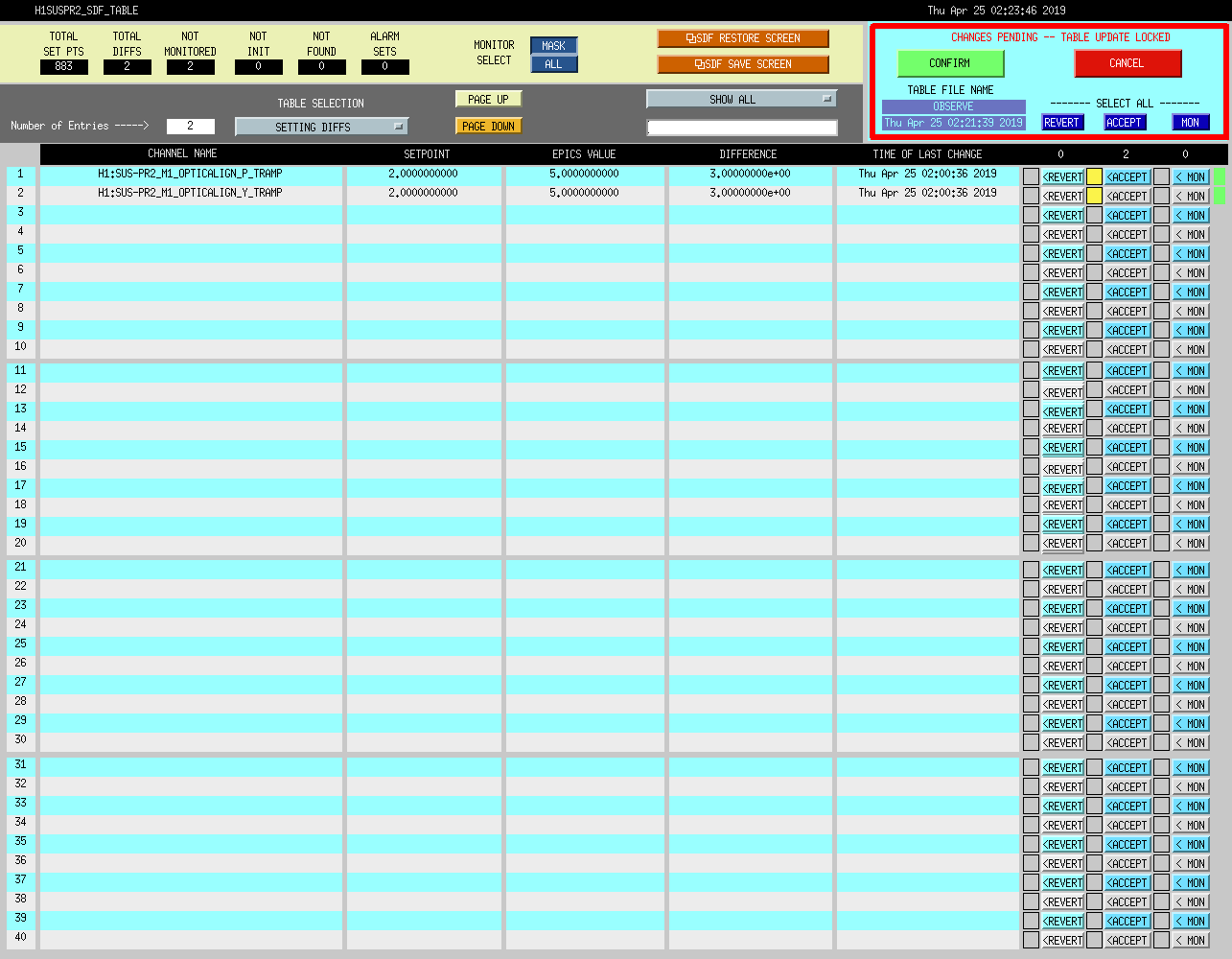
After running an INITIAL ALIGNMENT, H1 locked up with not too many issues. While at NLN, had some diffs (screenshot is attached):
1) H1OAF
This was known, and Sheila said I should ACCEPT these.
2) SUS-BS_M1_LOCK_P stuff!
For some reason this filter bank had its Input OFF, the gain at 0 (vs -1), and the TRAMP was different. There was also a TRAMP diff for M1_OPTICALIGN_P. Georgia figured out that the issue was an error with guaridan for a Fast EZCA (i.e. "fez" step). Basically:
(see log for ISC_DRMI node below)
2019-04-25_00:15:36.433915Z ISC_DRMI [OFFLOAD_DRMI_ASC.main] ezca: H1:SUS-IM4_M1_LOCK_Y_TRAMP => 5
2019-04-25_00:15:36.434484Z ISC_DRMI [OFFLOAD_DRMI_ASC.main] ezca: H1:SUS-IM4_M1_LOCK_Y_GAIN => 0
2019-04-25_00:15:36.435067Z ISC_DRMI [OFFLOAD_DRMI_ASC.main] ezca: H1:SUS-IM4_M1_OPTICALIGN_Y_TRAMP => 5
2019-04-25_00:15:36.435459Z ISC_DRMI [OFFLOAD_DRMI_ASC.main] waiting for ramps to finish...
2019-04-25_00:15:41.447834Z ISC_DRMI [OFFLOAD_DRMI_ASC.main] done waiting
2019-04-25_00:15:41.453307Z Traceback (most recent call last):
2019-04-25_00:15:41.453307Z File "_ctypes/callbacks.c", line 315, in 'calling callback function'
2019-04-25_00:15:41.466866Z File "/usr/lib/python2.7/dist-packages/epics/ca.py", line 583, in _onConnectionEvent
2019-04-25_00:15:41.467296Z if int(ichid) == int(args.chid):
2019-04-25_00:15:41.467296Z TypeError: int() argument must be a string or a number, not 'NoneType'
2019-04-25_00:15:41.492347Z ISC_DRMI [OFFLOAD_DRMI_ASC.main] ezca: H1:SUS-BS_M1_LOCK_Y_RSET => 2
2019-04-25_00:15:41.493127Z ISC_DRMI [OFFLOAD_DRMI_ASC.main] ezca: H1:SUS-BS_M1_LOCK_Y_SW1 => 4
2019-04-25_00:15:41.532661Z ISC_DRMI [OFFLOAD_DRMI_ASC.main] ezca: H1:SUS-PR2_M1_LOCK_P_RSET => 2
2019-04-25_00:15:41.533281Z ISC_DRMI [OFFLOAD_DRMI_ASC.main] ezca: H1:SUS-PR2_M1_LOCK_P_SW1 => 4
Tonight's Solution: For this lock, Georgia Turned ON the input, increased the TRAMP from 5 to 10, and then changed the gain from 0 to -1.0.
This cleared our SDF Diffs issue, and we then had a signal for H1:ASC-MICH_P_OUT16 (it had been 0 due to the gain of 0).
Conclusion: We are back to OBSERVING. But we are curious about whether this will occur for the next lock.
(If this happens again for BS_M1 Pitch, follow the steps for "Tonight's Solution" above until it can be fixed.)
Sheila weeded calls to fast ezca out of ISC_LOCK and ISC_DRMI, because of the problem Corey describes above. This instance snuck through as it is hidden in ISC_GEN_STATES, in the gen_OFFLOAD_ALIGNMENT_MANY state.
What happened today is there was a connection error to some channel, and the beamsplitter top mass LOCK filter never got switched back on. Amazingly, we still acquired lock.
I have updated ISC_GEN_STATES, removing the fez. I think we need to reload the ISC_DRMI and ALIGN_IFO guardians to implement the new guardian code. I only updated the lines about fez, but the code is untested and I'm not very confident in my python/guardian skills, so I'm attaching the code for ISC_GEN_STATES.py as it was before my changes. If guardian complains upon reloading or relocking, and there isn't an obvious typo my changes can be reverted by replacing
/opt/rtcds/userapps/release/isc/h1/guardian/ISC_GEN_STATES.py
with what I've attached here, and re-re-loading.
[Sharan, Sundae, Niko]
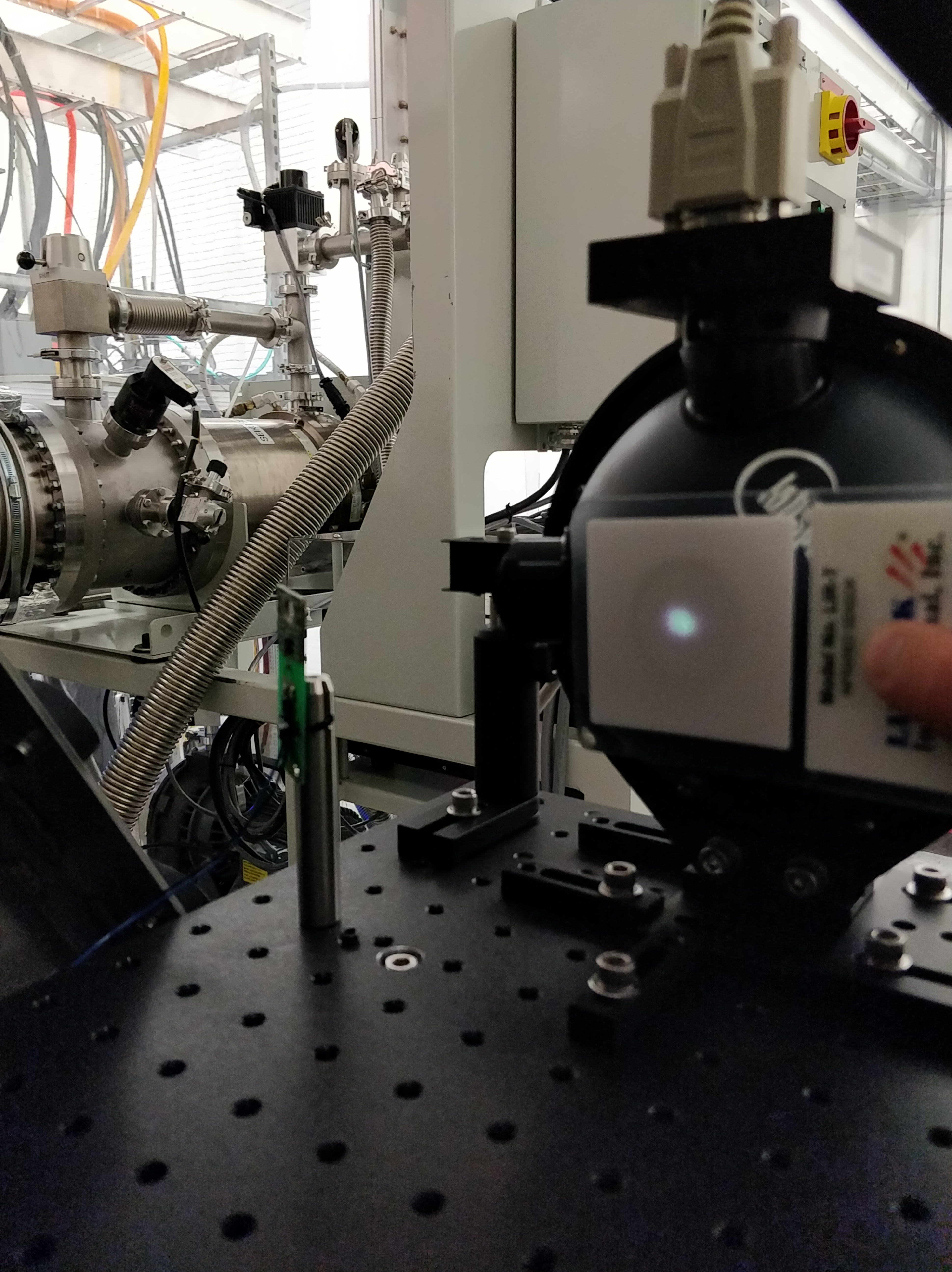
We went to EX and performed an end station calibration during Tuesday maintenance. Our resulting value deviates from previous measurements by about one tenth of a percent, we think potentially because the Working Standard was mistakenly placed in front of the RxPD rather than in its place. We will take another EX measurement next week to check our value. Rx beam alignment looks good.
| Sensor | Jan. 22 | Mar. 05 | Mar. 12 | Apr. 23 | Apr. 23 / mean of prev. meas. |
|---|---|---|---|---|---|
| Tx (V/V) | -0.558870 | -0.558129 | -0.558519 | -0.559161 | 1.00117 |
| Rx (V/V) | -0.720173 | -0.720980 | -0.720198 | -0.721624 |
1.00096 |
[Jenne, Sheila]
We have, as part of our commissioning and calibration efforts over the last few months, been a bit confused about our PUM ETMX actuator. Formerly, we only (in the calibration and commissioning contexts) modeled the direct length-to-length drives of our suspensions when looking at the DARM loop. Since the model that the calibration group uses does not include the extra terms that Sheila describes in alog 47982 and T1900148 (from angle to length), the measurements that the calibration group takes don't perfectly match their models, which they interpret as systematic uncertainty in part of the DARM actuator. This was confirmed with a test of driving length through both the usual drivealign matrix and in parallel through the test filter bank, with results summarized in Lilli's alog 47979.
Understanding the PUM actuator better will help the calibration group in lowering their systematic uncertainty, but also will help us understand why it has been such a struggle to boost our DARM loop offloading. See, for example, alogs 47164 and 47982 for some discussions of the boost.
The length motion of the test mass is (partly) due to actuation of the PUM: L3length = L2length drive * [L2_DriveAlignLength_to_Length * MechanicalCouplingL2length_to_L3length + L2_DriveAlignLength_to_Pitch * (MechanicalCouplingL2pitch_to_L3length + SpotPosition * MechanicalCouplingL2pitch_to_L2pitch)]
The traditionally modeled direct L2L coupling is the first purple term above, and I'm calling the second blue term L2P2L coupling for shorthand. After March 29th, we have set our L2_DriveAlignLength_to_Pitch term to zero to simplify our system. However, it would be nice to be able to turn the L2P filters back on in order to decouple our system more fully.
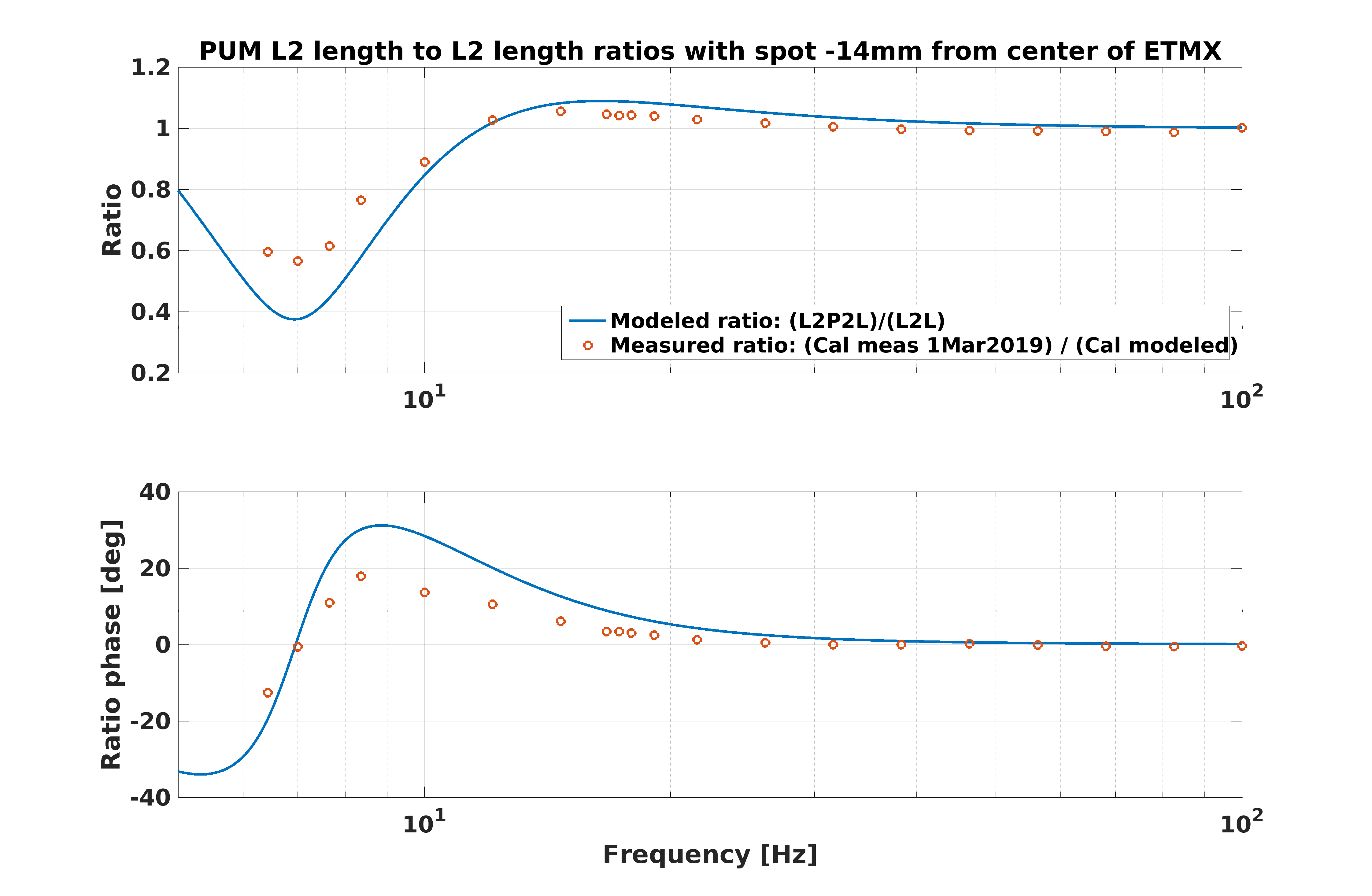
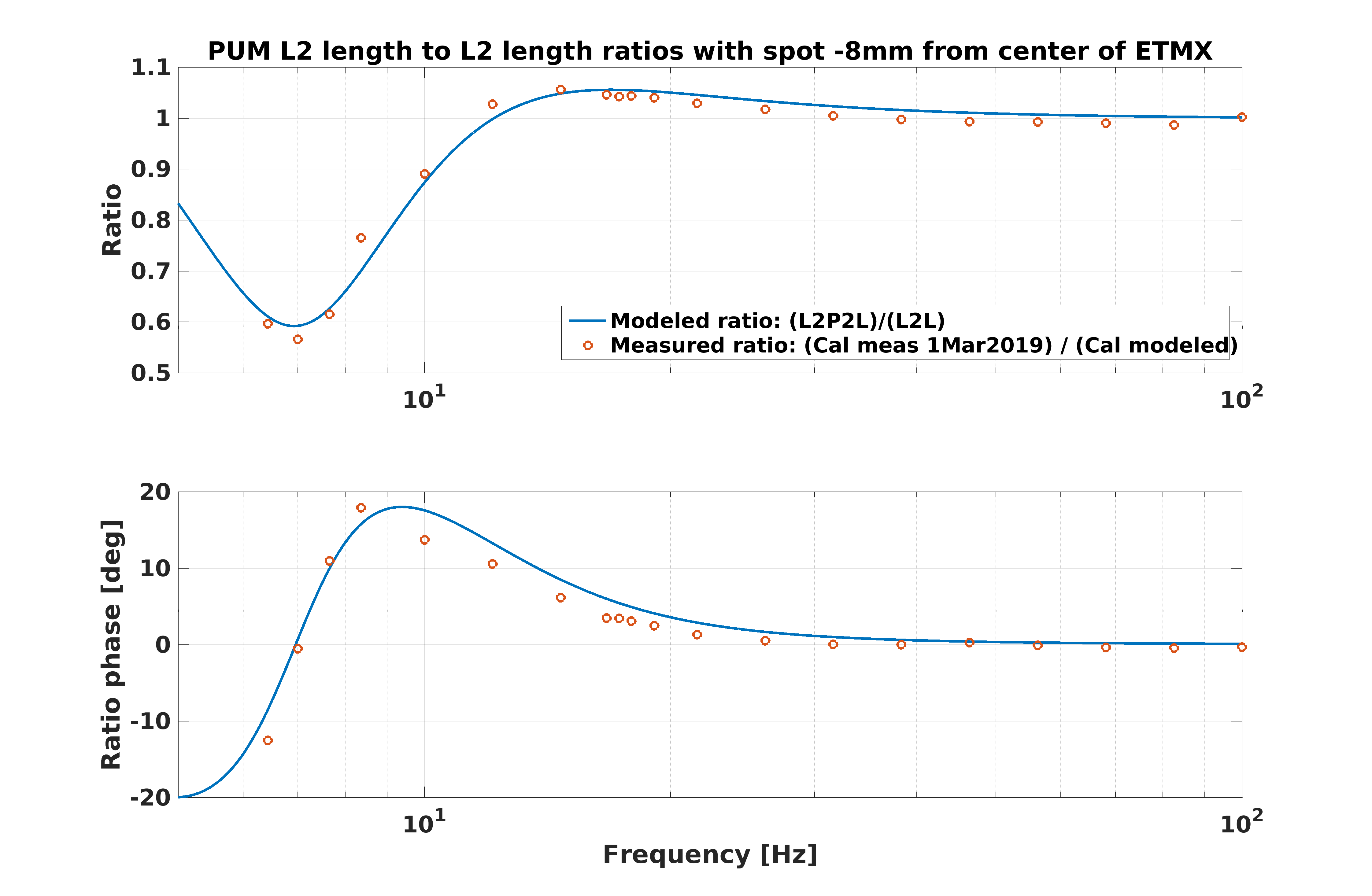
I have modeled the PUM actuator, including the "L2P2L" path, and it matches quite well with the calibration measurements of the PUM actuator from times before we turned off the L2A drivealign filters. This model does not take any yaw couplings, and also does not include any loops such as ASC. The matching comes up best if I set the spot position on the ETM at -8mm, rather than what we believe is the true value of -14mm at the time of this measurement (we're at -18mm now, but this is a slightly older measurement). But, the shape is qualitatively the same, and likely some of the residual discrepancy comes from yaw couplings.
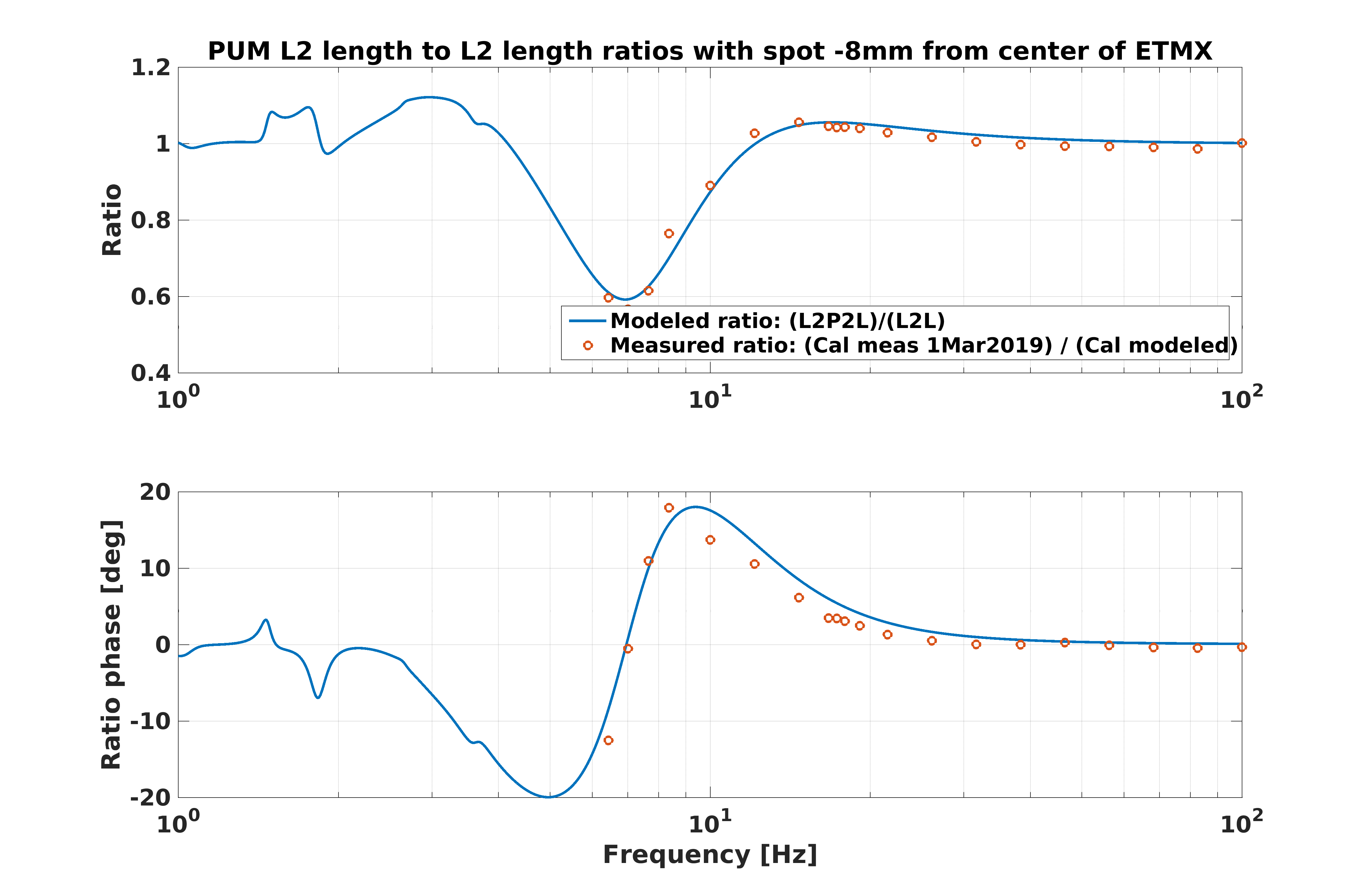
It is easier to see these differences between the L2L-only and the includes pitch effects versions of the models if we look at a ratio between the full model versus the L2L-only model. So, in the attached figures, the blue trace is the ratio of my full (includes pitch) model versus just the direct length-to-length coupling. The orange dots are the ratio of the calibration measured PUM actuator data from 1 March 2019 (a time when we were still using the L2A filter on ETMX L2) versus the calibration model of PUM length actuation. If the calibration PUM model captured all of the effects, we would expect this ratio to be unity at all frequencies. Similarly, if the effects of pitch couplings were negligible, we would expect the modeled ratio to be near unity. However, we see that neither the measured nor modeled ratios are unity at all frequencies.
The first attachment shows the modeled ratio plotted with the measured ratio for a spot position of -14mm, which is where the spot was at the time of the measured data (we're at -18mm on ETMX now, but this is an older measurement). You can see that the modeled ratio shows a larger discrepancy from unity than the measured ratio. If I guess-and-check a few spot positions, I find that a spot position of -8mm makes the data match the modeled ratio more closely, but recall that the model is missing effects such as yaw couplings. The -8mm spot position model is shown in attachment 2. The final attachment is a zoom out of the -8mm model, and you can see that it makes a fairly significant difference at around 4.2 Hz, where we have been having troubles with our PUM crossover. We should use this more full PUM length actuation to Test mass motion model for future DARM modelling work.
TITLE: 04/24 Day Shift: 15:00-23:00 UTC (08:00-16:00 PST), all times posted in UTC
STATE of H1: Lock Acquisition
INCOMING OPERATOR: Corey
SHIFT SUMMARY: locked most of the shift, successful measurements on SQZ and successful calibration sweeps, lockloss, relocking now
LOG:
Today I took some frequency noise measurements. Posted are the results and the file locations.
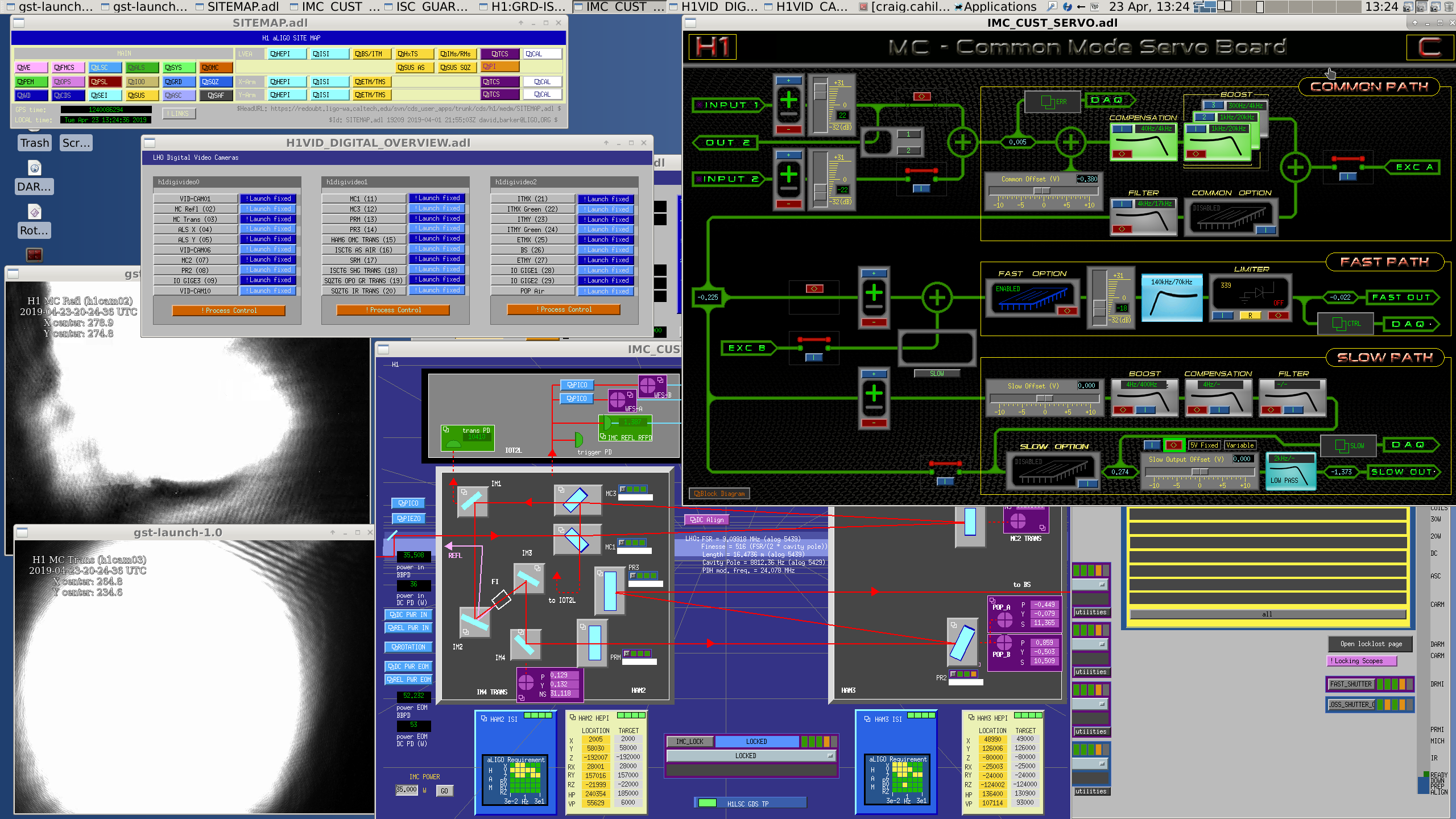
I increased CMB IN1 from +9dB to +12dB. We should always do this after thermalization of the IFO.
We can't increase the CARM digital gain too much or we'll hit the FSR with the CARM UGF. We have to wait for the optical gain to decay and replace it with digital gain.
POP18 NORM MON is at ~47 cts now, but is at around 60 when we first lock. We should wait until we hit around 50 cts, then up the CARM gain.
IMC Locked Alone at 35 W
- IMC REFL stitched spectra : /ligo/home/craig.cahillane/Git/IFO/IMC/data/Spectra/StitchedSpectrum_20190423_IMC_REFL_IMON_Spectra_IMCAlone_35WInput_IN1_22dB_SecondBoostOn.txt
- IMC OLG : /ligo/home/craig.cahillane/Git/IFO/IMC/data/TFs/20190423_IMC_OLG_IMCAlone_35WInput_IN1_22dB_SecondBoostOn.txt
- IMC MCL Crossover : /ligo/home/craig.cahillane/Git/IFO/FrequencyNoise/data/20190423_IMC_MCL_Crossover.xml
- MC2 to IMCF TF (Refs 16 and 17): /ligo/home/craig.cahillane/Git/IFO/FrequencyNoise/data/20190423_MC2_to_IMCF_35W.xml
Full Lock at 35 W
- REFL B Spectra : /ligo/home/craig.cahillane/Git/IFO/CARM/data/Spectra/StitchedSpectrum_20190423_REFL_B_35W_Input_CMBIN1Gain_9dB.txt
- REFL A Spectra : /ligo/home/craig.cahillane/Git/IFO/CARM/data/Spectra/StitchedSpectrum_20190423_REFL_A_35W_Input_CMBIN1Gain_9dB.txt
- CARM OUT2 Spectra : /ligo/home/craig.cahillane/Git/IFO/CARM/data/Spectra/StitchedSpectrum_20190423_CARM_OUT2_35W_Input_CMBIN1Gain_9dB.txt
- IMC REFL Spectra : /ligo/home/craig.cahillane/Git/IFO/CARM/data/Spectra/StitchedSpectrum_20190423_IMC_REFL_35W_Input_CMBIN1Gain_9dB.txt
- IMC TEST1 Spectra : /ligo/home/craig.cahillane/Git/IFO/CARM/data/Spectra/StitchedSpectrum_20190423_IMC_TEST1_35W_Input_CMBIN1Gain_9dB.txt
- CARM OLG w/ CMB IN1 = +9dB : /ligo/home/craig.cahillane/Git/IFO/CARM/data/TFs/20190423_213400_20190423_CARM_OLG_FullLock_35W_Input_60mV_Exc.txt
- CARM OLG w/ CMB IN1 = +12dB : /ligo/home/craig.cahillane/Git/IFO/CARM/data/TFs/20190423_214036_20190423_CARM_OLG_FullLock_35W_Input_60mV_Exc_12dB_CMBIN1Gain.txt
- IMC OLG w/ CMB IN1 = +9dB : /ligo/home/craig.cahillane/Git/IFO/IMC/data/TFs/20190423_212909_IMC_OLG_FullLock_35W_Input_0dBm_Exc.txt
- IMC OLG w/ CMB IN1 = +12dB : /ligo/home/craig.cahillane/Git/IFO/IMC/data/TFs/20190423_214142_IMC_OLG_FullLock_35W_Input_0dBm_Exc_12dB_CMBIN1Gain.txt
- LSC MCL Crossover : /ligo/home/craig.cahillane/Git/IFO/FrequencyNoise/data/20190423_LSC_MCL_Crossover.xml
- MC2 to REFL9 Cal TF (Current): /ligo/home/craig.cahillane/Git/IFO/FrequencyNoise/data/20190423_MC2_to_IMCF_35W.xml (This is the same as the MC2 to IMCF template above. The current references are in full lock, Refs 16 and 17 are from IMC locked alone.)
- Frequency Noise Injs +9dB: /ligo/home/controls/craig.cahillane/Git/IFO/FrequencyNoise/data/Injections/20190423/1240118413_GPSstart_FrequencyNoise_CMB_EXC_inj_2000_7000_Hz.pkl
/ligo/home/controls/craig.cahillane/Git/IFO/FrequencyNoise/data/Injections/20190423/1240118674_GPSstart_FrequencyNoise_CMB_EXC_inj_600_2000_Hz.pkl
/ligo/home/controls/craig.cahillane/Git/IFO/FrequencyNoise/data/Injections/20190423/1240118847_GPSstart_FrequencyNoise_CMB_EXC_inj_175_600_Hz.pkl
/ligo/home/controls/craig.cahillane/Git/IFO/FrequencyNoise/data/Injections/20190423/1240119020_GPSstart_FrequencyNoise_CMB_EXC_inj_50_175_Hz.pkl
/ligo/home/controls/craig.cahillane/Git/IFO/FrequencyNoise/data/Injections/20190423/1240119191_GPSstart_FrequencyNoise_CMB_EXC_inj_15_50_Hz.pkl
- Frequency Noise Injs +12dB: /ligo/home/controls/craig.cahillane/Git/IFO/FrequencyNoise/data/Injections/20190423/1240119574_GPSstart_FrequencyNoise_CMB_EXC_inj_2000_7000_Hz.pkl
/ligo/home/controls/craig.cahillane/Git/IFO/FrequencyNoise/data/Injections/20190423/1240119754_GPSstart_FrequencyNoise_CMB_EXC_inj_600_2000_Hz.pkl
/ligo/home/controls/craig.cahillane/Git/IFO/FrequencyNoise/data/Injections/20190423/1240119927_GPSstart_FrequencyNoise_CMB_EXC_inj_175_600_Hz.pkl
/ligo/home/controls/craig.cahillane/Git/IFO/FrequencyNoise/data/Injections/20190423/1240120100_GPSstart_FrequencyNoise_CMB_EXC_inj_50_175_Hz.pkl
/ligo/home/controls/craig.cahillane/Git/IFO/FrequencyNoise/data/Injections/20190423/1240120272_GPSstart_FrequencyNoise_CMB_EXC_inj_15_50_Hz.pkl
- LSC MCL Noise Injection +9dB: /ligo/home/controls/craig.cahillane/Git/IFO/MCL/data/Injections/20190423/1240123470_GPSstart_MCL_inj_5_200_Hz.pkl
- LSC MCL Noise Injection +12dB: /ligo/home/controls/craig.cahillane/Git/IFO/MCL/data/Injections/20190423/1240120857_GPSstart_MCL_inj_5_200_Hz.pkl
- PRCL Noise Injection +9dB: /ligo/home/controls/craig.cahillane/Git/IFO/PRCL/data/Injections/20190423/1240123215_GPSstart_PRCL_inj_5_200_Hz.pkl
- PRCL Noise Injection +12dB: /ligo/home/controls/craig.cahillane/Git/IFO/PRCL/data/Injections/20190423/1240121461_GPSstart_PRCL_inj_5_200_Hz.pkl
- Intensity Noise Inj +9dB: /ligo/home/controls/craig.cahillane/Git/IFO/IntensityNoise/data/Injections/20190423/1240122973_GPSstart_Intensity_inj_10_7300_Hz.pkl
- Intensity Noise Inj +12dB: /ligo/home/controls/craig.cahillane/Git/IFO/IntensityNoise/data/Injections/20190423/1240122556_GPSstart_Intensity_inj_10_7300_Hz.pkl
I upped the CMB IN1 gain from 9 to 12 dB for a couple of CARM and IMC OLGs. From the CARM OLG (PDF 3), we seem to have about 3 dB of clearance from the FSR with CMB IN1 = +12dB.
We know that frequency noise is starting to limit us with our squeezing levels.
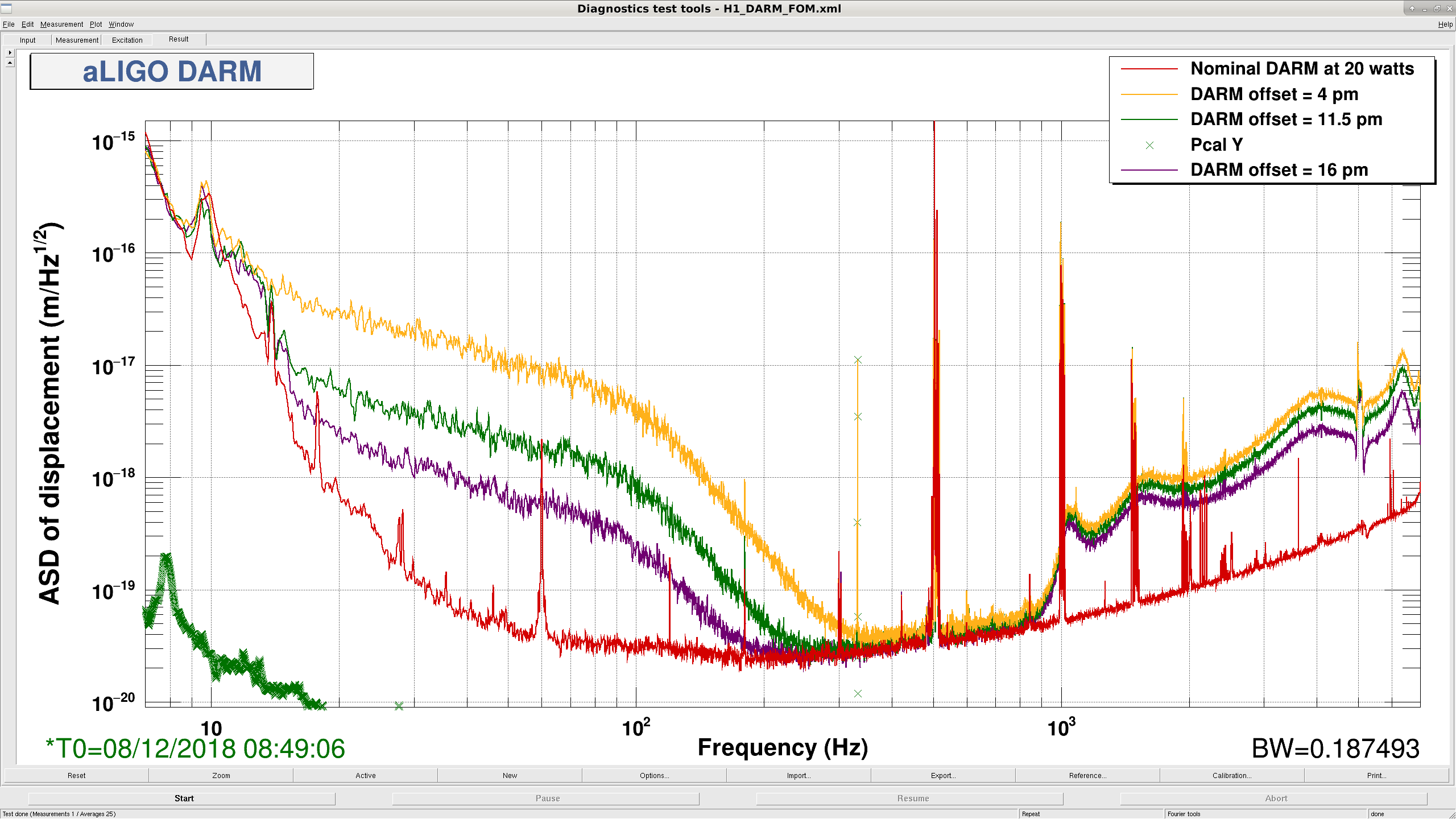
Quick comparison of the frequency noise injections with low (CMB IN1 +9dB) and high (CMB IN1 +12 dB) CARM gain. PDF 1 shows four ASDs: 1) DARM during a 2 to 7 kHz frequency noise injection into the common mode board, with +9dB on the CMB IN1 gain slider. 2) DARM during a 2 to 7 kHz frequency noise injection into the common mode board, with +12dB on the CMB IN1 gain slider. 3) Nominal DARM 4) Frequency noise projection into DARM for +9dB The frequency noise levels apparent in DARM decreased when the CARM analog gain was increased. This is because we have squashed the frequency noise imposed by the IMC shot noise. REFL B with high CARM gain was not measured yesterday. The CARM to DARM coupling TF did not change between gain changes. This is expected.
Some long term questions to answer: - Unmodeled CARM OLG hump at 18 kHz -- Daniel claims this is 9 MHz resonating in the arms, we can try to model this -- Was not apparent in Evan's thesis Figure 2.7 -- Not that apparent at Livingston (LLO alog 37620) - Make sure OMC control noise not limiting DARM at current frequency noise levels -- Georgia made OMC controls projections in the current noise budget at 30 W, showed noise way below DARM. -- Controls noise not linear with frequency noise (alog 45768) - Model shot noises for CARM, IMC -- Can get a quick win of sqrt(2) from using both REFL detectors -- Cyclostationary noise on REFL -- Should increase optical gain of IMC to squash its shot noise so it doesn't appear in DARM --- Increase modulation depth for IMC --- Add fast shutter and rotation stage to IOT2L to control power levels on IMC REFL
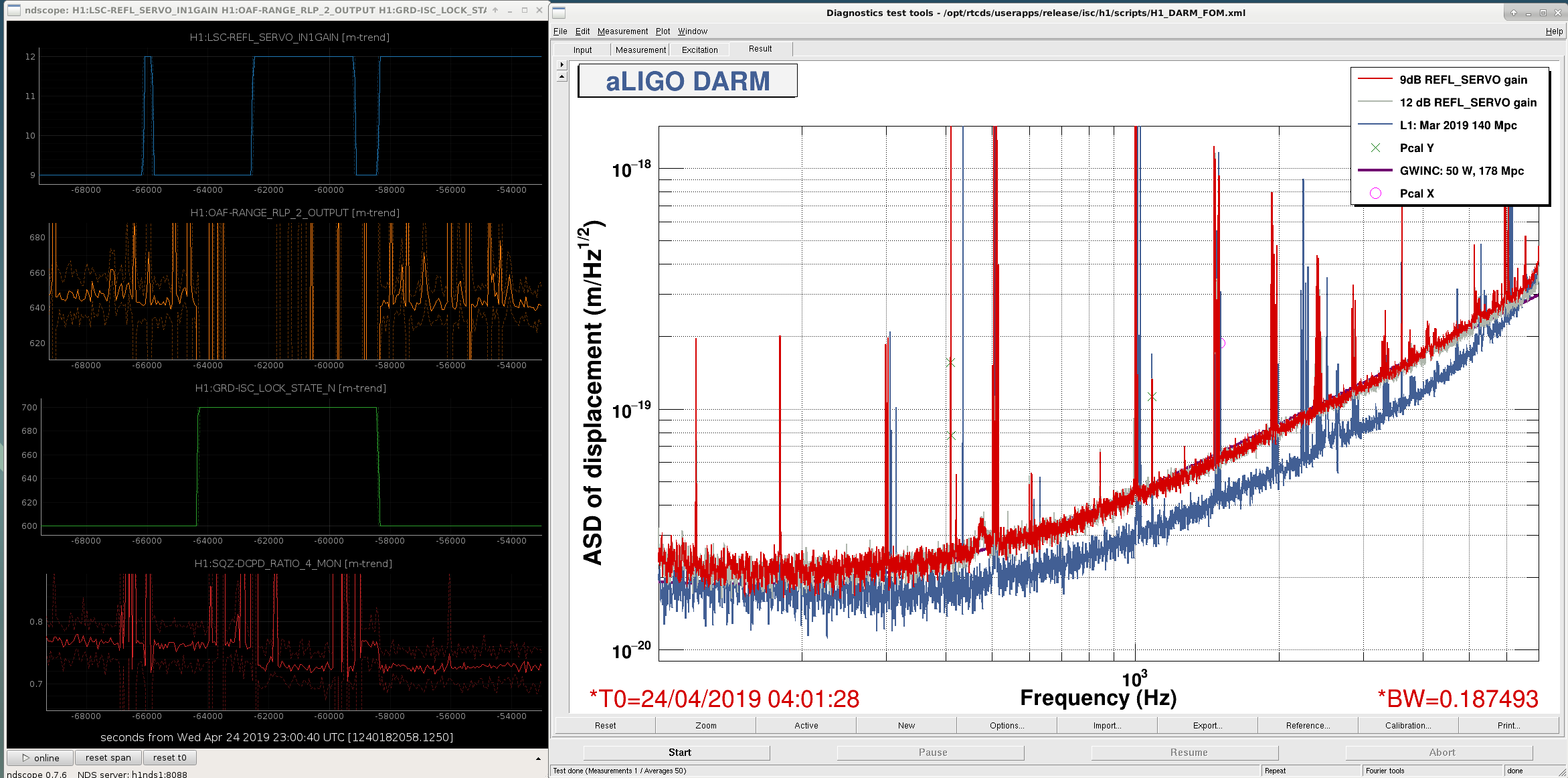
Attaching a screenshot shows DARM with the two LSC-REFL_SERVO_IN1 gains (grey = 12dB, red = 9dB). The improved frequency noise suppression is visible in DARM above 3.5 kHz, and also in the squeezer BLRMS (bottom time series), which looks at DARM at 4.68 kHz.
Additional CARM Spectra from 0.5 Hz to 5 MHz with the new changed configurations: CMB IN1 = +12 dB: REFL B : /ligo/home/craig.cahillane/Git/IFO/CARM/data/Spectra/StitchedSpectrum_20190425_REFL_B_35W_Input_CMBIN1_12dB.txt REFL A : /ligo/home/craig.cahillane/Git/IFO/CARM/data/Spectra/StitchedSpectrum_20190425_REFL_A_Spectrum_35W_Input_CMBIN1_12dB.txt CARM OUT2 : /ligo/home/craig.cahillane/Git/IFO/CARM/data/Spectra/StitchedSpectrum_20190425_CARM_OUT2_Spectrum_35W_Input_CMBIN1_12dB.txt IMC REFL : /ligo/home/craig.cahillane/Git/IFO/CARM/data/Spectra/StitchedSpectrum_20190425_IMC_REFL_Spectrum_35W_Input_CMBIN1_12dB.txt IMC TEST1 : /ligo/home/craig.cahillane/Git/IFO/CARM/data/Spectra/StitchedSpectrum_20190425_IMC_TEST1_Spectrum_35W_Input_CMBIN1_12dB.txt CMB IN1 = +6dB, CMB IN2 = +6dB (split control for REFL A and B) REFL B : /ligo/home/craig.cahillane/Git/IFO/CARM/data/Spectra/StitchedSpectrum_20190425_REFL_B_Spectrum_35W_Input_CMBIN1_6dB_CMBIN2_6dB.txt REFL A : /ligo/home/craig.cahillane/Git/IFO/CARM/data/Spectra/StitchedSpectrum_20190425_REFL_A_Spectrum_35W_Input_CMBIN1_6dB_CMBIN2_6dB.txt Posted are the comparison spectra of the three configurations of CARM we've been playing with:We can see that the CARM loop is gain limited at ~2kHz, since the REFL B spectrum decreased from increasing the CARM gain (Dark blue vs Light Blue). We can also see that REFL shot noise is dominating the spectrum from 3kHz down, from the switch to split sensor control (Light blue vs Orange)
+9 dB, REFL A sensor controlling CARM +12 dB, REFL A sensor controlling CARM +12 dB, Split REFL A and B sensors (+6 dB on each of the CMB Inputs)
Probably happens all the time, but while we heard a plane flying by, Robert noticed it sweep on the running DARM spectra here in the Control Room (from the "bucket" down below 60Hz).
This roughly happened from 3:06:30- 3:06:45utc.
See alog 34547 for a study of an airplane glitch in O2.
Attached are a couple of spectrograms. We will try to predict the effect on DARM from our latest PEM injections.
I believe that I have found and fixed the errors in the non-fez version of ISC_GEN_STATES.py, so I have put Georgia's modifications back in (with the fixes). We just lost lock (I don't know why, but I hadn't reloaded or changed anything in the running code), so I've reloaded the guardian and hopefully next lock we won't be plagued by this problem again.
We got through the acquisition sequence okay, and the BS pit top mass offloading is on as it should be, so I think we can call this one case closed.