11:45 Lockloss occurred without Verbal Alarm warning as it seems that VA had stopped.
12:25 FIrst re-lock attempt failed at ENGAGE_ASC_FOR_FULL_IFO - "H_T_T_S"
RF 90 started to increase, leading into the loss, causing a dip in RF 18
Second attempt is looking better. ASC loops took approx 6 minutes to converge.
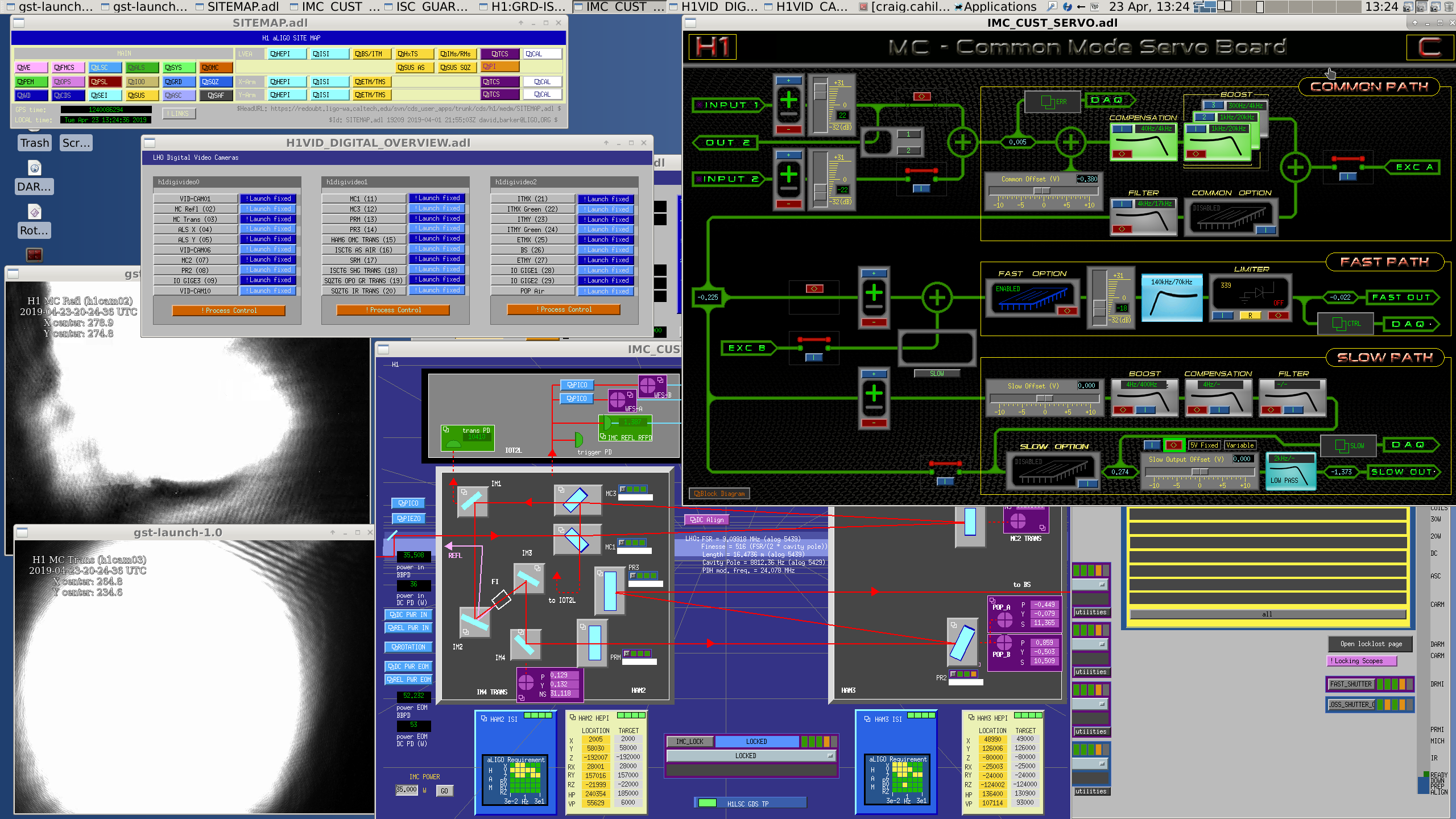
13:09 increased H1:LSC-REFL_SERVO_IN1GAIN up 3dB from 9 to 12 at NLN upon RF 9/18 trace settling at 47 cts (on Craig's tutelage)
ETMY violin modes 1 and 6 elevated but ringing down. I increased the gain on Mode 6 to .6 from 0
13:10 H1 back to Observing
Today I took some frequency noise measurements. Posted are the results and the file locations.
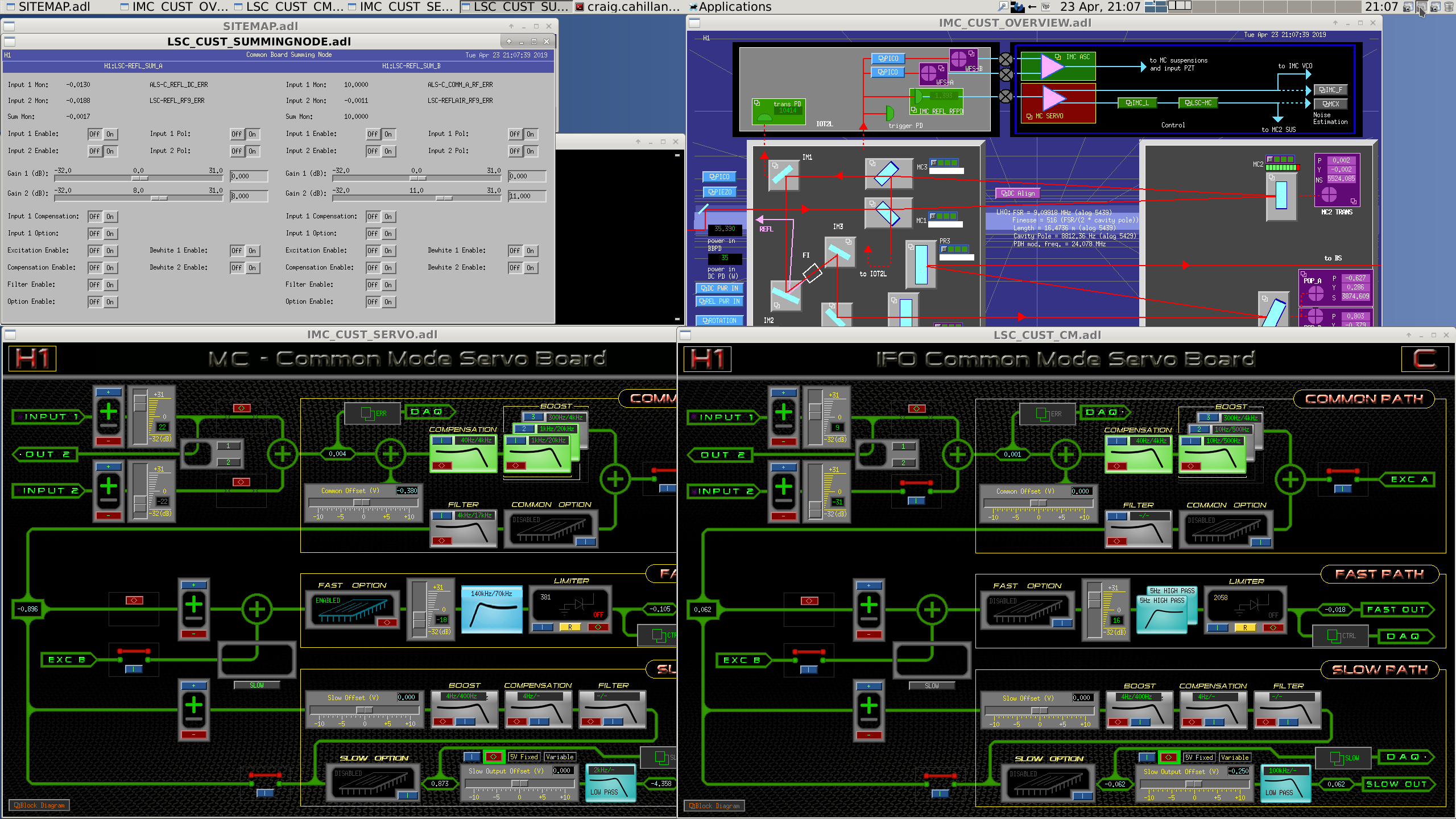
I increased CMB IN1 from +9dB to +12dB. We should always do this after thermalization of the IFO.
We can't increase the CARM digital gain too much or we'll hit the FSR with the CARM UGF. We have to wait for the optical gain to decay and replace it with digital gain.
POP18 NORM MON is at ~47 cts now, but is at around 60 when we first lock. We should wait until we hit around 50 cts, then up the CARM gain.
IMC Locked Alone at 35 W
- IMC REFL stitched spectra : /ligo/home/craig.cahillane/Git/IFO/IMC/data/Spectra/StitchedSpectrum_20190423_IMC_REFL_IMON_Spectra_IMCAlone_35WInput_IN1_22dB_SecondBoostOn.txt
- IMC OLG : /ligo/home/craig.cahillane/Git/IFO/IMC/data/TFs/20190423_IMC_OLG_IMCAlone_35WInput_IN1_22dB_SecondBoostOn.txt
- IMC MCL Crossover : /ligo/home/craig.cahillane/Git/IFO/FrequencyNoise/data/20190423_IMC_MCL_Crossover.xml
- MC2 to IMCF TF (Refs 16 and 17): /ligo/home/craig.cahillane/Git/IFO/FrequencyNoise/data/20190423_MC2_to_IMCF_35W.xml
Full Lock at 35 W
- REFL B Spectra : /ligo/home/craig.cahillane/Git/IFO/CARM/data/Spectra/StitchedSpectrum_20190423_REFL_B_35W_Input_CMBIN1Gain_9dB.txt
- REFL A Spectra : /ligo/home/craig.cahillane/Git/IFO/CARM/data/Spectra/StitchedSpectrum_20190423_REFL_A_35W_Input_CMBIN1Gain_9dB.txt
- CARM OUT2 Spectra : /ligo/home/craig.cahillane/Git/IFO/CARM/data/Spectra/StitchedSpectrum_20190423_CARM_OUT2_35W_Input_CMBIN1Gain_9dB.txt
- IMC REFL Spectra : /ligo/home/craig.cahillane/Git/IFO/CARM/data/Spectra/StitchedSpectrum_20190423_IMC_REFL_35W_Input_CMBIN1Gain_9dB.txt
- IMC TEST1 Spectra : /ligo/home/craig.cahillane/Git/IFO/CARM/data/Spectra/StitchedSpectrum_20190423_IMC_TEST1_35W_Input_CMBIN1Gain_9dB.txt
- CARM OLG w/ CMB IN1 = +9dB : /ligo/home/craig.cahillane/Git/IFO/CARM/data/TFs/20190423_213400_20190423_CARM_OLG_FullLock_35W_Input_60mV_Exc.txt
- CARM OLG w/ CMB IN1 = +12dB : /ligo/home/craig.cahillane/Git/IFO/CARM/data/TFs/20190423_214036_20190423_CARM_OLG_FullLock_35W_Input_60mV_Exc_12dB_CMBIN1Gain.txt
- IMC OLG w/ CMB IN1 = +9dB : /ligo/home/craig.cahillane/Git/IFO/IMC/data/TFs/20190423_212909_IMC_OLG_FullLock_35W_Input_0dBm_Exc.txt
- IMC OLG w/ CMB IN1 = +12dB : /ligo/home/craig.cahillane/Git/IFO/IMC/data/TFs/20190423_214142_IMC_OLG_FullLock_35W_Input_0dBm_Exc_12dB_CMBIN1Gain.txt
- LSC MCL Crossover : /ligo/home/craig.cahillane/Git/IFO/FrequencyNoise/data/20190423_LSC_MCL_Crossover.xml
- MC2 to REFL9 Cal TF (Current): /ligo/home/craig.cahillane/Git/IFO/FrequencyNoise/data/20190423_MC2_to_IMCF_35W.xml (This is the same as the MC2 to IMCF template above. The current references are in full lock, Refs 16 and 17 are from IMC locked alone.)
- Frequency Noise Injs +9dB: /ligo/home/controls/craig.cahillane/Git/IFO/FrequencyNoise/data/Injections/20190423/1240118413_GPSstart_FrequencyNoise_CMB_EXC_inj_2000_7000_Hz.pkl
/ligo/home/controls/craig.cahillane/Git/IFO/FrequencyNoise/data/Injections/20190423/1240118674_GPSstart_FrequencyNoise_CMB_EXC_inj_600_2000_Hz.pkl
/ligo/home/controls/craig.cahillane/Git/IFO/FrequencyNoise/data/Injections/20190423/1240118847_GPSstart_FrequencyNoise_CMB_EXC_inj_175_600_Hz.pkl
/ligo/home/controls/craig.cahillane/Git/IFO/FrequencyNoise/data/Injections/20190423/1240119020_GPSstart_FrequencyNoise_CMB_EXC_inj_50_175_Hz.pkl
/ligo/home/controls/craig.cahillane/Git/IFO/FrequencyNoise/data/Injections/20190423/1240119191_GPSstart_FrequencyNoise_CMB_EXC_inj_15_50_Hz.pkl
- Frequency Noise Injs +12dB: /ligo/home/controls/craig.cahillane/Git/IFO/FrequencyNoise/data/Injections/20190423/1240119574_GPSstart_FrequencyNoise_CMB_EXC_inj_2000_7000_Hz.pkl
/ligo/home/controls/craig.cahillane/Git/IFO/FrequencyNoise/data/Injections/20190423/1240119754_GPSstart_FrequencyNoise_CMB_EXC_inj_600_2000_Hz.pkl
/ligo/home/controls/craig.cahillane/Git/IFO/FrequencyNoise/data/Injections/20190423/1240119927_GPSstart_FrequencyNoise_CMB_EXC_inj_175_600_Hz.pkl
/ligo/home/controls/craig.cahillane/Git/IFO/FrequencyNoise/data/Injections/20190423/1240120100_GPSstart_FrequencyNoise_CMB_EXC_inj_50_175_Hz.pkl
/ligo/home/controls/craig.cahillane/Git/IFO/FrequencyNoise/data/Injections/20190423/1240120272_GPSstart_FrequencyNoise_CMB_EXC_inj_15_50_Hz.pkl
- LSC MCL Noise Injection +9dB: /ligo/home/controls/craig.cahillane/Git/IFO/MCL/data/Injections/20190423/1240123470_GPSstart_MCL_inj_5_200_Hz.pkl
- LSC MCL Noise Injection +12dB: /ligo/home/controls/craig.cahillane/Git/IFO/MCL/data/Injections/20190423/1240120857_GPSstart_MCL_inj_5_200_Hz.pkl
- PRCL Noise Injection +9dB: /ligo/home/controls/craig.cahillane/Git/IFO/PRCL/data/Injections/20190423/1240123215_GPSstart_PRCL_inj_5_200_Hz.pkl
- PRCL Noise Injection +12dB: /ligo/home/controls/craig.cahillane/Git/IFO/PRCL/data/Injections/20190423/1240121461_GPSstart_PRCL_inj_5_200_Hz.pkl
- Intensity Noise Inj +9dB: /ligo/home/controls/craig.cahillane/Git/IFO/IntensityNoise/data/Injections/20190423/1240122973_GPSstart_Intensity_inj_10_7300_Hz.pkl
- Intensity Noise Inj +12dB: /ligo/home/controls/craig.cahillane/Git/IFO/IntensityNoise/data/Injections/20190423/1240122556_GPSstart_Intensity_inj_10_7300_Hz.pkl
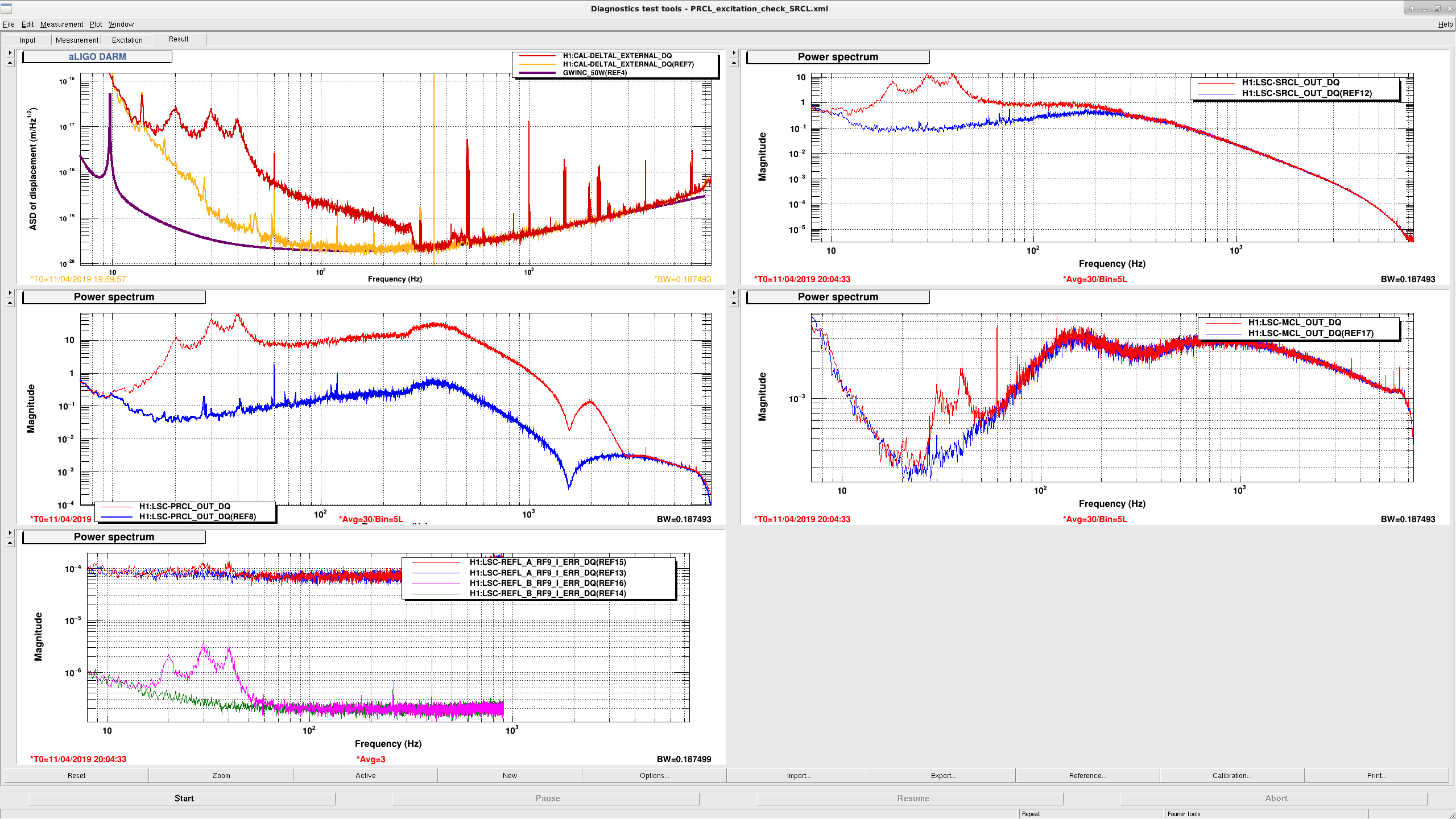
I upped the CMB IN1 gain from 9 to 12 dB for a couple of CARM and IMC OLGs. From the CARM OLG (PDF 3), we seem to have about 3 dB of clearance from the FSR with CMB IN1 = +12dB.
We know that frequency noise is starting to limit us with our squeezing levels.
Quick comparison of the frequency noise injections with low (CMB IN1 +9dB) and high (CMB IN1 +12 dB) CARM gain. PDF 1 shows four ASDs: 1) DARM during a 2 to 7 kHz frequency noise injection into the common mode board, with +9dB on the CMB IN1 gain slider. 2) DARM during a 2 to 7 kHz frequency noise injection into the common mode board, with +12dB on the CMB IN1 gain slider. 3) Nominal DARM 4) Frequency noise projection into DARM for +9dB The frequency noise levels apparent in DARM decreased when the CARM analog gain was increased. This is because we have squashed the frequency noise imposed by the IMC shot noise. REFL B with high CARM gain was not measured yesterday. The CARM to DARM coupling TF did not change between gain changes. This is expected.
Some long term questions to answer: - Unmodeled CARM OLG hump at 18 kHz -- Daniel claims this is 9 MHz resonating in the arms, we can try to model this -- Was not apparent in Evan's thesis Figure 2.7 -- Not that apparent at Livingston (LLO alog 37620) - Make sure OMC control noise not limiting DARM at current frequency noise levels -- Georgia made OMC controls projections in the current noise budget at 30 W, showed noise way below DARM. -- Controls noise not linear with frequency noise (alog 45768) - Model shot noises for CARM, IMC -- Can get a quick win of sqrt(2) from using both REFL detectors -- Cyclostationary noise on REFL -- Should increase optical gain of IMC to squash its shot noise so it doesn't appear in DARM --- Increase modulation depth for IMC --- Add fast shutter and rotation stage to IOT2L to control power levels on IMC REFL
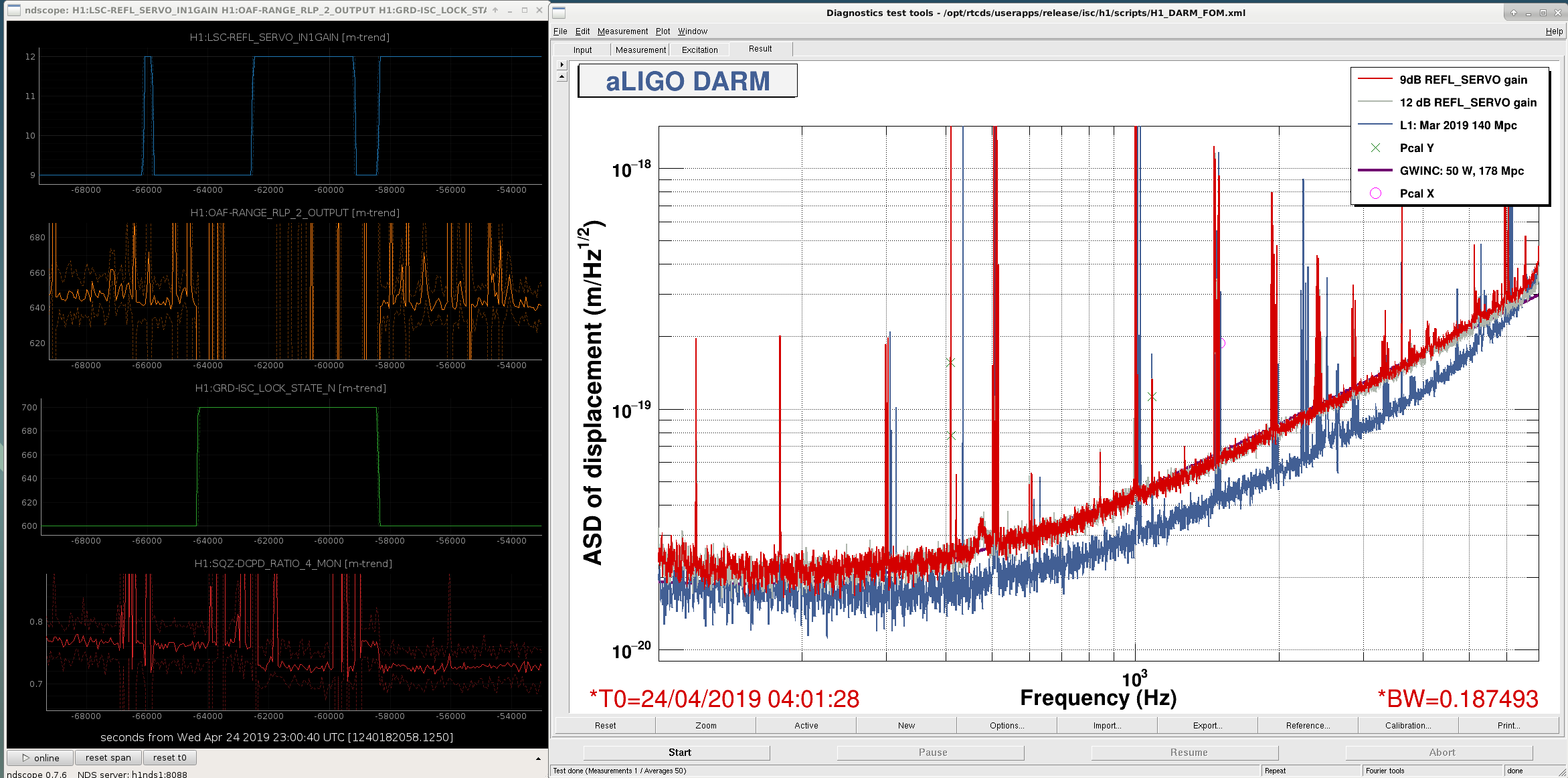
Attaching a screenshot shows DARM with the two LSC-REFL_SERVO_IN1 gains (grey = 12dB, red = 9dB). The improved frequency noise suppression is visible in DARM above 3.5 kHz, and also in the squeezer BLRMS (bottom time series), which looks at DARM at 4.68 kHz.
Additional CARM Spectra from 0.5 Hz to 5 MHz with the new changed configurations: CMB IN1 = +12 dB: REFL B : /ligo/home/craig.cahillane/Git/IFO/CARM/data/Spectra/StitchedSpectrum_20190425_REFL_B_35W_Input_CMBIN1_12dB.txt REFL A : /ligo/home/craig.cahillane/Git/IFO/CARM/data/Spectra/StitchedSpectrum_20190425_REFL_A_Spectrum_35W_Input_CMBIN1_12dB.txt CARM OUT2 : /ligo/home/craig.cahillane/Git/IFO/CARM/data/Spectra/StitchedSpectrum_20190425_CARM_OUT2_Spectrum_35W_Input_CMBIN1_12dB.txt IMC REFL : /ligo/home/craig.cahillane/Git/IFO/CARM/data/Spectra/StitchedSpectrum_20190425_IMC_REFL_Spectrum_35W_Input_CMBIN1_12dB.txt IMC TEST1 : /ligo/home/craig.cahillane/Git/IFO/CARM/data/Spectra/StitchedSpectrum_20190425_IMC_TEST1_Spectrum_35W_Input_CMBIN1_12dB.txt CMB IN1 = +6dB, CMB IN2 = +6dB (split control for REFL A and B) REFL B : /ligo/home/craig.cahillane/Git/IFO/CARM/data/Spectra/StitchedSpectrum_20190425_REFL_B_Spectrum_35W_Input_CMBIN1_6dB_CMBIN2_6dB.txt REFL A : /ligo/home/craig.cahillane/Git/IFO/CARM/data/Spectra/StitchedSpectrum_20190425_REFL_A_Spectrum_35W_Input_CMBIN1_6dB_CMBIN2_6dB.txt Posted are the comparison spectra of the three configurations of CARM we've been playing with:We can see that the CARM loop is gain limited at ~2kHz, since the REFL B spectrum decreased from increasing the CARM gain (Dark blue vs Light Blue). We can also see that REFL shot noise is dominating the spectrum from 3kHz down, from the switch to split sensor control (Light blue vs Orange)
+9 dB, REFL A sensor controlling CARM +12 dB, REFL A sensor controlling CARM +12 dB, Split REFL A and B sensors (+6 dB on each of the CMB Inputs)
TITLE: 04/24 Owl Shift: 07:00-15:00 UTC (00:00-08:00 PST), all times posted in UTC
STATE of H1: Observing at 106Mpc
OUTGOING OPERATOR: Corey
CURRENT ENVIRONMENT:
Wind: 18mph Gusts, 16mph 5min avg
Primary useism: 0.04 μm/s
Secondary useism: 0.15 μm/s
QUICK SUMMARY:
Smooth handoff of H1 in Observing following commissioning work by Georgia and Craig. A bit windy but nothing to be concerned with.
TITLE: 04/24 Eve Shift: 23:00-07:00 UTC (16:00-00:00 PST), all times posted in UTC
STATE of H1: Observing at 106Mpc
INCOMING OPERATOR: Ed
SHIFT SUMMARY:
Managed 3min of OBSERVING for my shift! (this was due to Maintenance recovery at the beginning and then Commissioning for the rest of the shift!) Winds have died a little, but still blowing & useism still low!
LOG:
Earlier in shift ran an alignment (took an hour, wanted to make sure ALS alignment was good). Required several locking attempts in windy conditions, but finally made it to Observing. Stayed in Observing for roughly 2-hrs (to let H1 heat up for Craig & Georgia).
(notified Doug L at LLO about our status via Teamspeak).
Probably happens all the time, but while we heard a plane flying by, Robert noticed it sweep on the running DARM spectra here in the Control Room (from the "bucket" down below 60Hz).
This roughly happened from 3:06:30- 3:06:45utc.
See alog 34547 for a study of an airplane glitch in O2.
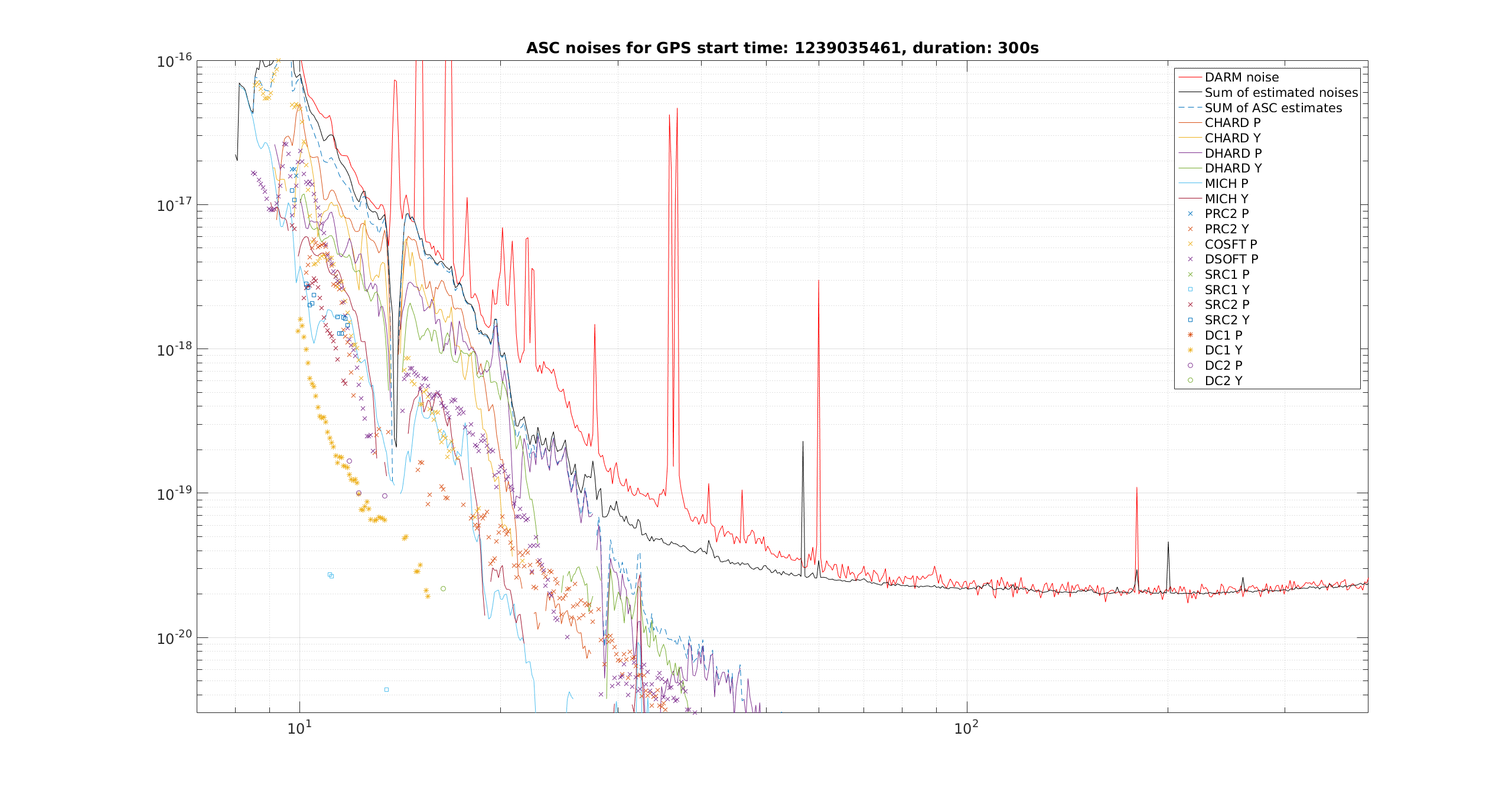
Attached are a couple of spectrograms. We will try to predict the effect on DARM from our latest PEM injections.
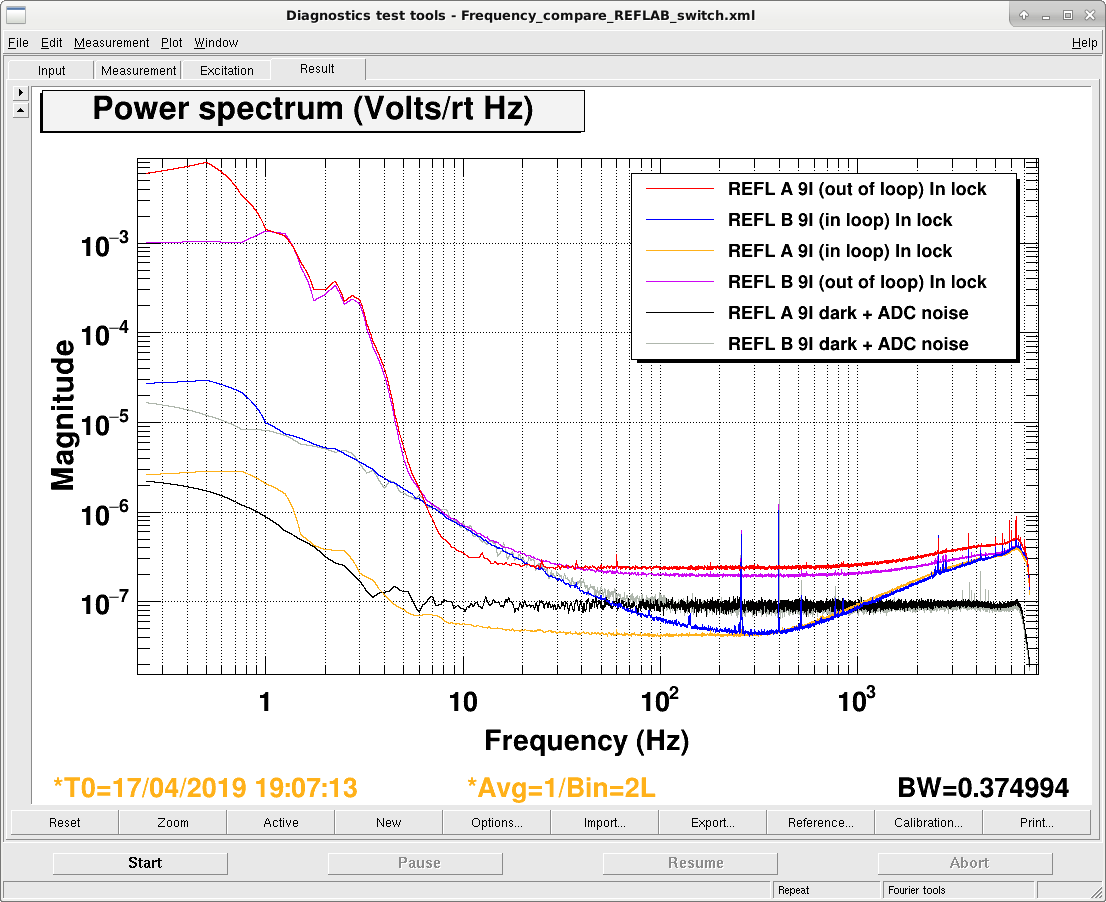
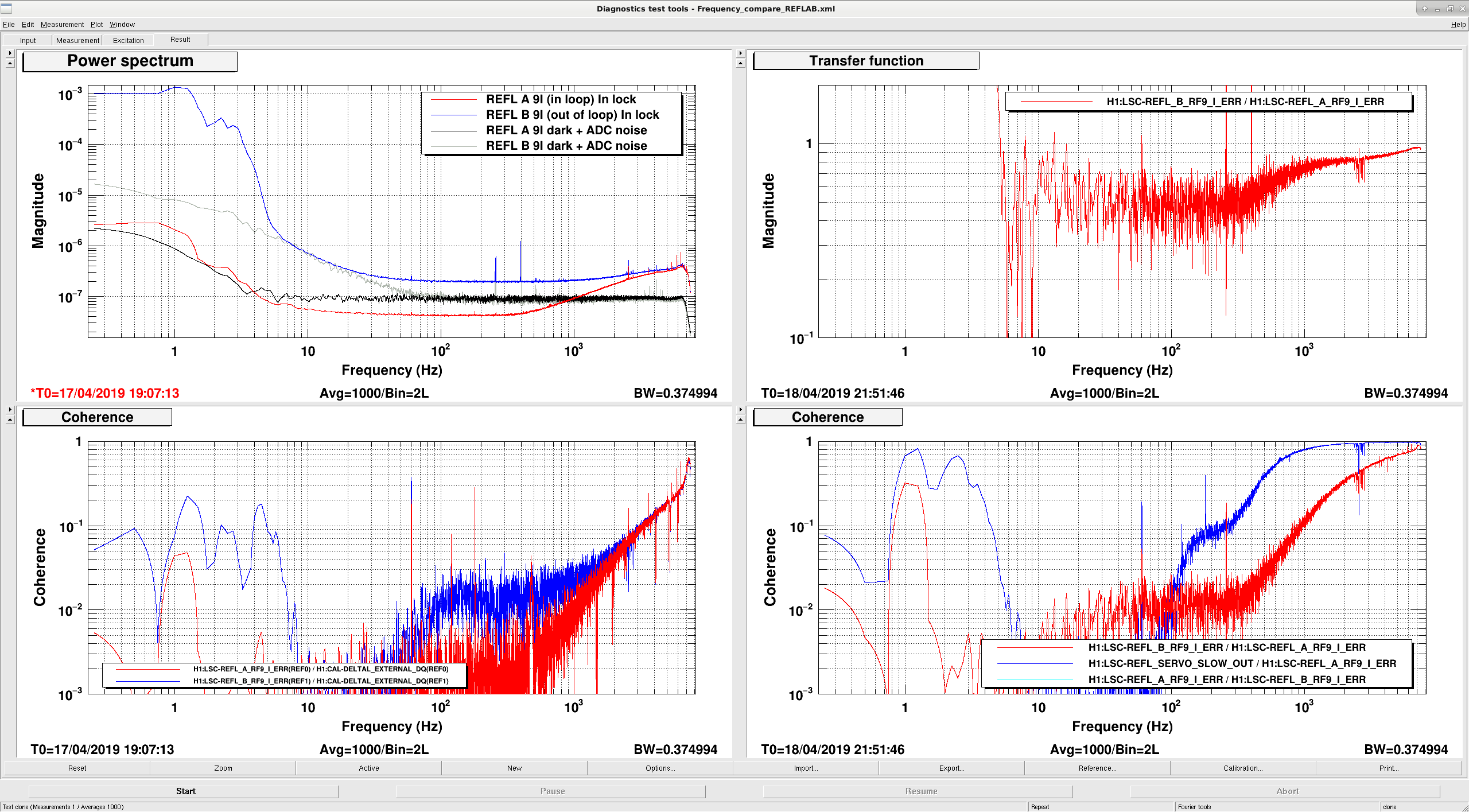
This morning while the IFO was still locked at the begining of maintence, Richard helped me cable the REFL B9I signal to the common mode summing junction. We plugged it into REFL B IN2, which is labeled for REFLAIR on the medm screen. We also added a label on the cable that is the same on both ends.
We switched the CARM loop over to REFL B without any problems, using the same gain settings as are used for REFL A. The CARM ugf stayed at around 10kHz. We were locked with REFL B in loop and REFL A out of loop from about 15:38 UTC until 16:15 UTC.
The attachment shows the spectrum of REFL A B with no light, with A in loop, and with B in loop. The REFL B readback is limited by ADC noise, so by switching the CARM control to REFL B we can use REFL A with it's better whitening to get a better out of loop REFL measurement. The DARM spectrum had many large glitches during this time because the sensor correction was off and people were working on maintence in the VEAs, so it would be worth doing this again in low noise to look at coherences with DARM.
TITLE: 04/23 Eve Shift: 23:00-07:00 UTC (16:00-00:00 PST), all times posted in UTC
STATE of H1: Lock Acquisition
OUTGOING OPERATOR: Cheryl
CURRENT ENVIRONMENT:
Wind: 26mph Gusts, 23mph 5min avg
Primary useism: 0.12 μm/s
Secondary useism: 0.15 μm/s
QUICK SUMMARY:
Beckhoff Slow Controls Work:
Daniel, Patrick, Fil, Dave:
The upgrade of EY Beckhoff was stopped following problems. The corner station PLC1 was upgraded to add BUSY signels for the Beam Diverters. A DAQ restart was needed.
h1build reboot
Dave:
I've been getting errors on my daily builds due to the /tmp file system getting full on h1build. This machine had been running for 105 days, so I rebooted it.
h1edc channel stats hosted by new IOC
Dave:
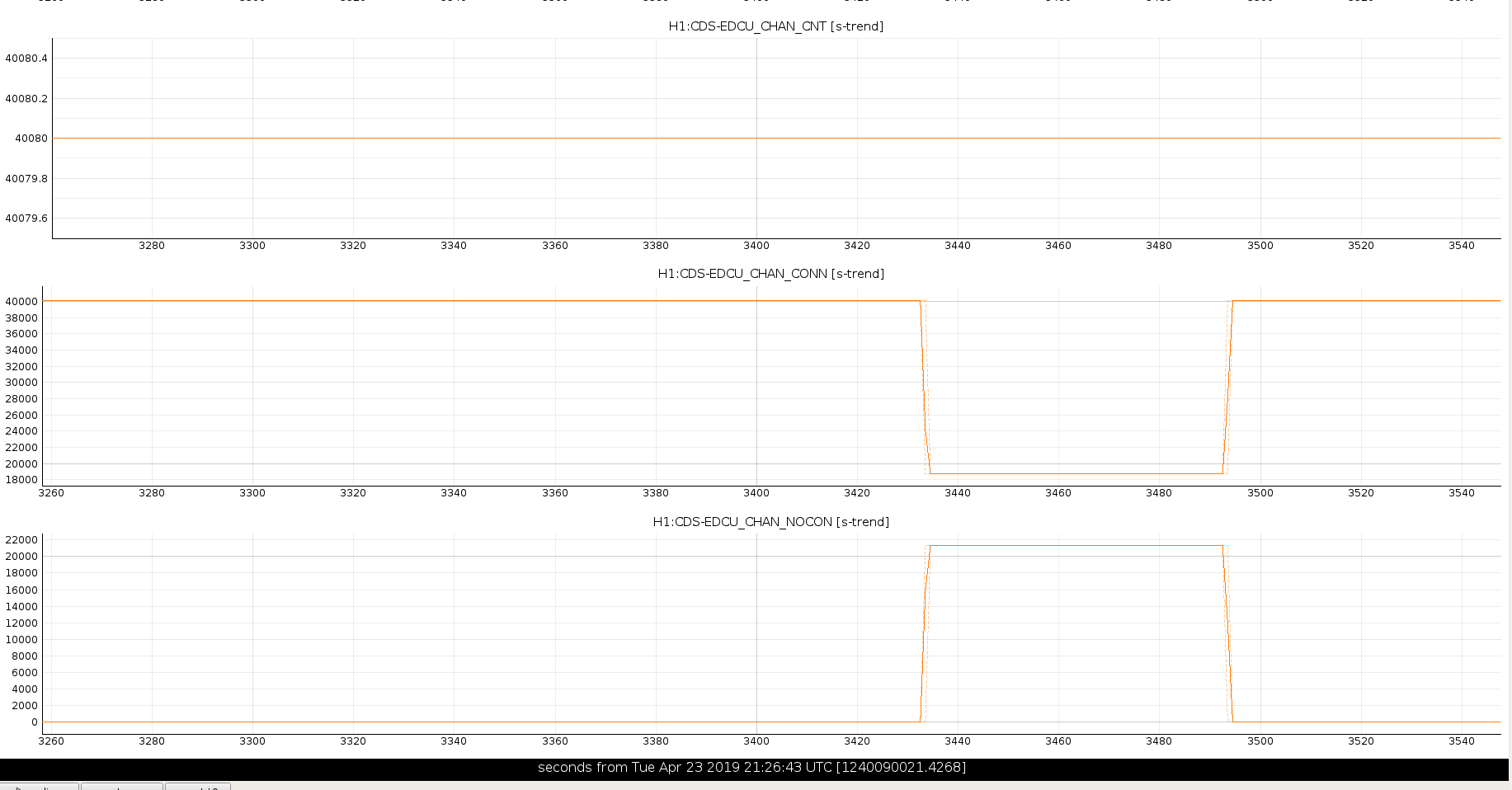
I found that h1edc has problems trending its own EPICS channels (e.g. connected and non-connected counters). I am running a new IOC on h1fescript0 (under a controls screen session) which samples these channels one a minute and reposts them. The new channels have the names H1:CDS-EDCU_CHAN_[CNT, CONN, NOCON, TIMESTAMP]. I removed the h1edc channels and replaced them with the new ones in H1EPICS_DAQ.ini. A DAQ restart was needed.
Attempted scrub of /opt/rtcds ZFS file system
Dave:
The /opt/rtcds ZFS pool on h1fs0 has not been scrubed recently (a file system cleanup, similar to fsck). I started one by hand at 21:23 UTC and immediately saw problems. First it was very difficult to log back into h1fs0 to monitor the status of the scrub. After 3 minutes, the continuous wave psinject stopped running, and the DAQ-CRC error count on h1edc started ramping up from 0 to 115 in 6 steps.
While this was happening I was checking file access times on my workstation, but I could not see any slow down.
At 21:46 UTC I cancelled the zpool scrub.
I cleared the DAQ-CRC error counters. I started the psinject process on h1hwinj1 (as user hinj):
[hinj@h1hwinj1 ~]$ /home/hinj/Details/bin/x_start_psinject david.barker "restart after possible /opt/rtcds slow down"
Entered psinject_common.tcl
Sourcing /ligo/cdscfg/stdenv.tcl
Sourced stdenv.tcl
Sourcing /home/hinj/Details/psinject_config.tcl
Entering psinject_config.tcl
Sourcing /ligo/cdscfg/stdenv.tcl
Sourced stdenv.tcl
Sourced psinject_config.tcl
Note: H1 psinject WAS running as process 23420, but has died
Starting H1 injection into H1:CAL-INJ_CW_EXC using RELEASE -> preO3_H1
Injection will start at t=1240093622 (60 seconds from now)...
Injection starting now
Note that h1fs0 has been running since 06 June 2016 (1051 days). We have started planning its reboot/replacement.
DAQ Restart:
Dave:
DAQ was restarted at 12:41 PDT for the ecatc1plc1 and h1edc changes. Again, after the restart all DAQ data from h1sush2a was marked as bad. I restarted mx_stream on this machine and the data became good.
Test of trending h1edc channels in DAQ
Daniel restarted the ecatc1 IOCs at 15:23 PDT, which meant that about 21,000 EPICS channels were taken away from h1edc. This gave me an opportunity to check that the EDCU channel counts were trending correctly in the DAQ using the new IOC. All looks good, plot attached.
Some comments on /opt/rtcds slow down causing problems. Our first thoughts are that h1edc and psinject perhaps are particularly sensitive to disk slowdown.
h1edc has been giving infrequent CRCs due to its large data component (40,000 channels) and we have been tuning its mx_stream delays. Perhaps when it calculates the H1EDC.ini file's check sum, any slow down in this access can affect the data transport to h1dc0 which results in data CRC errors. This is somewhat borne out by some of the steps being one minute apart, which I think is the INI file checking frequency.
h1hwinj1 perhaps relies on just-in-time data delivery?
The Beckhoff SDF system for ecatc1plc4 has frozen up, I restarted it on h1ecatmon0 (starth1sysecatc1plc4sdf).
Unplugged a two unused extension cords.
Powered off the oscilloscopes next to the PSL racks after confirming with commissioners.
Noted clean room flaps on HAM5 (as in alog48549), as well on the East side of HAM3 (see picture).
Doesn't look like the curtains are on the suspended parts of HEPI; otherwise I don't worry about the curtains. But, to be safe, it wouldn't be a bad idea to keep them clear.
Maintenance Timeline:
Log for remainder of shift:
22:23 (03:23) Beckhoff reboot in CS
22:29 (03:29) Beginning to relock
22:55 (03:55) Christina to MX, MY
23:00 (04:00) End of shift
There have been several times recently when operators had trouble relocking the squeezer after it unlocks and takes us out of observing, which seemed to be solved by re-requesting different states from the squeezer guardian.
The reason the squeezer knocks us out of observing is because the SHG PZT hits it's rail, this seems to be happening ~once or twice a day.
The reason the squeezer wasn't relocking is because the beam diverter wasn't re-opening after the squeezer relocked. The problem was that the beam diverter won't respond to multiple requests to move that happen too soon after each other, and in some places the guardian was making the requests to rapidly.
Daniel added a channel for the beam diverter called "busy" which can be checked before making a request of the beam diverter. This problem should be avoided with changes to the SQZ_MANAGER for the time being, but in the future we can have a busy check for the beam diverter.
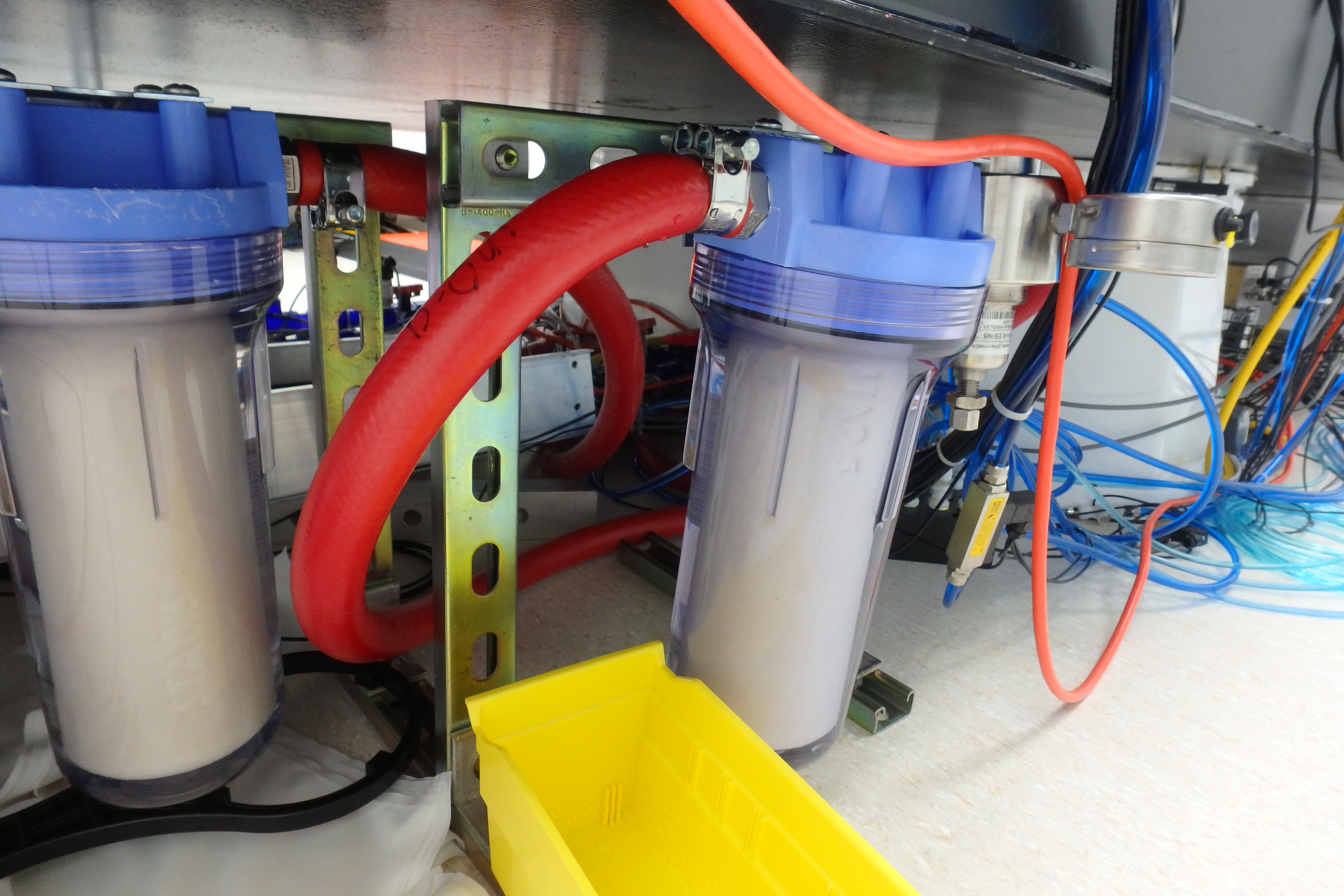
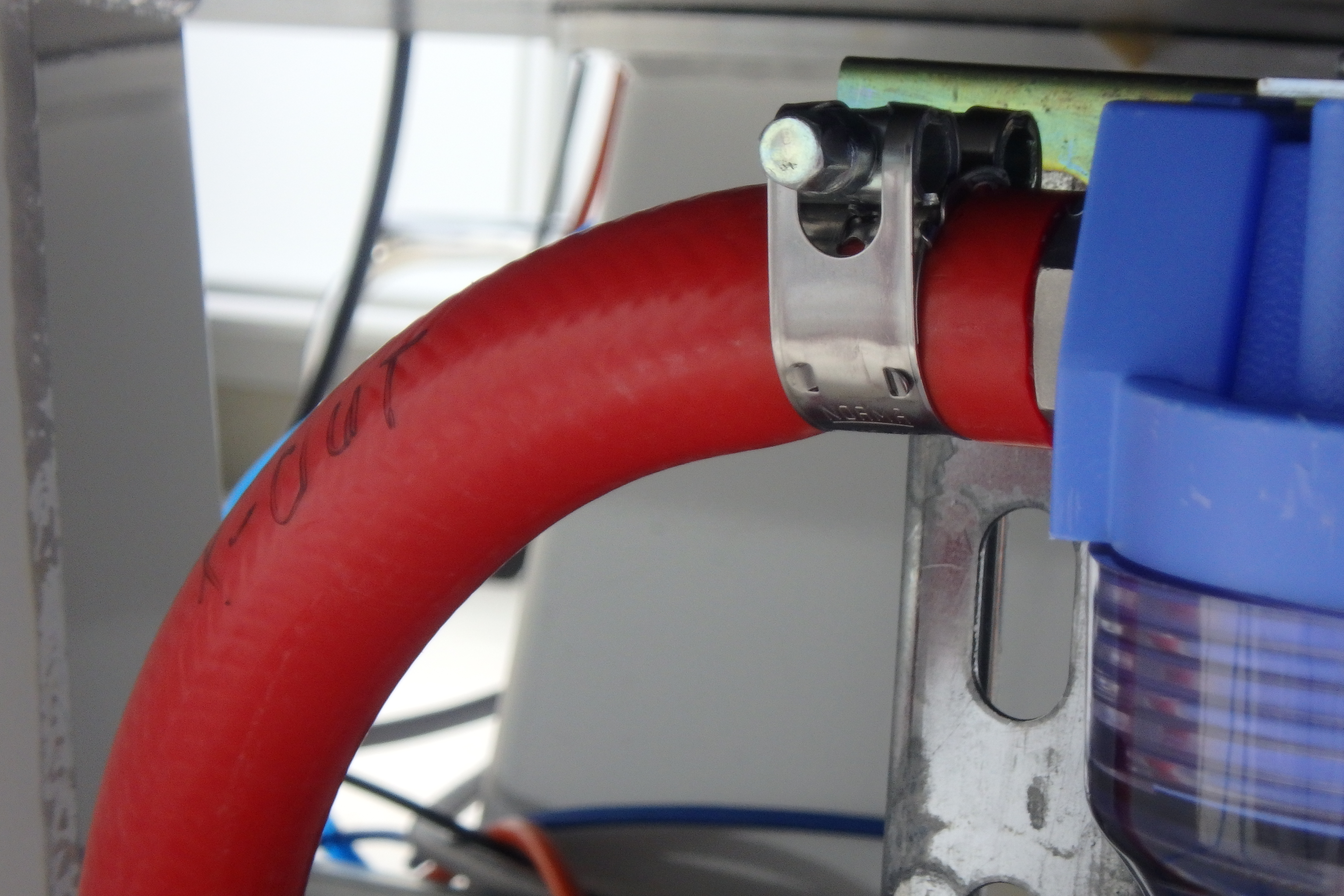
This morning Robert noticed water on the floor of the PSL enclosure. Inspection showed the leak to be at the barb fitting on the output side of the Diode chiller filter. There was a bulge in the hose from the hose clamp to the end of the barb. The Teflon inner liner of the hose had failed at the barb, allowing water between the Teflon and the outer rubber, which created the leak. Shutdown the laser and the Diode chiller. Cut out the bad section of hose and reconnected the hose to the filter. Powered up the system and noted no further leaks.
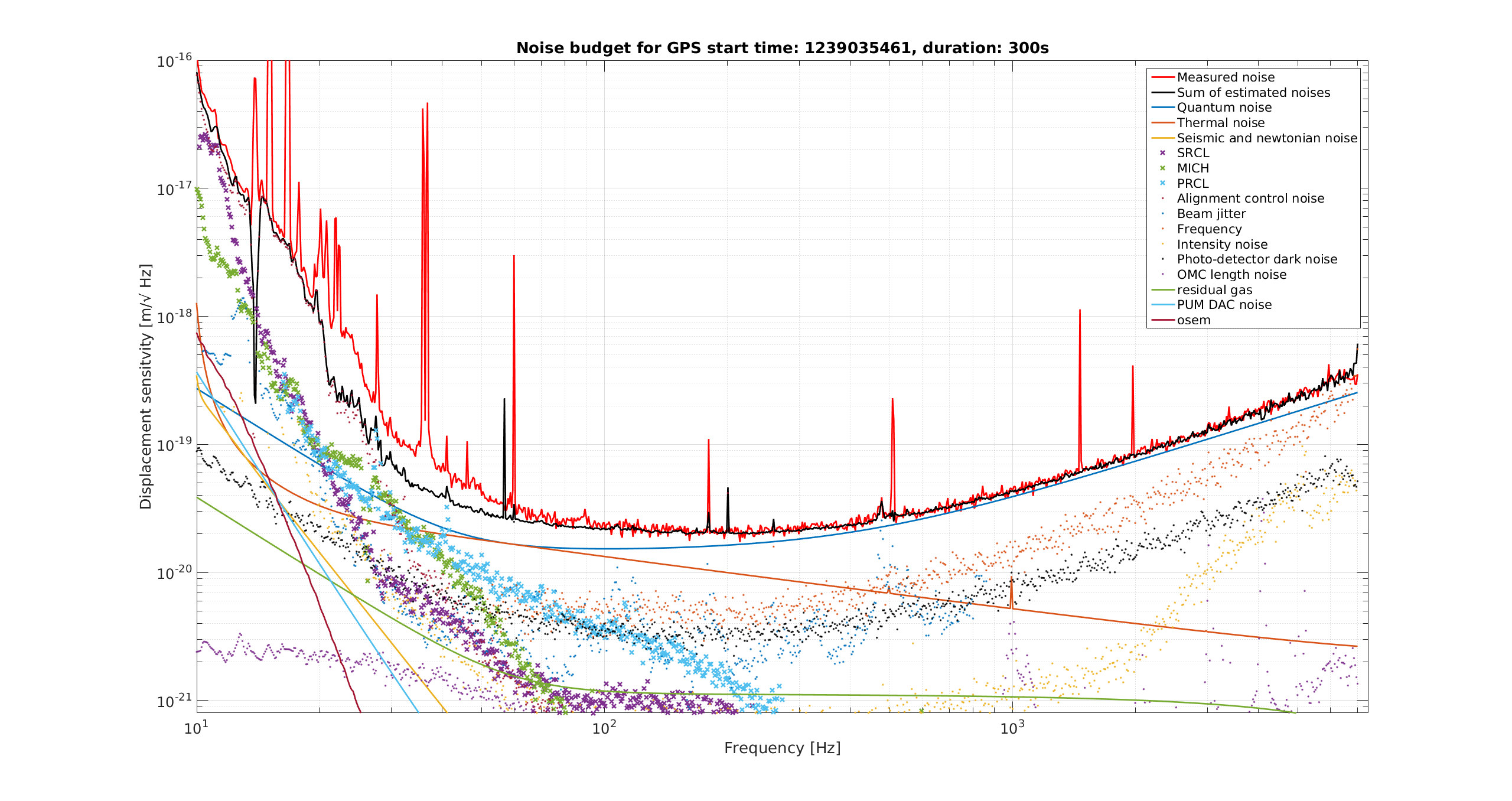
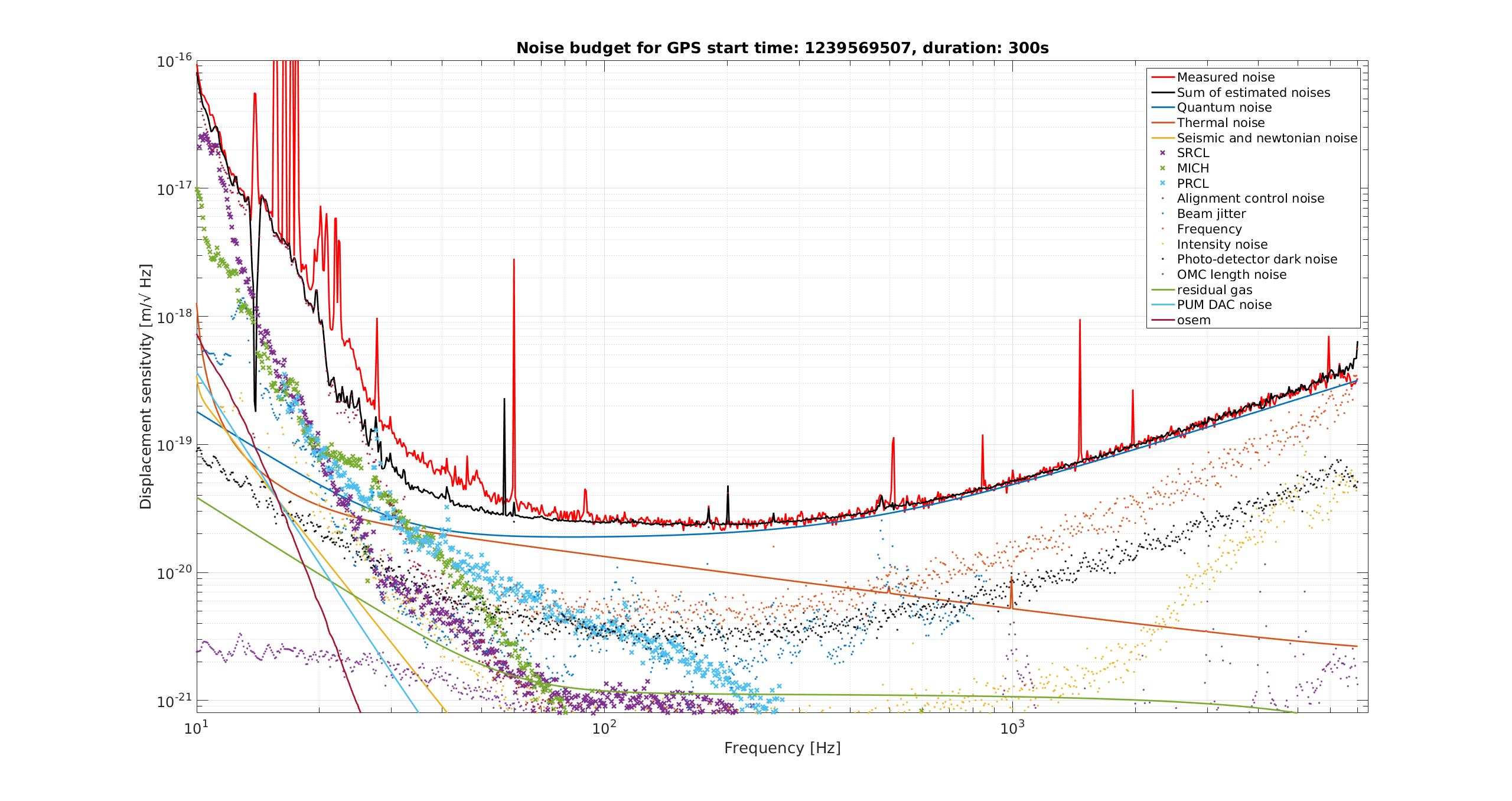
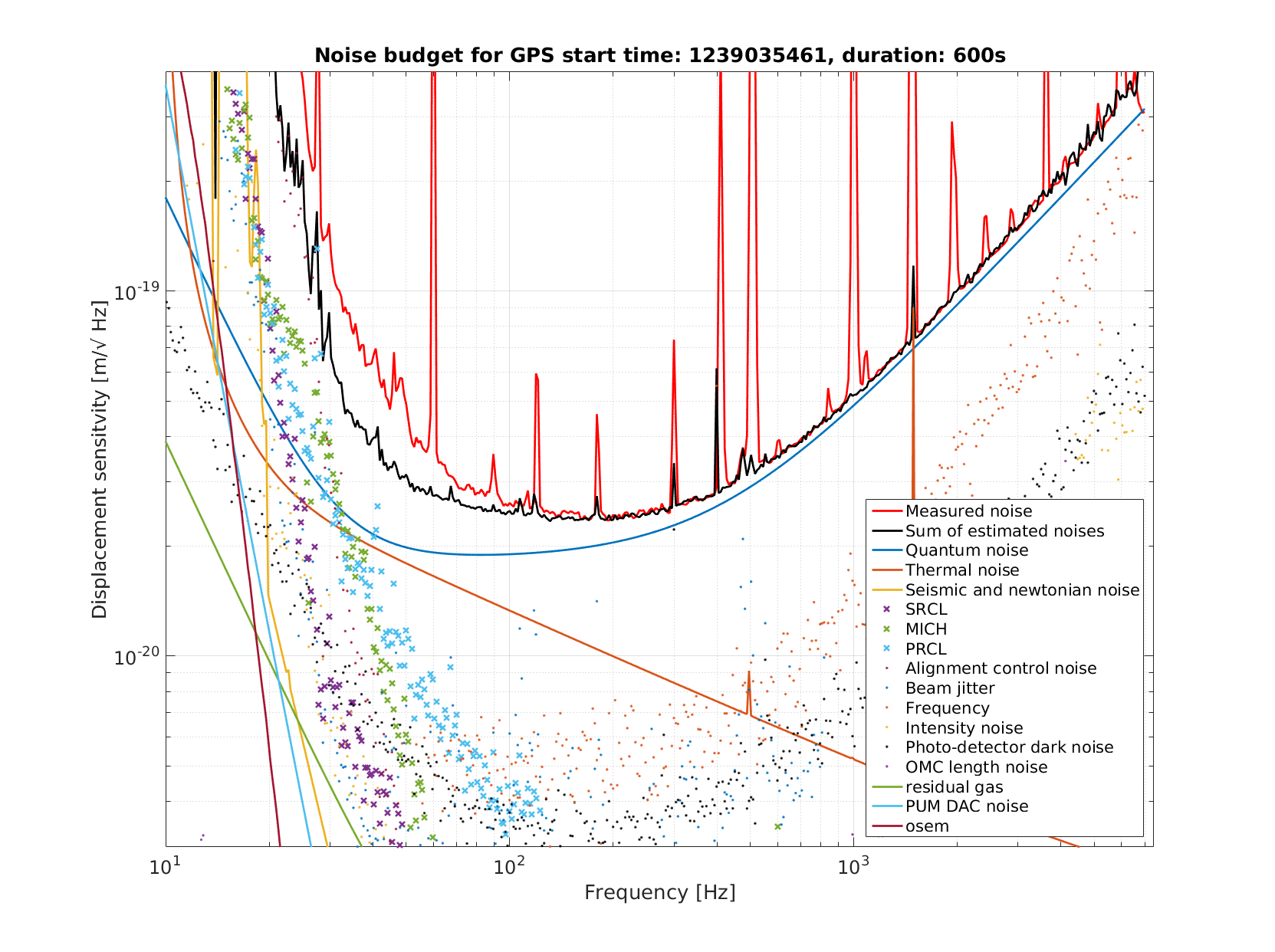
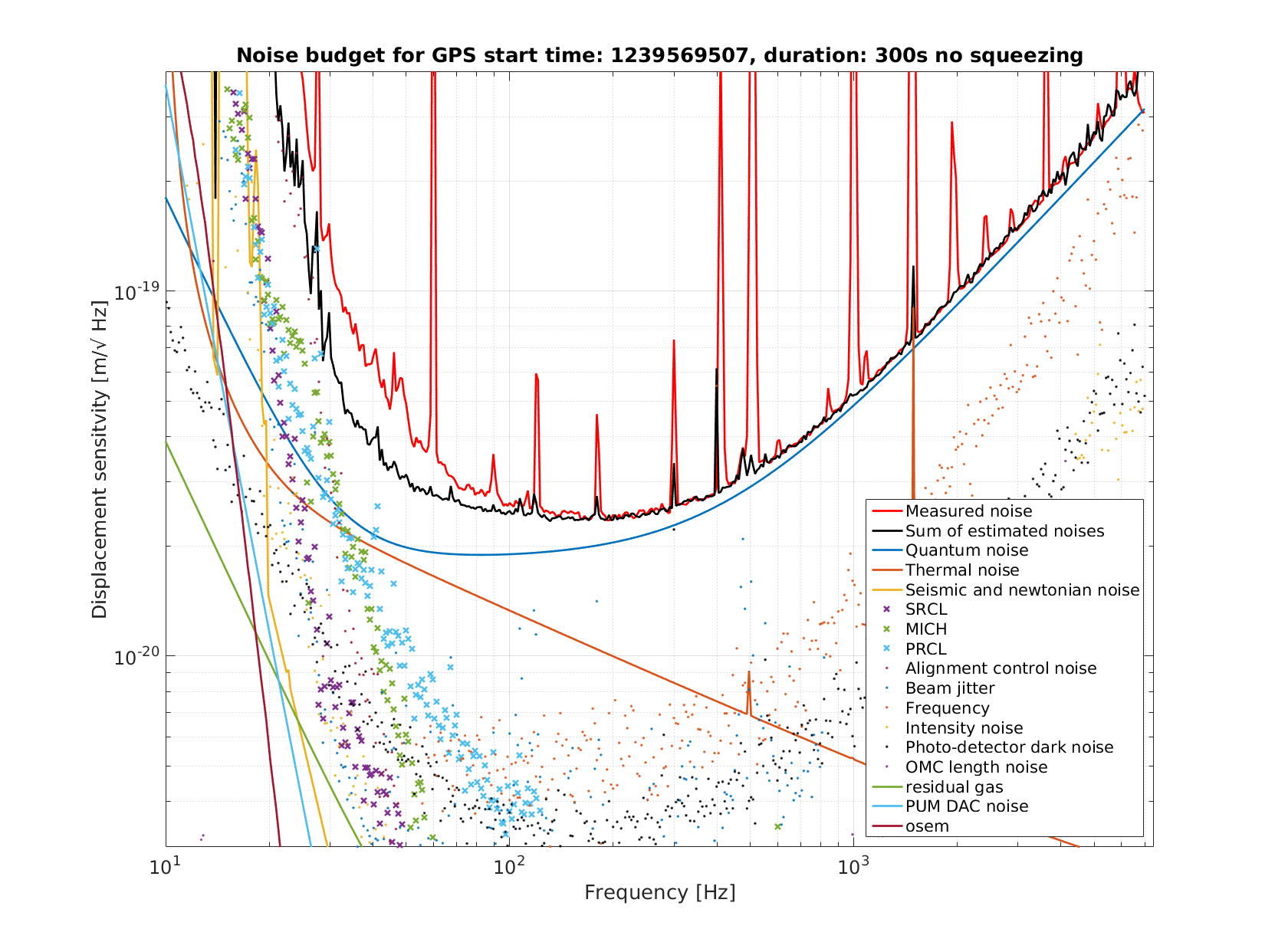
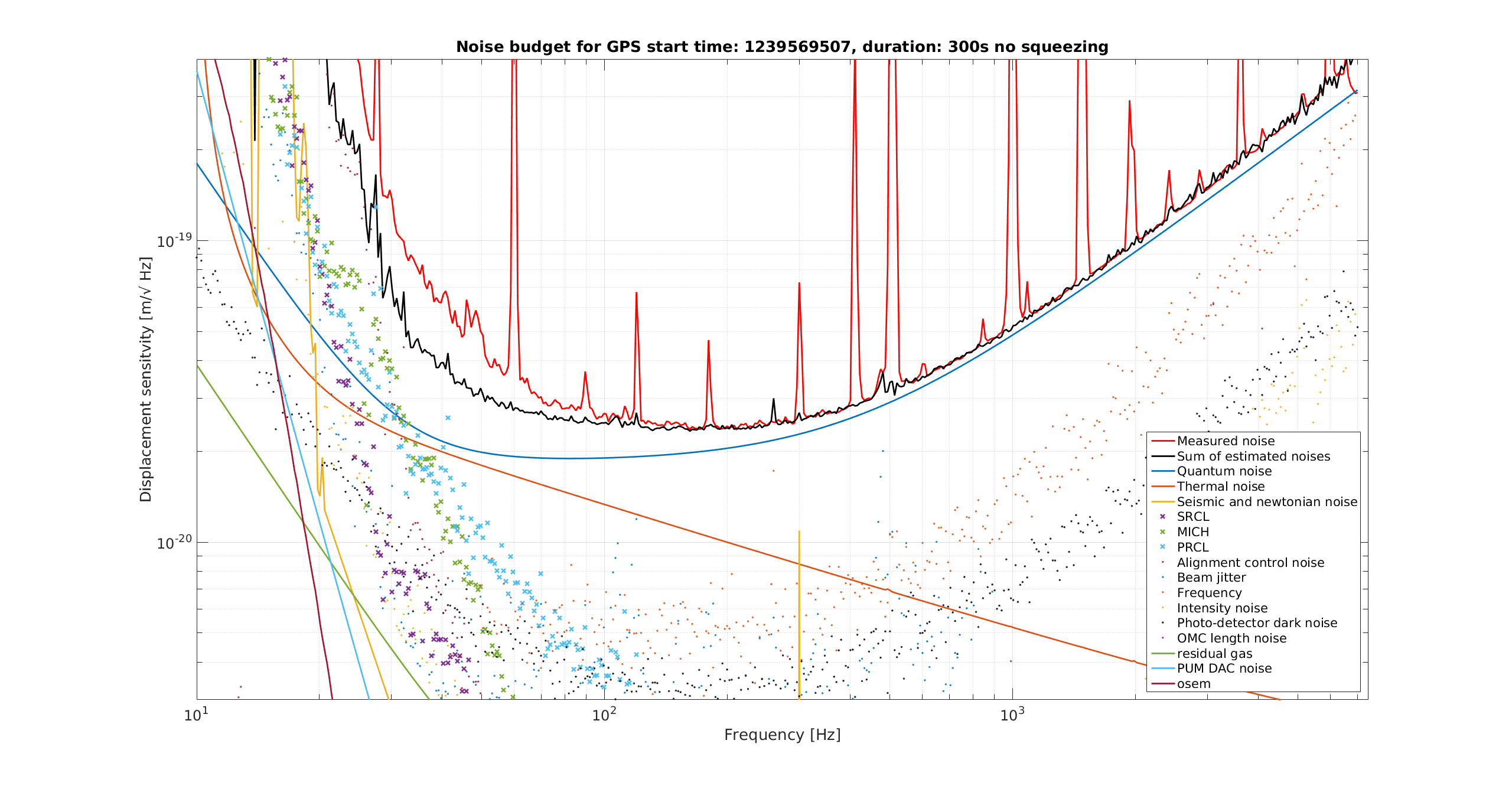
This is a quick update on the noise budget injections that we did last week. The first attachment is the noise budget for a time with squeezing, the second attachment is for a time without.
Some things that can still be improved in this noise budget:
I used the noise budget to look a little more closely at the quantum noise.
The first two attachments are the noise budgets with and without squeezing (same data as above, logarithmic binning fixed using some code from Tobin Fricke).
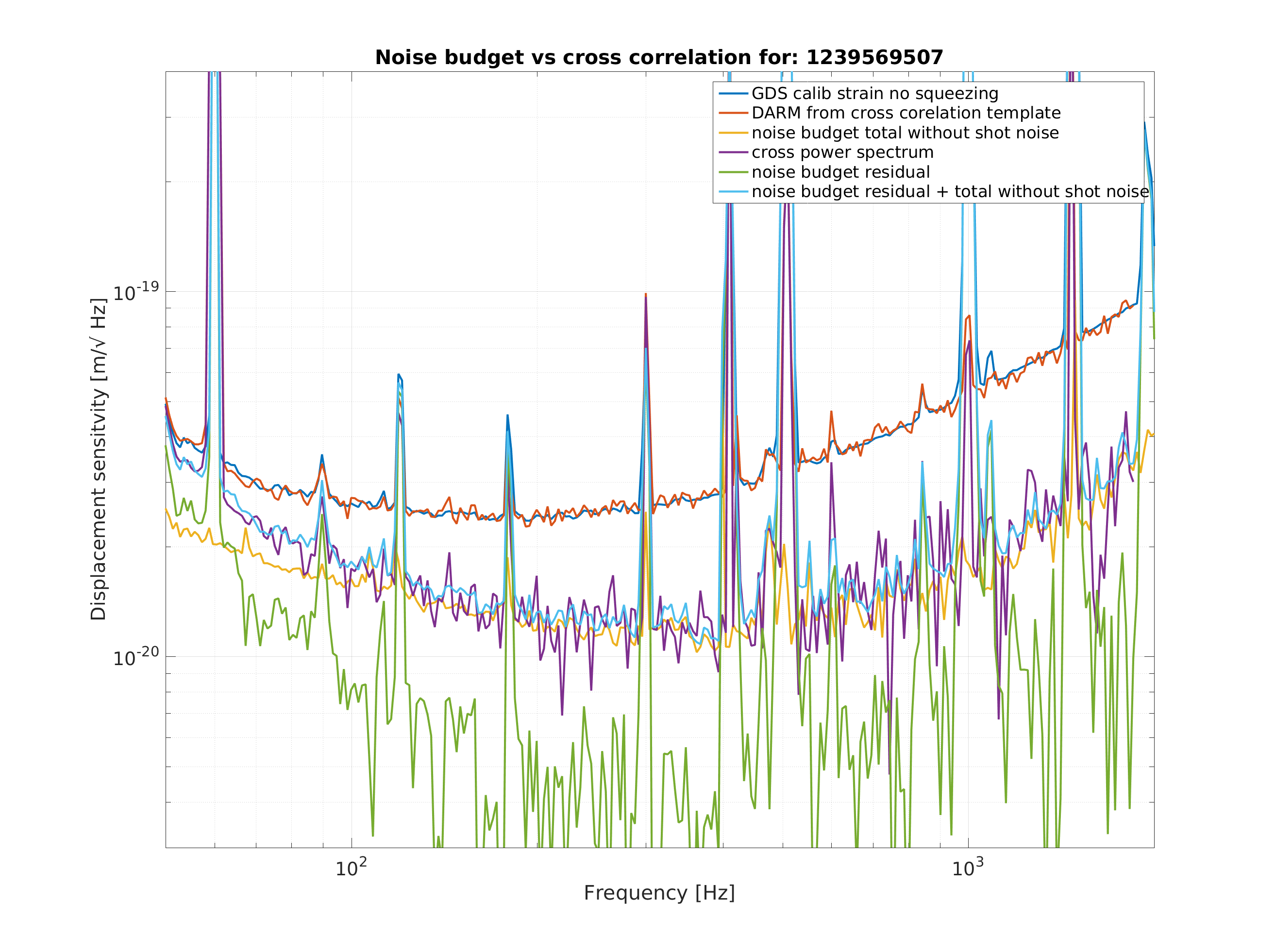
The next attachment is a comparison of the cross correlation (produced by the front end) for the no squeezing time to the noise budget. The main message here is that the cross correlation is in rough agreement with the noise budget above 150Hz, and the noise budget residual below 150 Hz is due to noise that is correlated between the two detectors.
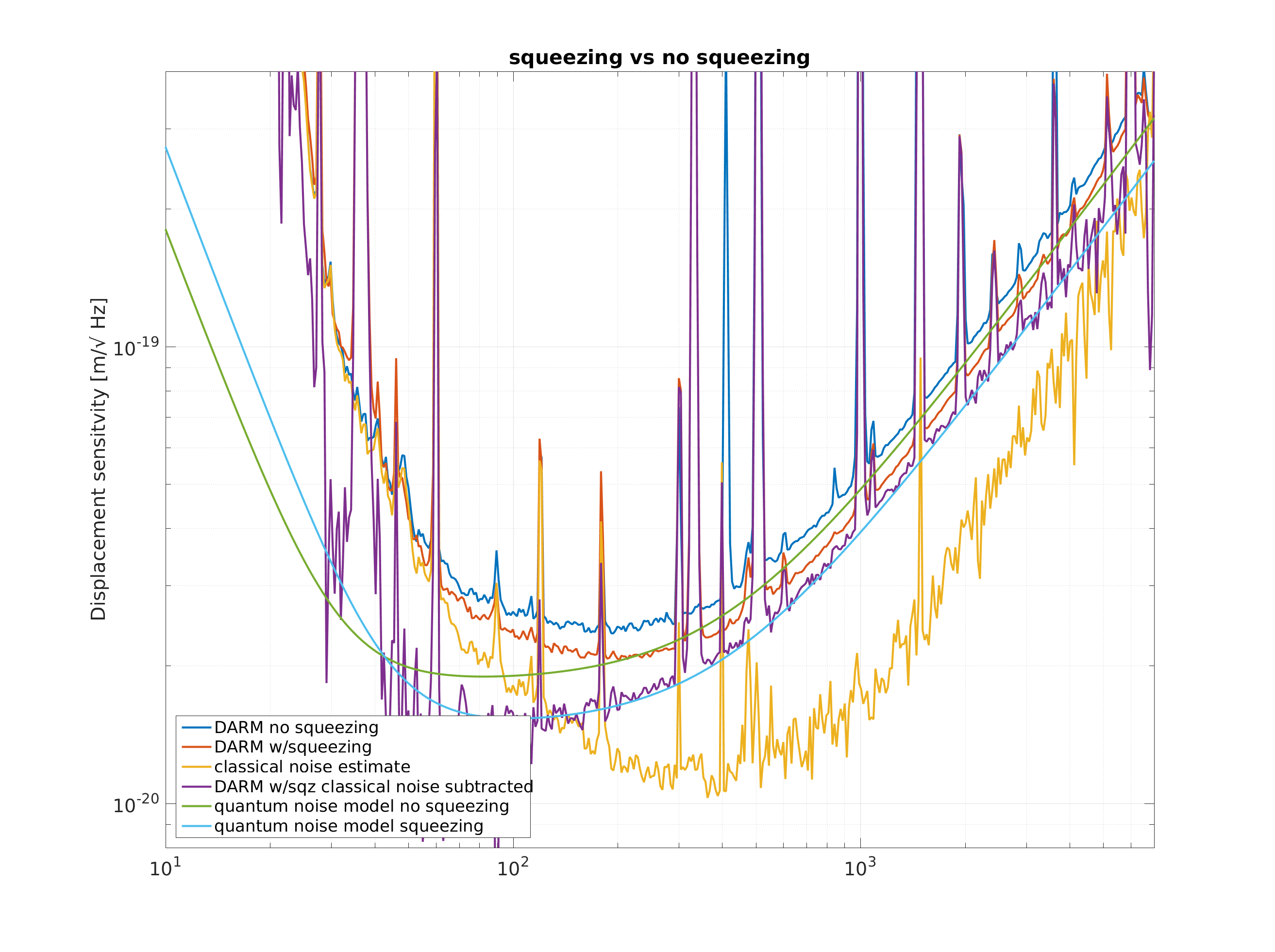
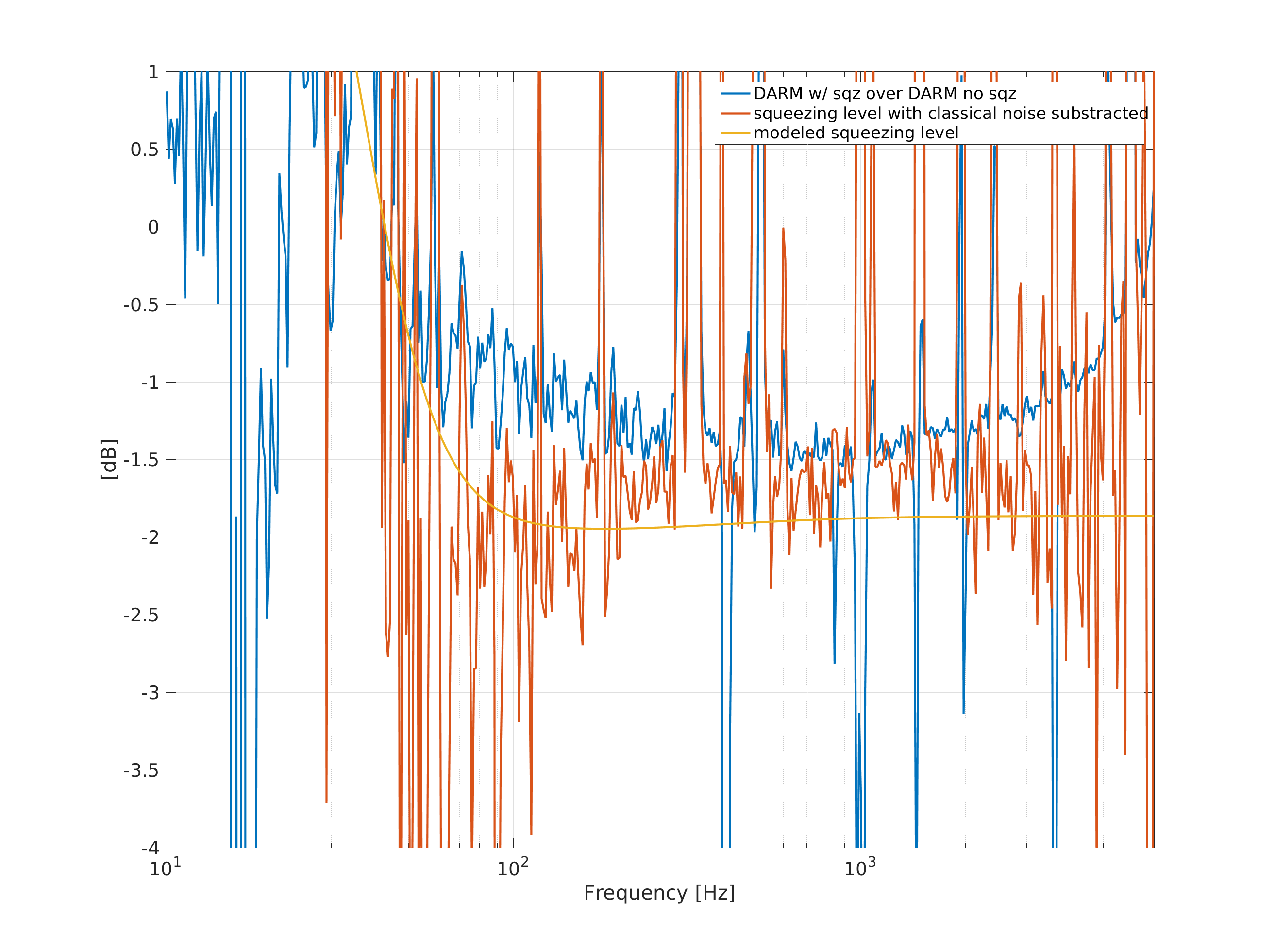
The fourth attachment shows a comparison of the DARM sensitivity with and without squeezing, and the modeled quantum noise in each case.
The 5th attachment shows the squeezing level based on the estimates used to make the 4th attachment.
The first two plots in the comment above were mixed up, the correct plots are attached here.
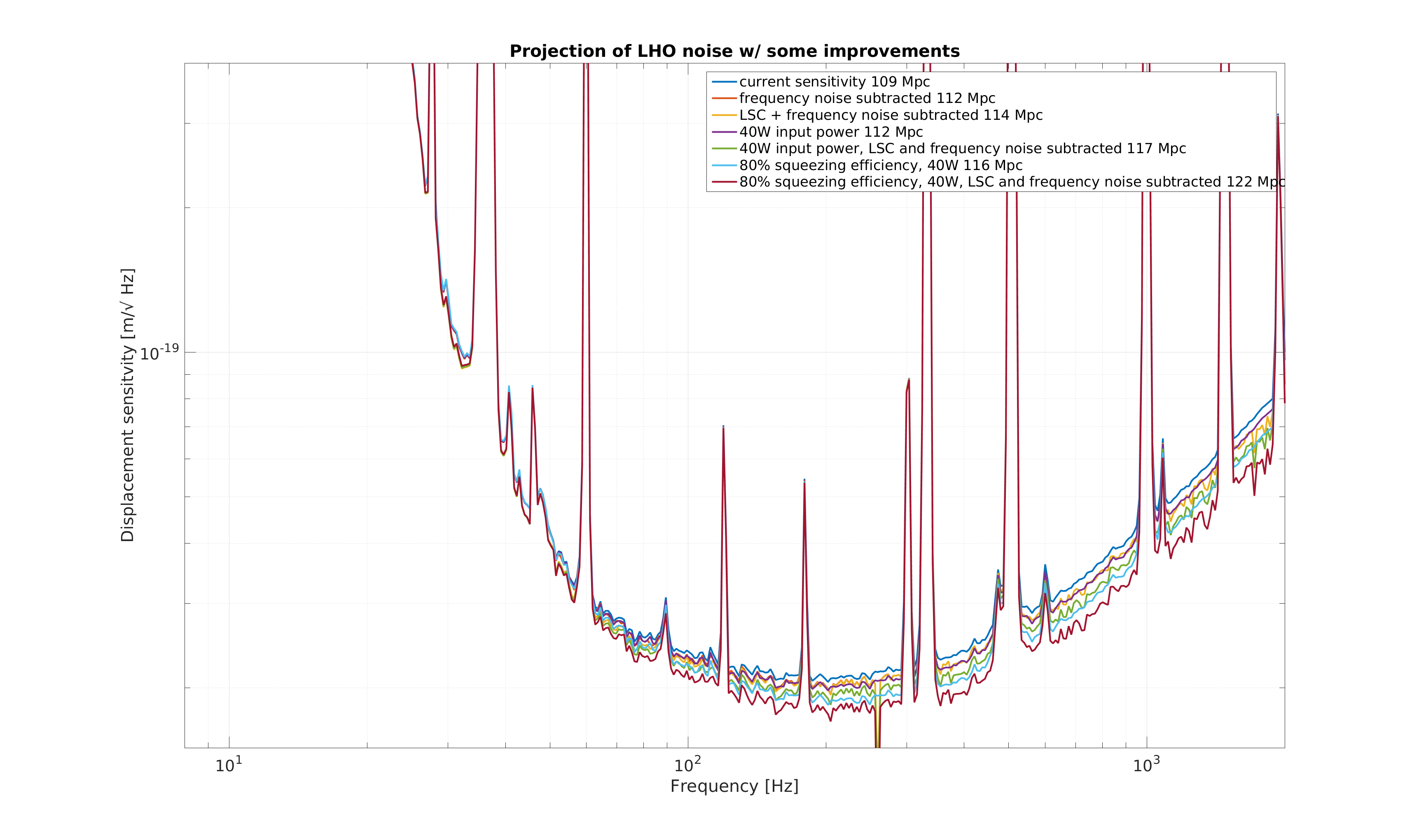
I estimated some of the improvements that we might be able to make to DARM in the third attachment, estimated ranges are in the legend.
We would gain a couple of Mpc each from improving our LSC feedforward (including PRCL which we aren't doing right now), and from reducing the frequency noise. The projection of 5MPc total for both of these is assuming that we can get rid of them totally, which is optimistic. We can get a similar improvement by increasing the power into the IMC to 40W, assuming that the circulating power continues to scale with the input power. Combining an increase in the input power and improvements in LSC and frequency noise, we can start to approach 120 Mpc.
I also estimated what we would get if we had 3dB of squeezing. I estimated this as an improvement in the losses, with our current nonlinear gain and phase noise of 150 mrad, we would need about 78% efficiency to reach 3dB of squeezing. This could also be achieved by a different route, which would result in slightly different anti squeezing levels. This would indicate that with 3dB of squeezing, 40W power into the IMC, improved LSC feedforward, and reduced frequency noise, we could reach just above 120 Mpc.
https://ldas-jobs.ligo-wa.caltech.edu/~lockloss/index.cgi?event=1240143964