craig.cahillane@LIGO.ORG - posted 20:52, Saturday 02 November 2019 - last comment - 01:53, Tuesday 05 November 2019(52923)
FSS Common Gain increased further, from +23 dB to +25 dB
We were seeing "frequency noise" become very apparent in DARM again.
("frequency noise" is in quotes because it is the underlying cause, but probably not the direct agent actually putting noise into DARM.  That honor belongs to intensity noise.)

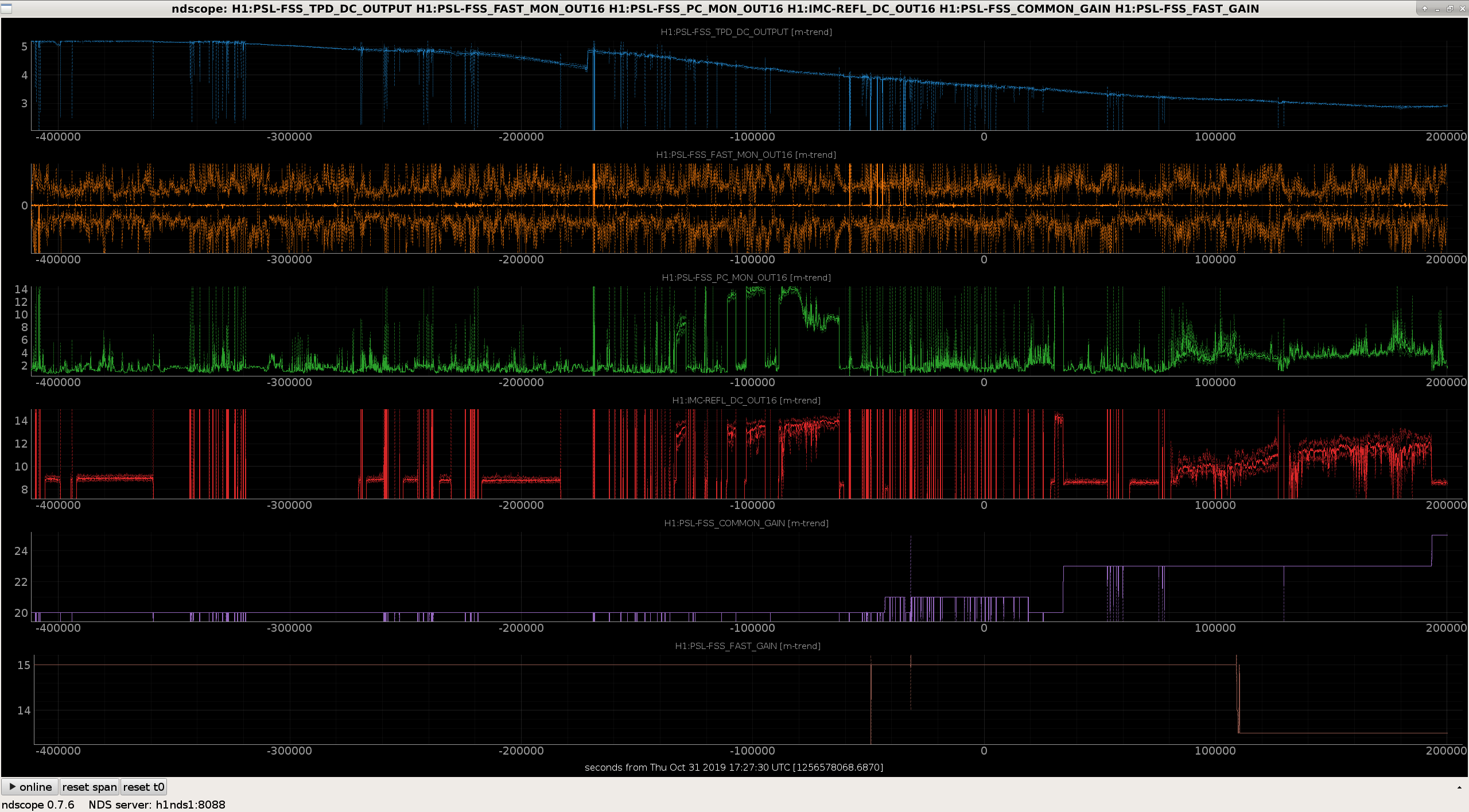
We've seen a continued plummet in the reference cavity transmission over the last week.  We are now at the point where the ref cav transmission has dropped 47%.  (Attachment 1)
Jason posted in alog 52882 about trying to fix up the alignment, with some success in recovering some transmitted power (seen in attachment 1 between -200000 and -100000 seconds ago), but not resolving the underlying issue.
Probably the best witness of FSS health is the IMC_REFL_DC signal (red trace, first and second attachment).  When signal goes above ~10 mW, we are likely to be having frequency stabilization problems originating in the FSS, high high-frequency noise in DARM, and worse range.

I increased the FSS common gain from 23 to 25 dB
In the first PDF attachment, we see DARM and laser noise coherence at FSS gains of 23, 24, and 25.
After increasing from 23 to 24 dB, pretty much all the "frequency noise" we were seeing in DARM went away.  There is no apparent change in laser noise coupling when increasing from 24 to 25 dB.

ASDs:
In the second PDF attachment, I plot DARM, CARM, and ISS secondloop ASDs before and after the FSS gain increase.
It's clear that the noise levels of all go down significantly.

I expected there to be significant coherence between the ISS and CARM, but this is not the case.

Coupling:
In the third PDF attachment, we see there is high coherence between the ISS secondloop and DARM with lower FSS gain, and much smaller coherence after the gain is increased by one dB.
In the fourth PDF attachment we see low coherence between DARM and CARM at all times, likely because the true frequency noise is drowned out by the high intensity noise apparent in DARM.
However, at no time is there coherence between CARM, IMC, or FSS error signals and the ISS loop. (fifth, sixth, seventh PDF attachments)

Jury is still out on why falling FSS gain causes high intensity noise.  I would have thought this sort of intensity noise would be generated by the frequency noise incident on the IMC.
It is possible that this noise coupling is nonlinear, or I have looked at the incorrect witnesses.
Images attached to this report

Non-image files attached to this report

Comments related to this report
With the FSS gain low, the ISS first loop is not performing well at all.
The ISS second loop is able to compensate for the first loop's failure until about 700 Hz, where the true intensity noise begins to dominate over the second loop sensing noise.
The second loop is doing the best it can under the circumstances, but cannot do the job of both loops.

The below plots shows the ISS first loop sensors (out of loop = PDA, in-loop = PDB), and the ISS second loop sensors (out-of-loop = OUTER, in-loop = INNER) with the FSS gain at 23 dB and 24 dB.
Non-image files attached to this comment
Posting the ASDs I made trying to look into this problem.
Probably the most interesting plot is PDF 1, which suggests ISS SECONDLOOP ERR1 DC coupling changed somehow.

Overall, we see increased noise everywhere in the ISS and IMC and CARM error signals, and not much in the control signals as the high loop gains impress the high noise on the loop.
Still not clear where the source of the noise is.
Non-image files attached to this comment