Displaying reports 37661-37680 of 89097.Go to page Start 1880 1881 1882 1883 1884 1885 1886 1887 1888 End
Reports until 11:55, Tuesday 05 November 2019
LHO VE
chandra.romel@LIGO.ORG - posted 11:55, Tuesday 05 November 2019 - last comment - 07:51, Wednesday 06 November 2019(53015)
PT-110 pressure gauge swap on HAM6

{Gerardo, Chandra}

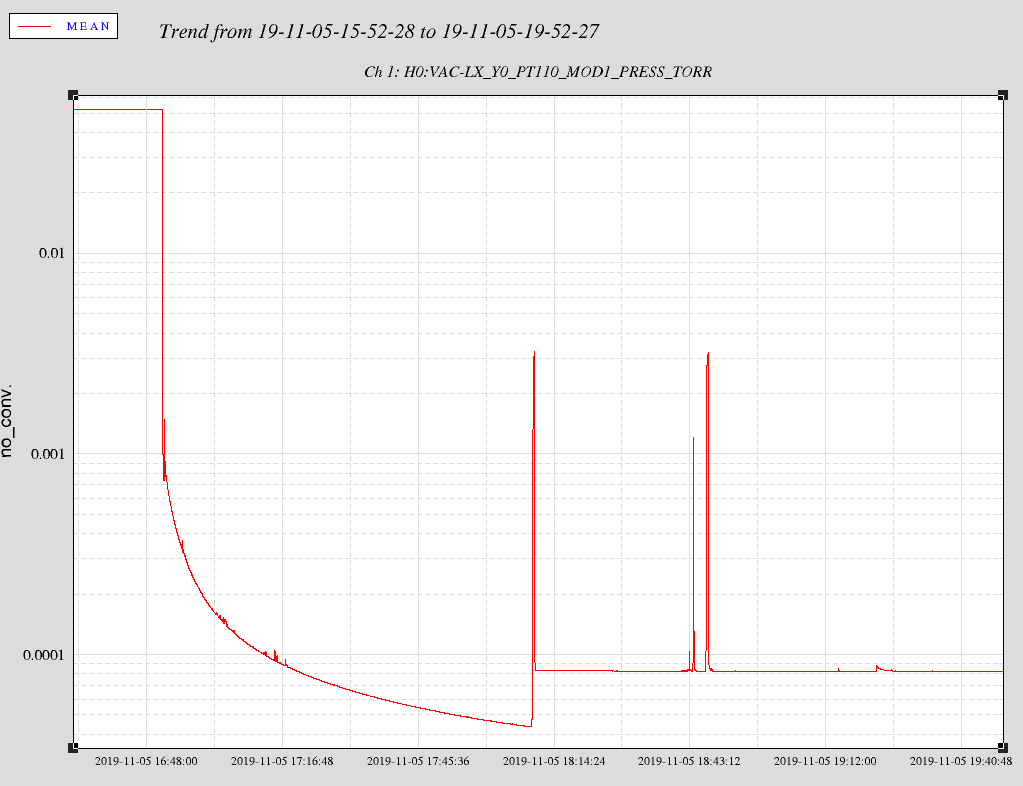
Replaced faulty PT-110 pressure gauge (SN 217) on HAM6 today with SN 214; however, the hot filament will not come on after some pressure transitions. I've asked Patrick to try to force it on through software when he is on shift tonight. Here is what we did:

  1. isolated gauge from HAM6
  2. connected aux cart and hung turbo
  3. vented gauge tee with room air
  4. replaced gauge
  5. pumped back down
  6. pressure fell as expected into low e-5 Torr range
  7. helium leak checked 2-3/4" CF (no leaks beyond 6e-10 Torr-L/s background)
  8. valved out turbo and then valved in gauge to main volume
  9. pressure is flat lined at 8e-5 Torr, suggesting the filament is not turning on after a pressure spike from isolating "wet" gauge/tee
  10. reset gauge, rebooted power, increased gauge pressure --> none triggered the filament
  11. next Patrick will run emissions command in software
  12. if that doesn't work we will replace with a different model gauge

Gauge is Inficon BCG450-SE and was tested on pump cart prior to installation. IP14 and small 10 l/s IP on RGA both remain stable.

Images attached to this report
Comments related to this report
chandra.romel@LIGO.ORG - 14:00, Tuesday 05 November 2019 (53021)PEM

In order to connect the pump cart, I had to temporarily move the PEM Vibration Table sitting on 16.5" flange set on top of HAM6.

patrick.thomas@LIGO.ORG - 07:22, Wednesday 06 November 2019 (53041)
I set the units for the gauge to Torr. It is now reading around 6E-7.
chandra.romel@LIGO.ORG - 07:51, Wednesday 06 November 2019 (53042)

Thank you, Patrick!!
H1 TCS
thomas.shaffer@LIGO.ORG - posted 11:38, Tuesday 05 November 2019 (53014)
Disbled HWS EY 520nm Laser and Stopped Code

The TSOP for the 520nm laser that was installed a few weeks ago is up. I went down to the end station and removed the power cable, as well as the key. I will remove the entire laser at a later time.

I stopped the HWS code to save a bit of disk space as well.

H1 ISC (GRD)
thomas.shaffer@LIGO.ORG - posted 11:31, Tuesday 05 November 2019 (53010)
Added Bootstrapping to LASER_PWR Guardian

I added bootstrapping to LASER_PWR node to help us keep our power a bit better. My quick tests to 10W and 25W both worked well, getting under 0.1W  of the target each time.

H1 SQZ (SQZ)
nutsinee.kijbunchoo@LIGO.ORG - posted 11:07, Tuesday 05 November 2019 (53009)
All SQZ transfer functions

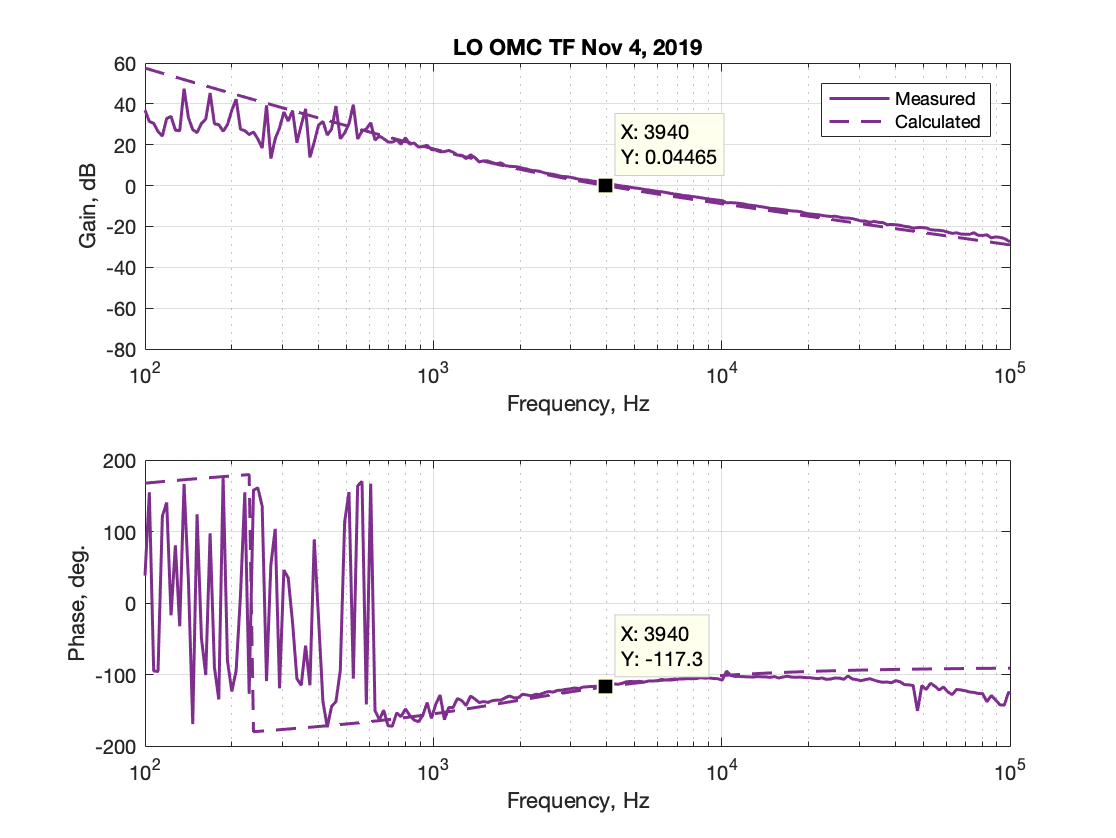
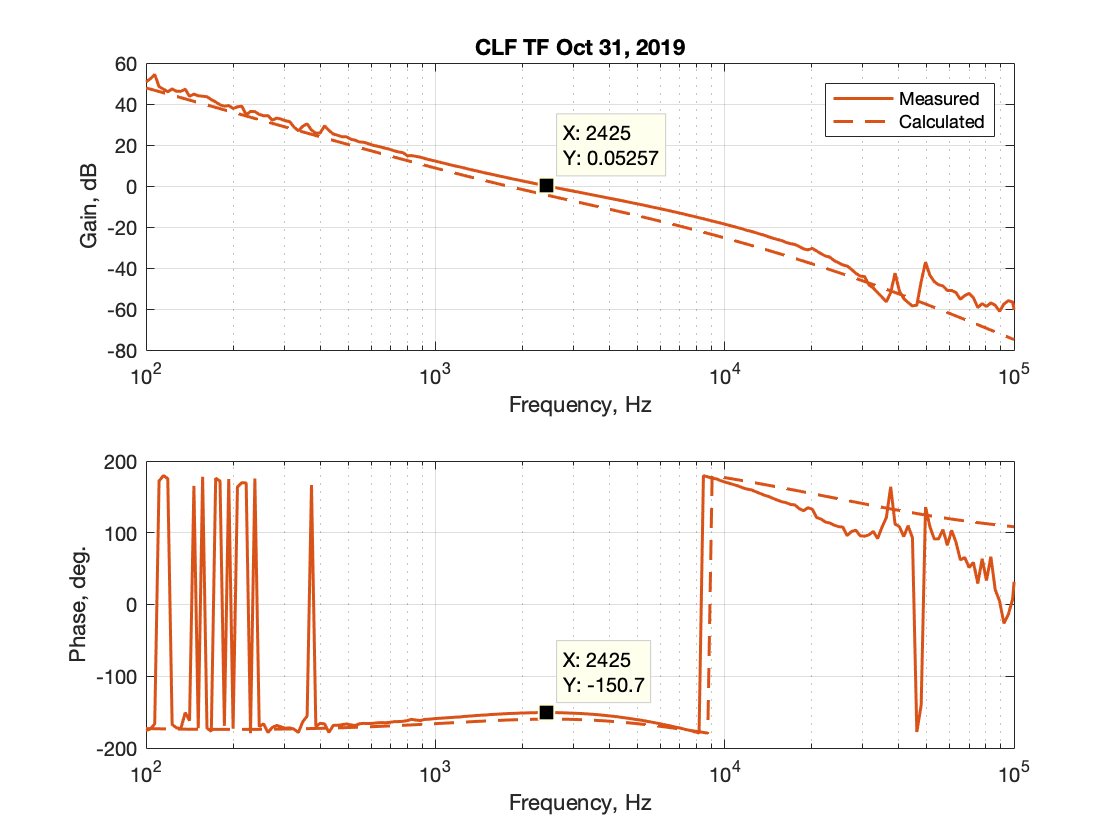
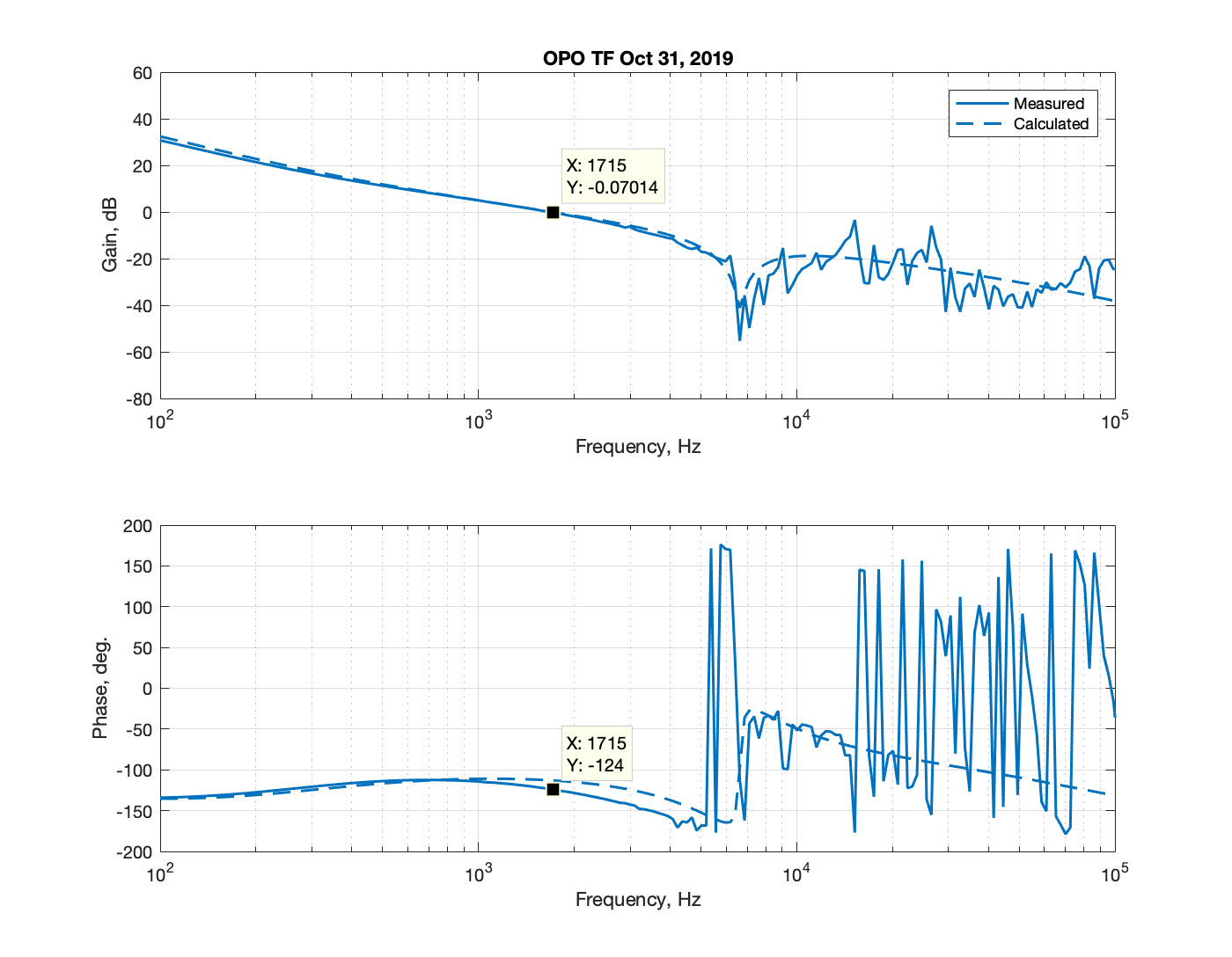
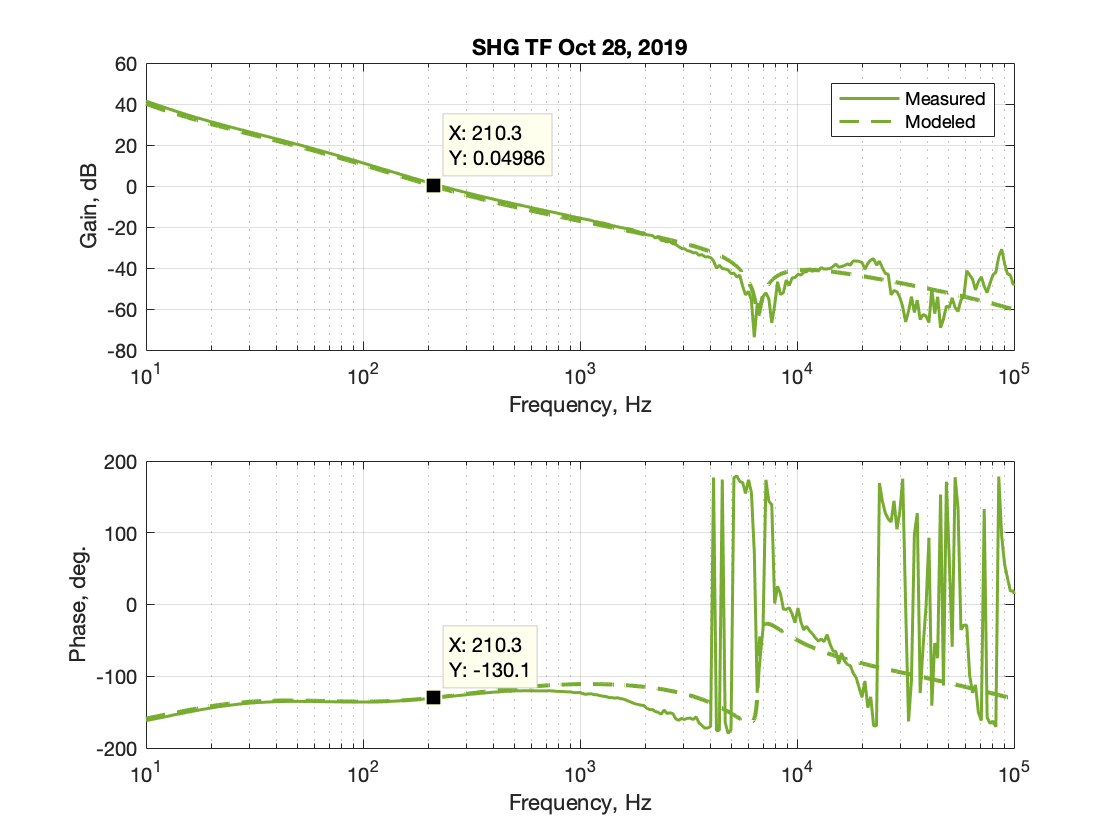
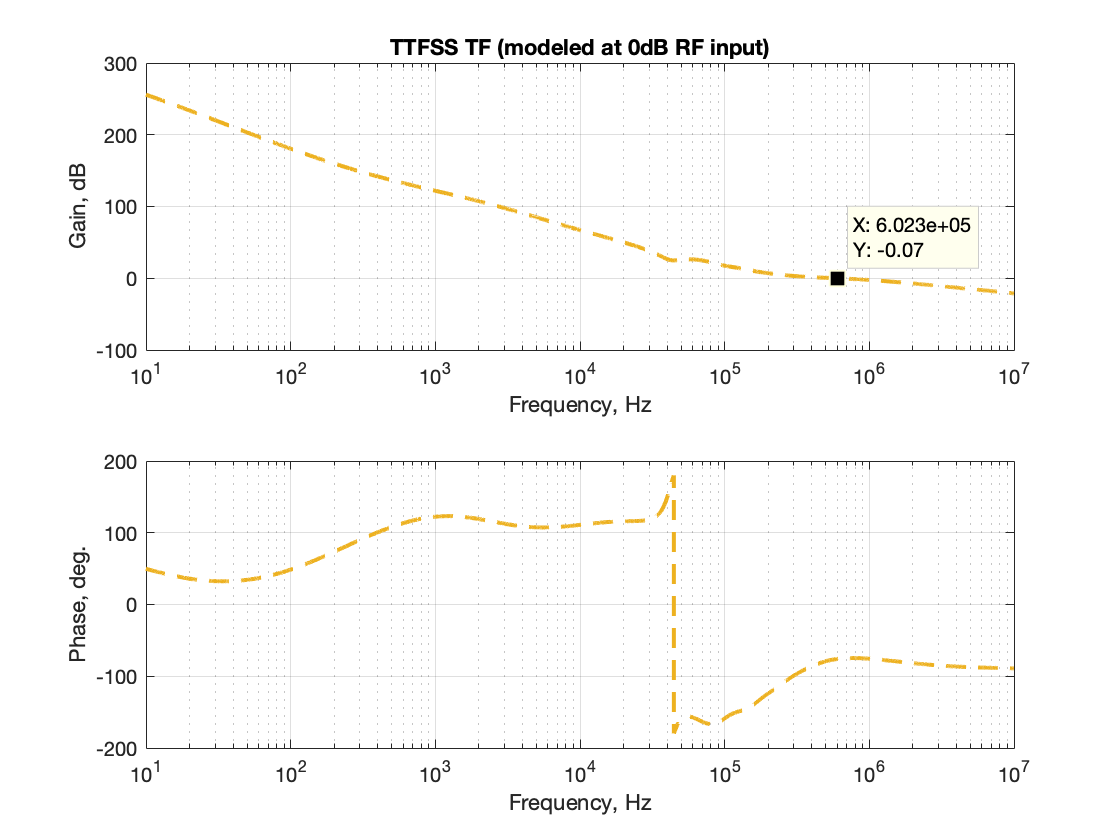
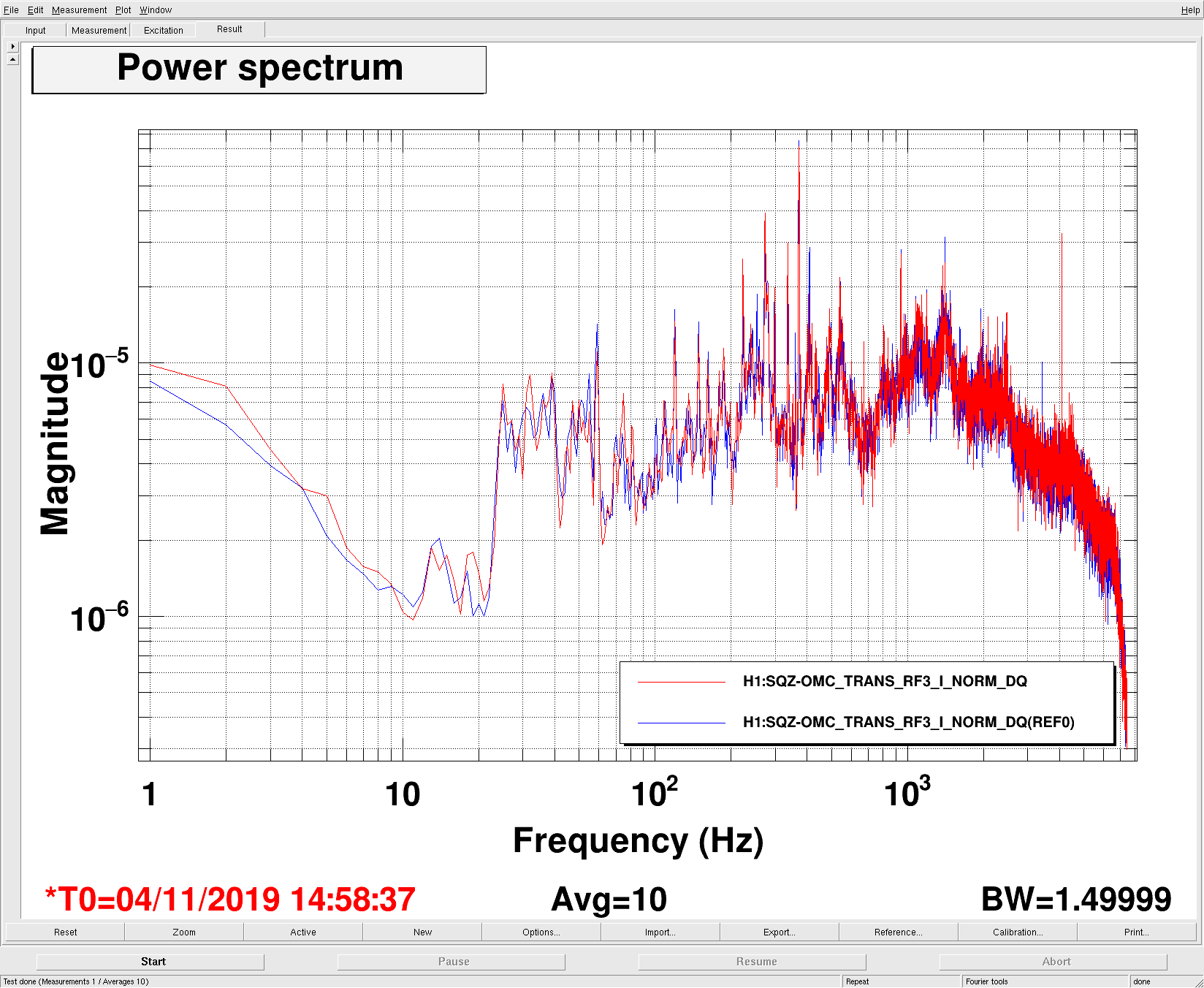
Include all the measured and modeled transfer functions (with calibrations) taken between this week and last week. This should be pretty much where we operate for the rest of O3. Didn't retake TTFSS transfer function recently but the loop was already well modeled (and had compared it with the real data at one point). The modeled pretty much all checked about except the CLF loop that's missing a factor of ~1.5. 


Fast gain is 0dB unless noted otherwise. Guardian should have all the correct filter settings.


---------------------------------------------------------------------------------------------

LO loop (taken with IFO locked)

Calibration: 1.12Vpp at RF3 -14.66dBm.

Common mode board gain (common path): -5dB

Boosts: 0Hz/10Hz, 20Hz/2kHz

Input: In1 for OMC, In2 for HD

CLF loop

Calibration: 2.9Vpp measured at RF6 -2dBm. RF6 was -3dBm during the measurement. Probably close enough.

Common mode board gain common path -9dB, fast path 6dB

Boosts: 0Hz/10Hz, 20Hz/2kHz

Input: Use In2 (Q)

OPO loop

Calibration: 164mVpp measured at 0.4mW input power to the OPO. 3.57mW input power to OPO during the measurement

Common mode board gain (common path): -13dB

Boosts: 0Hz/10Hz, slow path 4Hz/400Hz

SHG loop

Calibration: 79mVpp measured at 1.8mW transmitted power

Comments: Low UGF because the loop inject (possibly) mechanical noise that shows up in CLF spectrum (alog52755). So far this hasn't been a problem.

Common mode board gain (common path): 7dB

Boosts: 0Hz/10Hz, slow path 4Hz/400Hz


TTFSS (Beckhoff control)


Images attached to this report
Non-image files attached to this report
H1 SUS
rahul.kumar@LIGO.ORG - posted 10:58, Tuesday 05 November 2019 - last comment - 11:37, Tuesday 05 November 2019(53007)
OPLEV charge measurements on ETMX and ETMY

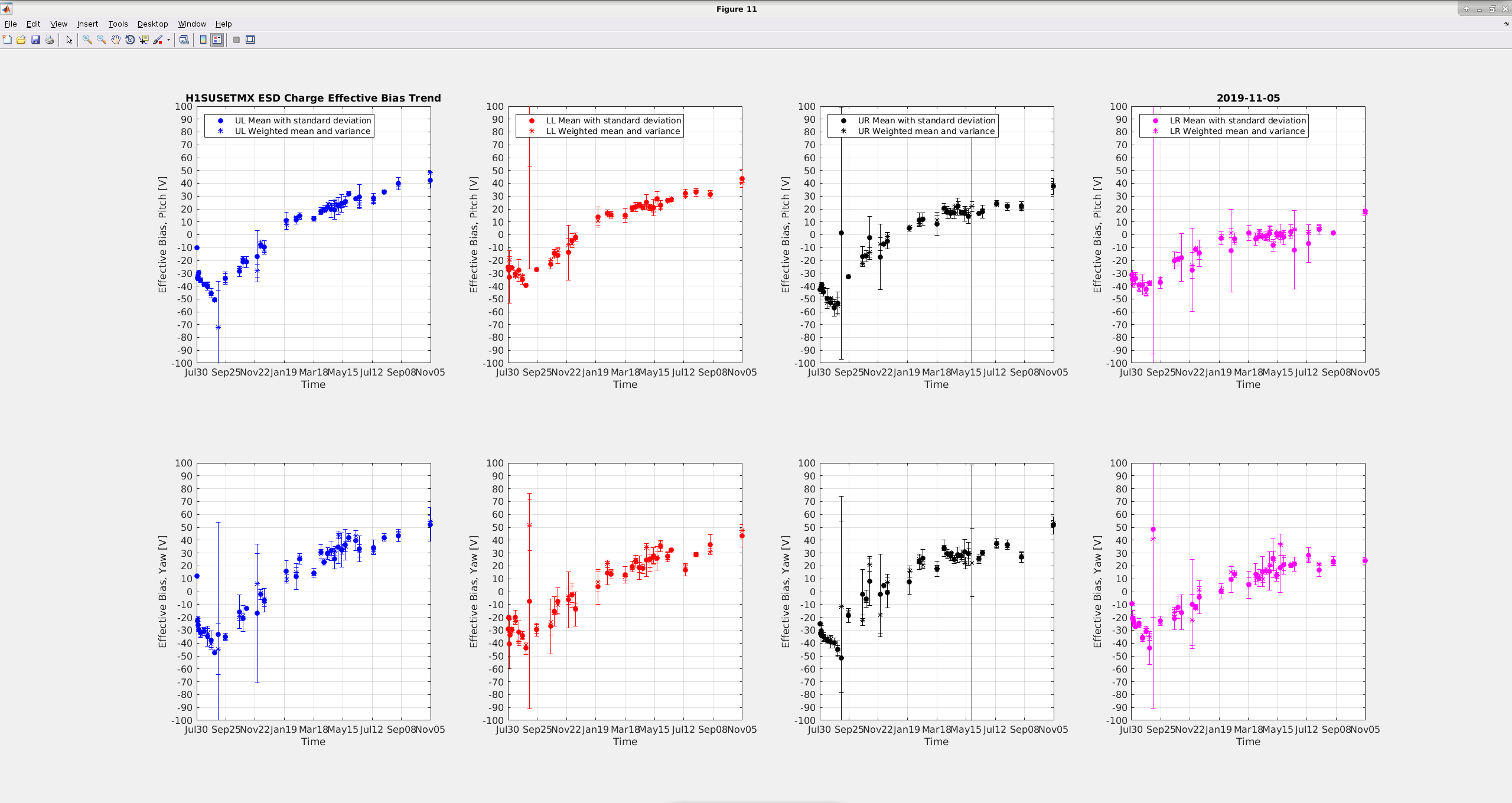
Attached below are the results for the charge measurements performed on the ETMX and ETMY (post Oct 2019 vent break).

ETMX: There has been a definite rise in the charge accumulations on all 4 quadrant for the pitch and yaw mode. The first and the 4th quadrant for the pitch mode shows an average bias voltage of +40V and +20V respectively. The  bias voltage on the 2nd, 3rd and 4th quadrant for the pitch mode has jumped by 10-20V.  For the Yaw mode, the 1st and the 3rd quadrant are at 50V, which is quite high. The 3rd quadrant is just above 40V.

I will discuss these results with J. Kissel to see if we need to flip the sign yet.


ETMY: There hasn't been a huge change and the effective bias voltage on most of the quadrant has remained the same or declined. The biggest fall has been seen on the 2nd quadrant (Yaw). The rest of them are between 0-20V.

The slider values were restored after the measurement was complete, and any SDF difference was removed.


Images attached to this report
Comments related to this report
rahul.kumar@LIGO.ORG - 11:37, Tuesday 05 November 2019 (53011)

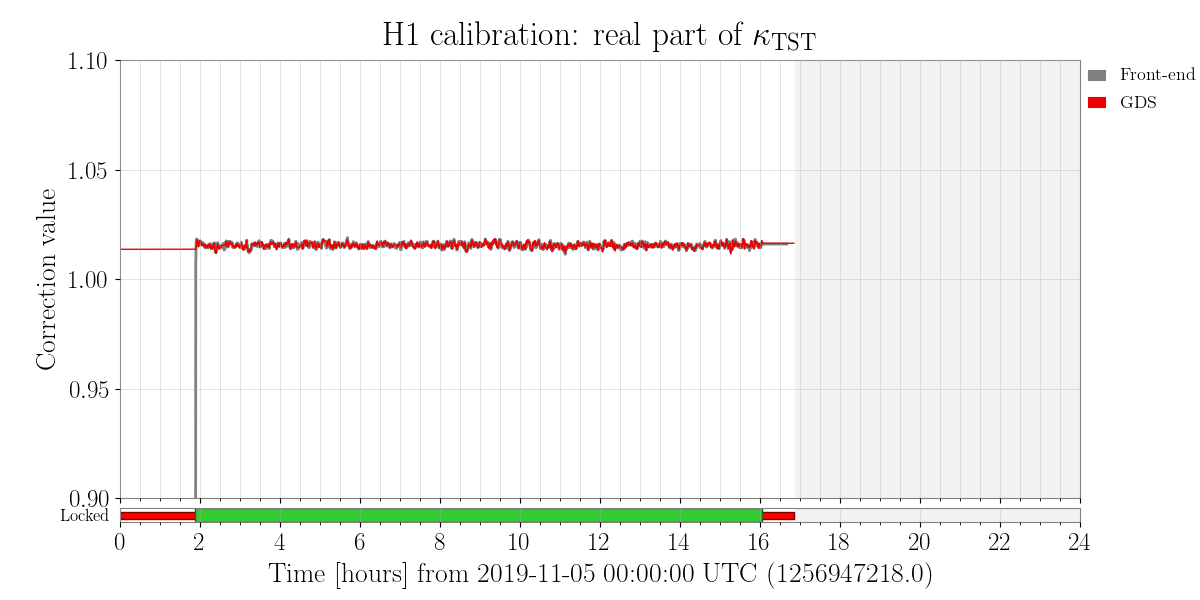
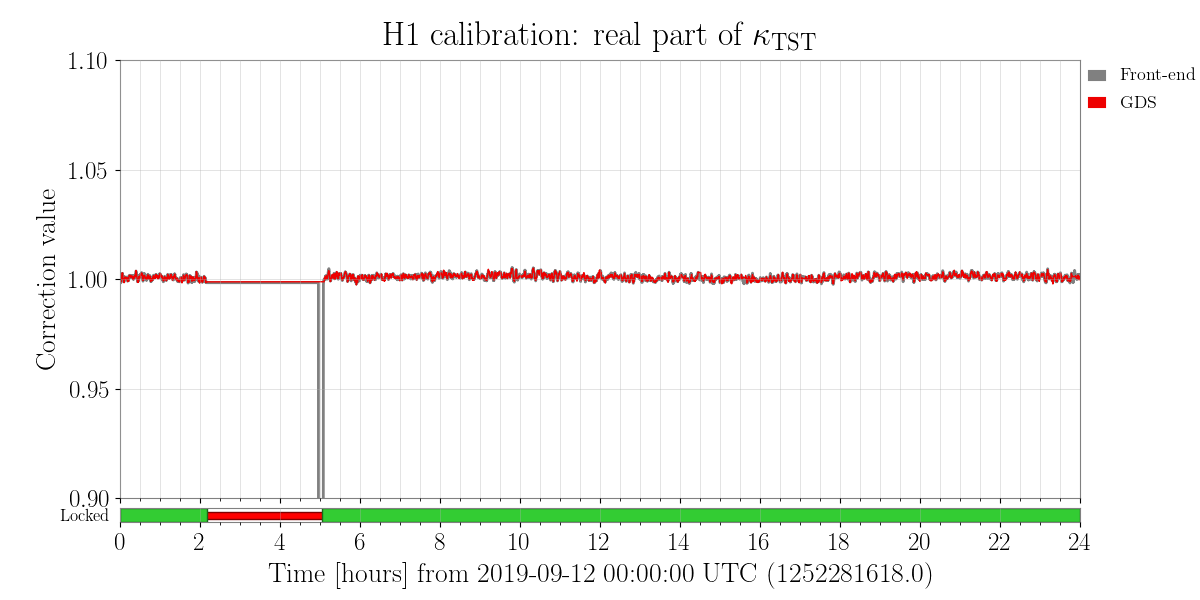
adding a plot of time varying calibrations lines and the Kappa values are off by say 2%. Just for comparison from Sept, the then Kappa values were at 1.0

Images attached to this comment
H1 AOS (CAL, CDS, SUS)
vladimir.bossilkov@LIGO.ORG - posted 10:37, Tuesday 05 November 2019 - last comment - 11:38, Friday 08 November 2019(53008)
Importing SUS model to foton filterbank using foton.py

Continuing from conclusion of aLOG.

I have sought to import SUS models into foton using the foton.py library linked in the last alog, which was written by Lee McCuller.

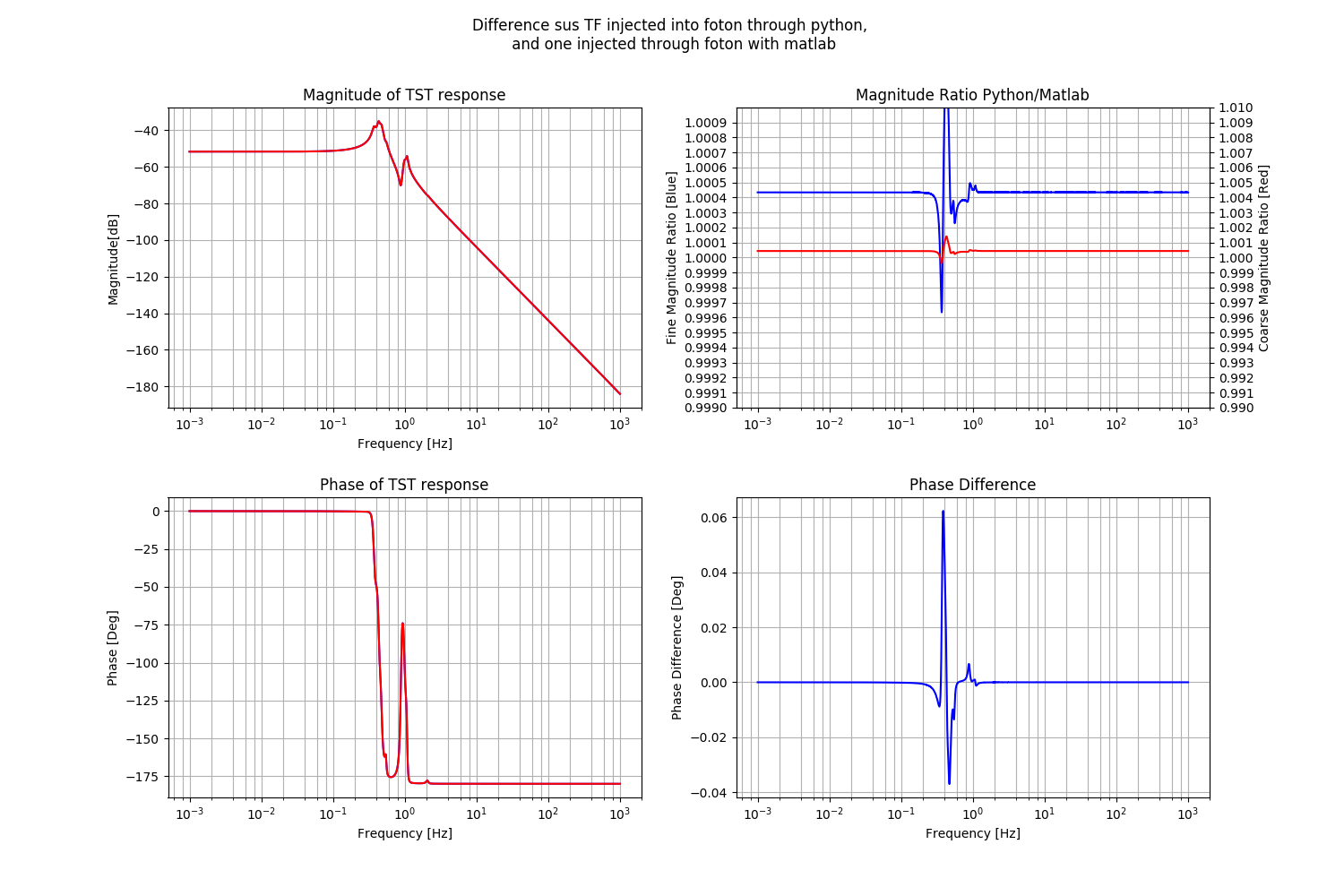
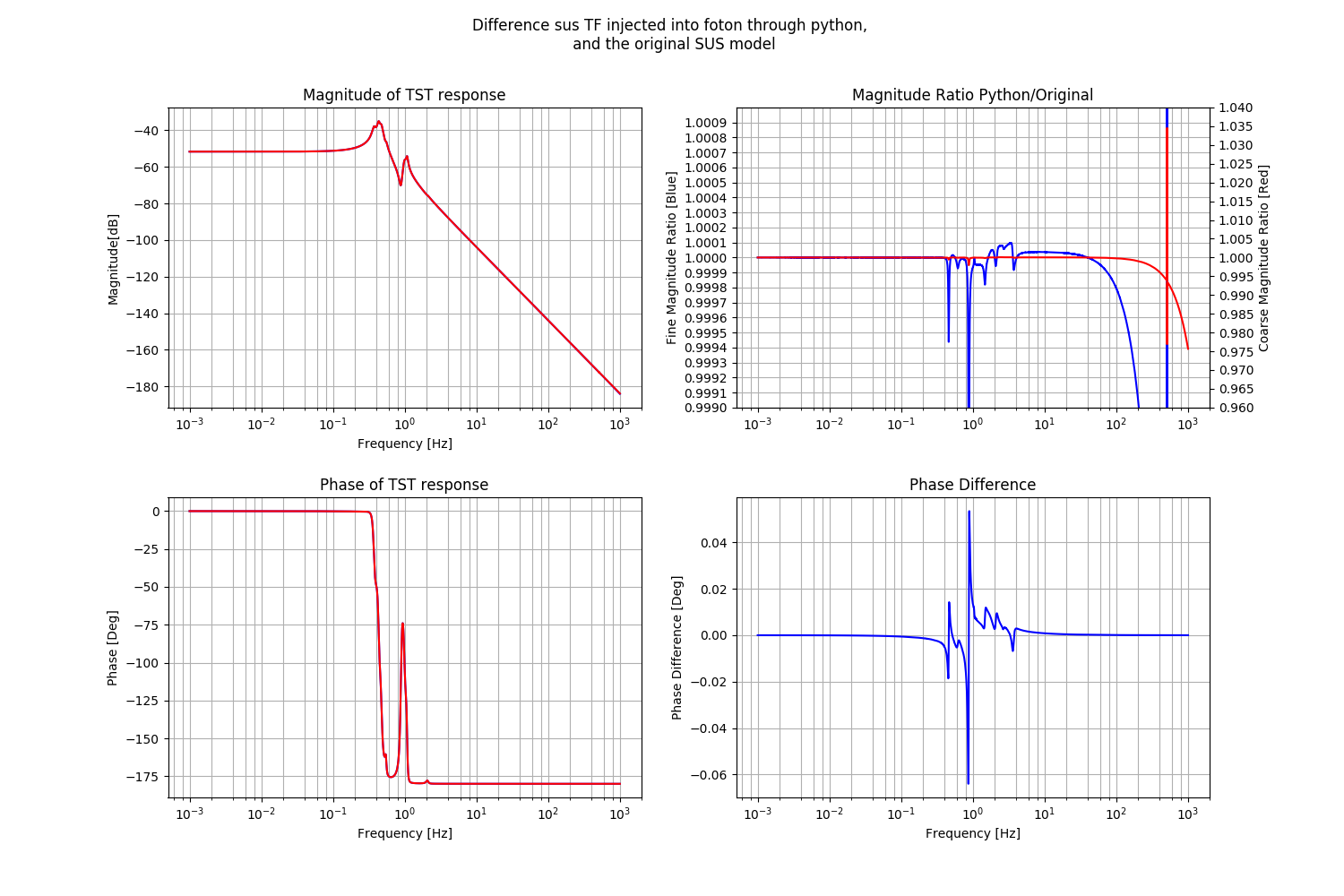
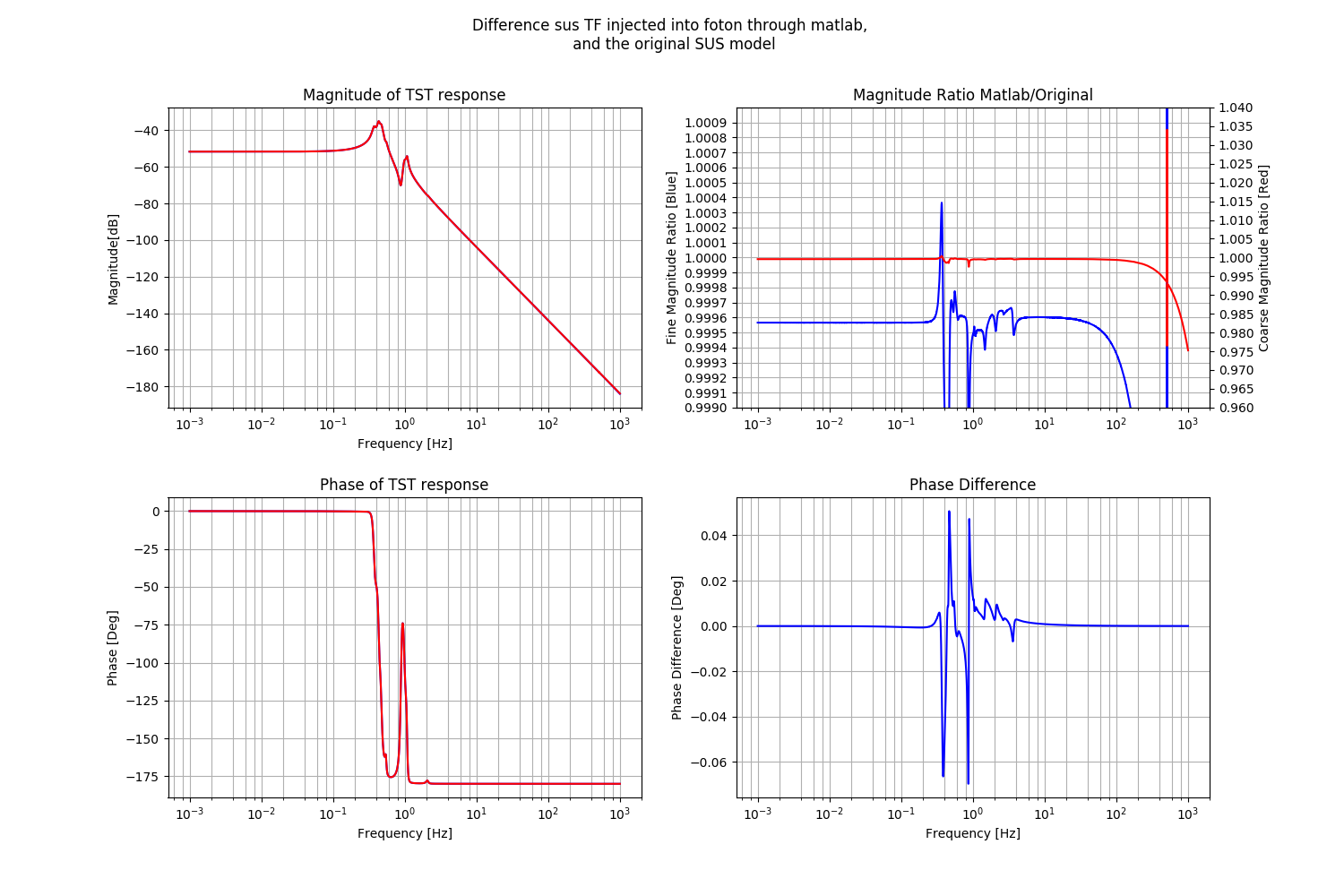
I have produced a script which takes the TST transfer function to update the foton filters for Pcal via a python script, avoiding the need to 'quack' the filter with matlab scripts.

The quack scripts have a lot of error handling so that filters are compatible with foton. Here I directly input the filters with foton, with all its built in error handling.

I produce a filter that is arguably more accurate than what matlab is putting into foton... since I handle the DC gain with more precision.

I compare how matlab and my script fare against the original intended TF, by comparing the TFs that foton sees the inputs to be. You will note that the TF's have a bit of an error in magnitude at high frequency, I suspect that is due to the fact that the 1/f^2 filter (titled '1:1') is built within foton, and there is some difference from the system modelled in matlab.

Caveats of this process:
Until there is an update to the python control library, there is no clean way of recovering to true DC gain of a ZPK TF, without importing the SS model generated by matlab. One also needs to import the ZPK model generated by matlab, because the python control library doesn't make the same changes to the SS to produce the ZPK, and I get a bit of a magnitude error at around 2 Hz.
Hence, I end up importing both the SS and ZPK models that matlab spits out, which is not great.


If you want to play with this, be concious that you must change paths to things.

I will be putting this in the relevant places in the CalSVN, and writing up some more robust documentation going forward.

Images attached to this report
Non-image files attached to this report
Comments related to this report
vladimir.bossilkov@LIGO.ORG - 11:38, Friday 08 November 2019 (53098)

Improved the main filter updating script - removed need for loading the SS TF using a bit of code from pyDARM, for which I fixed some python3 related bug. Added some more comments and removed unneeded comments.

Non-image files attached to this comment
H1 ISC
stefan.ballmer@LIGO.ORG - posted 09:57, Tuesday 05 November 2019 - last comment - 09:57, Tuesday 05 November 2019(52979)
Spectrogram before and after range drop

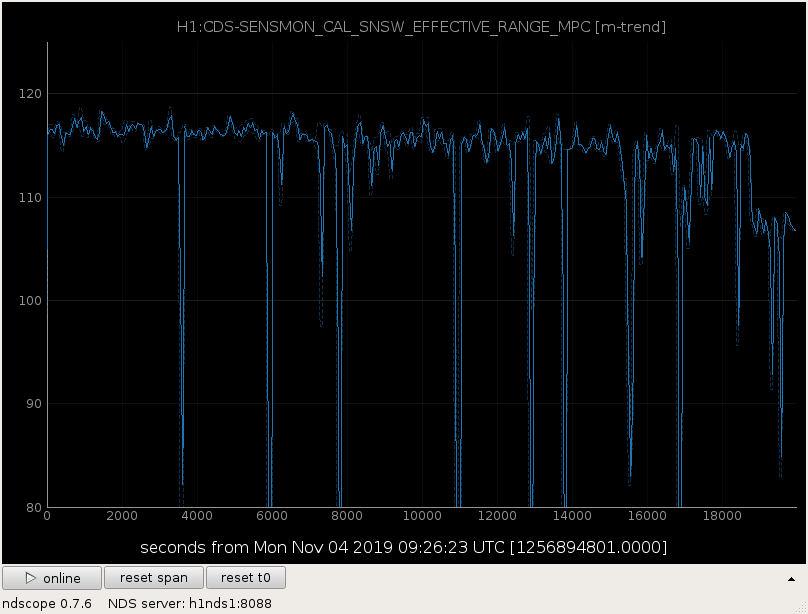
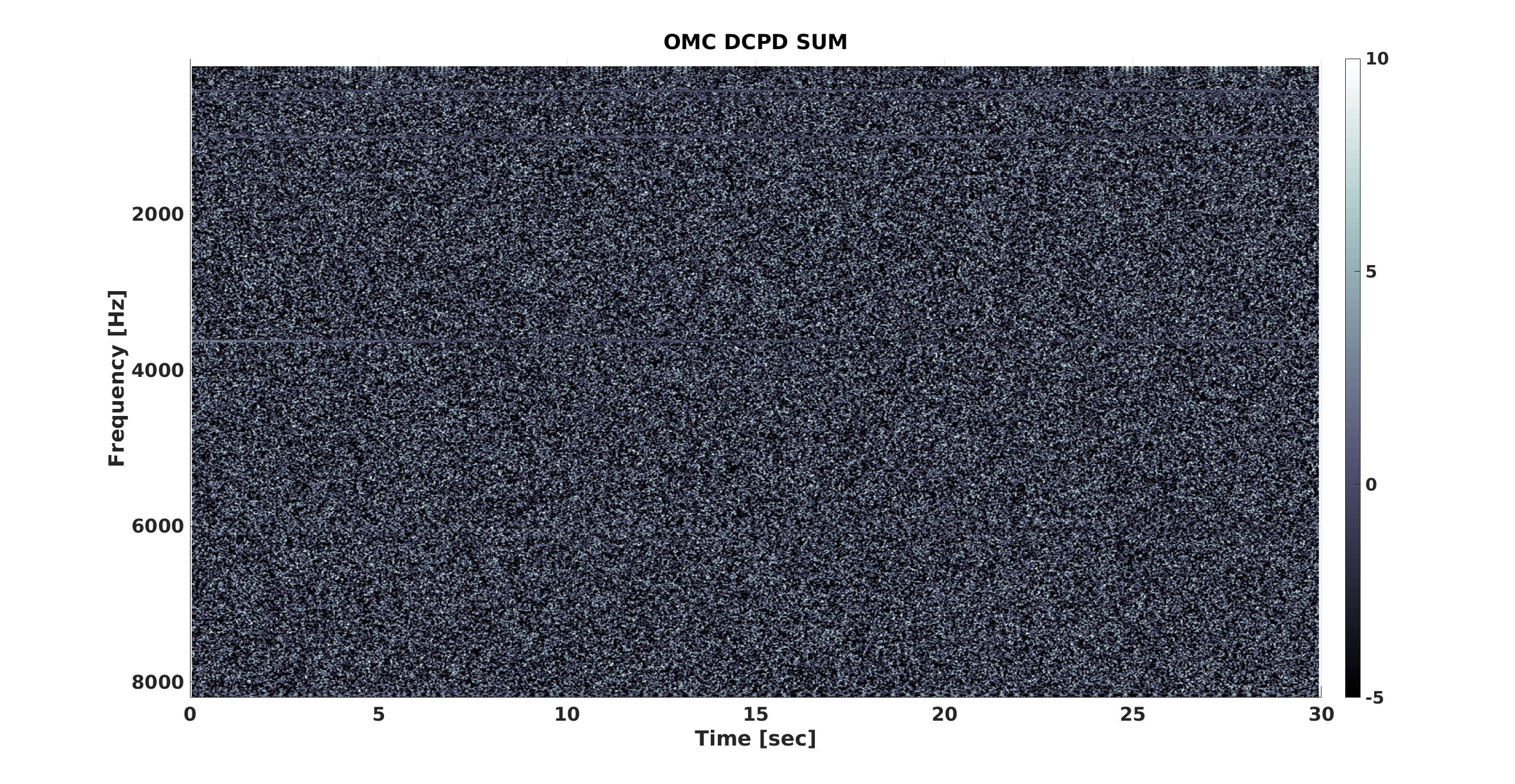
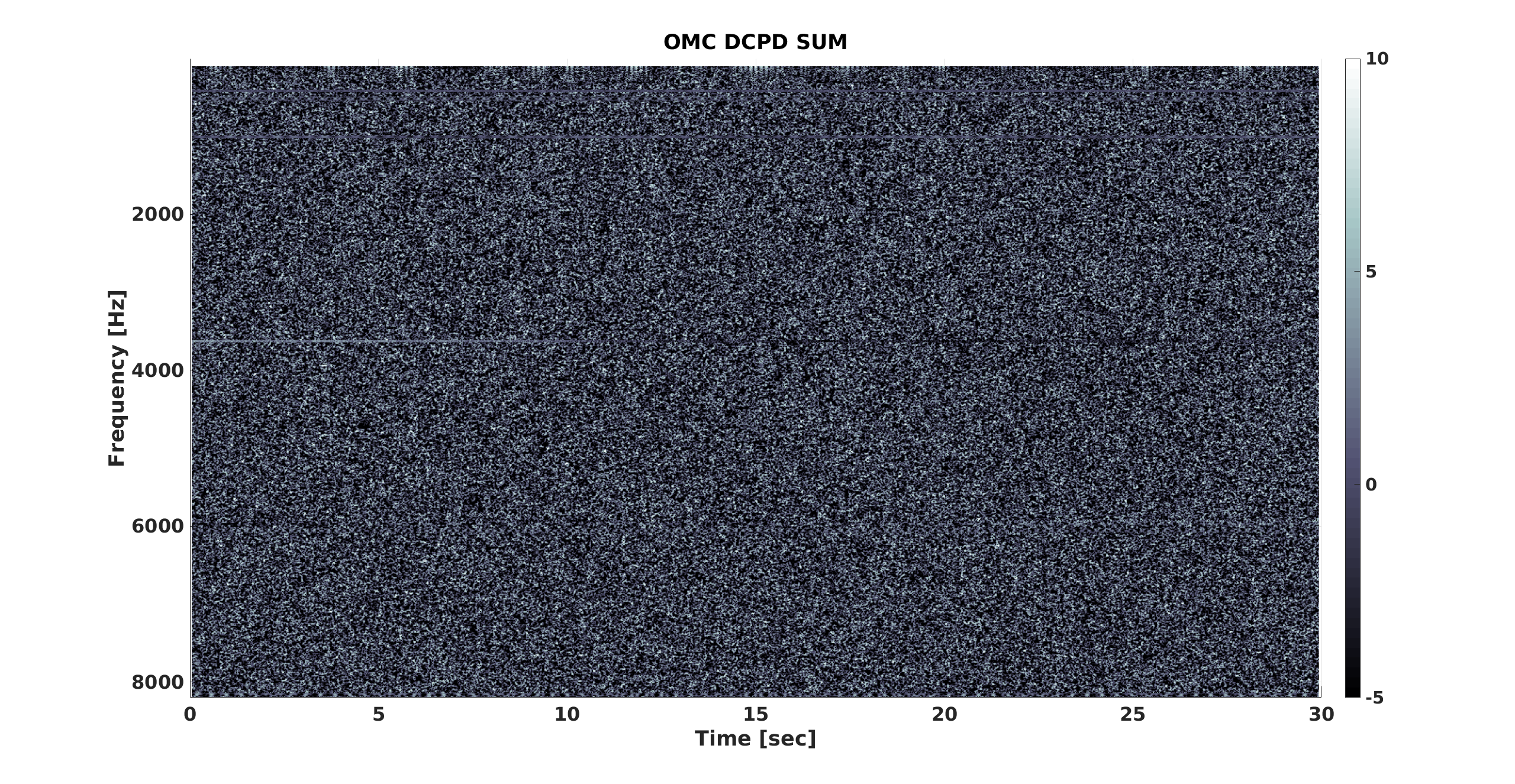
We have been chasing the reason for th3e range drops all day today. Here is another negative:

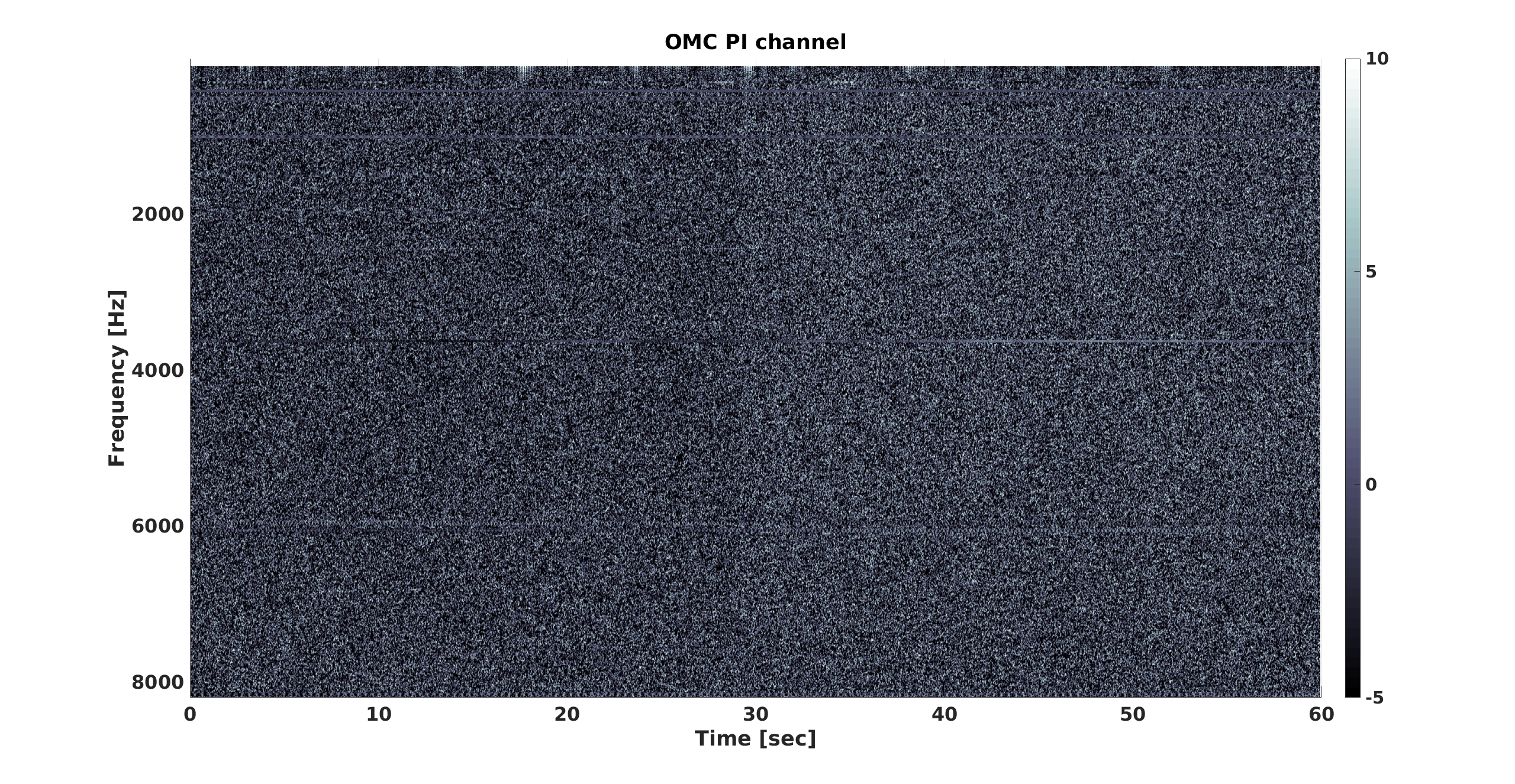
Suspecting something like "microwhistles" I made a 30sec spectrogram before and after the range drop. I don't see any difference in the statistics.

Good: GPS 1256894801
Bad:   GPS 1256914735

Plot 1: Range, the date in the spectrogram corresponds to the first 30seconds (good) and the last 30 seconds (bad).
Plot 2: Spectrogram of the good time.
Plot 3: Spectrogram of the bad time.


==============

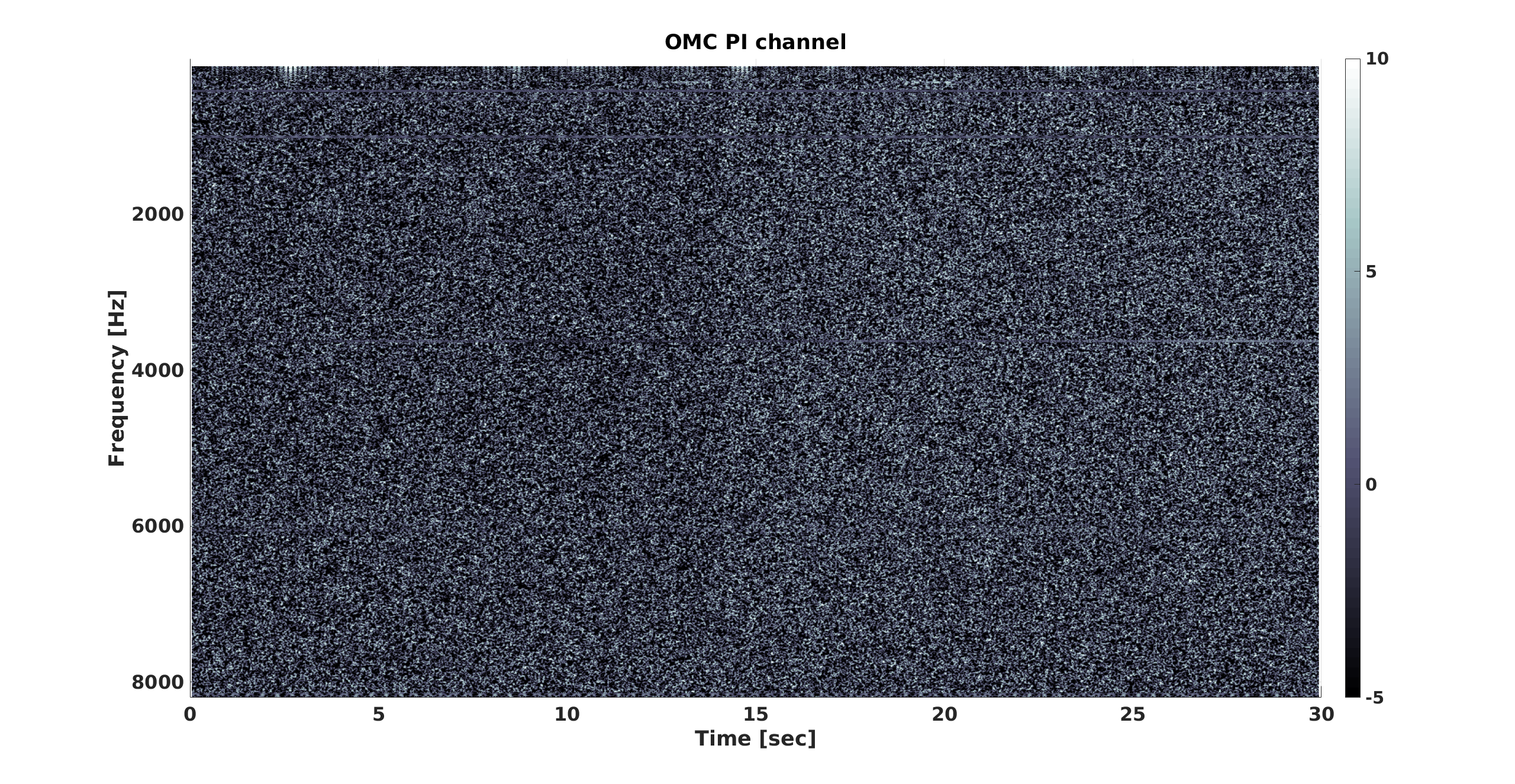
Plot 4 and plot 5 show spectrogram centered around the range drop at GPS 1256913467. (plot 4 GPS start 1256913437, plot 5 GPS start 1256913452,)
Note the slight increase in the noise level, but no associated pattern whatsoever. The range indeed dropped within 1 second.
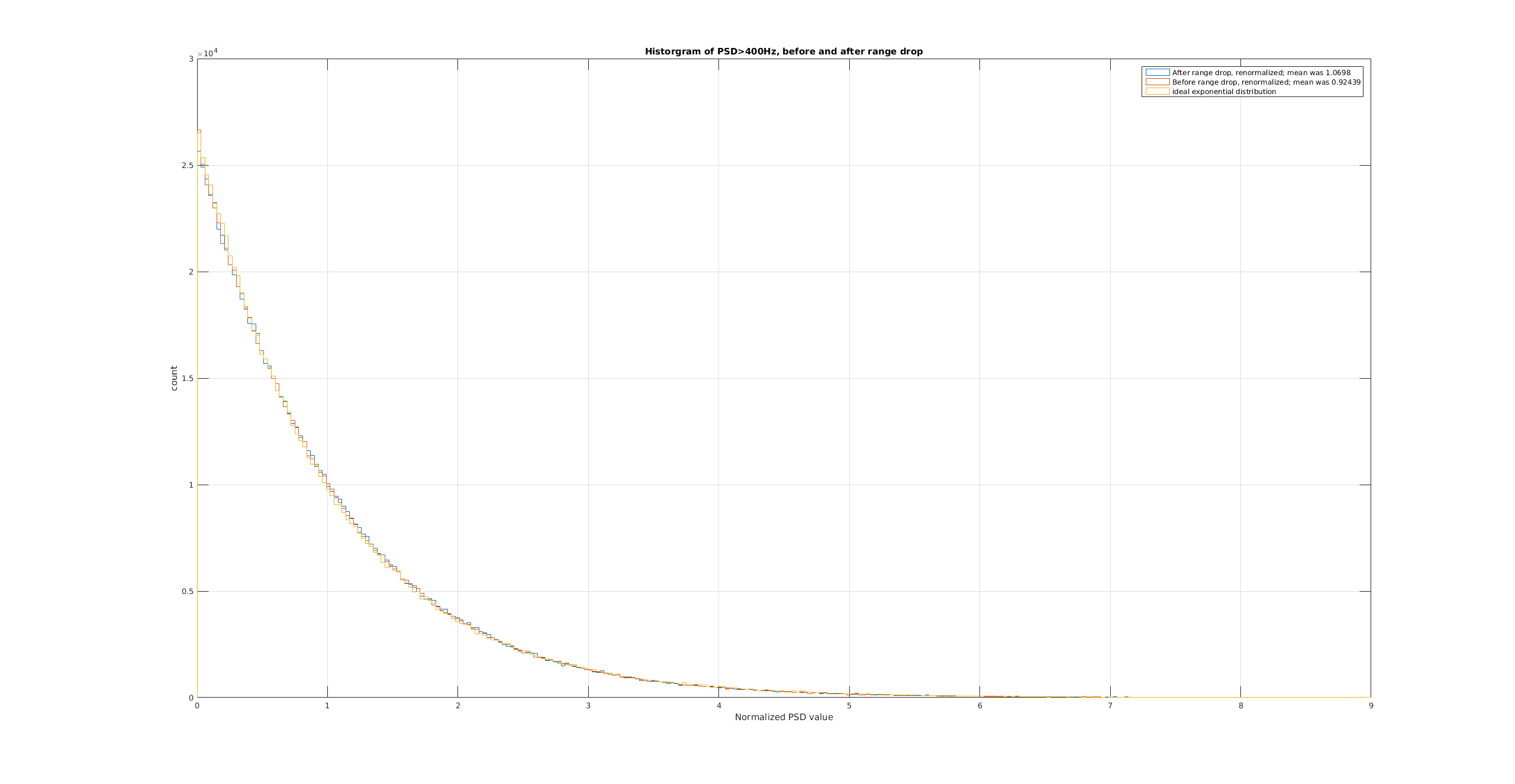
Finally, plot 6 shows histograms of the PSD values before and after the range drop, renormalizing with the mean. Both histograms are indistingushable from an exponmential distribution.

Images attached to this report
Comments related to this report
stefan.ballmer@LIGO.ORG - 16:33, Monday 04 November 2019 (52980)

Daniel, Stefan

Suspecting some excess phase noise in the squeezer phase locking loop, we bade spectra of the error point for the same good and bad times.

They look the same. Yet another null result...

(That technically does not rule out excess phased noise above the Nyquist frequency.)


Images attached to this comment
H1 DetChar
ethan.payne@LIGO.ORG - posted 08:32, Tuesday 05 November 2019 - last comment - 08:58, Tuesday 05 November 2019(53004)
BruCo analysis during range drop on 2019-11-04
Ethan, Sheila

We ran BruCo over 10 minutes worth of data during yesterday's unexplained range drop. No channels had significant unexpected coherence with DELTAL_EXTERNAL.
The summary of results is located here.

An analysis with LASSO is next on the agenda.
Comments related to this report
thomas.massinger@LIGO.ORG - 08:58, Tuesday 05 November 2019 (53005)DetChar

To avoid duplication of effort, I want to point out Beverly's note in alog 52998, the daily summary page version of LASSO did analyze this range drop: https://ldas-jobs.ligo-wa.caltech.edu/~detchar/summary/day/20191104/detchar/lasso/

H1 General
jeffrey.bartlett@LIGO.ORG - posted 08:08, Tuesday 05 November 2019 (53002)
Ops Owl Shift Summary
Ops Shift Log: 11/05/2019, Owl Shift 08:00 – 16:00 (00:00 - 08:00) Time - UTC (PT)
State of H1: Locked
Intent Bit: Observing  
Support: N/A
Incoming Operator: TJ & Camilla
Shift Summary: IFO was observing all shift, except from 15:12 (07:12) to 15:24 (07:24) to run the PEM injection scripts. No problems of any consequence to report. TJ & Camilla taking to IFO down for the start of maintenance.
 
Activity Log: Time - UTC (PT)
08:00 (00:00) Take over from Jim
08:20 (00:20) Drop out of Observing for TCS commissioning
08:22 (00:22) Back in Observing
15:12 (07:12) Drop out of Observing to run PEM Injection script
15:24 (07:24) Back in Observing
15:50 (07:50) Tyler – Going down both arms to check for tumbleweeds
16:00 (08:00) Turn over to TJ and Camella
LHO General
thomas.shaffer@LIGO.ORG - posted 08:07, Tuesday 05 November 2019 (53001)
Ops Day Shift Transition

TITLE: 11/05 Day Shift: 16:00-00:00 UTC (08:00-16:00 PST), all times posted in UTC
STATE of H1: Preventive Maintenance
OUTGOING OPERATOR: Jeff
CURRENT ENVIRONMENT:
    SEI_CONF state: SC_OFF_NOBRSXY
    Wind: 1mph Gusts, 0mph 5min avg
    Primary useism: 0.01 μm/s
    Secondary useism: 0.13 μm/s
QUICK SUMMARY: Killed the lock to start measurements and Maintenance Day.

H1 PEM
jeffrey.bartlett@LIGO.ORG - posted 07:33, Tuesday 05 November 2019 (52999)
PEM Injection
   Dropped out of Observing from 15:12 (07:12) to 15:24 (07:24) to run the PEM injections. 
H1 SEI
jeffrey.bartlett@LIGO.ORG - posted 05:48, Tuesday 05 November 2019 (52997)
Weekly ISI CPS Noise Spectra Checks (FAMIS #12872)
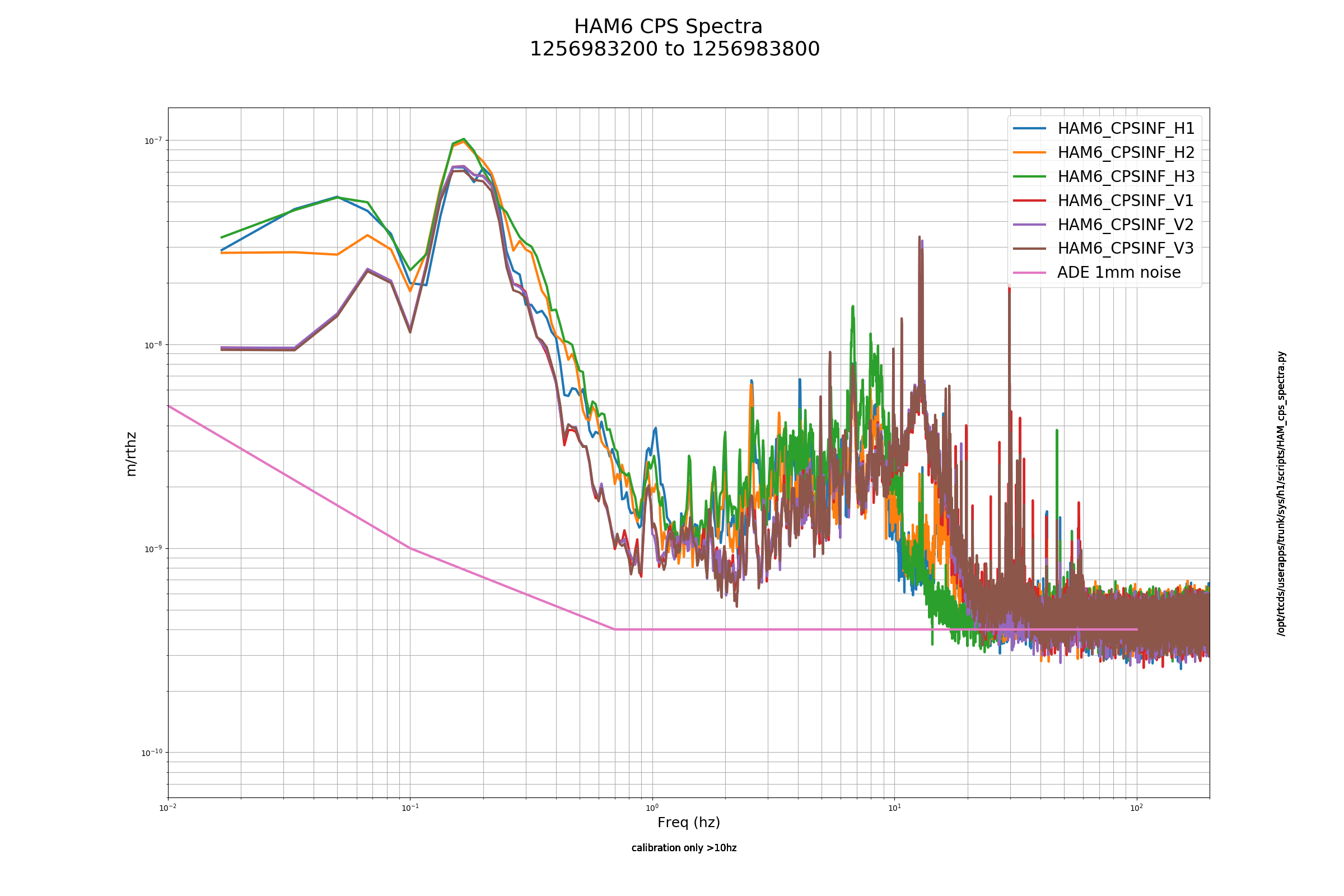
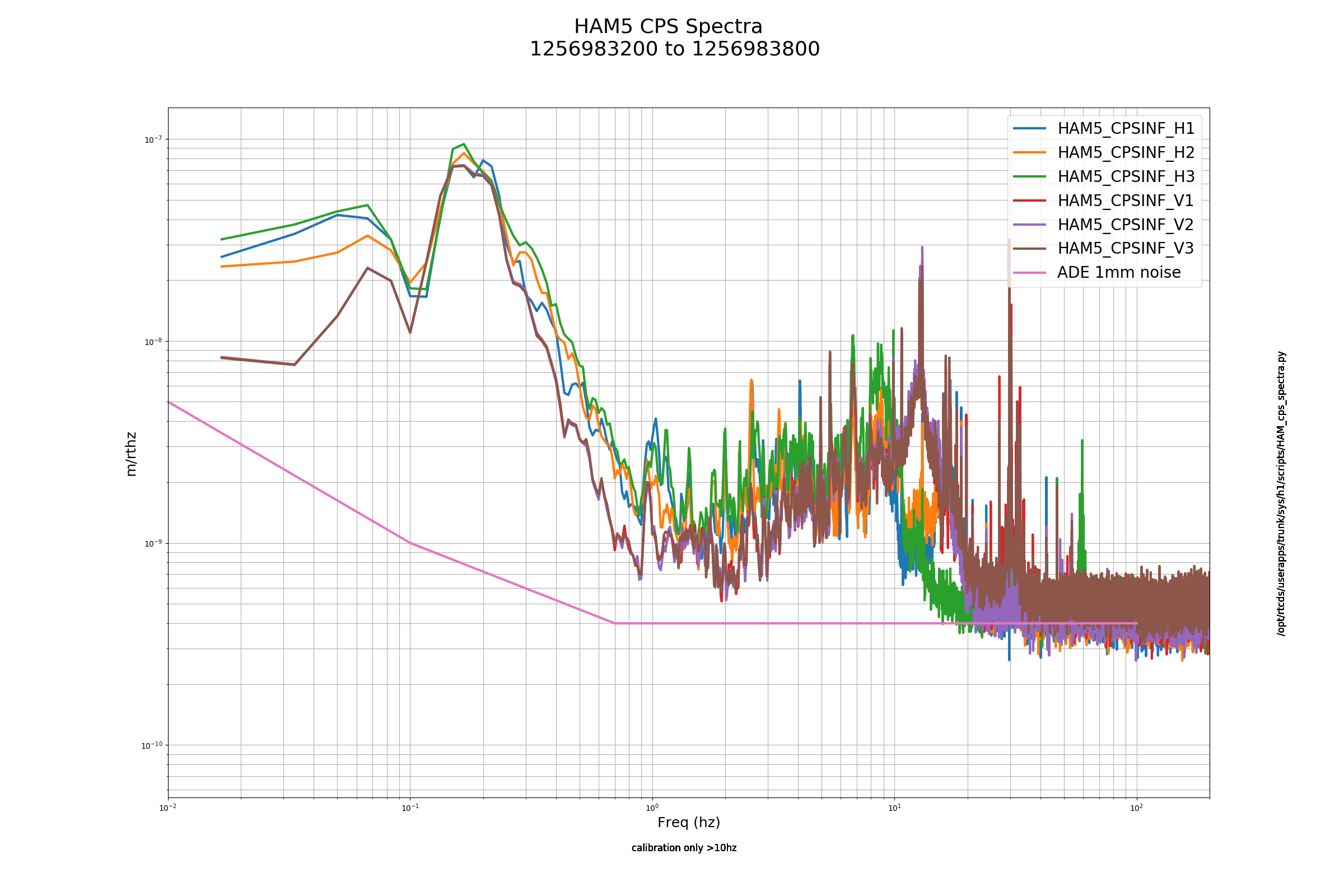
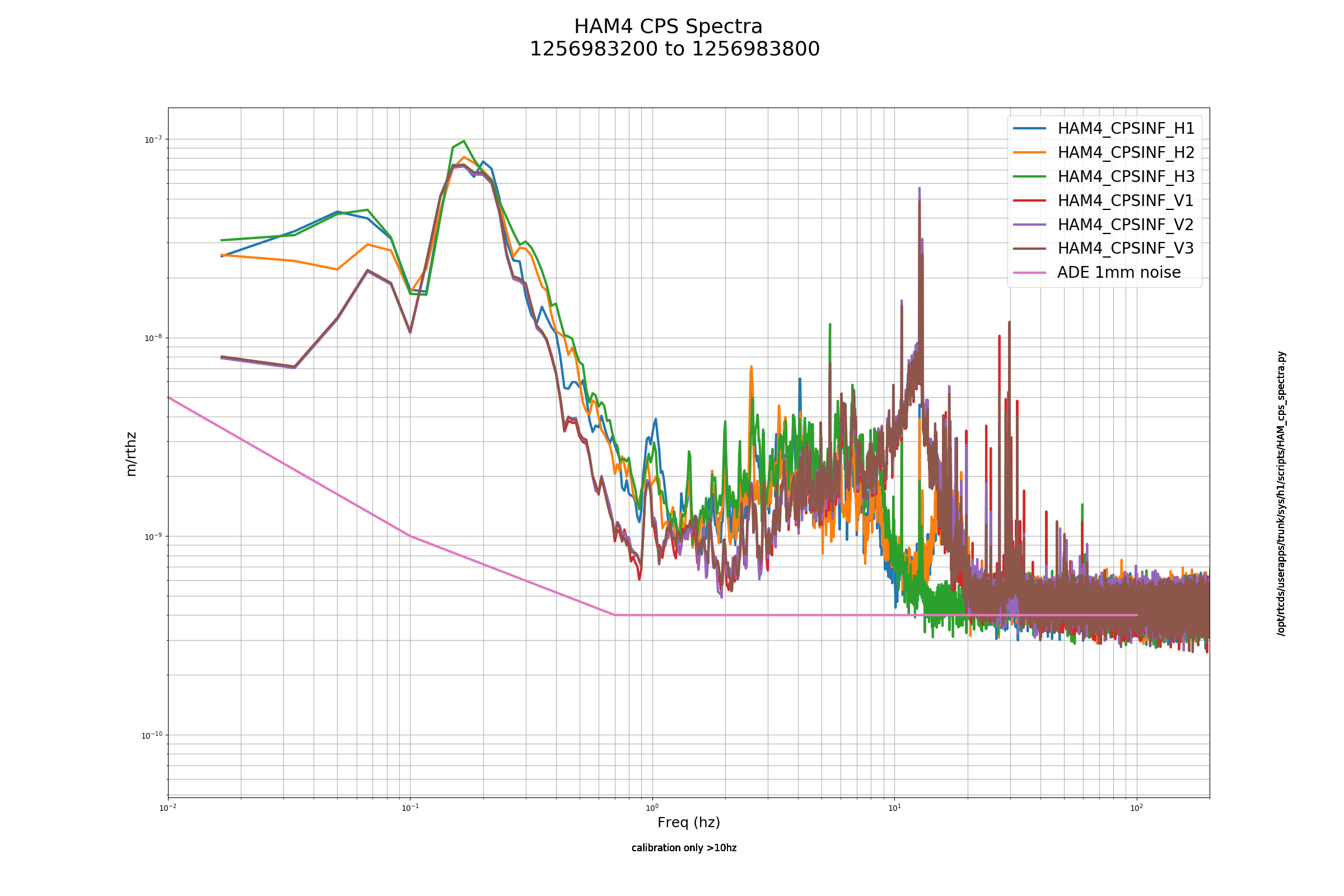
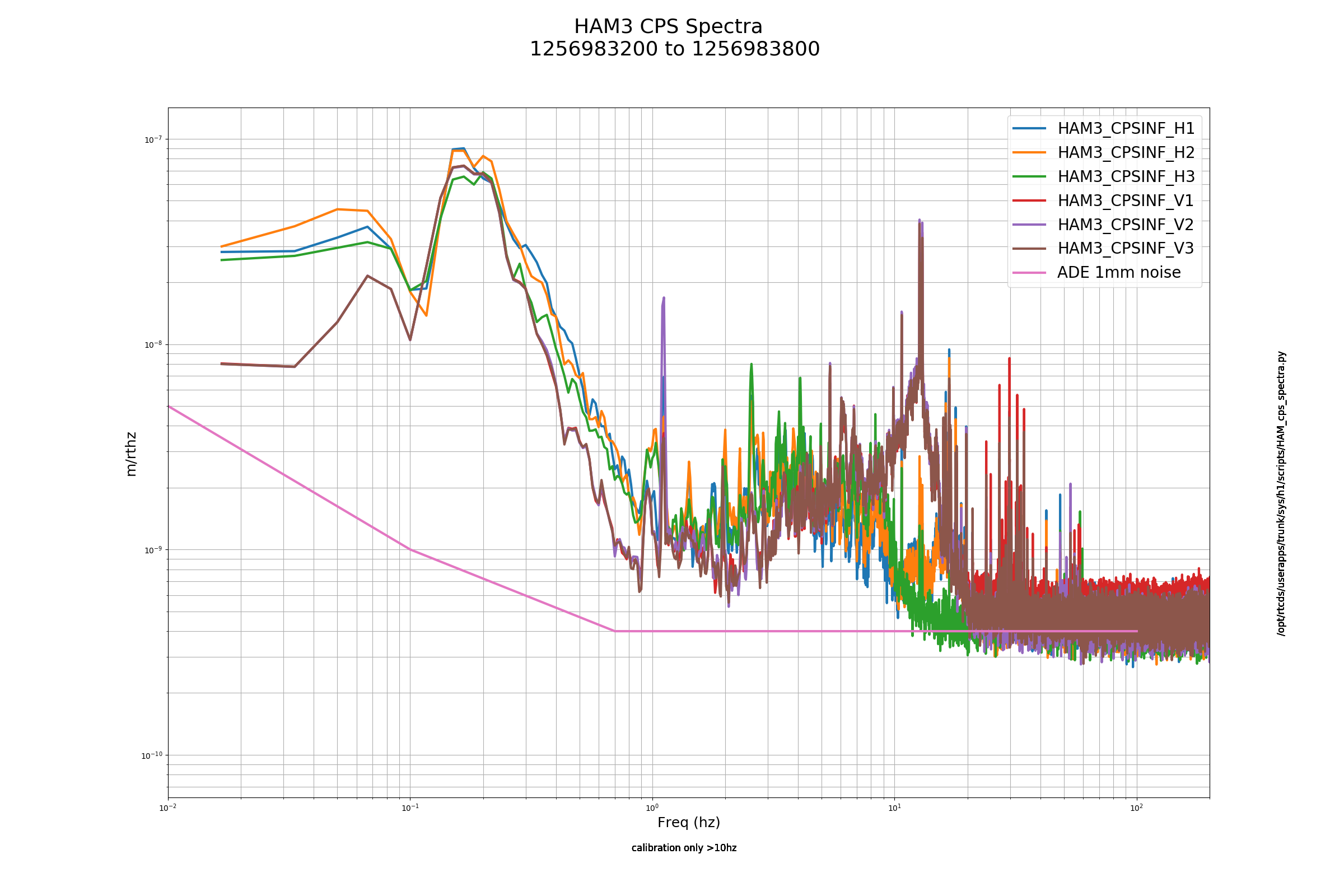
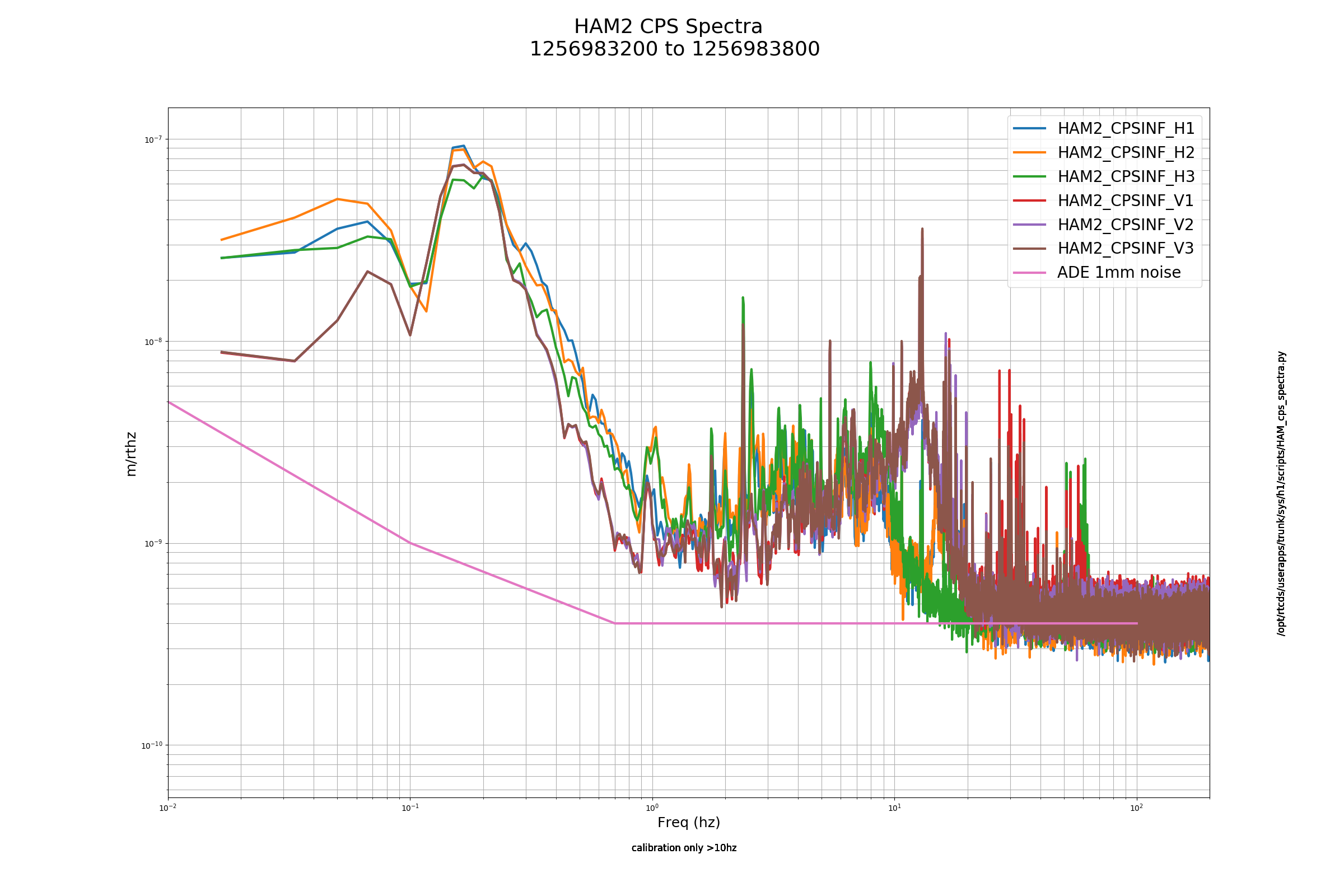
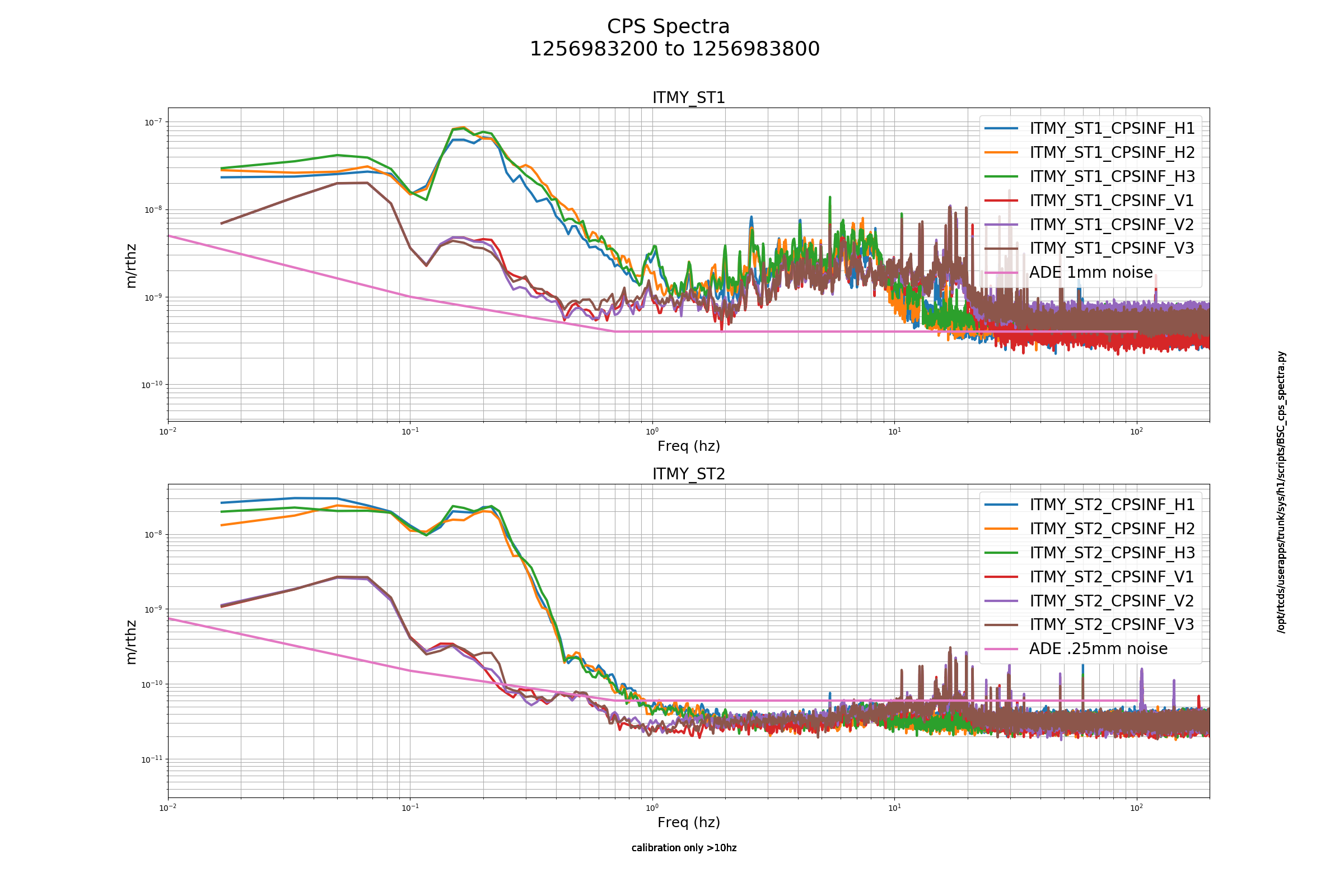
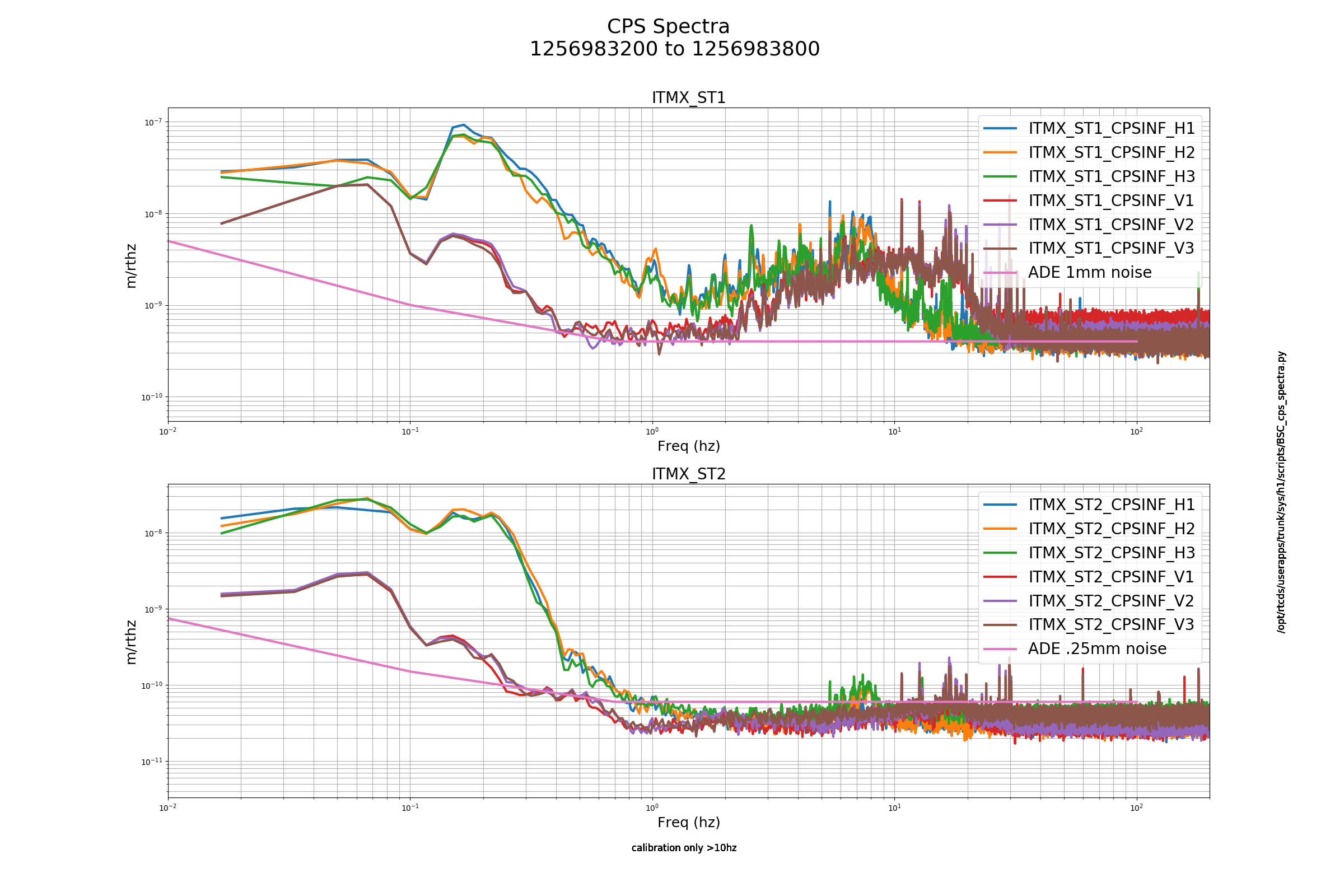
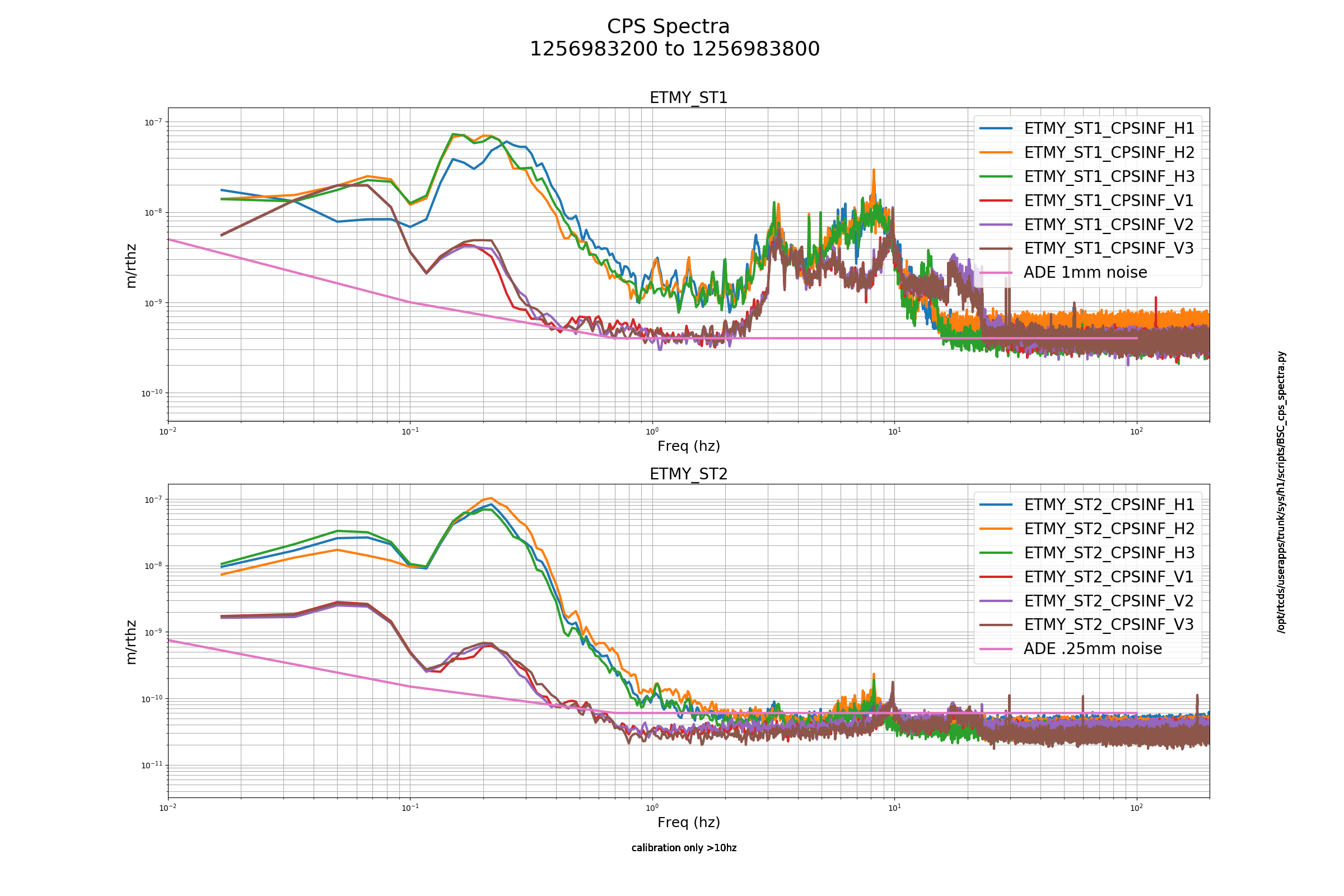
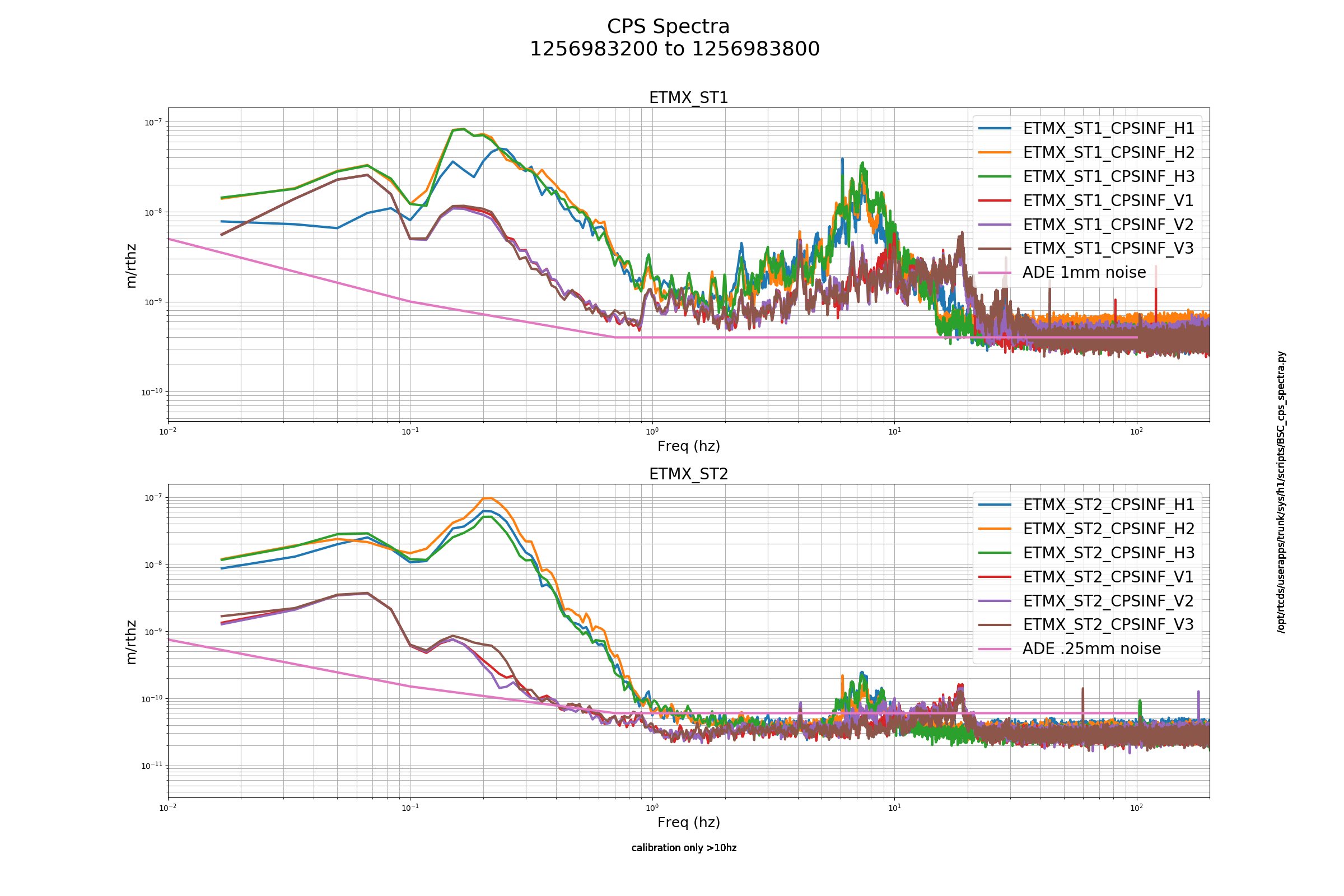
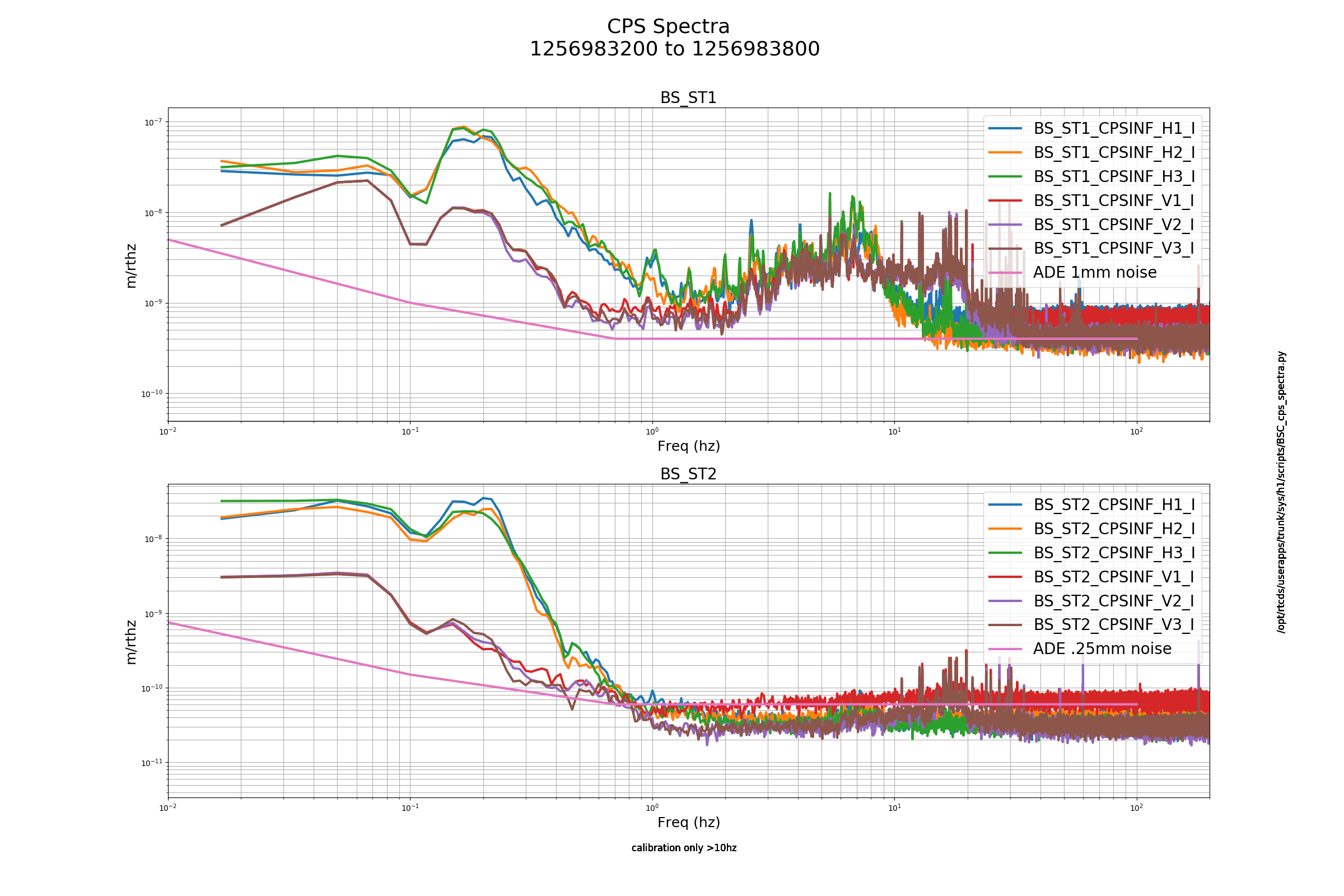
   Posted below are the plots from the weekly ISI CPS noise spectra. BS_ST2_CPSINF_V1_I is reporting elevated high frequency noise. The other plots look OK. 

Closing FAMIS #12872
Images attached to this report
H1 General
jeffrey.bartlett@LIGO.ORG - posted 04:23, Tuesday 05 November 2019 (52996)
Ops Owl Mid-Shift Summary
   At Mid-shift all is well. 
H1 TCS (DetChar)
daniel.brown@LIGO.ORG - posted 23:55, Monday 04 November 2019 - last comment - 01:49, Tuesday 05 November 2019(52989)
Phase camera overheating, powerup + CO2X test round 2

In the movie linked in alog 52927 we saw the phase camera begining to fail in a way we hadn't seen before, around 35s into the movie. We ran it again during throughout the lock acquisition today and it lasted much longer into the lock however it started to happen again. It seems the resonant circuit used to drive the pockel cell has reached some temperature limit after prolonged use. When we reduce the driving voltage by half we start seeing the same images as we did before, except with 50% reduction in amplitude. Leaving it to cool down also seems to fix the problem for the first few images but the it starts up quickly again. Something to be fixed in the next version.

We also wanted to try the CO2X test again (agreed with Keita) where we drop CO2X and then raise it up again to see how the carrier+sideband mode matching changes. The change will be small +-100mW left over an hour. Short jumps out and back into observing will be required, I'll comment GPS times when we start.

However we just had yet another GRB event so we're standing down again, hopefully can try this later.

Comments related to this report
daniel.brown@LIGO.ORG - 00:24, Tuesday 05 November 2019 (52992)DetChar

Starting: 1256977145

Seems the CO2 powers aren't actually tracked by the SDF, so I won't drop out of observe next time.

daniel.brown@LIGO.ORG - 01:49, Tuesday 05 November 2019 (52995)

Finished up at 1256982152. Went back to nominal CO2X setting as DHARD P 0.6Hz started to get angry.

H1 CDS
sheila.dwyer@LIGO.ORG - posted 18:16, Monday 04 November 2019 - last comment - 01:01, Tuesday 05 November 2019(52985)
LSC unloaded filter

earlier today I tried loading a new PRCL FF filter, which I did not load.  That is why there is an orange block on the CDS overview for LSC, but it has no impact on the interferometer. 

Comments related to this report
craig.cahillane@LIGO.ORG - 01:01, Tuesday 05 November 2019 (52993)
The feedforward conda environment is repaired.  
I have created an environment.yml out of this conda environment and added it to the svn, so in case of disaster, we can always come back to this commit where things are working.

Instructions:
1) Open new terminal.  

2) cd to the feedforward directory
$ cd /opt/rtcds/userapps/release/lsc/h1/scripts/feedforward

3) Add anaconda to your PATH.  To do this run:
$ setupanaconda
or if you haven't aliased this command, run:
$ source /opt/rtcds/userapps/release/cds/h1/scripts/setup_anaconda

4) Source the feedforward conda environment:
$ source activate feedforward

5) Start jupyter notebook:
$ jupyter notebook ipython_notebooks/PRCL2DARMfeedforward.ipynb

6) Fit feedforward TFs using IIRrational.
H1 General
cheryl.vorvick@LIGO.ORG - posted 17:13, Sunday 03 November 2019 - last comment - 06:41, Tuesday 05 November 2019(52946)
OPS Day Summary

TITLE: 11/04 Day Shift: 16:00-00:00 UTC (08:00-16:00 PST), all times posted in UTC
STATE of H1: Observing at 115Mpc
INCOMING OPERATOR: Patrick
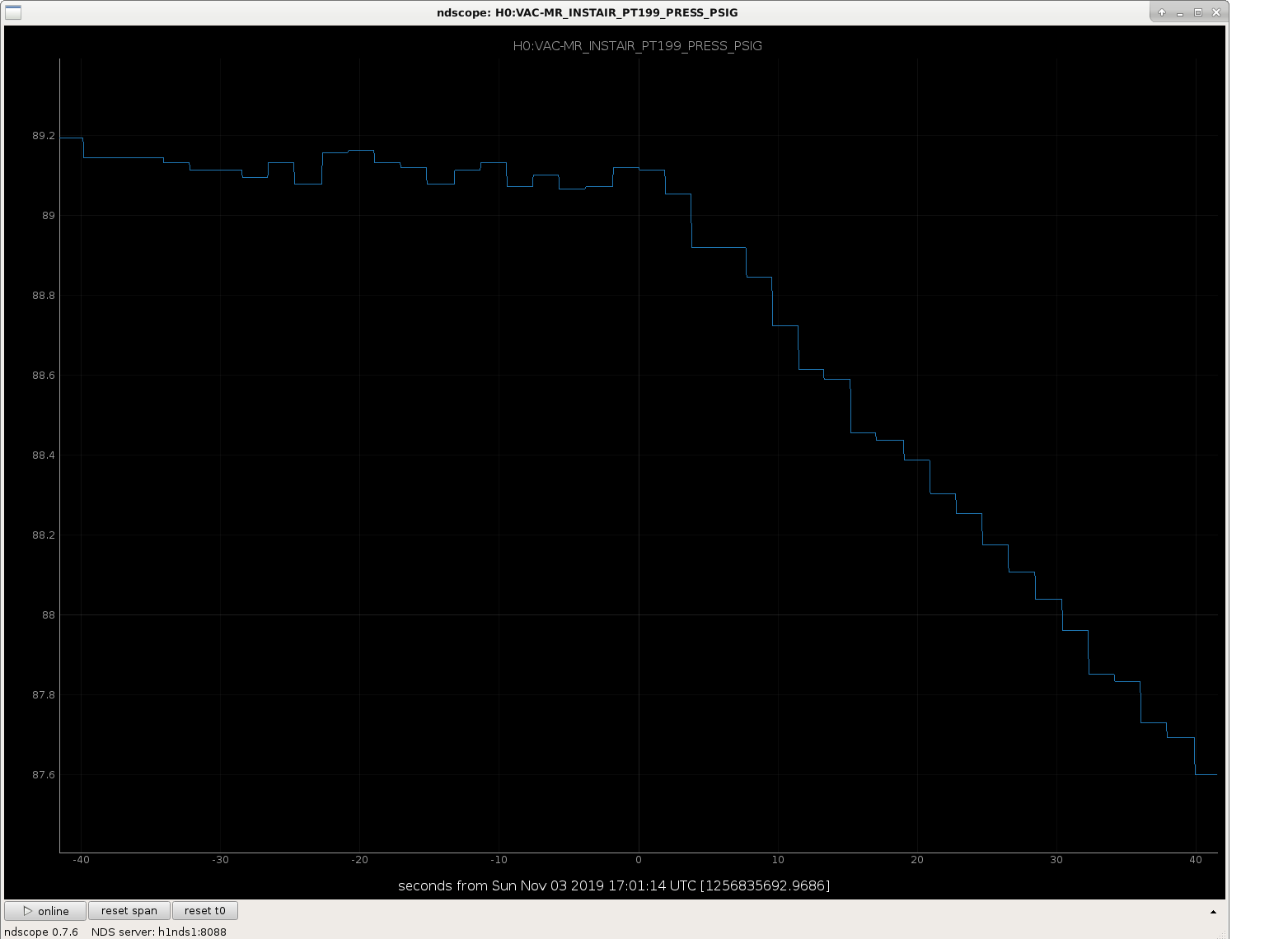
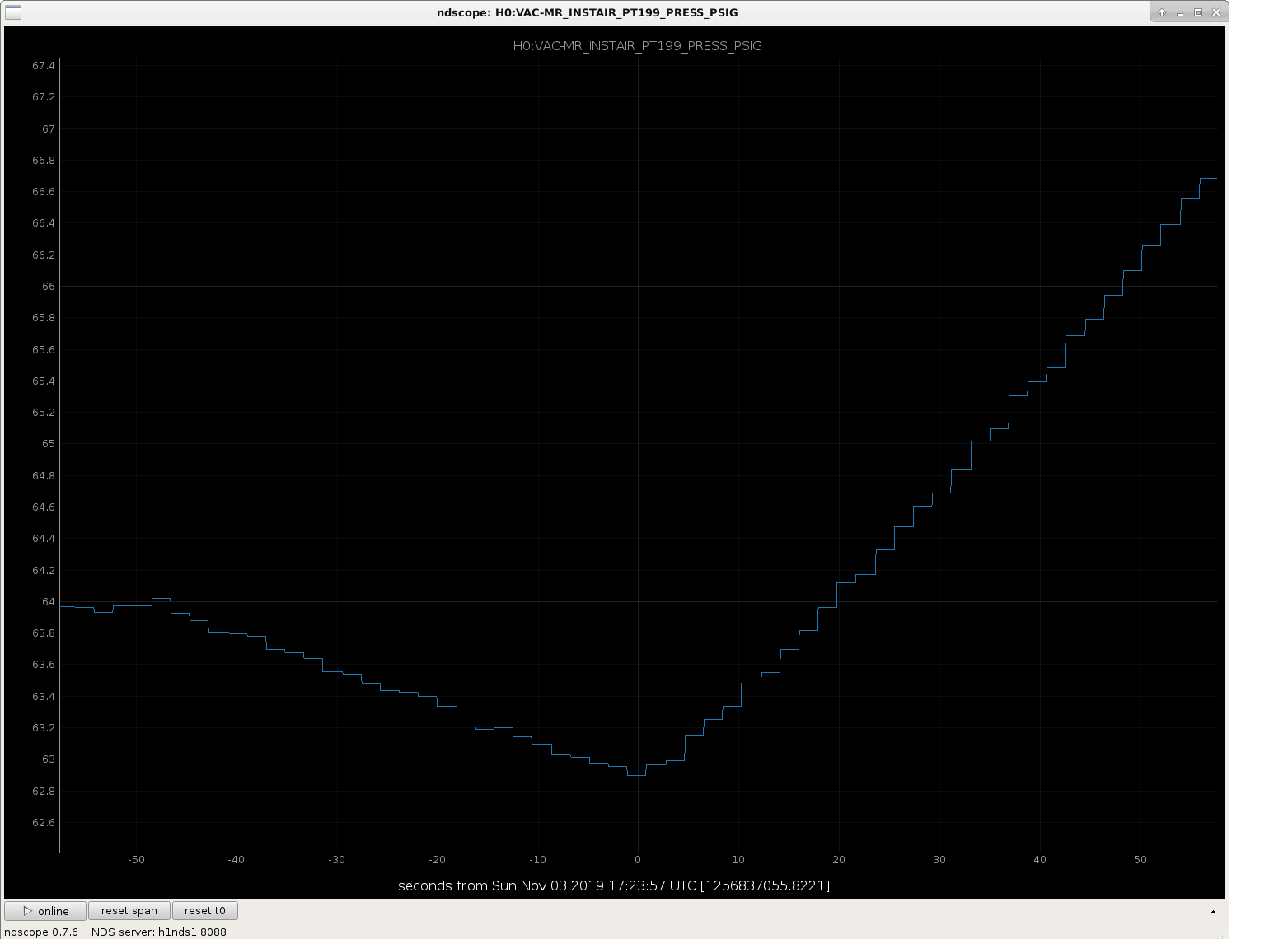
SHIFT SUMMARY: H1 in Observe, instrument air pumps for LVEA are working, SQZ just fixed itself, causing an increase in range
LOG:

VACUUM:

SQZ:

Comments related to this report
cheryl.vorvick@LIGO.ORG - 08:55, Monday 04 November 2019 (52961)

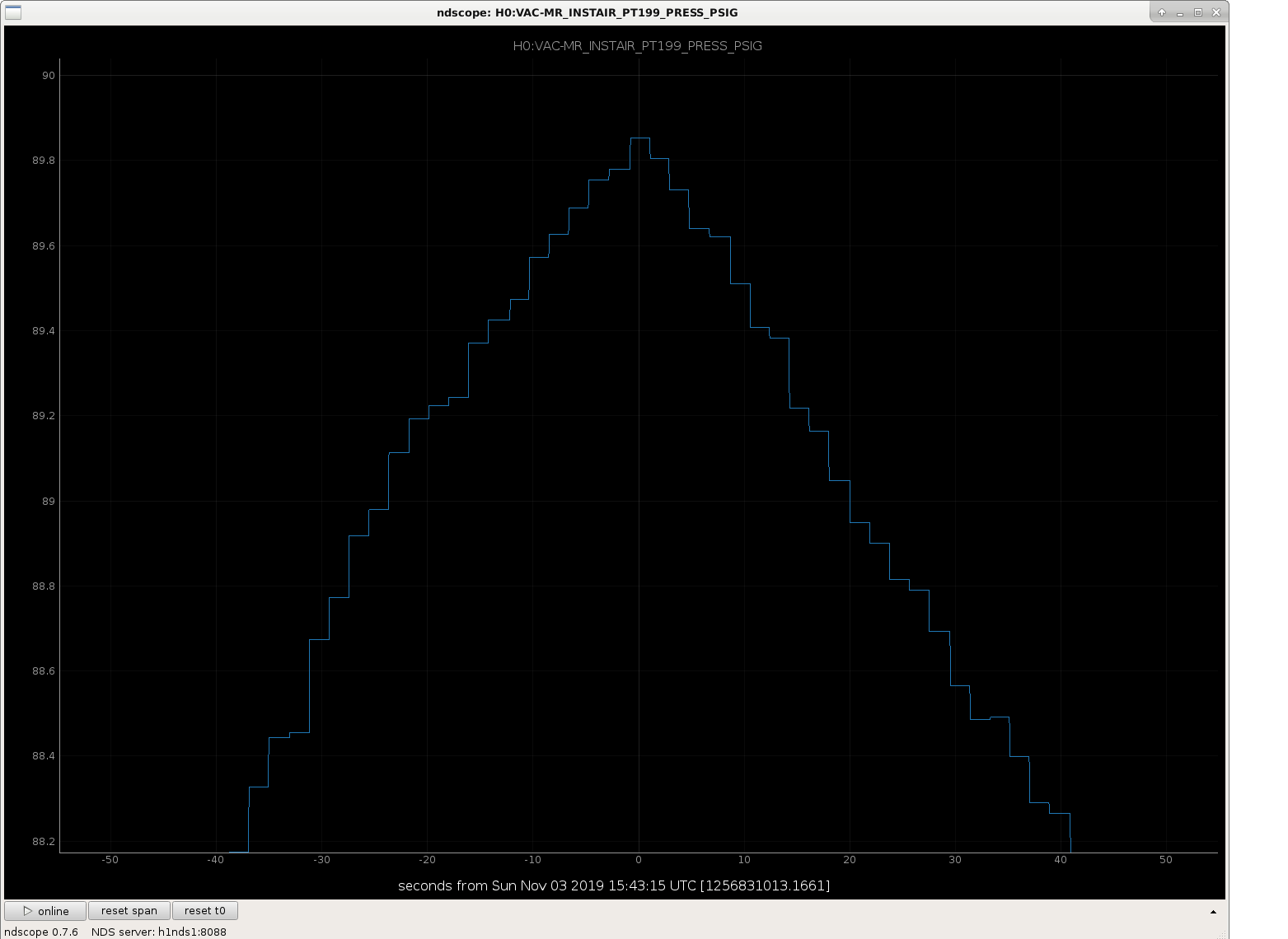
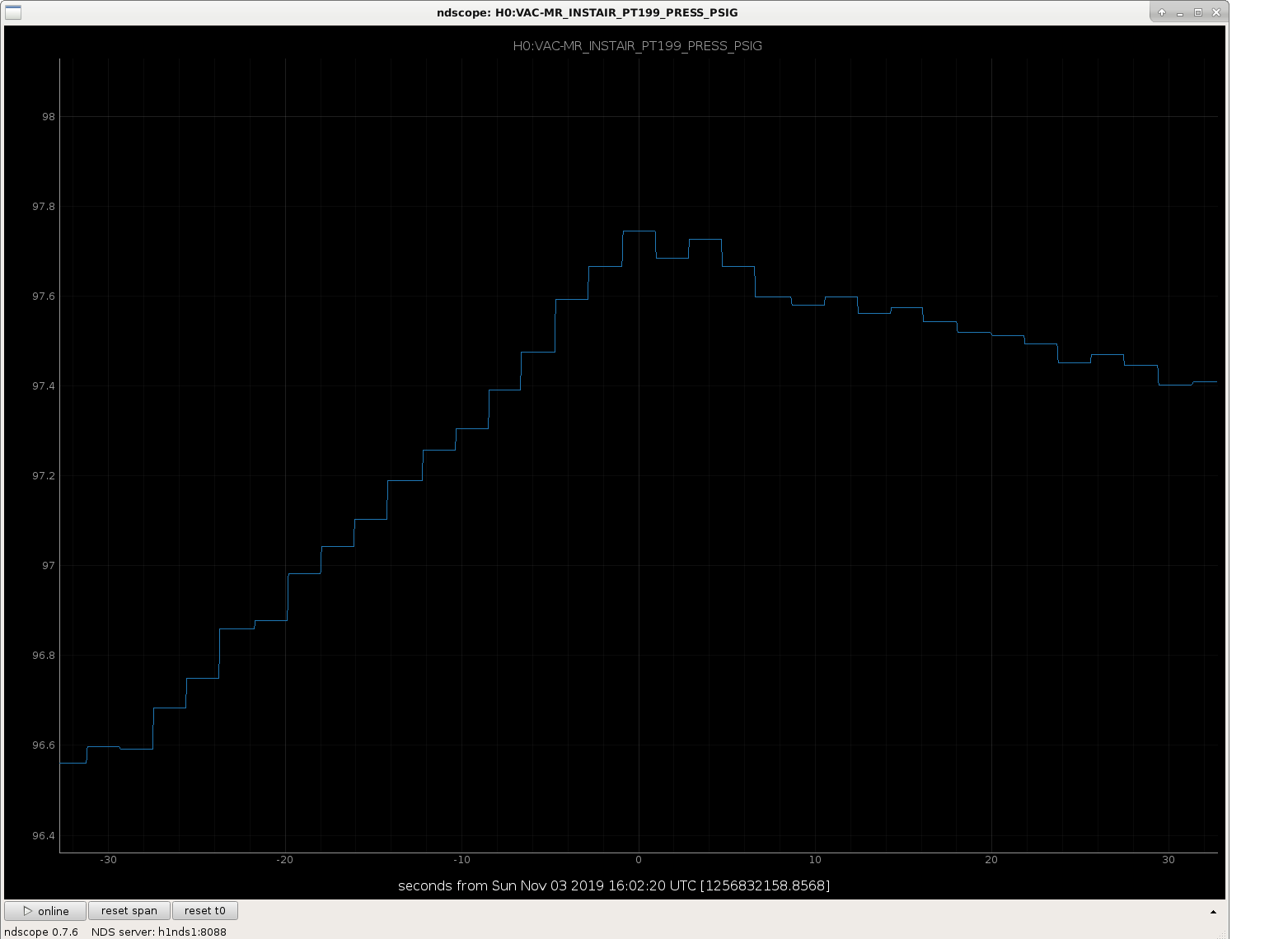
Images that go with the PT199 timeline:

Images attached to this comment
cheryl.vorvick@LIGO.ORG - 09:02, Monday 04 November 2019 (52962)

An interesting plot showing an alignment change in ZM2 yaw that coincides with the increase in H1 Range.

Images attached to this comment
jeffrey.kissel@LIGO.ORG - 13:21, Monday 04 November 2019 (52971)DetChar
Tagging @DetChar on this one -- these distinct range changes are still a mystery to the on-site team. 
Perhaps comparing BRUCO's (looking for linear coherence) or LASSO's (looking for slow changes that correlate to the times of distinct change) around these times might reveal some smoking guns?
Any help is appreciated!
beverly.berger@LIGO.ORG - 06:41, Tuesday 05 November 2019 (52998)DetChar

The LASSO results for 4 Nov (see https://ldas-jobs.ligo-wa.caltech.edu/~detchar/summary/day/20191104/detchar/lasso/) show a strong correlation between SQZ channels (perhaps excited by seismic motion) and the range drop. Similar results exist for 1 Nov, the most recent prior day with a long lock crossing the range drop. 

H1 ISC (ISC)
craig.cahillane@LIGO.ORG - posted 20:52, Saturday 02 November 2019 - last comment - 01:53, Tuesday 05 November 2019(52923)
FSS Common Gain increased further, from +23 dB to +25 dB
We were seeing "frequency noise" become very apparent in DARM again.
("frequency noise" is in quotes because it is the underlying cause, but probably not the direct agent actually putting noise into DARM.  That honor belongs to intensity noise.)

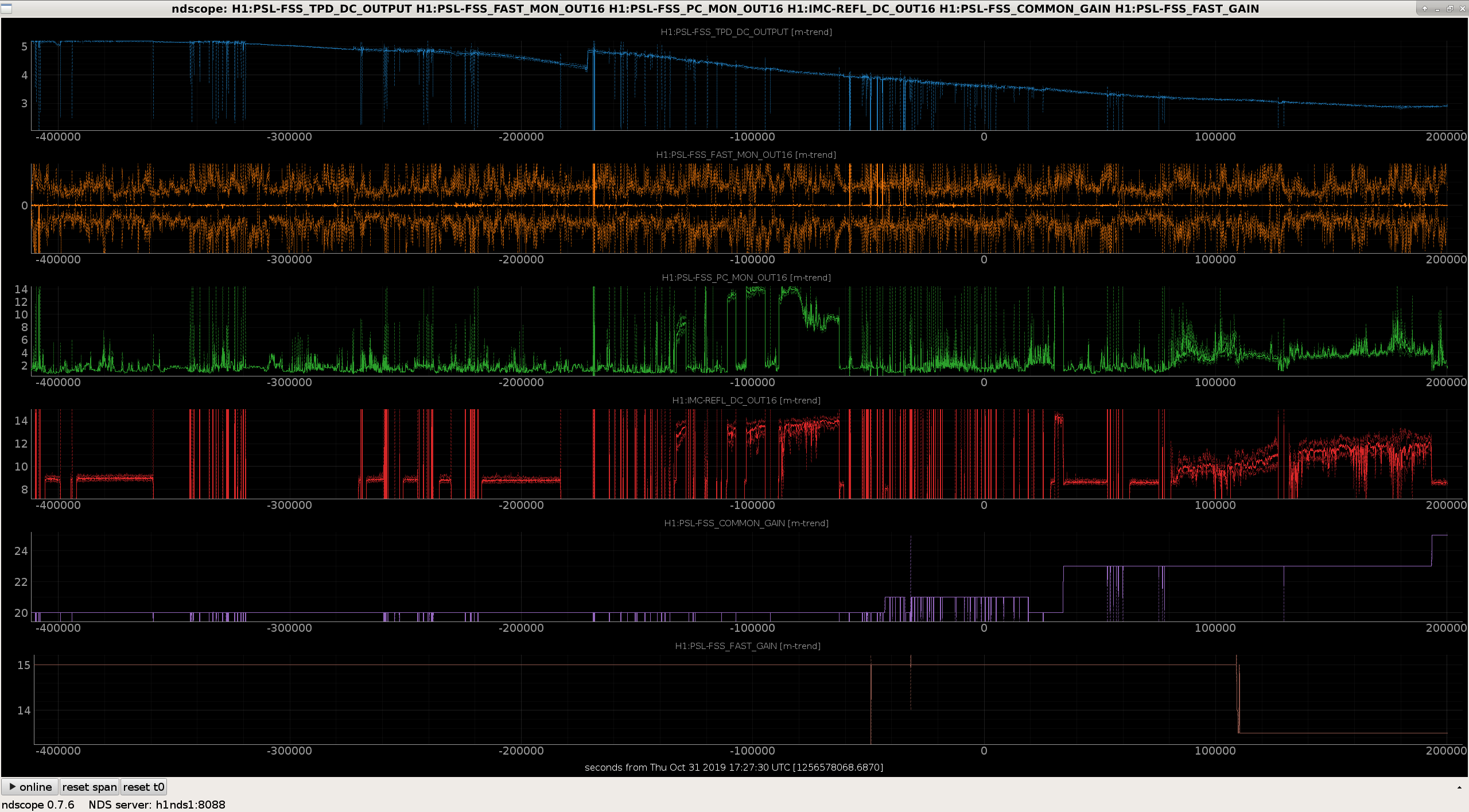
We've seen a continued plummet in the reference cavity transmission over the last week.  We are now at the point where the ref cav transmission has dropped 47%.  (Attachment 1)
Jason posted in alog 52882 about trying to fix up the alignment, with some success in recovering some transmitted power (seen in attachment 1 between -200000 and -100000 seconds ago), but not resolving the underlying issue.
Probably the best witness of FSS health is the IMC_REFL_DC signal (red trace, first and second attachment).  When signal goes above ~10 mW, we are likely to be having frequency stabilization problems originating in the FSS, high high-frequency noise in DARM, and worse range.

I increased the FSS common gain from 23 to 25 dB
In the first PDF attachment, we see DARM and laser noise coherence at FSS gains of 23, 24, and 25.  
After increasing from 23 to 24 dB, pretty much all the "frequency noise" we were seeing in DARM went away.  There is no apparent change in laser noise coupling when increasing from 24 to 25 dB.

ASDs:
In the second PDF attachment, I plot DARM, CARM, and ISS secondloop ASDs before and after the FSS gain increase.
It's clear that the noise levels of all go down significantly. 
 
I expected there to be significant coherence between the ISS and CARM, but this is not the case.

Coupling:
In the third PDF attachment, we see there is high coherence between the ISS secondloop and DARM with lower FSS gain, and much smaller coherence after the gain is increased by one dB.
In the fourth PDF attachment we see low coherence between DARM and CARM at all times, likely because the true frequency noise is drowned out by the high intensity noise apparent in DARM.
However, at no time is there coherence between CARM, IMC, or FSS error signals and the ISS loop. (fifth, sixth, seventh PDF attachments)

Jury is still out on why falling FSS gain causes high intensity noise.  I would have thought this sort of intensity noise would be generated by the frequency noise incident on the IMC.  
It is possible that this noise coupling is nonlinear, or I have looked at the incorrect witnesses.
Images attached to this report
Non-image files attached to this report
Comments related to this report
craig.cahillane@LIGO.ORG - 21:50, Saturday 02 November 2019 (52928)
With the FSS gain low, the ISS first loop is not performing well at all.
The ISS second loop is able to compensate for the first loop's failure until about 700 Hz, where the true intensity noise begins to dominate over the second loop sensing noise.  
The second loop is doing the best it can under the circumstances, but cannot do the job of both loops.

The below plots shows the ISS first loop sensors (out of loop = PDA, in-loop = PDB), and the ISS second loop sensors (out-of-loop = OUTER, in-loop = INNER) with the FSS gain at 23 dB and 24 dB.
Non-image files attached to this comment
craig.cahillane@LIGO.ORG - 01:53, Tuesday 05 November 2019 (52994)
Posting the ASDs I made trying to look into this problem. 
Probably the most interesting plot is PDF 1, which suggests ISS SECONDLOOP ERR1 DC coupling changed somehow.

Overall, we see increased noise everywhere in the ISS and IMC and CARM error signals, and not much in the control signals as the high loop gains impress the high noise on the loop.
Still not clear where the source of the noise is.
Non-image files attached to this comment
H1 ISC
daniel.sigg@LIGO.ORG - posted 17:33, Tuesday 29 October 2019 - last comment - 09:18, Tuesday 05 November 2019(52784)
End station laser locking

The end station laser locking ran away when the reference cavity was unlocked earlier today. When PSL tries to relock the reference cavity it searches for a resanance by changing the PSL frequency substabtially. The end station lasers try to follow but eventually lost it and went into lala land.

In the past this didn't happen because the end station laser locking would automatically pause, when the reference cavity was unlocked. When we changed the PSL fiber pick-off, we moved the monitor PD as well and it now just monitors the power after the PMC. The PD after the reference cavity is still there, so we should conect it to a spare channel in the auxiliary signals concentrator 3.

Comments related to this report
daniel.sigg@LIGO.ORG - 09:18, Tuesday 05 November 2019 (53006)

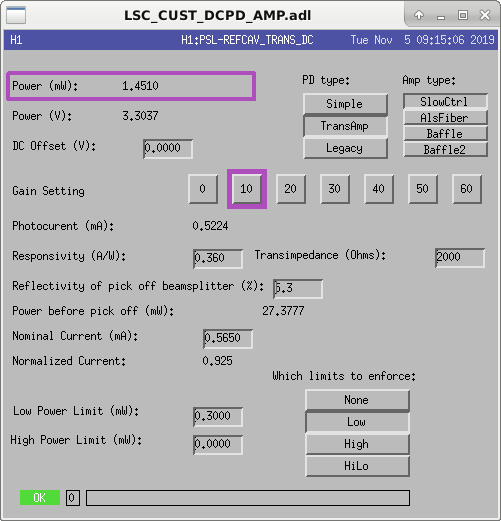
The PSL reference cavity transmission PD was hooked up to a spare channel and the software was updated accordingly.

Channel names are H1:PSL-REFCAV_TRANS_DC_POWER and similar.

The normalized current of this new PD channel is sent to the ALS and SQZ lasers for determining the locking conditions. The threshold has been set to 0.3. So, when the refernce cavity looses lock, these laser locking servos will now pause.

Images attached to this comment
Displaying reports 37661-37680 of 89097.Go to page Start 1880 1881 1882 1883 1884 1885 1886 1887 1888 End