Displaying reports 37721-37740 of 89095.Go to page Start 1883 1884 1885 1886 1887 1888 1889 1890 1891 End
Reports until 16:38, Sunday 03 November 2019
H1 ISC
daniel.brown@LIGO.ORG - posted 16:38, Sunday 03 November 2019 - last comment - 16:40, Sunday 03 November 2019(52945)
Phase camera power up initial sideband analysis

In alog 52927 I posted up a video of the phase camera data taken for each sideband and carrier from DRMI to just after nominal low noise. Attached are some initial fits of a model to this data to see how each sideband is behaving during the process of locking.

The model

The model I have used for this analysis consists of two gaussian beams, one being the reference field and the other being the IFO field. The phase camera images are these two multiplied together. To get a good idea of the reference beam I took stretch of data looking at just the reference field without any IFO beam and measured the intensity at the camera. Fitting the intensity of a gaussian beam to this data we can get a good idea of the size of the reference field. The intensity of the reference field stays constant enough for each sideband over a lock stretch. For the curvature I assume the reference field is flat, which should be a good assumption considering the beam is coming out of a single mode fiber and collimated into a large beam about 70cm before the camera. "Knowing" the reference beam we can now fit the combined beam model to the actual amplitude and phase images coming from the phase camera. This fits beam size, radii of curvature, offset from the reference, angle from the reference, and amplitude of the IFO beam.

Results

This isn't an exhaustive or quantative analysis, more to come no doubt, but just what was noticed so far. On most of the plots I have plotted the average of both the upper and lower, as they are very similar.

Non-image files attached to this report
Comments related to this report
daniel.brown@LIGO.ORG - 16:40, Sunday 03 November 2019 (52948)

Forgot to mention, this analysis goes from resonance of the carrier to just before the images start getting strange in the movie.
LHO General
patrick.thomas@LIGO.ORG - posted 16:34, Sunday 03 November 2019 (52947)
Ops Eve Shift Transition
TITLE: 11/03 Eve Shift: 00:00-08:00 UTC (16:00-00:00 PST), all times posted in UTC
STATE of H1: Observing at 115Mpc
OUTGOING OPERATOR: Cheryl
CURRENT ENVIRONMENT:
    SEI_CONF state: WINDY
    Wind: 3mph Gusts, 2mph 5min avg
    Primary useism: 0.01 μm/s
    Secondary useism: 0.11 μm/s 
QUICK SUMMARY: No issues.

H1 General
cheryl.vorvick@LIGO.ORG - posted 13:46, Sunday 03 November 2019 (52943)
OPS Mid-Day Update, PT199 and SQZ
LHO VE
kyle.ryan@LIGO.ORG - posted 10:16, Sunday 03 November 2019 (52941)
Frost causing glitches?

Everything old is new again! 

In casual conversation this morning with Cheryl V. and Jeff B, the possible link to cryopump frost flakes falling off of the inner reserviors of the site's cryogenic pumps being a possible source of the unexplained IFO glitches seemed to have been "news" to them.  In the distant past, it had been common knowledge that glitches might be resulting from frost flakes falling off of the surfaces of the inner vessel of the 80K pumps.  Glitches could result from the flakes crossing the beam as particulates or effecting the beam when they were evaporated upon contacting the relatively warm vacuum vessel surfaces. 

We know that "liberating frost flakes" result when we hard close the GVs or otherwise bang on vacuum equipment near the 80K pumps.  We have seen pressure spikes from the evaporated frost followed by the tell-tale pump down curve for some large cases of this.  It is unknown to what degree that this is happening for events too small to see by the pressure gauges.  Meaning, not seeing this in the pressure data may not exclude the possibility that it is still happening at IFO-impacting levels too small to see with the gauges. 

Cheryl V. asked that aLOG theory as it may be of interest to others. 

LHO VE
kyle.ryan@LIGO.ORG - posted 09:47, Sunday 03 November 2019 - last comment - 14:02, Sunday 03 November 2019(52940)
Corner Station instrument air

Jeff B. phoned me informing me that PT199 had fallen befow 50 psi and wasn't recovering -> Upon arival, I investigated and found that neither the LEAD nor the LAG pressure switches were mechanically closing (my previous "tinkerings" had only been directed at adjustments to the LEAD pressure switch).  Repeated cycles of manually bleeding-off the local receiver tank whilst visually monitoring the mechanical contacts so as to observe if/when they were closing allowed me to adjust the "cut-in" and "span" values of both units. 

I did not find an obvious explaination as what caused the initial problem (only one instance of not working).  My current theory is that there is an imbalance of spring forces occuring on the sheet metal plate which rocks/pivots to open or close the contacts.  There are two springs ("cut-in" spring and range or "span" spring) of differing spring rates which act on this plate.  The mismatched spring forces may be causing the plate to mechanically "bind" too much on its pivot.  As such I altered the spring preload combination a little.  We'll see. 

Anyway, I am leaving the two pressure switches with nearly the same settings in hopes that, at least, one will operated in the desired pressure range.  Though this ought to reduce the compressor run time(s), this is a side effect and isn't part of the motivation for doing this.  

0946 hrs. local -> Leaving site now.

Comments related to this report
chandra.romel@LIGO.ORG - 14:02, Sunday 03 November 2019 (52944)

Thanks, Kyle!

H1 General
jeffrey.bartlett@LIGO.ORG - posted 08:06, Sunday 03 November 2019 (52938)
Ops Owl Shift Summary
Ops Shift Log: 11/03/2019, Owl Shift 07:00 – 16:00 (00:00 - 08:00) Time - UTC (PT)
State of H1: Locked at NLN; Range is 115.0Mpc
Intent Bit: Observing
Support: Kyle
Incoming Operator: Cheryl
Shift Summary: IFO was locked and observing for entire shift. Switched to Standard Time 10:00 (02:00).
Switched to EARTHQUAKE Mode for a M5.4 in Chile. Switched back after waves passed.
Received Low Pressure Alarm on PT-199 Instrument Air. Pressure dropped into the mid 40PSIG. Spoke with Kyle. Put compressor #1 into manual (Hand) and built pressure up to 95PSIG, while Kyle was coming out to the site. Kyle is on site now looking into the problem.
 
A Big Thank You to Cheryl for coming in early to help cover the time switch!
 
Activity Log: Time - UTC (PT)
07:00 (00:00) Take over from Patrick
10:00 (02:00) Switch to Standard Time
13:45 (05:45) Switch to EARTHQUAKE for M5.4 from Chile
14:11 (06:11) Switch back to WINDY after EQ passed
15:00 (07:00) Turn over to Cheryl


H1 General
jeffrey.bartlett@LIGO.ORG - posted 07:58, Sunday 03 November 2019 (52937)
Low Pressure Alarm on PT-199 Inst Air
   At 15:31 (07:31) received low pressure alarm on PT-199 Instrument Air. Cheryl trended the channel and found the pressure dropping rapidly; passing through 50PSIG. 

   I called Kyle. He gave me instructions on running the compressor by hand. Went to Chiller Yard and turned on both compressors by hand. Both worked in the Hand position but did not run in the Auto position. Switched compressor #1 to Hand and built pressure up to  95PSIG. Put switch back into the Auto position. 

  As of 15:52 (07:52) Kyle was on site looking into the problem.  
H1 General
cheryl.vorvick@LIGO.ORG - posted 07:48, Sunday 03 November 2019 (52936)
OPS Day Transition

TITLE: 11/03 Day Shift: 16:00-00:00 UTC (08:00-16:00 PST), all times posted in UTC
STATE of H1: Observing at 115Mpc
OUTGOING OPERATOR: Jeff
CURRENT ENVIRONMENT:
    SEI_CONF state: WINDY
    Wind: 0mph Gusts, 0mph 5min avg
    Primary useism: 0.01 μm/s
    Secondary useism: 0.10 μm/s
QUICK SUMMARY: H1 is locked in Observe, PT199 instrument air had both pumps trip off, JeffB running manually to keep the GVs open, Kyle is on his way

H1 General (VE)
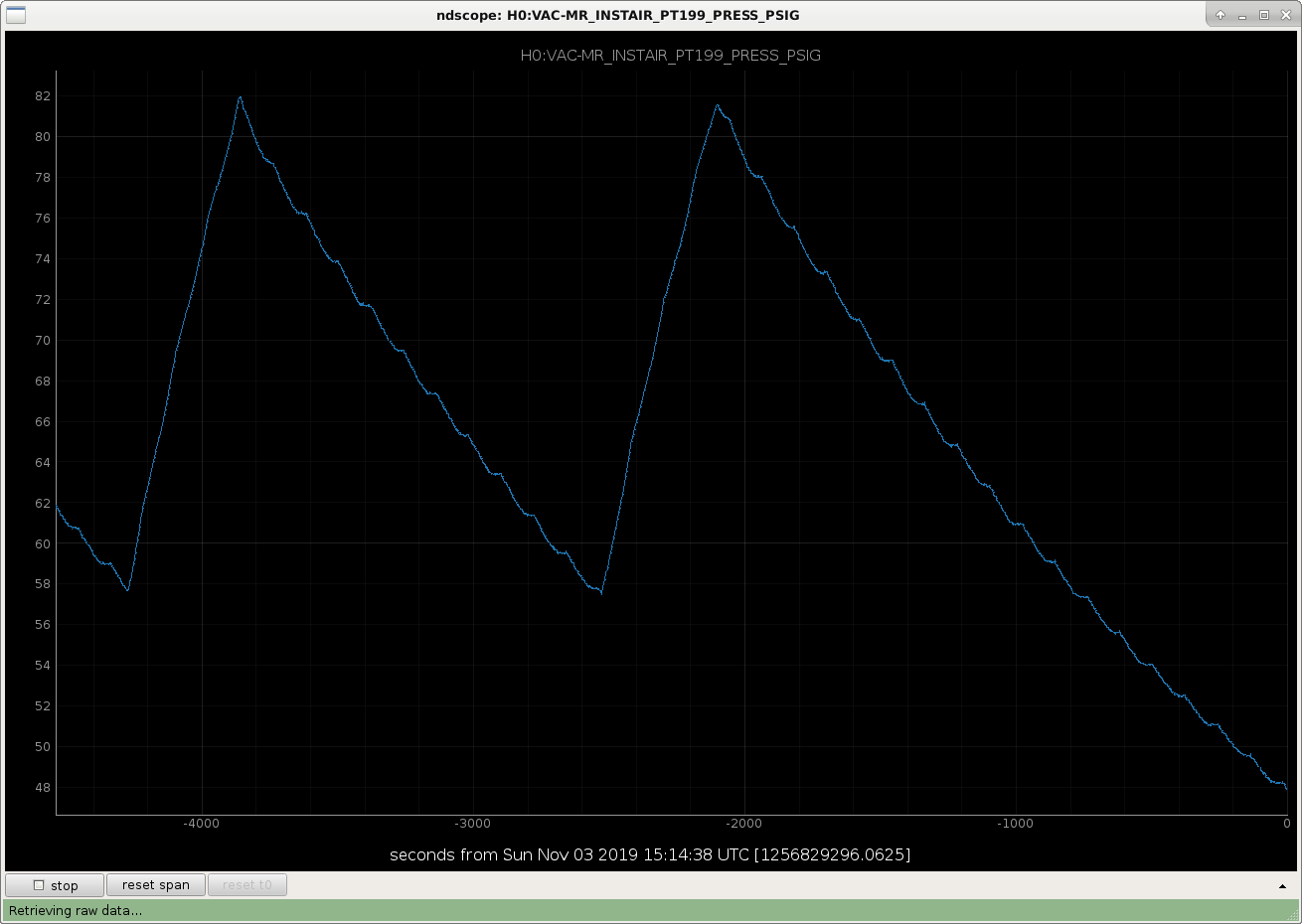
cheryl.vorvick@LIGO.ORG - posted 07:17, Sunday 03 November 2019 - last comment - 10:47, Sunday 03 November 2019(52933)
PT199 at 47PSIG and falling, JeffB talking to Kyle, going to check out if it's running

Plot attached, showing last cycle.

Images attached to this report
Comments related to this report
cheryl.vorvick@LIGO.ORG - 07:28, Sunday 03 November 2019 (52934)

JeffB reports that instrument air pumps for the Corner station were both off, he talked to Kyle, he's going to manually run a pump until instrument air is above 50, to keep the pneumatic GVs open, preserving the lock, and buy some time for Kyle to make it to the site, Kyle is on his way.

cheryl.vorvick@LIGO.ORG - 07:40, Sunday 03 November 2019 (52935)

GLITCH IN H1: glitch 2, I was watching DARM and this glitch appeared to happened at the same time that JeffB turns on the pump for Instrument air, at 15:28:29UTC.

GLITCH IN H1: possible glitch 1 - it's possible that there was also a glitch when JeffB cycled the pumps the first time at 15:19:42UTC.

CURRENT Pressure 76PSIG, JeffB running the pump manually

Images attached to this comment
cheryl.vorvick@LIGO.ORG - 08:55, Sunday 03 November 2019 (52939)
  • status as of 16:38UTC - Kyle is here, and has tuned on the pump(s) again and raised the pressure to around 95.
  • after Kyle checked the pumps, he came to the CR and Kyle, JeffB, and myself
    • we talked briefly about worst case, where someone would need to manually run the pumps until we have a fix
  • status as of 16:54UTC - Kyle is diagnosing the pumps
H1 General
jeffrey.bartlett@LIGO.ORG - posted 04:15, Sunday 03 November 2019 (52932)
Ops Owl Mid Shift Summary
   Good first half of the shift. The IFO remains locked and observing. Environmental conditions are favorable. The range is floating around 116.3Mpc. No current issues to be concerned about. 

   At 10:00 (02:00) the clocks rolled back one hour as Daylight Savings Time yielded to Standard Time. Today, at 25 hours, is truly the longest day of the year. 
H1 General
jeffrey.bartlett@LIGO.ORG - posted 00:09, Sunday 03 November 2019 (52931)
Ops Owl Shift Transition
Ops Shift Transition: 11/03/2019, Owl Shift 07:00 – 15:00 (00:00 -08:00) - UTC (PT)
State of H1: Locked at NLN
Intent Bit: Observing
Weather:  Mostly clear skies this morning, with temperatures in the high 20s to low 30s. No rain is in the forecast. The winds are Calm. 
Primary 0.03 – 0.1Hz: 0.009um/s
Secondary 0.1 – 0.3Hz: 0.08um/s
Outgoing Operator: Patrick
Quick Summary: The IFO has been locked for almost 25 hours, and undisturbed observing for the past 7 hours. The current range is 117.4Mpc. No problems or concerns at this time. 


LHO General
patrick.thomas@LIGO.ORG - posted 23:59, Saturday 02 November 2019 (52930)
Ops Eve Shift Summary
TITLE: 11/02 Eve Shift: 23:00-07:00 UTC (16:00-00:00 PST), all times posted in UTC
STATE of H1: Observing at 115Mpc
INCOMING OPERATOR: Jeff
SHIFT SUMMARY: Remained locked entire shift. Squeezer took us out of observing for about a minute. Craig fixed the high frequency noise by increasing the FSS gain. Robert, Dan, Craig and Cao fixed the scattering shelves by unplugging the CMOS camera on ISCT1.
LOG:

22:53 UTC Out of observing for phase camera fan test
22:55 UTC Dan and Robert to ISCT1
23:11 UTC Robert and Dan back. Craig adjusting FSS gain.
23:17 UTC Back to observing
00:04 UTC Dropped out of observing by squeezer
00:05 UTC Back to observing
05:15 UTC Dust alarm at end Y
H1 AOS
daniel.brown@LIGO.ORG - posted 21:18, Saturday 02 November 2019 (52927)
Phase camera movie DRMI to full IFO

This week we have been working to tune the phase camera's phase locking loop and the camera exposure settings to enable us to image all the sidebands and carrier going from DRMI all the way up to full lock. The aim is too see how they may change in balance and shape. Unfortunately the only coincident times when the phase camera worked (nearly) as intended and we got a clean lock up to maximum power was Friday 1am PST before the run started and it was switched off, I was hoping to get a few powerups to compare before pulling it out on Tuesday.

https://lhocds.ligo-wa.caltech.edu/exports/powerup_odd.mp4

The above is a movie of the sidebands and carrier from left to right, carrier, +9, -9, -45, +45. Top row is phase and the bottom is the amplitude. I have applied a rolling average of 10 frames to the amplitude to stop it jittering around so much frame to frame. Each frame of the movie is ~20s. We start whilst acquiring DRMI and see the sidebands first appear and the carrier not very visible. We then reach resonance of the carrier. Next we see the powerup and the fields shifting from moving the spot positions. Shown in the bottom plot is the PSL and CO2X powers normalised. We also wanted to try pulsing CO2X on and off to see if we could see similar effects as we did before with the beam becoming more astigmatic and displaced, but with the new IFO alignment.

At around 25s seconds into the movie we see some odd shapes starting to emerge. The fields all become distorted and the signals oscillate around. This is not what is actually happening to the POP beam, at least I hope not. However it is also not a behaviour we have witnessed whilst using this phase camera previously, we had long stretches of DRMI time where this was not present. Our best guess is that phase lock became unstable, glitching maybe, with the increased power on the photodiode. Each frame in the movie is actually 10 frames averaged over 1s for each field, so it could be the glitch was large enough to distort each set of frames consistently. Which seems unlikely given the images of the fields change gradually over many frames. We weren't storing each individual frame to minmise the load on writing to the disk and also how much space was required, assuming we would leave it running over the weekend, so we can't go back and look. Although at the end of the movie it settles down to a constant shape which is odd. It doesn't really seem to match up with us changing the CO2 power, and I can't think of any reason why it would even effect the phase camera output like this.

H1 ISC (ISC)
craig.cahillane@LIGO.ORG - posted 20:52, Saturday 02 November 2019 - last comment - 01:53, Tuesday 05 November 2019(52923)
FSS Common Gain increased further, from +23 dB to +25 dB
We were seeing "frequency noise" become very apparent in DARM again.
("frequency noise" is in quotes because it is the underlying cause, but probably not the direct agent actually putting noise into DARM.  That honor belongs to intensity noise.)

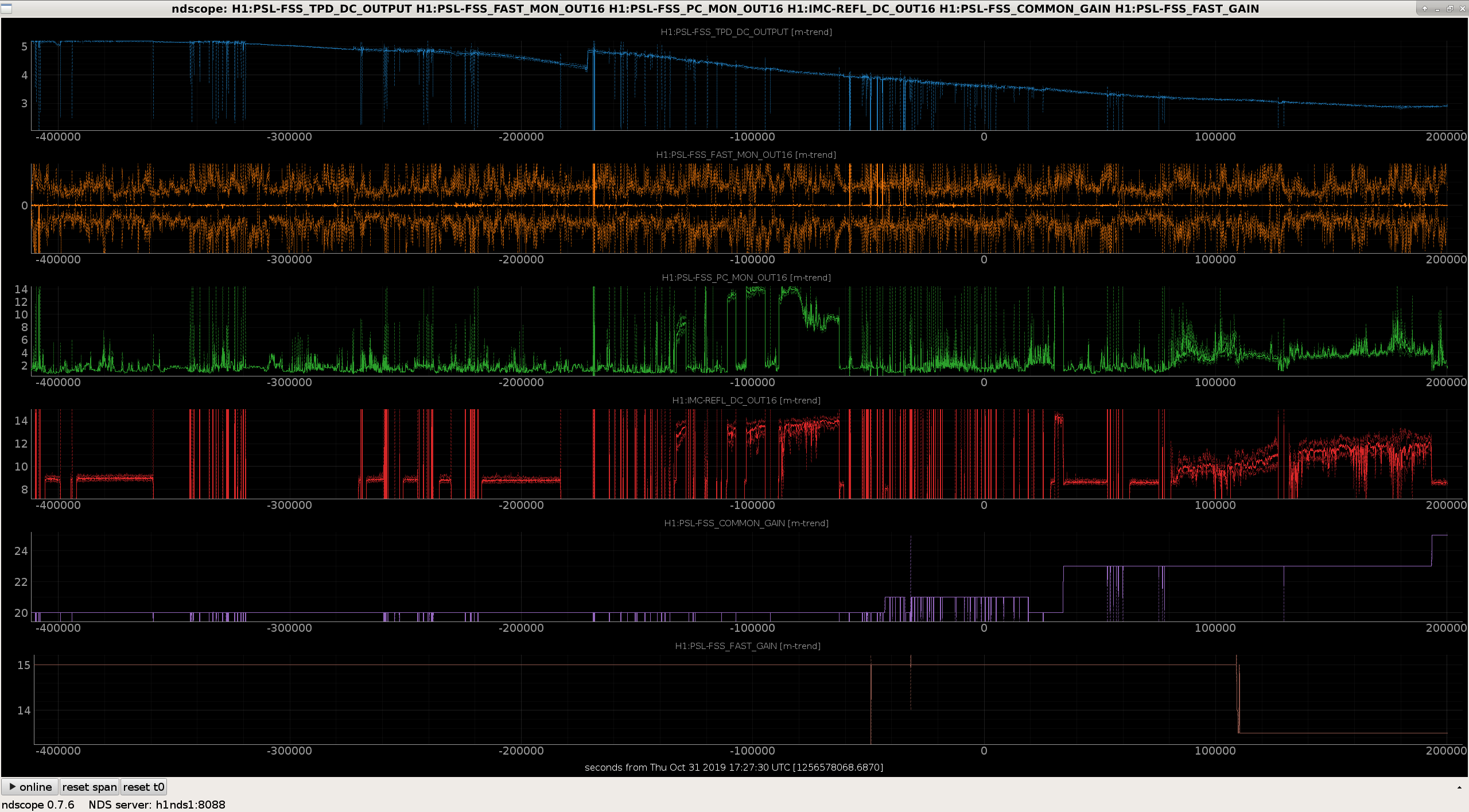
We've seen a continued plummet in the reference cavity transmission over the last week.  We are now at the point where the ref cav transmission has dropped 47%.  (Attachment 1)
Jason posted in alog 52882 about trying to fix up the alignment, with some success in recovering some transmitted power (seen in attachment 1 between -200000 and -100000 seconds ago), but not resolving the underlying issue.
Probably the best witness of FSS health is the IMC_REFL_DC signal (red trace, first and second attachment).  When signal goes above ~10 mW, we are likely to be having frequency stabilization problems originating in the FSS, high high-frequency noise in DARM, and worse range.

I increased the FSS common gain from 23 to 25 dB
In the first PDF attachment, we see DARM and laser noise coherence at FSS gains of 23, 24, and 25.  
After increasing from 23 to 24 dB, pretty much all the "frequency noise" we were seeing in DARM went away.  There is no apparent change in laser noise coupling when increasing from 24 to 25 dB.

ASDs:
In the second PDF attachment, I plot DARM, CARM, and ISS secondloop ASDs before and after the FSS gain increase.
It's clear that the noise levels of all go down significantly. 
 
I expected there to be significant coherence between the ISS and CARM, but this is not the case.

Coupling:
In the third PDF attachment, we see there is high coherence between the ISS secondloop and DARM with lower FSS gain, and much smaller coherence after the gain is increased by one dB.
In the fourth PDF attachment we see low coherence between DARM and CARM at all times, likely because the true frequency noise is drowned out by the high intensity noise apparent in DARM.
However, at no time is there coherence between CARM, IMC, or FSS error signals and the ISS loop. (fifth, sixth, seventh PDF attachments)

Jury is still out on why falling FSS gain causes high intensity noise.  I would have thought this sort of intensity noise would be generated by the frequency noise incident on the IMC.  
It is possible that this noise coupling is nonlinear, or I have looked at the incorrect witnesses.
Images attached to this report
Non-image files attached to this report
Comments related to this report
craig.cahillane@LIGO.ORG - 21:50, Saturday 02 November 2019 (52928)
With the FSS gain low, the ISS first loop is not performing well at all.
The ISS second loop is able to compensate for the first loop's failure until about 700 Hz, where the true intensity noise begins to dominate over the second loop sensing noise.  
The second loop is doing the best it can under the circumstances, but cannot do the job of both loops.

The below plots shows the ISS first loop sensors (out of loop = PDA, in-loop = PDB), and the ISS second loop sensors (out-of-loop = OUTER, in-loop = INNER) with the FSS gain at 23 dB and 24 dB.
Non-image files attached to this comment
craig.cahillane@LIGO.ORG - 01:53, Tuesday 05 November 2019 (52994)
Posting the ASDs I made trying to look into this problem. 
Probably the most interesting plot is PDF 1, which suggests ISS SECONDLOOP ERR1 DC coupling changed somehow.

Overall, we see increased noise everywhere in the ISS and IMC and CARM error signals, and not much in the control signals as the high loop gains impress the high noise on the loop.
Still not clear where the source of the noise is.
Non-image files attached to this comment
H1 ISC (ISC)
craig.cahillane@LIGO.ORG - posted 03:35, Friday 01 November 2019 - last comment - 22:04, Saturday 02 November 2019(52864)
Intensity noise projection
Just processed an intensity noise injection from earlier tonight.  The coupling is about the same as before and does not limit DARM.

Injection script in /ligo/home/craig.cahillane/Git/IFO/general/scripts/Intensity_noise_injection_caller.py
Plotting script in  /ligo/home/craig.cahillane/Git/IFO/general/scripts/intensity_noise_injection_plotter.py

Command Line: python intensity_noise_injection_plotter.py /ligo/home/controls/craig.cahillane/Git/IFO/IntensityNoise/data/Injections/20191031/1256622575_GPSstart_Intensity_inj_7_7300_Hz.pkl 1256625100 1256625300 --logbin
Non-image files attached to this report
Comments related to this report
craig.cahillane@LIGO.ORG - 22:04, Saturday 02 November 2019 (52929)
Adding .txts for posterity
Non-image files attached to this comment
Displaying reports 37721-37740 of 89095.Go to page Start 1883 1884 1885 1886 1887 1888 1889 1890 1891 End